Standing before King Agrippa and all the pomp of Roman power, Paul doesn’t defend his life—he declares the gospel. With courage and clarity, he shares his story of seeing the risen Christ and the mission he received “to open their eyes, so that they may turn from darkness to light… and receive forgiveness of sins” (v. 18).
Even when Festus mocks him and Agrippa shrugs off the message, Paul presses on: “Whether short or long… I would to God… all… might become such as I am—except for these chains” (v. 29). He knows it’s not about his freedom—it’s about their salvation.
🎯 Theme: Almost persuaded isn’t enough – Paul wants everyone to be saved.
🌀 Reflection: Are you prepared to share your story like Paul? Who in your life needs to hear what Jesus has done for you?
💬 Mission Challenge: Ask God to give you boldness today. Look for an opportunity to speak about Jesus—even if it’s just a sentence or two. The gospel doesn’t need a stage—it just needs a willing voice.
Political pressure, religious rage, and unjust accusations swirl around Paul—yet he stands firm, appealing to Caesar rather than being handed over to those who sought his death (v. 11). Festus wants to appease the Jews, but God is working a greater plan. Paul may be in chains, but the gospel is not.
Even King Agrippa and Bernice arrive with pomp and power, but it’s Paul, the prisoner, who carries eternal authority as a witness to Christ. Behind the politics and pretense, God is fulfilling His promise—Paul will testify in Rome (Acts 23:11).
🎯 Theme: Paul refused to back down and appealed to Caesar.
🌀 Reflection: Are you trusting God’s purpose even when life feels unfair or uncertain? Do you see difficulty as a platform for witness?
💬 Mission Challenge: Pray for someone who is facing injustice or difficulty today—and encourage them with God’s promises. Stand with them, and remind them that the gospel never stops moving forward.
5:1 Therefore, since we have been justified by faith, we have peace with God through our Lord Jesus Christ. 2 Through him we have also obtained access by faith into this grace in which we stand, and we rejoice in hope of the glory of God. 3 Not only that, but we rejoice in our sufferings, knowing that suffering produces endurance, 4 and endurance produces character, and character produces hope, 5 and hope does not put us to shame, because God’s love has been poured into our hearts through the Holy Spirit who has been given to us.
📖 Revelation 4:1–11In this episode of The King is Coming, Keith Harris and Jamie Harrison move beyond Jesus’s letters to the churches and into the next part of John’s vision. In Revelation 4, John is invited through an open door into heaven—and what he sees is the throne room of God.At the center of everything is a throne, and seated on it is the Lord in all His glory. From this point forward in Revelation, the throne becomes the focal point of the entire book.John describes the scene the best way he can: the brilliance of precious stones, a rainbow surrounding the throne, flashes of lightning and thunder, and a crystal-like sea before it. Surrounding the throne are twenty-four elders and four living creatures who never cease to worship the Lord.Together, Keith and Jamie discuss:✔️ Why Revelation 4 marks a shift from the letters to the churches to John’s heavenly vision✔️ What the throne room reveals about God’s authority and security over all things✔️ Why John uses comparisons (“like” and “as”) to describe the glory he sees✔️ The mystery of the twenty-four elders and what we can—and cannot—know✔️ The constant worship of the living creatures crying “Holy, holy, holy”✔️ Why heaven’s worship centers on God simply because He is worthyIn the throne room, everything points to one truth: God alone is worthy of worship.“Worthy are you, our Lord and God, to receive glory and honor and power, for you created all things, and by your will they existed and were created.” (Revelation 4:11)🔗 If you would like to see a written version of this podcast, complete with footnotes and cross-references, you can find it here.
I’m home from the hospital after several weeks (18 days and 19 hours) and so glad and thankful!
Being with Candice, Keri, and Xander again has been absolutely wonderful. It’s not just about being back at our house; it’s about being with them. They are my home. Sharing meals, watching movies, hearing them laugh—just being with them—reminds me of what I’m working toward in recovery. I don’t want them to have to be my babysitters and caretakers; I’m ready to get back to being husband, daddy, son, brother, Uncle Keith – full and whole.
And this past Sunday, I got to be back with my Christ Community family. What a gift. I was overwhelmed—in the best way possible. There were tears, but they were tears of joy. So many encouraged me with their words, their hugs, and especially their voices. When I was too overcome to sing during “Nothing Without You,” I heard my sisters Nikki and Shonna lifting their voices and carrying the song—and carrying me with it. And when our church gathered around to pray for me and others longing for healing, James 5:13–15 came to life. John anointed me with oil, the church prayed, and I was deeply moved by the tangible presence of God’s people doing what His Word calls us to do.
If you haven’t already, I’d encourage you to look back at the two previous writings I shared from the hospital. They were part of my processing in real time, and I hope they encourage you:
Now that I’m home and healing (and awaiting more doctor appointments), I want to walk through the passage that held me through the hardest nights. Romans 5:1–5 has been like an anchor for me. These verses walk us through what it means to have peace with God, to stand in grace, and to find real, lasting hope—even when life hurts. This passage has met me where I’ve been—sometimes flat on my back, sometimes inching forward with shaky steps, but always needing the kind of hope that doesn’t put us to shame. It’s not theoretical to me anymore—it’s lived truth. And I want to walk through it with you, verse by verse, to see again what I’ve been reminded of: that Jesus is our peace, Jesus gives us access to grace, Jesus brings joy even in our suffering, and Jesus is our unshakable hope.
Jesus is Our Peace (v. 1)
Verse 1 starts with the word “Therefore”, signaling that this is building on what came before in Romans 3-4. Paul had previously shown that no one is justified — made right with God — by good works or keeping the Law but only by faith in Jesus (Romans 3:28, 4:5). Romans 5:1 shows the result of being justified and saved by grace through faith in Jesus: peace with God.
This isn’t merely some inner calm or warm fuzzy feeling. It’s not circumstantial peace. This is peace that “surpasses all understanding” (Philippians 4:7) — a settled reality that, for those who are saved, the war we waged against God in our sin is over. We once lived as enemies of God (Romans 5:10), alienated and hostile in mind (Colossians 1:21). But now, through Christ, the conflict is resolved in Him. There is no more wrath for those who are in Christ (Romans 5:9). The gavel has fallen. The verdict is in. And the Judge is also the Savior who made peace by the blood of His cross (Colossians 1:20).
The peace we see here in v. 1 is peace through our Lord Jesus Christ. It doesn’t come through human effort, morality, or religion. It is through a Person — Jesus — who took our punishment upon Himself (Isaiah 53:5), died in our place (Romans 4:25), and rose again to give us life and right standing before God (Romans 4:24-25).
Coming home from the hospital reminded me how vital this peace truly is. While my body is still healing and I’m learning new limits and routines, I have peace that’s not dependent on my strength or stability—peace that holds even when I feel weak or uncertain. When you’re going through trials, peace with God means everything. This peace has sustained me through days I couldn’t lift my arms or stand without help, through nights of tears and questions. But it never left. It never failed. No, He never left or failed. This is not pointing to my circumstances but a reality that extends to all of the trials of this life. This peace with God means your soul is safe no matter the circumstances affecting your body or earthly life. Jesus has made a way for us to come to the Father, not out of fear, but as beloved children (John 14:6, Romans 8:15). We get the peace that a child feels when they, terrified in the middle of the night, run and are embraced in the arms of their parents. Knowing Jesus has made a way for us to run to the Father is about the truest idea of peace there is.
Jesus Gives Us Access to Grace (v. 2a)
Paul builds on the peace we now have with God by saying that through Jesus, we have access to grace — and not just a momentary taste, but a continual standing in it. This is the grace of God that justifies us (Romans 3:24), the grace of God that saves (Ephesians 2:8), and the grace of God that sustains us (2 Corinthians 12:10).
It’s grace, so it’s not something we’ve earned, and it’s not something we could ever keep on our own. This grace is a place we stand because Jesus holds us there.
That word “access” in v. 2 is rich in meaning. It describes being brought into the presence of royalty by someone with the right to do so. That’s what Jesus has done for us. He doesn’t just bring us peace with God — He brings us into the throne room of grace (Hebrews 4:16). And because of Him, we don’t stand in fear or shame but in favor, the favor Jesus earned and deserves, welcomed and secure in relationship with God (Romans 5:1-2, Ephesians 1:6, Hebrews 4:16).
I think about this truth often now that I’m home and trying to rebuild strength. There were weeks I couldn’t physically stand—I had to be lifted, guided, even fed. Yet even then, I never stopped standing in grace. Not once. Not when I was flat on my back, not when I was wheeled down hallways to therapy, not when I cried out to God in pain and weakness. His grace held me. His grace still holds me.
This is where the theology meets real life—especially when you’re walking through suffering. Grace is not a place we earn; it’s what we receive because of Jesus – because of what He earned. My standing in grace isn’t special or unique to me; everyone who has been saved by Jesus is still standing in His grace (2 Corinthians 12:9-10, 1 Peter 5:10, Romans 8:18). This is part of the beauty of being in Christ. If you are in Christ, your position with God is not fragile. It’s not based on your performance or dependent on your condition. Jesus has secured it and sustains it by His grace (John 10:28-29, Philippians 1:6, Romans 8:38-39).
Jesus Brings Joy Even in Our Suffering (vv. 2b-4)
This section of Romans 5:1-5 is where people get caught up because Paul says something pretty shocking: not only do we rejoice in our hope — we rejoice in our sufferings.
Yup, read that again. We are supposed to rejoice in our hope. But we are also supposed to rejoice in our sufferings.
If you think that sounds strange, and can even be offensive if taken out of the context of Romans 5 (which is something we need to be especially careful with here). Paul denying the reality of pain. Paul knew pain deeply. He knew beatings, imprisonment, sickness, shipwrecks, rejection, and weakness (2 Corinthians 11:24–28). What the Spirit through Paul is doing here is showing us that, in Christ, even our pain has a purpose. We rejoice in our sufferings not because it feels good but because we know what God can and is doing through it.
Let’s break it down.
First, we rejoice in the “hope of the glory of God”. This is the secure promise that one day we will see Jesus face-to-face and be fully transformed into His likeness (1 John 3:2, Colossians 3:4). That’s not a vague wish — it’s a guaranteed future secured by the finished work of Jesus. It gives us eternal perspective and lifts our heads to look forward beyond our present troubles (2 Corinthians 4:17-18, Romans 8:18).
Paul goes further. He says we can also rejoice now, in the middle of our trials. Why? Because suffering shapes us:
“suffering produces endurance” — the Spirit works in us to give the strength to persevere, holding us when things are hard
“endurance produces character” — a tested, refined faith that isn’t superficial but rooted in Christ and who He is making us to be
“character produces hope” — again, a hope not based on circumstances or fickle, earthly, hypothetical hope but built on who Jesus is, what He’s done, and all He’s promised
Over the last few weeks in the hospital, I’ve seen this unfold in ways I couldn’t have expected. Lying in a hospital bed with no ability to move, no answers, and nothing but time and pain forced me to lean into Jesus like never before. I found that suffering is a classroom—not one I signed up for, but one in which the Spirit was a very present teacher. He reminded me that I wasn’t alone (Psalm 139:7–10, Isaiah 41:10, Matthew 28:20), that He had not abandoned me, and that He was working something in me I could never have built on my own (Romans 8:28, James 1:2–4). He’s shown me how He gives strength when I am beyond weak (2 Corinthians 12:9-10, Isaiah 40:29-31), producing something in me I couldn’t manufacture on my own (Romans 5:3-5).
Only a fool would revel in the difficulties or try to enjoy the pain and suffering. No, this is rejoicing in the loving hands of God that lift us up out of the mire and difficulty (Psalm 40:1-3, 1 Peter 5:6-7) and hold us safe and secure in Him (John 10:28-29, Romans 8:38-39). It is rejoicing in knowing that we can look to the horizon and see the beauty of eternity with Jesus (Revelation 21:3-4), knowing that every speedbump and tribulation is something that can draw us closer to Jesus and make us more like Him (2 Corinthians 4:16-18; Romans 8:17-18, 29). Let me be clear: this isn’t the result of grit—it’s the fruit of grace. Joy in suffering is not natural, but it is supernatural. It’s a gift from God to His people who are held fast by Jesus.
Jesus is Our Unshakable Hope (v. 5)
After walking us through the path of suffering, endurance, and character, Paul arrives at the bold and beautiful conclusion of that paragraph: hope does not put us to shame.
In a world of letdowns, empty promises, and fragile dreams, that’s a stunning calm. But Paul isn’t talking about generic, hypothetical optimism. He’s talking about Jesus — and He’s unshakable.
Why doesn’t this hope disappoint? Because it’s grounded in the love of God, not in the shifting sand of circumstances. Paul says that God’s love has been poured into our hearts. That verb there translated “poured” isn’t a trickle — it’s a flood. Through the Holy Spirit, given to every believer, God pours out His love — not just toward us, but into us. The very presence of God’s Spirit is assurance that we belong to Him (Ephesians 1:13-14), and that His love for us is not distant but deeply personal and present. His Spirit is inside those He saves – not some concept or ethereal force but a Person, God within us.
In Jesus, you’re not holding onto hope, white knuckling it and hoping everything might work out okay. In Christ, hope is holding onto you (Hebrews 6:19-20), secured by the Spirit (Ephesians 1:13-14) and sealed in the love of God (Romans 8:38-39). When your strength fails, He doesn’t (Isaiah 40:28-31). When your feelings falter, His love doesn’t (Lamentations 3:22-23, 2 Timothy 2:13). Even when you don’t feel hopeful, you can trust that the Spirit is at work in you, reminding you who you are and Whose you are (Romans 8:16, Galatians 4:6).
I’ve needed that reminder every day this month. There were moments when I wondered what the future held.
I was reminded of David Miller who suffered from muscular atrophy from his teenage years and lost the use of every muscle in his body until he was bound in a wheelchair. I think of his testimony about the aftermath of his son being paralyzed in a wreck. He told me that he sat by his son’s hospital bed — in his own wheelchair, a wheelchair identical to the one his son would have to use — and sang the hymns of the faith, quoted Scripture over his son (as he couldn’t hold a Bible), and thanked God for giving him decades to live in a wheelchair like that so that he could help his son.
A month in the hospital can’t compare to lives like theirs. Yet God showed me that, if He could handle their trials and give them endurance, character, and hope, He can handle any and every trial that His children will go through. God’s goodness, protection, and care aren’t limited to Spurgeon or Miller, though; think of all the people He carried through trials in the Bible.
Job was carried through Satan attacking his family, health, and sanity (Job 1–2).
Joseph was carried through betrayal, slavery, and prison to save his family and many others (Genesis 37, 39–50).
Moses was carried through forty years in the wilderness with a complaining people (Exodus 3–Numbers 20).
Hannah was carried through years of barrenness and deep grief (1 Samuel 1–2).
David was carried through hiding in caves and fleeing for his life before becoming king (1 Samuel 18–31).
Elijah was carried through exhaustion, fear, and depression under a broom tree (1 Kings 19).
Jeremiah was carried through persecution and tears while faithfully proclaiming God’s Word (Jeremiah 20, Lamentations 3).
Hananiah, Mishael, and Azariah (a.k.a. Shadrach, Meshach, and Abednego) were carried through the fiery furnace and came out without even smelling like smoke (Daniel 3).
Daniel was carried through the lion’s den with unshakable faith, not receiving so much as a nibble from hungry lions (Daniel 6).
Mary was carried through scandal, fear, and wonder as she bore the Son of God (Luke 1–2).
Peter was carried through the shame of denying his Savior and restored by Jesus Himself (Luke 22:54–62, John 21:15–19).
Paul was carried through imprisonments, beatings, and shipwrecks for the sake of the gospel (2 Corinthians 11:24–28, Acts 27).
Our God is not just the God of our mountaintop faith—He’s the God who meets us in the valley, walks with us through the fire, and floods our hearts with His love even when we feel empty. Doubts creep in. Trials come and go and sometimes never go away on earth, but God keeps pouring out His love. He does it because He is good and He is God and He is faithful. His hope doesn’t put us to shame.
Wrapping Up
Romans 5:1-5 isn’t a feel-better-formula or some kind of positive thinking strategy — it’s a gospel-soaked promise from the living God. It is real peace, real grace, real joy, real hope—and every bit of it comes through Jesus.
If you’re reading this and you’ve never trusted in Jesus for salvation—if you don’t know what it’s like to have peace with God or hope that holds firm even when life falls apart—hear this clearly: you don’t have to stay where you are. Jesus invites you to come to Him. His Word says, “If you confess with your mouth that Jesus is Lord and believe in your heart that God raised Him from the dead, you will be saved” (Romans 10:9).
This isn’t about fixing yourself or cleaning yourself up first — it’s about trusting the One who already paid the price to redeem you. The Bible promises that “everyone who calls on the name of the Lord will be saved” (Romans 10:13). That invitation is for you.
Come to Jesus. Lay down your burdens. Trust in His finished work on the cross. Let Him pour His love into your heart by His Spirit and anchor your life in a hope that never puts you to shame.
And if you already belong to Jesus, but you find yourself weary or hurting, don’t forget what the Holy Spirit has taught you in Romans 5.
You have peace with God — He’s not against you.
You stand in grace — you are held and sustained by him.
Your suffering is not pointless — He is producing endurance, character, and a hope that is alive because He is alive.
You may feel weak (or very well be weak), but the Spirit of God lives in you.
Your circumstances may shift, but Jesus never will.
So, hold on, and more than that — let hope, let Jesus hold you. You are seen. You are loved. And in Christ, you are not alone and never forsaken (Hebrews 13:5, Romans 8:38–39).
Thank you for reading. While I hope my story and testimony will help others who are struggling or going through trials, I know that the Word of God offers better and lasting hope — for “faith comes from hearing and hearing from the Word of Christ” (Romans 10:17). If you are struggling or going through trying times, look at the many, many cross-references; click on them and let God’s Word encourage and comfort you. And may you encounter the God of the Bible, our great God and Savior Jesus Christ, in your time of need.
Paul stood before the Sanhedrin with integrity and a clear conscience. When struck unjustly, he spoke boldly yet submitted to God’s Word (v. 5). In a moment of Spirit-led strategy, he used the council’s own division to protect himself (v. 6). Though surrounded by chaos, Paul wasn’t alone—the Lord stood by him that night and said, “Take courage… you must testify also in Rome” (v. 11).
God’s providence moved quietly but powerfully—from a listening nephew to a Roman escort of 470 soldiers. The road ahead was difficult, but God was guiding every step.
🎯 Theme: Take courage – Jesus promises we will testify for Him.
🌀 Reflection: When life feels uncertain or dangerous, are you looking for the quiet ways God is still at work? What would it look like to take courage today?
💬 Mission Challenge: Encourage someone this week with the words from Acts 23:11. Reach out to someone facing a hard road and remind them: Jesus stands by His people.
Paul stood before the Sanhedrin with integrity and a clear conscience. When struck unjustly, he spoke boldly yet submitted to God’s Word (v. 5). In a moment of Spirit-led strategy, he used the council’s own division to protect himself (v. 6). Though surrounded by chaos, Paul wasn’t alone—the Lord stood by him that night and said, “Take courage… you must testify also in Rome” (v. 11).
God’s providence moved quietly but powerfully—from a listening nephew to a Roman escort of 470 soldiers. The road ahead was difficult, but God was guiding every step.
🎯 Theme: Take courage – Jesus promises we will testify for Him.
🌀 Reflection: When life feels uncertain or dangerous, are you looking for the quiet ways God is still at work? What would it look like to take courage today?
💬 Mission Challenge: Encourage someone this week with the words from Acts 23:11. Reach out to someone facing a hard road and remind them: Jesus stands by His people.
Paul stood on the temple steps and gave a defense—not by arguing, but by telling his story. He spoke of his Jewish upbringing, his zeal for the law, and his dramatic encounter with Jesus. His testimony was both bold and respectful, deeply personal and clearly centered on Christ.
But when he mentioned being sent to the Gentiles (v. 21), the crowd erupted. It wasn’t the story of his conversion that offended them—it was the grace of God going to people they didn’t think deserved it. The same gospel that saves also divides.
🎯 Theme: Paul was appointed to know God’s will and be His witness.
🌀 Reflection: Are you willing to share your story—even if it’s rejected? Have you grown cold to the grace of God being extended to those who seem far off?
💬 Mission Challenge: Write out or record a short version of your testimony. Share it with one person this week and pray that God would use it for His glory.
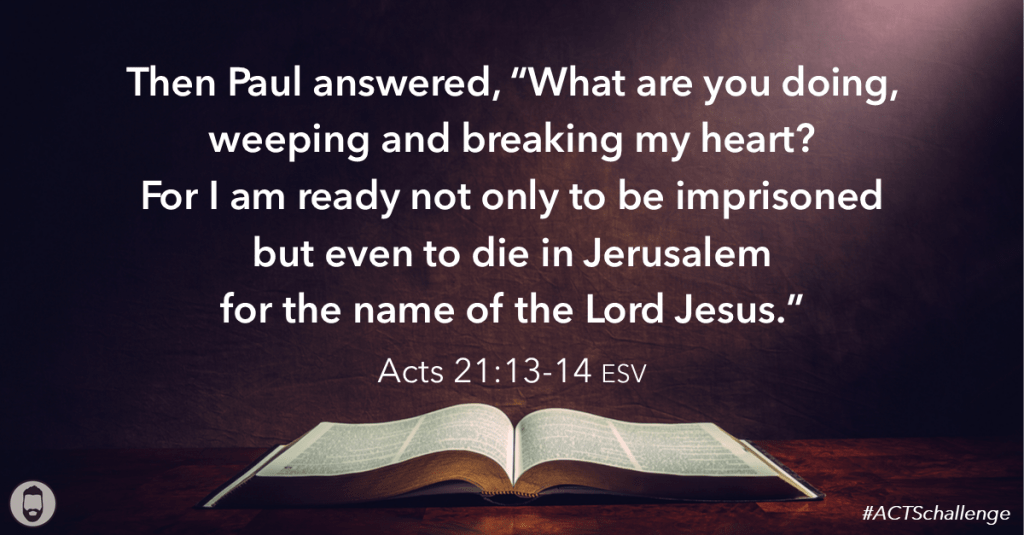
Paul knew danger was waiting for him in Jerusalem. Multiple times, the Holy Spirit—through faithful believers—warned him of what lay ahead (vv. 4, 11). But Paul’s heart was resolved: “I am ready not only to be imprisoned but even to die in Jerusalem for the name of the Lord Jesus” (v. 13). His goal wasn’t safety—it was obedience to His Lord, Jesus Christ.
When he arrived, he tried to unify Jewish and Gentile believers, but rumors stirred, mobs formed, and Paul was violently arrested. Still, God was working. Even chains would not stop the gospel.
🎯 Theme: Paul was ready to die for Jesus, trusting the Lord’s will above all.
🌀 Reflection: Are you willing to follow Jesus even when it’s costly? What would it look like to surrender your comfort for the sake of Christ’s name?
💬 Mission Challenge: Encourage a fellow believer who is walking through a hard season. Remind them of the hope and purpose found in Jesus—He is worth it.
As Paul journeys toward Jerusalem, he takes time to encourage believers along the way—especially the elders from Ephesus. In his farewell, Paul reminds them of his example: a life of humility, courage, and faithful teaching. He says, “I did not shrink from declaring to you the whole counsel of God” (v. 27) and testifies, “I do not account my life of any value…if only I may finish my course…to testify to the gospel of the grace of God” (v. 24).
His words are heavy with love, urgency, and warning. Wolves will come. The church must be alert. But through it all, God’s grace will sustain and build up His people.
🎯 Theme: Being faithful to the end testifies to the gospel of the grace of God.
🌀 Reflection: Are you living with gospel urgency—serving, teaching, and finishing your race with joy? What part of Paul’s example challenges or encourages you most?
💬 Mission Challenge: Write down or pray over your personal mission—to live and speak the gospel. Ask God to help you “not shrink back” but keep pressing forward.
God’s Word is powerful—and when it goes forth, it exposes false religion, transforms lives, and causes real spiritual upheaval. In Ephesus, the gospel disrupts both demonic activity and economic idolatry. New believers burn their magic books (v. 19), and the name of Jesus is exalted. As the chapter says, “the Word of the Lord continued to increase and prevail mightily” (v. 20).
But not everyone celebrates. Paul’s ministry sparks a riot led by those whose profits were threatened. The gospel still challenges idols—whether carved in silver or hidden in the heart.
🎯 Theme: The Word of the Lord continued to increase and prevail mightily.
🌀 Reflection: Is there anything you’ve been holding onto that competes with the Lordship of Jesus? What needs to be surrendered so His Word can prevail more fully in you?
💬 Mission Challenge: Share your testimony this week with someone—even briefly. The gospel that changed Ephesus is still changing lives.
23 During those many days the king of Egypt died, and the people of Israel groaned because of their slavery and cried out for help. Their cry for rescue from slavery came up to God. 24 And God heard their groaning, and God remembered his covenant with Abraham, with Isaac, and with Jacob. 25 God saw the people of Israel—and God knew.
This is the passage we closed with in the adult Bible study at Christ Community last Sunday, and the beauty of it has captivated me. For context and to understand the magnitude of these verses, we’ve got to get the lay of the land in Exodus 1-2.
Genesis ends with all of Israel’s family (the person Israel, aka Jacob) in Egypt after God providentially took the evil done to Joseph by his brothers and put him in a position to “preserve life” (Genesis 45:5, cf. Genesis 50:20). God used Joseph and gave him the ability to interpret dreams, which let Egypt enjoy plenty when the world around them faced famine (Genesis 47:13-26). Joseph was second only to Pharaoh, and God preserved Israel (the Hebrews/people group), moving them to the land of Goshen in Egypt (Genesis 47:27).
Now, fast forward many generations there in Egypt and “there arose a new king over Egypt, who did not know Joseph” (Exodus 1:8). This king found himself surrounded by God’s people who He had providentially made to be “fruitful” and “increased greatly”, growing “exceedingly strong, so that the land was filled with them” (Exodus 1:7, cf. Genesis 1:28). This king was worried about the position this great people group could put him in and was afraid of losing his power, so he decided to “set taskmasters over them to afflict them with heavy burdens” (Exodus 1:11). He made God’s people His slaves, but “the more they were oppressed, the more they multiplied and the more they spread abroad” (Exodus 1:12). Even in the midst of turmoil and trial, God was keeping His promise to Abraham that He would make his offspring number like the stars of the heavens (Genesis 15:5) and the sand on the seashore (Genesis 22:17), and bless all the nations of the earth through his offspring (Genesis 18:18, 22:18, cf. Galatians 3:8). In the midst of terrible oppression, He who promised was faithful (Hebrews 10:23, cf. Lamentations 3:22-23).
The trouble in Egypt rose to from oppression to murder and semi-genocide as Pharaoh commanded that baby Hebrew boys be cast into the Nile (Exodus 1:22). The bulk of Exodus 2 is God providentially saving Moses from death in the Nile, using that same river to float him to a life where he would be adopted by Pharaoh’s daughter (Exodus 2:1-10).
It’s an understatement to say that the Israelites were experiencing terrible things. Atrocities. Evil. Wickedness.
Sometimes, we find ourselves in times of trials and troubles when it seems like no relief is coming and that no one sees or notices. We can easily feel isolated and alone. These are the times when people begin to ask the question whether or not God cares or even knows — asking, why won’t He do something?(Psalm 10:1, Habakkuk 1:2-3)
This was surely how Israel felt by the end of Exodus 2. They “groaned because of their slavery and cried out for help” (Exodus 2:23). Just as the load of their taskmasters burdened them, they were burdened with grief and despair. Where was the God who brought them from a land of famine to the land of plenty? Why bring them there if only to leave them and forsake them? But God never leaves nor forsakes His people (Joshua 1:5, Hebrews 13:5, 2 Corinthians 4:9, Deuteronomy 31:6).
Look at what God had for Israel (and has for us) in Exodus 2:23-25.
“Their cry for rescue from slavery came up to God.” (v. 23b)
This wasn’t a formal prayer or some polished religious petition. It was a groan (v. 24) — a raw cry made out of desperation. Yet it came up to God. That is grace (Romans 8:26-27).
Their pain wasn’t lost in transmission or ignored by God. He’s not aloof or distant when His people suffer (Psalm 139:1-2, Exodus 3:7). Look at how David puts it in Psalm 34:17-18:
“When the righteous cry for help, the LORD hears and delivers them out of all their troubles. The LORD is near to the brokenhearted and saves the crushed in spirit.”
The cries of God’s people — His children — always find His ear, even when our words run out and all we have left is a groan (Romans 8:26). We need to know that our cries don’t disappear into silence — they rise to God (1 Peter 3:12, Isaiah 65:24, Psalm 55:17).
“And God heard their groaning….” (v. 24a)
Let me say it again: God hears. He heard them, and He can hear you.
When the Israelites groaned under the weight of slavery, it didn’t go unnoticed. Their pain was not wasted. God isn’t like Pharaoh who heard and ignored. He is a Father who bends low to listen (Psalm 116:1-2, Isaiah 64:4). This should encourage us in prayer because God is never too busy, too disinterested, or too far away (Psalm 145:18, Jeremiah 33:3). He hears the whisper of the wounded and the shout of the desperate (Psalm 10:17).
“…and God remembered His covenant with Abraham, with Isaac, and with Jacob.” (v. 24b)
When it says “remembered” here, it does not mean that God is recalling something He had momentarily forgotten or lost track of. It means God was about to act (Exodus 6:5-6).
To “remember” in the biblical sense here is covenant language. It means God is faithful to what He has promised (Hebrews 10:23). Even after generations of silence, God had not abandoned His people or His Word. He made a covenant to bless them and bring them to the land He had promised (Genesis 15:18-21, Exodus 3:6-8), and He was preparing to fulfill it.
When we feel forgotten, we can rest in this:
“God is not man, that He should lie, or a son of man, that He should change His mind. Has He said, and will He not do it? Or has He spoken, and will He not fulfill it?” (Numbers 23:19)
God made promises to Abraham, to Isaac, and to Jacob. He remembers. He fulfills His promises (Psalm 105:8-10, Luke 1:72-73). Sometimes, we can almost be afraid to hope (maybe I’m speaking from where I am now), but God’s memory is perfect and His promises are sure.
“God saw the people of Israel — and God knew.” (v. 25)
These are some of the most tender words of all. God saw. He didn’t just hear — He saw their suffering, saw them (Genesis 16:13, Psalm 33:13-15). And God knew. He knew their pain, their burdens, their brokenness. This is the kind of knowing that moves the heart of God toward His people. It’s intimate. It’s personal. It’s the same kind of knowing we see in Jesus, who looked at the crowds and had compassion on them (Matthew 9:36, Mark 6:34).
You are not invisible to God. Wait, I need to say that to myself: I am not invisible to God. He sees. He knows. And because of Jesus — our Savior who bore our griefs and carried our sorrows (Isaiah 53:4) — we can be sure that He enters into our suffering with us (Hebrews 4:15).
Exodus 2:23-25 shows us something precious about the heart of God. The Israelites were enslaved, burdened, and groaning under cruel oppression, yet God was not distant. He heard them. He remembered His covenant with them. He saw them. And He knew them.
The ultimate fulfillment of that covenant — the promise to bless all nations through Abraham’s offspring — was Jesus (Galatians 3:16, Genesis 22:18)! He is the same God — the covenant-keeping God who never changes (Hebrews 13:8, Malachi 3:6) — who still hears, still sees, and still knows today.
These past three weeks have been some of the hardest in my life. Pain, immobility, weakness, and unknowns have left me stripped of my independence and strength. I have needed help to do the most basic of things. But what I’ve learned — or perhaps what I’ve been lovingly reminded — is that though I have limits, God does not. Though I am weak, He is strong (2 Corinthians 12:9-10). Though I have groaned, He has heard. Though I have wrestled in the dark, He has seen. And when I’ve felt confused, broken, lost, or even forgotten by doctors and insurance companies these last three days, He has known — not just facts about my situation, but He knows me because I am His (Nahum 1:7, John 10:14).
This is not unique to me. That’s who God is. He invites the weary and the burdened to come — to to a system or religion but to Him:
[Jesus said] “Come to me, all who labor and are heavy laden, and I will give you rest. Take my yoke upon you, and learn from me, for I am gentle and lowly in heart, and you will find rest for your souls. For my yoke is easy, and my burden is light.” (Matthew 11:28-30)
God isn’t merely aware of your pain — He cares (1 Peter 5:6-7, Psalm 55:22). He is not powerless to act — He sent His Son, Jesus Christ, to take on your greatest burden: sin and death. On the cross, Jesus bore our sins and carried our sorrows (Isaiah 53:4). He died to pay for our sins, and He rose again to offer us life — real, eternal, abundant life (John 10:10, Romans 6:4). If God could hear the groans of Israel in Egypt and set in motion their deliverance through Moses, how much more should we see His heart in the Deliverer He sent us — Jesus.
So, what do you do when you find yourself groaning, crying out, and feeling forgotten?
You call upon the name of the Lord:
“For everyone who calls on the name of the LORD will be saved.” (Romans 10:13)
Salvation isn’t about cleaning yourself up or fixing your own problems. It’s about trusting the One who can save despite your need of cleansing and sin. The Bible says:
“If you confess with your mouth that Jesus is Lord and believer in your heart that God raised Him from the dead, you will be saved.” (Romans 10:9)
This isn’t salvation from a mere problem or seeking to be lifted out of a trial. This is taking us and bringing us from dead in sin to alive in Christ (Ephesians 2:1-5). This is taking us from lost to found (Luke 15:24). This is taking us from the darkness and bringing us into His light (1 Peter 2:9, Colossians 1:13-14). If God can do that, what is a little trial or sickness or tribulation (2 Corinthians 4:17-18)?
So, if you’re weary — if you’re burdened — if you’re groaning under the weight of suffering — come to Jesus. He sees, hears, knows, and saves.
And for those who are already in Christ, let this be a fresh reminder: our God is not absent in affliction. He is near to the brokenhearted (Psalm 34:18). His Spirit intercedes with groanings too deep for words (Romans 8:26). He will never leave you nor forsake you (Hebrews 13:5). And one day, He will wipe every tear from your eyes and swallow up death, pain, and sorrow forever (Revelation 21:4, Isaiah 25:8).









 Just Keith Harris