Paul opens by reminding the Galatians that his apostleship comes not from men but through Jesus Christ and God the Father (v. 1). He greets them with grace and peace, pointing immediately to the gospel—that Jesus gave Himself for our sins to deliver us from the present evil age, all according to God’s will and for His glory (vv. 3–5). His authority and his message both come directly from the risen Lord, not through human instruction (vv. 11–12).
But Paul is astonished that the Galatians are so quickly deserting the grace of Christ for a different gospel that is not the good news about Jesus at all (vv. 6–7). He warns that the message of salvation through Christ alone cannot be altered, and that anyone—whether an apostle or even an angel—who preaches another gospel stands under God’s curse (vv. 8–9). Paul’s concern is not to please people but to remain a faithful servant of Christ (v. 10).
🌀 Reflection: Where are you tempted to care more about human approval than about the truth of the gospel? Ask the Lord to help you stand firm in His grace.
💬 Mission Challenge: Share with someone this week what makes the gospel “good news”—that Jesus gave Himself to rescue us from sin and bring us peace with God.
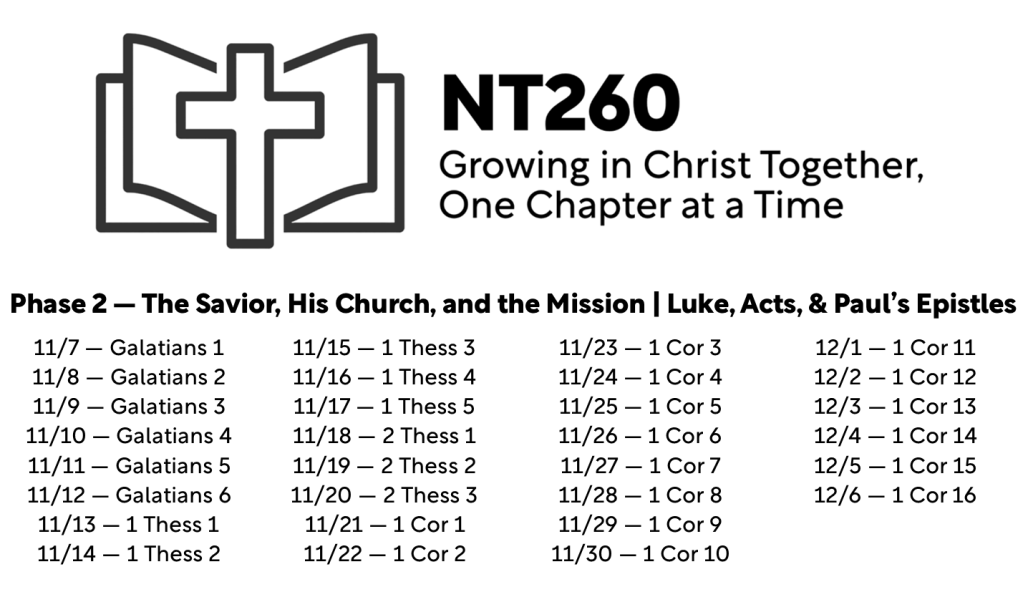
This phase will have us reading about Jesus’s life in the gospel of Luke, the formation of the Church in Acts, and walk through the theology found in Paul’s letters that the Church needs to know about and live out the eternal life given by grace through faith in Jesus.
Below, you’ll find brief synopses of each book in this phase to help you understand the scope of the book and most importantly, how it fits into the full Story of the Bible.
When you click on each day’s link, you will find a link to audio, a summary of the chapter, a key verse from the chapter, and opportunities for reflection and outreach.
We’re moving into Paul’s epistles, which we’ll go through chronologically rather than in the order they appear in our Bibles.
Galatians
The letter to the Galatians (check out this cool visual summary from the Bible Project) was written by Paul to churches in the Roman province of Galatia who were facing a spiritual crisis. After Paul preached the gospel of grace, other teachers arrived saying Gentile believers had to be circumcised and keep parts of the Mosaic law to belong to God’s people. Paul writes with urgency to defend the true gospel and his apostolic message, warning that any “different gospel” is no gospel at all (Galatians 1:6–9). His aim is pastoral and clear: believers are made right with God not by works of the law but by faith in Jesus Christ (Galatians 2:15–16).
Galatians shows how Christ’s cross brings a new era of freedom and life. Jesus bore the curse of the law so that blessing might come to the nations and the Spirit be given through faith (Galatians 3:13–14). Paul explains the law’s temporary role—it guarded and pointed to Christ—but now that Christ has come, we are God’s children by faith and clothed with Christ (Galatians 3:24–27). This freedom is not for selfishness but for love: “through love serve one another” (Galatians 5:13–14). The Christian life is life in the Spirit, where the desires of the flesh are put to death and the Spirit produces his good fruit—love, joy, peace, and more (Galatians 5:16–25). At the center stands the cross, which reshapes our identity and boasts (Galatians 2:20, 6:14).
In the story of salvation, Galatians declares that the promise to Abraham is fulfilled in Christ: Jew and Gentile are one family, justified by faith and adopted as sons through the Son (Genesis 12:3; Galatians 3:8, 3:26–29, 4:4–7). The gospel does not add law to Christ; it gives Christ alone by grace, and with him the Spirit who makes us new. Because Jesus has set us free, we stand firm in that freedom, walking by the Spirit and bearing one another’s burdens until the day of glory (Galatians 5:1, 5:16, 6:2).
Paul writes 1 Thessalonians to a young church he planted in a strategic, bustling city and had to leave sooner than he wanted (Acts 17:1–10). After sending Timothy to check on them, Paul hears a mostly good report—but also real concerns: grief over believers who had died, questions about the day of the Lord, ongoing persecution, and a few idle members refusing to work (1 Thessalonians 3:1–6, 4:13, 5:1–11, 4:9–12). With a warm pastoral tone, he defends the integrity of the gospel workers (1 Thessalonians 2), thanks God for their evident faith, love, and hope (1 Thessalonians 1:2–3), and urges them to keep growing in holiness, especially in sexual purity and brotherly love (1 Thessalonians 4:1–8, 9–12).
A major theme is Christ’s return—the “coming” of Jesus appears in every chapter (1 Thessalonians 1:10, 2:19, 3:13, 4:13–18, 5:23). Paul comforts grieving believers: those who have died “in Christ” will rise first, and together with the living they will be caught up to meet the Lord—and “so we will always be with the Lord” (1 Thessalonians 4:14–17). He reassures them that the day of the Lord will not overtake them like a thief because they belong to the day, not the night (1 Thessalonians 5:1–5, 9–10). In light of this hope, he calls the church to a steady, everyday obedience—respecting leaders, helping the weak, rejecting idleness, praying constantly, and testing everything by God’s Word (1 Thessalonians 5:12–22).
In the story of salvation, 1 Thessalonians looks back to Jesus’ death and resurrection as the ground of our hope and forward to His coming as the goal of our hope (1 Thessalonians 4:14, 5:9–10). The God who chose and called them is faithful; He Himself will sanctify them completely and keep them blameless at the coming of the Lord Jesus (1 Thessalonians 1:4, 5:23–24). Until that day, the church waits with active faith, steadfast love, and durable hope—turning from idols to serve the living and true God and to wait for His Son from heaven (1 Thessalonians 1:3, 9–10).
Paul’s second letter to the Thessalonians comes soon after the first and meets a church still under pressure. Persecution had not let up, and a false claim had spread that “the day of the Lord” had already come, leaving some shaken and afraid (2 Thessalonians 1:4, 2:1–2). Paul reassures them: when Jesus returns, He will bring justice—rest for His people and judgment on those who oppose the gospel (2 Thessalonians 1:5–10). He prays that God would make them worthy of their calling and glorify the name of Jesus in them, even as they suffer (2 Thessalonians 1:11–12).
Building on 1 Thessalonians, Paul clarifies what must happen before the Lord’s coming: a rebellion and the revealing of “the man of lawlessness,” whom Jesus will overthrow by the breath of His mouth at His appearing (2 Thessalonians 2:3–8; cf. 1 Thessalonians 4:13–18, 5:1–11). Until that day, the church must “stand firm and hold to the traditions” taught by the apostles, trusting the Lord to comfort and strengthen their hearts (2 Thessalonians 2:15–17). Paul also addresses a practical problem—idleness—commanding believers to work quietly and earn their own living, and instructing the church to correct those who refuse to obey (2 Thessalonians 3:6–12, 14–15). In the story of salvation, 2 Thessalonians keeps our eyes fixed on Christ’s certain return and calls us to steady, holy, hope-filled lives while we wait (2 Thessalonians 3:5, 13).
Paul writes 1 Corinthians to a gifted but divided church in a major port city shaped by status, rhetoric, and idolatry (Acts 18:1–11). After hearing troubling reports and receiving their questions, he calls them back to the gospel—to humble unity and holy living (1 Corinthians 1:10–13, 5:1–2, 7:1, 11:18). From the start, Paul centers everything on “Christ crucified,” God’s wisdom and power, not human show (1 Corinthians 1:18–25, 2:1–2). Because they belong to Jesus, they must stop boasting in leaders, flee sexual sin, and remember they are God’s temple where the Spirit dwells (1 Corinthians 3:16–17, 5:1–13, 6:18–20). Love—not pride or personal rights—must shape their life together (1 Corinthians 8:9–13, 13:1–7).
Paul also answers practical questions about marriage and singleness (1 Corinthians 7), food and idolatry (1 Corinthians 8–10), and gathered worship (1 Corinthians 11–14). He urges them to build up the church: take the Lord’s Supper in a worthy way, honor one another, and use spiritual gifts for the common good, not for display (1 Corinthians 11:23–26; 12:4–7; 14:12, 26). The famous “love chapter” shows that without love, even the greatest gifts amount to nothing (1 Corinthians 13:1–3). Above all, Paul insists on the bodily resurrection of Jesus and its hope for believers; because Christ is raised, our faith is not empty, our labor is not in vain, and we will be raised imperishable (1 Corinthians 15:3–4, 20–22, 51–58).
In the story of salvation, 1 Corinthians shows the gospel forming a holy people in a worldly place. The church is God’s family, Christ’s body, and the Spirit’s temple—set apart to reflect His character (1 Corinthians 1:2, 3:16, 12:12–27). So we lay down our rights for the weak (1 Corinthians 8:11), pursue love (1 Corinthians 14:1), and do all to the glory of God (1 Corinthians 10:31). Standing on the sure foundation—Jesus Christ our Lord—we work together for the advance of the gospel until He comes (1 Corinthians 3:11; 16:13–14, 22–24).
Shipwrecked on Malta, Paul is met with “unusual kindness.” Even a viper bite cannot stop God’s plan; Paul shakes it off and keeps serving (vv. 1–6). He prays for Publius’s sick father and the man is healed; soon many on the island come and are cured, and the people supply everything needed for the voyage (vv. 7–10). After winter, Paul sails north—Syracuse, Rhegium, Puteoli—and believers walk out from Rome to meet him at the Forum of Appius and Three Taverns. Seeing them, Paul thanks God and takes courage (vv. 11–16).
In Rome, Paul does what he always does: he starts with the Jews. He explains his chains and spends a full day “from morning till evening” showing from Moses and the Prophets that Jesus is the promised King (vv. 17–23). Some believe; others don’t (v. 24). Paul quotes Isaiah about dull hearts and declares that God’s salvation is sent to the Gentiles (vv. 26–28). The book closes with Paul under house arrest for two years, welcoming all who come, preaching the kingdom, and teaching about the Lord Jesus “with all boldness and without hindrance” (vv. 30–31).
🌀 Reflection: Where might God be calling you to keep speaking about Jesus “without hindrance” even when life feels inconvenient—cold rain, snakebites, delays, or discouraging responses (vv. 1–6, 23–28, 30–31)?
💬 Mission Challenge: Encourage a weary believer today. Send a short note or text that says, “Keep going—God’s word is not bound” (vv. 15, 31). Offer one practical help (a meal, a ride, a call) that helps them keep serving Jesus.
On the way to Rome, Paul sails as a prisoner under the care of a kind centurion named Julius (vv. 1–3). Against Paul’s warning to winter in Fair Havens, the crew and owner push on—and a violent northeaster slams the ship (vv. 9–15). For days they battle the storm, throwing cargo and tackle overboard until all hope seems gone (vv. 18–20). Then Paul stands up with a word from God: an angel has promised that everyone’s lives will be spared, though the ship will be lost—because Paul “must stand before Caesar” (vv. 22–26).
Paul’s faith turns panic into purpose. He stops a secret escape by the sailors to protect the others (vv. 30–32), urges everyone to eat for strength, and publicly gives thanks to God before 276 souls (vv. 33–37). At daylight they aim for a beach, strike a reef, and the ship breaks apart—but every person makes it safely to shore on planks and pieces of the boat, just as God said (vv. 39–44).
🌀 Reflection: Where are you feeling storm-tossed right now? Ask the Lord to steady your heart so you can move from fear to faithful action—trusting His promise and doing the next wise thing (vv. 22–26, 31–35).
💬 Mission Challenge: Be a “Paul” in someone’s storm. Share a brief prayer and a stabilizing verse with a friend who’s struggling today (text or call), and—if possible—meet a practical need that helps them “take heart” (vv. 33–36).
Standing before King Agrippa, Paul once again turned his defense into an opportunity to share the gospel. With respect and courage, he told his story—how he had once lived as a zealous Pharisee, opposing Jesus and persecuting His followers (vv. 4–11). Then, on the road to Damascus, a light brighter than the sun surrounded him, and the risen Jesus spoke to him, calling him to be His servant and witness (vv. 13–16). Jesus sent Paul to proclaim forgiveness and salvation, to turn people “from darkness to light and from the power of Satan to God” (v. 18).
Paul declared that he had been obedient to this heavenly vision, preaching repentance to both Jews and Gentiles (vv. 19–20). Though his message led to persecution, he boldly testified that Christ’s death and resurrection fulfilled what Moses and the prophets had promised (vv. 22–23). When Festus interrupted, calling Paul insane, Paul calmly insisted that his message was true and reasonable (vv. 24–25). Then he turned directly to Agrippa: “Do you believe the prophets? I know that you believe” (v. 27). Agrippa’s response revealed a heart almost—but not entirely—persuaded (v. 28). Paul’s closing words captured his mission and his heart: “I would to God that not only you but also all who hear me this day might become such as I am—except for these chains” (v. 29).
When the hearing ended, Agrippa and Festus agreed: Paul was innocent and could have been set free if he had not appealed to Caesar (v. 32). Yet God’s purpose was unfolding—Rome was next.
🌀 Reflection: Like Paul, every believer is called to be a witness to the risen Jesus. Who in your life still needs to be invited to “turn from darkness to light” and receive forgiveness through Christ (v. 18)?
💬 Mission Challenge: Share your testimony this week. Tell someone—briefly and sincerely—how Jesus met you, changed you, and called you to walk in His light (vv. 13–18).
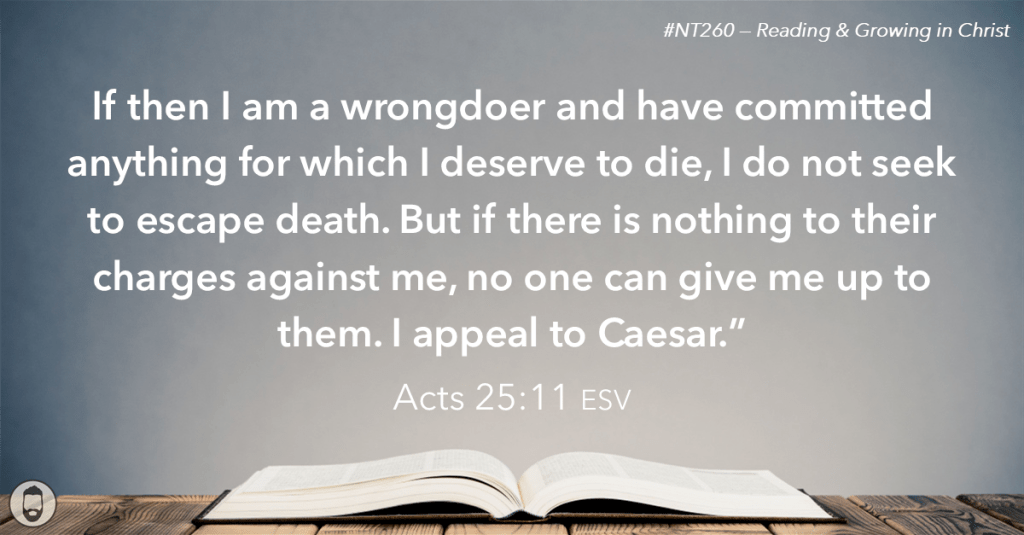
When Festus arrived, the Jewish leaders quickly tried to pressure him into transferring Paul to Jerusalem—hoping to ambush and kill him on the way (vv. 1–3). But Festus insisted the trial be held in Caesarea, unknowingly protecting Paul (vv. 4–5). Once again, the Jews brought serious accusations that they couldn’t prove, and Paul firmly defended himself: he had not broken the law of the Jews, profaned the temple, or rebelled against Caesar (vv. 7–8). When Festus, trying to please the Jews, suggested another hearing in Jerusalem, Paul appealed to Caesar—exercising his right as a Roman citizen (vv. 9–11). This bold move ensured his safety and set the course for his journey to Rome, just as the Lord had promised (23:11).
Soon after, King Agrippa II and his sister Bernice visited Festus, who explained Paul’s situation and admitted that the charges were purely religious—centered on “a certain Jesus, who was dead, but whom Paul asserted to be alive” (vv. 18–19). Agrippa agreed to hear Paul himself (vv. 22–23). As the royal pair entered the hall with great pomp, surrounded by Roman officials and city leaders, Paul was brought in—not as a defeated prisoner, but as a faithful witness for Christ. Festus admitted his dilemma: he had “nothing definite to write” about Paul’s charges to Caesar (vv. 26–27). What man saw as confusion, God was using for His sovereign purpose—to bring the gospel to the highest courts of Rome.
🌀 Reflection: Even when falsely accused or misunderstood, God’s purpose still stands. How can you, like Paul, trust that your trials may become divine opportunities to witness for Jesus (v. 11; cf. 23:11)?
💬 Mission Challenge: Look for an “occasion for testimony” this week (Luke 21:13). Use your circumstances—good or bad—as a platform to speak about the risen Jesus (v. 19).
After five days, the high priest Ananias and a lawyer named Tertullus arrived to accuse Paul before the governor, Felix (v. 1). Tertullus began with flattery, praising Felix’s leadership even though his rule was marked by corruption and unrest (vv. 2–4). Then he accused Paul of being a troublemaker, a leader of the “sect of the Nazarenes,” and one who tried to defile the temple (vv. 5–6). When Paul was allowed to respond, he calmly explained that he had come to Jerusalem only to worship and bring offerings, not to cause trouble (vv. 11–13). He confessed his faith in “the Way,” affirming belief in the Law, the Prophets, and the resurrection of both the just and the unjust (vv. 14–15).
Paul’s defense focused on truth and integrity. He reminded Felix that none of the accusers from Asia were even present to testify, and that his real “crime” was proclaiming the hope of resurrection through Jesus (vv. 19–21). Felix, who knew about Christianity through his Jewish wife Drusilla, delayed judgment and kept Paul under light custody (vv. 22–23). Later, when Paul spoke to Felix and Drusilla about faith in Christ—especially righteousness, self-control, and the coming judgment—Felix grew afraid and sent Paul away (vv. 24–25). Though he often sent for Paul, hoping for a bribe, he never repented. For two years, Paul remained imprisoned—but right where God wanted him, waiting for his next opportunity (vv. 26–27).
🌀 Reflection: Felix heard the truth but delayed responding. How often do we do the same? Don’t wait for a “better time” to obey God’s Word or share your faith—today is the time to respond (v. 25).
💬 Mission Challenge: Start a spiritual conversation this week. Like Paul, speak with courage and clarity about faith in Jesus, righteousness, and the hope of resurrection (vv. 14–15, 24–25).
Before the council, Paul declared that he had lived with a clear conscience before God (v. 1). The high priest Ananias ordered him struck, prompting Paul to rebuke his hypocrisy—though he quickly apologized when told it was the high priest, honoring the Scripture’s command to respect rulers (vv. 2–5). Seeing the council divided, Paul wisely pointed out that he was on trial for believing in the resurrection—a truth the Pharisees accepted but the Sadducees denied. The resulting argument turned violent, forcing Roman soldiers to rescue him (vv. 6–10).
That night, the Lord appeared to Paul and said, “Take courage, for as you have testified to the facts about me in Jerusalem, so you must testify also in Rome” (v. 11). Meanwhile, more than forty men plotted to kill Paul, vowing not to eat or drink until they had done so (vv. 12–15). God used Paul’s young nephew to uncover the plot and alert the Roman commander, who secretly arranged for Paul’s transfer to Caesarea under heavy guard—470 soldiers in all (vv. 16–24). The tribune Claudius Lysias wrote to Governor Felix, affirming that Paul had done nothing deserving death (vv. 25–30). By God’s providence, Paul arrived safely in Caesarea, where he would await trial before Felix (vv. 31–35).
🌀 Reflection: Even when opposition rises and fear surrounds you, remember—Jesus stands beside His people. Where might God be calling you to “take courage” and trust His plan today (v. 11)?
💬 Mission Challenge: Encourage someone who feels weary in their faith. Send a message or pray with them, reminding them that the Lord still stands by His servants in every trial (v. 11).
Paul stood before an angry mob and began his defense by speaking to them in their own language, showing respect and connection (vv. 1–2). He shared his story—his Jewish upbringing under Gamaliel, his zeal for the law, and his persecution of “the Way” (vv. 3–5). Then he recounted the moment that changed everything: when a blinding light from heaven revealed Jesus of Nazareth, whom he had been persecuting (vv. 6–8). Through Ananias, a devout and respected Jew, God restored Paul’s sight and commissioned him to be a witness of what he had seen and heard (vv. 12–15). Paul was baptized, his sins washed away, calling on the name of the Lord (v. 16).
Later, while praying in the temple, the Lord told Paul to leave Jerusalem, for his testimony would be rejected there. Instead, he was sent to the Gentiles (vv. 17–21). At that word, the crowd erupted again, demanding his death (v. 22). As Roman soldiers prepared to interrogate him by flogging, Paul calmly asked whether it was lawful to scourge a Roman citizen without trial (v. 25). When the tribune learned Paul was a citizen by birth, he became afraid and released him from his bonds (vv. 28–29). God used Paul’s testimony, tact, and even his Roman status to position him for what was coming next—the gospel reaching Rome itself.
🌀 Reflection: Your testimony is powerful because it’s personal. How can you, like Paul, use your story to point others to the grace and truth of Jesus (vv. 3–16)?
💬 Mission Challenge: Share your testimony this week—either in person or in writing—with one person who needs to hear how Jesus met you and changed your life (vv. 14–15).
Paul’s journey to Jerusalem was filled with both love and warning. The believers at Tyre urged him through the Spirit not to go, but Paul’s heart was set on obeying God’s call (vv. 4–6). In Caesarea, the prophet Agabus bound himself with Paul’s belt, foretelling his arrest in Jerusalem (vv. 10–11). Even then, Paul would not turn back—he was ready “not only to be imprisoned but even to die in Jerusalem for the name of the Lord Jesus” (v. 13). His companions could only answer, “Let the will of the Lord be done” (v. 14).
In Jerusalem, Paul was warmly received by James and the elders (vv. 17–20). To counter false rumors that he rejected Jewish law, Paul joined in a purification ritual at the temple (vv. 23–26). But when some Jews from Asia saw him there, they accused him of defiling the temple by bringing in a Gentile, which sparked a violent mob (vv. 27–29). Roman soldiers rushed in to stop the chaos, arresting Paul and carrying him away as the crowd shouted, “Away with him!” (vv. 30–36). Yet even then, Paul asked to speak to the people (vv. 37–40)—still seeing opportunity for the gospel where others saw only danger.
🌀 Reflection: Are you willing to follow Jesus when obedience costs your comfort—or even your safety? True faith stays the course, trusting that God’s will is good even when the path is hard (vv. 13–14).
💬 Mission Challenge: Encourage someone who’s facing hardship for their faith—write, call, or pray with them today, reminding them that the Lord’s will is worth every step (vv. 12–14).




 Just Keith Harris