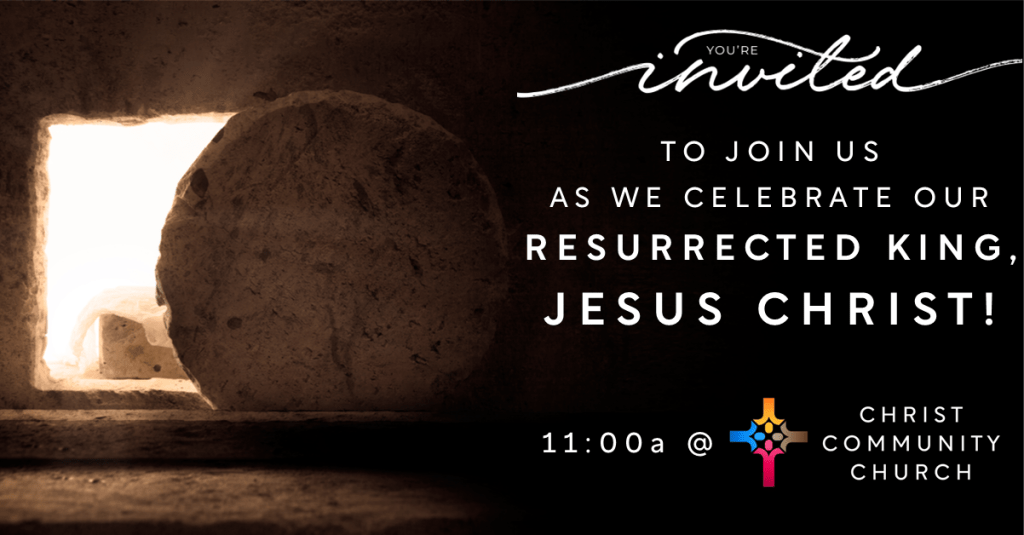
Songs for Resurrection Sunday 2024 @ Christ Community Church

Tomorrow is Sunday — RESURRECTION SUNDAY, and I am excited.

Sometimes, there can be a temptation to try and make holiday Sundays bigger, brighter, and, well, just to try and make it seem special by pulling out all the stops. As John said last week, we celebrate Resurrection Sunday every Sunday because our hope comes from Jesus’s resurrection — dead Saviors can’t save!

Every god or holy man or people who put themselves out there to say they are saviors either has or will die. Muhammed is dead. Buddha is dead. All of the false prophets who have claimed to be the messiah, both before and after Jesus, have died or will die. This isn’t an attack on other religions; it’s a clarification that religion can’t save because their founders don’t last. Jesus is something else entirely.

No, at Christ Community tomorrow, we are going to do our best to do what we always strive do: point people to Jesus!

Look at how Paul pointed the church at Corinth to Jesus in 1 Corinthians 15 — a chapter that beautifully proclaims the gospel and the importance of Jesus’s resurrection:

Now I would remind you, brothers, of the gospel I preached to you, which you received, in which you stand, and by which you are being saved, if you hold fast to the word I preached to you — unless you believed in vain.
For I delivered to you as of first importance what I also received: that Christ died for our sins in accordance with the Scriptures, that He was buried, that He was raised on the third day in accordance with the Scriptures….

1 Corinthians 15:3-4

Look at the language Paul used there to highlight the importance:

1. He wanted them to be reminded of the gospel (good news) that he had preached to them regarding Jesus and for them to hold fast to that truth (2 Timothy 1:13-14, Jude 3). Putting one’s faith in Jesus is not a one-time-thing but something that believers need to continually do. We trust in Him for salvation, but we continually trust in Him to continue to carry us (Hebrews 10:38-39). Those who believed were saved from the wrath of God toward sin, but as Paul says here, were “being saved” continually by their resurrected — their living — Savior who cares for them (Romans 5:9-10, 1 Corinthians 1:18)!

2. He made sure they knew that what he was preaching was “in accordance with the Scriptures” — something he says twice in v. 4. The gospel of Jesus Christ is not something that popped up new after he lived and died. His death, burial, and resurrection were foretold by the God’s prophets throughout the Old Testament (Luke 24:25-27). The gospel was not something new for someone like Paul who had studied it his whole life; no, it was the fulfillment of all he had studied (Acts 17:2-3).

2. He preached that gospel to them again: “Christ died for our sins in accordance with the Scriptures, …He was buried, …He was raised on the third day in accordance with the Scriptures”. The gospel he preached came from the Scriptures and was all about Jesus, who He is and all He had done and is doing (Acts 26:22-23).

3. He understood that the gospel is of “first importance” because that is what he “also received”. This is not a hypothetical gospel for Paul. Jesus is his hope as well (John 12:32, Romans 15:13, 1 Peter 1:3). His Ph.D. in Judaism wasn’t going to save him. The warrant given to him by when he was Saul of Tarsus the Jerusalem elite to arrest and imprison Christians wasn’t going to save him. His claims as a “Hebrew of Hebrews” and a “Pharisee” weren’t going to save him (Philippians 3:4). No, Paul knew that all of his hope was in Jesus, the same Jesus whom he had previously persecuted, and because Jesus had saved him, he understood that everything that came before was “rubbish” unable to be compared to the “surpassing worth of knowing Christ Jesus” as Lord (Philippians 3:7-8).

Tomorrow, we have the privilege, just as we do every Sunday, to remind ourselves and others of the good news of Jesus Christ and get to share His gospel through preaching, reading the Word, and singing in praise and worship of our resurrected King (Colossians 3:16-17). We will lift Him up “as of first importance” because we know that if we had not “also received” Him, we would have no hope.

Dead saviors can’t save, but our God is not dead — “He is risen as He said” (Matthew 28:6).

Won’t you gather with us as we worship Him?


Here are our Scriptures and songs:

  • Song | Ain’t No Grave
    Scripture Inspiration: John 8:34, Romans 6:6, 1 John 4:8, 1 Chronicles 28:20, 1 Corinthians 15:20-26, 1 Corinthians 15:50-56, John 8:44, 1 Peter 5:8, Revelation 12:9, Genesis 3:15, Ephesians 6:11-18, Isaiah 25:8, Hosea 13:14, 2 Timothy 1:10, Hebrews 2:14, Revelation 5:5, 1 Corinthians 15:3-8

  • Scripture | 1 Corinthians 15:50-57

50I tell you this, brothers: flesh and blood cannot inherit the Kingdom of God, nor does the perishable inherit the imperishable. 51Behold! I tell you a mystery. We shall not all sleep, but we shall all be changed, 52in a moment, in the twinkling of an eye, at the last trumpet. For the trumpet will sound, and the dead will be raised imperishable, and we shall be changed. 53For this perishable body must put on the imperishable, and this mortal body must put on immortality. 54When the perishable puts on the imperishable, and the mortal puts on immortality, then shall come to pass the saying that is written:

“Death is swallowed up in victory.”
55“O death, where is your victory?
O death, where is your sting?”

56The sting of death is sin, and the power of sin is the law. 57But thanks be to God, who gives us the victory through our Lord Jesus Christ.


  • Song | Graves Into Gardens
    Scripture Inspiration: Psalm 34:10, Isaiah 55:1-3, Psalm 53:1-3, Luke 15:11-24, Romans 6:23, John 6:26-35, Revelation 7:13-17, Matthew 11:28-30, 1 John 4:8, Psalm 51:10, Jeremiah 24:7, Ezekiel 36:26, Romans 12:2, Psalm 37:4, Exodus 8:10, Deuteronomy 3:24, Jeremiah 10:6, 1 Samuel 2:2, Isaiah 40:18, Romans 5:6-8, Psalm 138:8-9, 1 Kings 8:39, 1 John 3:20, John 15:15, Psalm 139:7-12, Hebrews 4:13, Psalm 30:11, Isaiah 62:2, Galatians 2:19-20, John 14:6, 1 Corinthians 15:20-49, Ezekiel 37:1-14, Exodus 14:1-31

  • Song | Thank You Jesus for the Blood
    Scripture Inspiration: Deuteronomy 6:5, Lamentations 3:22-23, Isaiah 64:8, Psalm 139:16, Deuteronomy 6:7, Psalm 113:3, 2 Timothy 2:13, Psalm 27:13, Psalm 31:19, Psalm 145:9, Psalm 150:6, Psalm 107:1, 1 Kings 19:11-12, Hebrews 1:3, Isaiah 43:1-3, Jeremiah 23:23-24, John 15:14-15, Psalm 23:6, Luke 9:23-24

  • Scripture | 1 Peter 1:3-5

3Blessed be the God and Father of our Lord Jesus Christ! According to His great mercy, He has caused us to be born again to a living hope through the resurrection of Jesus Christ from the dead, 4to an inheritance that is imperishable, undefiled, and unfading, kept in heaven for you, 5who by God’s power are being guarded through faith for a salvation ready to be revealed in the last time.


  • Song | Living Hope
    Scripture Inspiration: Acts 4:8-12, 1 Corinthians 15:3-11, 1 Peter 1:3, Philippians 2:5-8, 2 Corinthians 5:21, Hebrews 9:22, John 1:12-13, Hebrews 9:15, John 8:36, 1 Corinthians 15:54-57, Galatians 5:1, Psalm 107:14-15, John 14:6, Acts 3:15, Revelation 5:5, 1 Peter 1:4-5

  • Song | Because He Lives
    Scripture Inspiration: John 3:16, Isaiah 25:8, Hosea 13:14, 1 Corinthians 15:24-26, 1 Corinthians 15:55-57, 2 Timothy 1:10, Hebrews 2:14, Psalm 28:7-8, Isaiah 40:29-31, 2 Corinthians 12:9-10, John 14:25-27, Romans 8:38-39, 1 Peter 5:6-7, Jeremiah 29:11, Ephesians 2:10, Galatians 2:20, Philippians 4:6-7, Revelation 21:4, 1 Corinthians 11:26

  • Invitation | In Christ Alone

  • Offertory | Yet Not I But Christ in Me
    Scripture Inspiration: Genesis 15:6, Psalm 32:1-2, Romans 3:21-24, Romans 5:6-10, Ephesians 2:4-9, Titus 2:11, Isaiah 9:6, Luke 1:26-38, Matthew 1:18-255, John 3:15-16, 1 Thessalonians 1:6, Hebrews 12:2, 2 Corinthians 5:21, Psalm 119:45, Romans 8:1-4, Psalm 17:7, Psalm 36:5-7, Titus 3:4, 1 John 4:8, John 14:27, Romans 5:1, Ephesians 2:14-15, Acts 4:10-12, John 14:6, Galatians 2:20, Romans 8:9-11, Galatians 4:6, Psalm 107:10-16, Psalm 118:7, Hebrews 13:5-6, 2 Corinthians 12:9, John 10:11-18, 2 Samuel 22:3-4, Nahum 1:7, 1 John 5:18, Psalm 23:4, Matthew 20:28, John 1:29, Acts 20:28, Colossians 2:14, Titus 2:14, 1 Peter 1:17-21, 1 John 2:1-2, Revelation 5:9-13, Acts 4:33, 1 Corinthians 15:55-57, Hebrews 2:14, Revelation 21:3-4, Hebrews 13:6, Psalm 116:16, Romans 6:20, Galatians 5:1, Luke 21:33, Revelation 6:14, Psalm 51:10, Ezekiel 36:26, 2 Corinthians 5:17, Philippians 1:9-11, John 10:30


Songs for Sunday, March 10 @ Christ Community Church

Tomorrow is Sunday, and I am excited!

There is something about the approach of Easter — of Resurrection Sunday — that stirs something within me. There is hope in the emptiness of the borrowed tomb that is unlike anything this world has to offer. Well, the world cannot exactly offer empty or borrowed tombs, can it?

I think about Israel around that time. They had experienced Babylonian (and Mede-Persian) exile because of their sin. Their return home never quite met the luster or glory of the former days. But there was a promise — a Promised One, in fact, who would come and rescue them. They sought rescue from worldly oppression and wicked rulers and regimes, but this Promised One would rescue them from the wicked idolatry and sin that reigned in their own hearts. They would just have to wait for that rescue.

And they waited.

And waited.

In the silence of no more “Thus saith the Lord”, they waited about 400 years for this Promised One. Empires changed. The Persians were displaced by the Greeks, the Greeks inevitably by the Romans. They waited until the silence was broken by the cry of an infant.

God had promised that the Messiah (Promised One/Anointed One/Greek: Christ) would come — that He Himself would come. Emmanuel, translated God-with-us, would be born of a virgin. This child, this Son, would be given to bring Light and rescue to God’s people. They were desperate. They were helpless. They had no way to save themselves.

It is not hard to empathize with that kind of desperation. The effects of the Fall, sin and death, are all around us. Wickedness is rampant. Death is rampant. Idolatry is rampant. Hope seems to be in small supply. But we do not have to wait in silence! Emmanuel has already come, and He is coming again! His Spirit is with His people! His Word has and is and will continue to speak hope of rescue and salvation — of grace and mercy — of the good news of Jesus!

That’s what we are singing about tomorrow.

We are going to pour out our hearts and long for the return of Emmanuel, God-with-us. We are going to praise God for the finished work of Jesus. We are going to praise God for His steadfast love. And we are going to cry out — through the pain and sorrow and fear and longing — “Come, Lord Jesus”!

Won’t you join us?


Here are our Scriptures & songs:

  • Scripture | Isaiah 9:2-7

2The people who walked in darkness have seen a great light; those who dwelt in a land of deep darkness, on them has Light shone.
3You have multiplied the nation; You have increased its joy; they rejoice before You as with joy at the harvest, as they are glad when they divide the spoil.
4For the yoke of his burden, and the staff of his shoulder, the rod of his oppressor, you have broken as on the day of Midian.
5For every boot of the tramping warrior in battle tumult and every garment rolled in blood will be burned as fuel for the fire.
6For to us a Child is born, to us a Son is given; and the government shall be upon His shoulder, and His name shall be called Wonderful Counselor, Mighty God, Everlasting Father, Prince of Peace.
7Of the increase of His government and of peace there will be no end, on the throne of David and over His Kingdom, to establish it and to uphold it with justice and with righteousness from this time forth and forevermore. The zeal of the LORD of hosts will do this.


  • Scripture | 1 John 4:9-10

9In this the love of God was made manifest among us, that God sent His only Son into the world, so that we might live through Him. 10In this is love, not that we have loved God but that He loved us and sent His Son to be the propitiation for our sins.


  • Song | How Deep the Father’s Love for Us


***NOTE: We are revising the lyrics of this song to better reflect the love of God — that which we read about all through Scripture, that which was “made manifest” as we read in the verses above. Many might be familiar with the Greek word agape that describes the unique love of God; the Hebrew word for that type of never-ending, never-failing, never-stopping, never-giving-up love is chesed. It is often translated “steadfast love” in the Old Testament. This is a word God uses to describe Him and His love over 500 times!

This is an opportunity for the theology of what we sing to more specifically reflect the Scriptures, and therefore more accurately reflect the love of God as He shares it with us in His Word. The word “reckless” in the original lyrics was meant to show that God lavishly pours out His love for us. He does! He has poured out His love on us and made it manifest through the gift of Jesus Christ for our sins. Let’s praise God for and sing about His steadfast love!


https://www.google.com/maps/embed?pb=!1m18!1m12!1m3!1d3317.466271738482!2d-89.81243442462547!3d33.74861503370235!2m3!1f0!2f0!3f0!3m2!1i1024!2i768!4f13.1!3m3!1m2!1s0x8881ccec45cc3e69%3A0xf4738f6040973c36!2sChrist%20Community%20Church!5e0!3m2!1sen!2sus!4v1709943393515!5m2!1sen!2sus

A Tale of Two Saviors (Really, the Only One) — a Refresh & Restore Bible Study

In those days a decree went out from Caesar Augustus that all the world should be registered. This was the first registration when Quirinius was governor of Syria. And all went to be registered, each to his own town. And Joseph also went up from Galilee, from the town of Nazareth, to Judea, to the city of David, which is called Bethlehem, because he was of the house and lineage of David, to be registered with Mary, his betrothed, who was with child. And while they were there, the time came for her to give birth. And she gave birth to her firstborn son and wrapped him in swaddling cloths and laid him in a manger, because there was no place for them in the inn.

And in the same region there were shepherds out in the field, keeping watch over their flock by night. And an angel of the Lord appeared to them, and the glory of the Lord shone around them, and they were filled with great fear. 10 And the angel said to them, “Fear not, for behold, I bring you good news of great joy that will be for all the people. 11 For unto you is born this day in the city of David a Savior, who is Christ the Lord. 12 And this will be a sign for you: you will find a baby wrapped in swaddling cloths and lying in a manger.”
[1]

Luke 2:1-12


Merry Christmas, Sojourners!

Here we are just a few days before Christmas, and I find myself thinking on the scene into which God became flesh (John 1:14) and the happenings of the world during that time. If you will forgive the pun, it really was a Dickens of a time – the best of times and the worst of times. From a worldly perspective, Israel was in a tight spot, feeling the pressure of the Roman Empire bearing down on it.

A few centuries after being ruled by a foreign king in their own exile they found themselves ruled by one who seemed a world away. Those centuries between Babylon and the Roman Empire (with the Greeks whooping up on them somewhere in the middle) were silent in the sense that there was no “Thus saith the Lord” from a prophet. Even bad news or warning would be a comfort over silence. Their lives were loud with cries of help and hope in the coming Messiah, but God was silent – purposefully so. He had said all He needed to say. Messiah was coming. The Promised One was going to come and save His people. But in the meantime, there was waiting. And there was silence.

How do you do in silence and waiting? I am sure that there have been times in your life, just like in mine and in all the people I know, when trouble and trials and tribulations and terror have besieged you. Your world felt small and scary. Hope for the future was dim. And in waiting for help that seemed never to come, the silence and the waiting was rough.

Depending on the trouble you faced, there are those who would step in and want you to believe they are coming for your aid but are really coming to take advantage of you. There are other promises that, while they are not necessarily coming to take advantage of you are not working for your good, also try and convince you help is on the way. All you have to do is turn on your television and every other commercial is for a class action lawsuit going after big ___ to help people – you or your loved ones, they say – get help from their oppressors or benefits from whatever may have caused their unfortunate situation. If you flip to one of the news networks, you have political pundits representing both ends of the spectrum against the middle who are promising that their candidate is what is best, and the other is the oppressor. If your phone rings, it is likely that the person on the other end is offering you some kind of help if you pay money or bring a gift card to a certain location or offering to extend your car’s extended warranty for a nominal fee. Maybe you are in debt and people are promising rescue if you just turn your finances over to them. Or flip on over to the religious programming – labeled “Christian” oftentimes, and you can give a faith donation to support the starving millionaire “pastor” in his attempt to usher in the end times and mail you a prayer handkerchief that will heal you or save you.

Does any of this sound familiar?

Aside from television and modern situations, this is similar to what God’s people were hearing during that period of silence. Never mind that He had told them Messiah would come. He prophesied their deliverance. Their present circumstances, however, made listening to the other voices seem necessary. And those voices sounded so good, especially when the distant emperor proclaimed that his birth and existence were the beginning of good news for the world[2] and that he Himself was a son of Zeus come to be the savior of Rome and its empire[3].

In the absence of the promised Messiah amid divine silence, the turmoil of the times can make it easy to believe that there is help from somewhere else – even if that somewhere else is the Rome that is crushing the life out of your people and your homeland.

So, today, I want us to look at a tale of two Saviors – well, really the tale of the only Savior despite all the fake and the foolish that proclaim themselves to be Him.

Caesar Augustus and the Not-So-Good News (vv. 1-5)

Most of the time that I have spent looking at and studying the beginning of Luke 2 has been focused on trying to determine the real birth date of Jesus. Spoiler alert: it cannot be definitely known[4]. I am not a huge fan of history, but I do not want to be doomed to repeat it. Most of the history I, willingly, study is biblical and church history. Christianity is, after all, a historical religion not based on the present but on the God who has always been and all He has done in and for all that He created. Having said all that, I do not want this to seem like a history lesson. I want us to see the fingerprint of the one who proclaimed himself savior and lied about it: Caesar Augustus.

Caesar Augustus’s role in the story of Jesus began on the ides of March – remember Shakespeare’s Julius Caesar? Et tu, Brute? Anyone? Long story short, he – originally known as Octavian – was the nephew and only heir to Julius Caesar. When Roman senators conspired and murdered Julius Caesar (44BC), Octavian and Julius Caesar’s right-hand-man Mark Antony joined forces and waged a brutal civil war from Rome all the way to Philippi where they finally avenged Caesar’s death and, well, murdered his murderers in 42BC. Octavian rose to greater power and eventually turned on his ally Mark Antony and Cleopatra, defeating them in 31BC. Around thirty years later, all those events put Caesar Augustus in a position for God to move him about and use him to set the stage for His entrance into the world.

One thing that people who amass great wealth and power cannot help but do is counting and logging all they have. Such was the case with Caesar Augustus. He decreed that a census be taken throughout “all the world” (Luke 2:1). At his mere command, every household throughout the Roman Empire was immediately upturned. They had to return to their hometowns to be registered (Luke 2:3). Think of the power that displays: entire regions and people groups dropped everything at his command.

But what of his promises of his birth heralding the beginning of good news? What of his promises that he was born of Zeus and would be the savior of the world? Well, Caesar Augustus died in AD14. He is still dead today. Rome was not saved or safe under his rule. In fact, the Roman Empire is dead, too. The proof is in the pudding, or in the prophecy in this case. Caesar promised people peace and prosperity and got all the peace and prosperity he had himself by squeezing it out of the lands conquered and kept conquered throughout his empire. Yes, he could get them to move about at the drop of a hat, but once he dropped dead, he dropped out of the position of savior.

Looking at how God used him to move things about is cool, though. Jesus was prophesied to be born in Bethlehem (Micah 5:2), and Joseph’s hometown was Bethlehem. In a way, Caesar Augustus was right about one thing: good news began at his birth. God set things into motion through his life that inaugurated the coming of the Messiah. Now, that is the good news.

Jesus and the Good News of Great Joy (vv. 6-12)

Augustus was boastful and proud. He inherited a kingdom and made it his own. He built it up in his mind that the entire world belonged to him. But to whom did Augustus belong?

Jesus’s humble birth is the opposite of Augustus in nearly every way. Augustus was loud and boastful, proclaiming truths after his own birth to make it seem of consequence. Jesus’s birth was humble and quiet, fulfilling prophesies made all the way back to the beginning (Genesis 3:15). Jesus’s birth was heralded from the heavens (Luke 2:9-14). Jesus was God – God made flesh and dwelling among men to be the true Savior of the world (John 1:1, 14; Matthew 1:21; John 4:42).

Think about the difference this makes. Jesus did not lie about His father being divine and sending Him to rule and conquer. No, God became flesh and dwelt among us. He laid aside His throne and humbled Himself to become a man, lived a sinless life despite facing all the same temptations we face (Hebrews 4:15), and He died the death we deserve on the cross due to our sinfulness (Romans 6:23, 2 Corinthians 5:21). No one would make up that story. No one wanted to trade lives with Jesus. No palace, no riches, no fame. But, oh, what a King He is!

Jesus’s good news was better that Augustus’s, too. Augustus merely said his birth was the beginning of the good news. He merely heralded himself and proclaimed his own greatness. No one had to agree. No one would have believed it anyway. Rest assured that those who had been conquered did not recognize him as good news any more than they did Nebuchadnezzar and the Babylonians. Augustus was worthy to be feared, but Jesus is worthy of our faith. The angels proclaimed this to the shepherds in the field that night and to us today. We do not have to fear because “behold” there is “good news of great joy that will be for all people”; that “unto you is born this day in the city of David a Savior, who is Christ the Lord” (Luke 2:10-11). Good news. Of great joy. For all people. The Savior is born. The Messiah has come.

The truth of the prophecies of old were coming true. Light was shining into the darkness (Isaiah 9:2, John 1:4-5). Joy had come because there was One greater than Augustus, greater than the Greeks, greater than the Medes and Persians, greater than the Babylonians (Isaiah 9:3). Rather than oppressing, He was lifting up (Isaiah 9:4, Matthew 11:28-30). He was bringing peace through His finished work and retiring the weapons of His adversaries (Isaiah 9:5, Colossians 1:19-20). He was born, swaddled, and lying in a manger, but He did not stay in that manger. He grew up. He lived. He loved. He lifted the downtrodden, healed the sick, touched the untouchable, saved the most wicked of sinners, and died for them all. And everyone – every one – who calls upon Him, confesses Him as Lord and puts their faith and trust in Him – will be saved (Romans 10:9, 13). That is good news!

Wrapping Up

I started off our devotion today talking about how many things, how many voices, are trying to get us to believe in something temporary or something fake. It is easy to be jaded and look at how the world is getting and feel like God is not talking to us because the other voices are so loud. We want immediate relief from debt, pain, sorrow, and suffering, but that just is not reality – it is just not how this sinful, fallen world works. And every voice that is vying to be heard louder than the others cannot offer lasting help because they are products of this fallen world, too. But hear this, Sojourner, God is not being quiet.

From the moment that the silence between the Old and New Testament was broken by the cry of baby Jesus to the time when the trumpet sounds and He returns is not a time of silence. He is the Word (John 1:1-14), and He has given us His Word (2 Timothy 3:16-17) just as He did for His people. They interpreted it as silence because He had not said what they wanted to hear. He told them He was coming. He has told us the very same thing.

You see, Jesus is a better Savior than Augustus (or the Republicans or Democrats or whoever you think is waiting in the wings to rescue this country or this world). Augustus died. He is still dead. Whatever he was going to do for Rome, he did. All our leaders, good and bad, throughout history are dead. They saved and helped who they could, or they hurt and oppressed who they could. Either way, they are either dead and gone or will be. But God is a better Savior because He is alive. Death could not stop His love. Death could not stop Him from saving. Death is a victim of His victory! The death He died was for our sake – to save us, rescue us, and redeem us! It just did not keep because He is God.

This Christmas, amid the hustle and the bustle, the noise, and the activity, listen. Listen to the words of Hebrews 10:23-25 and hear the heart of our Savior for us:

Let us hold fast the confession of our hope without wavering, for He who promised is faithful. And let us consider how to stir up one another to love and good works, not neglecting to meet together as is the habit of some, but encouraging one another, and all the more as you see the Day drawing near.

That is good news! He who promised is faithful, and His Day is drawing near! When all around you seems to be giving way and there seems to be more hopeless than hope or help, look around you and see what He has for you. Do not turn to the easy slick promises of the world but trust in the divine hope, peace, joy, and love of the Savior who loves you and lives for you. You do not need a Sams Choice savior like Augustus or any of the other voices barking for your attention. Jesus is the genuine article.

The hope of Christmas is not in the nearness of family, the fullness of bellies, or the gratification of giving or receiving the perfect gift. Plans are going to go awry. Packages will be lost. Or the holiday will represent an entirely different perspective. It may be as miserable a time as you imagine. You may be facing a holiday that will remind you of a loss that is easy to suppress on regular days and are not ready for all the feelings that will arise. December 25 may be just another workday or weekday for you. You may even find yourself alone. No, the hope of Christmas is the same good news of great joy that the angel army proclaimed to those dirty shepherds on that hillside. It is the good news of great joy that proclaims to all people that the Savior has been born, that His name is Jesus, that His birth, death, resurrection, and return have been promised. And He who promised is faithful. Sojourner, know that I am praying for you this Christmas and as often as I can. May this good news of great joy cheer you on and cheer you up as you see that Jesus has come and is coming again.


[1] The Holy Bible: English Standard Version (Wheaton, IL: Crossway Bibles, 2016), Lk 2:1–12.

[2] This is based on an inscription found at Priene dating back to 9bc stating that Caesar Augustus’s “birthday signaled the beginning of good news for the world”. The inscription was found by German archaeologists and can be found in Berlin. | Deissmann, Light from the Ancient East, 366-67.

[3] This is based on an inscription from Halicarnassus preserved in the British Museum. | H. Kleinknecht, Pantheon: Religiose Texte des Griechentums (Tubingen: Mohr Siebeck, 1959), 40.

[4] While it cannot be known, there are a few interesting tidbits that I have found helpful in forming my own opinions. 1)The original language translated “governor of Syria” in the ESV can also be translated “governing in Syria”, which could mean ruling in some form or fashion. 2)Jesus’s birth had to be prior to 4bc because Herod the Great died that year. So, happy hunting should you want to research this on your own!

“Good News of Great Joy” or “The Weary World Rejoices” — Advent Reading for December 24

For I passed on to you as of first importance what I also received, that Christ died for our sins according to the scriptures, and that he was buried, and that he was raised up on the third day according to the scriptures, and that he appeared to Cephas, then to the twelve, then he appeared to more than five hundred brothers at once, the majority of whom remain until now, but some have fallen asleep.

1 Corinthians 15:3-6

He made the one who did not know sin to be sin on our behalf, in order that we could become the righteousness of God in him.

2 Corinthians 5:21

But what does it say? “The word is near to you, in your mouth and in your heart” (that is, the word of faith that we proclaim), that if you confess with your mouth “Jesus is Lord” and believe in your heart that God raised him from the dead, you will be saved. 10 For with the heart one believes, resulting in righteousness, and with the mouth one confesses, resulting in salvation. 11 For the scripture says, “Everyone who believes in him will not be put to shame.” 12 For there is no distinction between Jew and Greek, for the same Lord is Lord of all, who is rich to all who call upon him. 13 For “everyone who calls upon the name of the Lord will be saved.”

Romans 10:8-13


“Good News of Great Joy”
or
“The Weary World Rejoices”

We have spent a good bit of time this week in Luke 2:10 and the verses around it. The declaration of the angels to those poor and frightened shepherds should just about be memorized at this point: “Do not be afraid, for behold, I bring good news to you of great joy which will be for all the people”. Good news. Great joy. For all people.

The word translated “good news” is often translated gospel, and the message that the angels proclaimed on that hillside 2,000 years ago is a beautiful and succinct picture of the gospel. They preached that the Savior “who is Christ the Lord” was born for them – for those dirty, stinky shepherds – and that He could be found that very day in Bethlehem. It was news that would and could change the trajectory of their lives. They just needed to believe in Him and receive the salvation He had to offer – they would receive grace by faith through Him.

Now, I know that on the day they heard that gospel message Jesus was still laying in the feeding trough, still an infant, and was decades away from His death, burial, and resurrection. But the babe in the manger was still “the Word [become] flesh” (John 1:14). He was still the Lamb slain “before the foundation of the world” (Ephesians 1:4).

We sometimes want to overcomplicate things. We know the whole story and want to add and fill in the gaps in the angels’ proclamation that day, but the “good news of great joy” is still just as simple. In fact, Paul gives very succinct proclamations of the gospel, too. The first can be found in 1 Corinthians 15 where he tells the church at Corinth that he is passing on to them the most important message he had to offer – the very same message that he received himself: Jesus died for our sins according to the way that the Bible said He would, He was buried, and He rose from the dead on the third day exactly as the Bible and His own preaching said He would. That’s good news!

Paul’s second succinct gospel summary comes in his next letter to the church at Corinth in 2 Corinthians 5:21. In one complex little sentence, he shares that God put the sins of those who would be saved on Jesus. Jesus had never sinned and did not deserve any condemnation, but He willingly bore our sin on our behalf. Those who trust in Him no longer are under the condemnation and shame due to their sin; Jesus bore that (Colossians 2:13-14). In a great exchange, Jesus traded His righteousness for our sin. He bore the wrath of God and exchanged that for God’s favor. Basically, He traded His extravagantly full bank account for our bankrupt one so that when God looks upon those who Jesus has saved, He does not see their sinfulness but Jesus’ righteousness! That’s good news!

The gospel is good news, but there is also bad news. Those who do not confess Jesus as Lord and believe He died for their sins and rose again to not receive part in that great exchange. They remain in their sin. Their condemnation remains their own. It does not have to be that way. All who call out to Jesus in faith will be saved. Anyone who believes in Him will not be but to shame, but not believing leaves the shame where it belongs – on the sinner.

Look at how the Christmas hymn “O Holy Night” puts it:

Long lay the world in sin and error pining
Till He appeared and the soul felt its worth
A thrill of hope, the weary world rejoices
For yonder breaks a new and glorious morn
Fall on your knees!

Those who are without Jesus are still in their sin and “pining” after the wrong things, sinful things. But everyone – all people – have the opportunity to fall on their knees, believe in Him – confess Him as Lord, and repent of their sin. And those who do will not only have heard the good news of great joy but also to have believed it and received the salvation Jesus offers.

I love the phrase “good news of great joy” because 1) it is straight from the Bible, and 2) it captures what Jesus offers. But I also love the way the writer of “O Holy Night” captured what it is to be a sinner and receive Christ: “a weary world rejoices”. If you have been reading with us over these past two weeks, you have read snippets of the “good news of great joy”, but have you received it? Have you believed on Jesus, or are you still on the fence? If you haven’t, I urge you: fall on your knees, believe what the Bible says about Him, confess Him as Lord, and rejoice in the salvation He brings!

Reflection Questions:

  1. This devotion emphasizes different outcomes for those who believe in Jesus and those who do not. How does this reality influence your understanding of the urgency of sharing the gospel with others?
  2. There is an earnest call to embrace Jesus and rejoice in the salvation He brings in today’s devotion. How does this challenge you to examine your own beliefs and relationship with Jesus? What steps can you take to deepen your faith in Jesus?

Christ Has Come: The Promised King & His Gift of Peace (Advent 2025) Refresh & Restore | A JustKeithHarris.com Podcast

Christ Has Come – Week 3Episode Title: The Promised King & His Gift of JoyLuke 1:39–56In this Advent episode of Christ Has Come, Keith Harris turns to Luke 1 and invites us to slow down and listen to the joy that begins stirring before Bethlehem. Long before angels sing to shepherds, joy breaks the silence in the hill country of Judea—through a Spirit-filled confession, a leaping child, and the worshipful song of a young woman who trusts the promises of God.Together, we explore:What biblical joy is—and what it isn’t, distinguishing it from fleeting happiness or emotional highs.How joy appears before the word is even spoken, as John the Baptist leaps for joy in Elizabeth’s womb at the presence of the unborn Messiah.Why Mary’s joy is rooted not in circumstances but in God’s mercy, as she magnifies the Lord and rejoices in God her Savior.The meaning and message of the Magnificat, a Scripture-saturated song that celebrates God’s great reversal—lifting the lowly, filling the hungry, and humbling the proud.How Mary’s joy points beyond herself to Jesus, the promised King who fulfills God’s covenant promises and secures lasting joy through His saving work.This episode reminds us that joy is not something we manufacture—it’s something we receive, and it grows wherever Jesus is trusted. Advent teaches us that true joy is found not in having life figured out, but in the presence of Christ and the mercy He brings.If you would like to see a written version of this study, complete with footnotes and cross-references, you can find it here.
  1. Christ Has Come: The Promised King & His Gift of Peace (Advent 2025)
  2. Christ Has Come: The Promised King & His Gift of PEACE (Advent 2025)
  3. Christ Has Come: The Promised King & His Gift of HOPE (Advent 2025)
  4. Thankful: Learning to Number Our Days (Refresh & Restore)
  5. "Strengthen What Remains: Jesus's Letter to the Church at Sardis" (The KING is Coming)

Advent Reading for December 23, 2023 | “Because He is Love” from 1 John 4:9-10

9 In this the love of God was made manifest among us, that God sent His only Son into the world, so that we might live through Him. 10 In this is love, not that we have loved God but that He loved us and sent His Son to be the propitiation for our sins.

1 John 4:9-10


“Because He is Love”
by Robert Morman

Certain words in Scripture carry a massive amount of weight. One of those words is mentioned in verse 10 of I John 4. Propitiation is, as a hero of mine would say, a twenty-five-dollar word. It is huge to us as believers. It shows the amount of love the God the Father has for us. Propitiation means “appeasement or satisfaction”. These verses are discussing how God loves us. God loved us so much that, to satisfy the wrath of God, because of His holy standard, He, God the Father, sent Jesus to be the sacrifice to meet that holy standard for us. Let that sit with you for a moment. God, out of love (because He is love), sent Jesus, perfect and sinless, to be the sacrifice for our sins so that the debt of sin is paid in full for all time and we can have a relationship with God the Father. 

We must talk a minute about God’s wrath. This is an uncomfortable subject for some people. Some people even refuse to discuss it because “God is love”. Yes. God is love. But there is a wrath that is holy and sovereign. It is wrath brought on by sin and the brokenness of the world that came through Adam in the garden. But the “Second Adam” (referencing Jesus in 1 Corinthians 15:45-47) brought salvation to the world and gave us hope to have a restored relationship with God. Jesus’ love for the Father drove him to live a life of obedience even to death on the cross (Philippians 2:8). This is why Jesus is Lord of all. 

There is no greater expression of love than this. The Christ child would one day suffer and die for us because of the love of the Father. He would be betrayed. He would be beaten. He would be flogged. He would have thorns shoved down on his head. He would be forced to carry His cross. He would be nailed to that cross. He would suffer tremendously and die. Why? God’s love. This Child would be the ultimate expression of that love. A love sealed with the holy blood of Christ. 

As we approach Christmas Eve, remember that Jesus was the propitiation that settled the debt between you and God. The Christ Child would one day die and pay for our sins. He did this because only the perfect sacrifice could turn back the perfect wrath of God. Thank God today for His love for you. Thank Him for sending Jesus as the sacrifice for your sins. Thank God for His wrath turned back. 

Reflection Questions:

  1. Reflecting on that beautiful Bible-word propitiation, how does understanding that Jesus became the ultimate sacrifice to satisfy God’s wrath impact your perception on His love for His people?
  2. As Christmas approaches, how does understanding Jesus as the propitiation for our sins affect our gratitude and relationship with Him? How can you express your thankfulness for Him and to Him during this Christmas season?

Christ Has Come: The Promised King & His Gift of Peace (Advent 2025) Refresh & Restore | A JustKeithHarris.com Podcast

Christ Has Come – Week 3Episode Title: The Promised King & His Gift of JoyLuke 1:39–56In this Advent episode of Christ Has Come, Keith Harris turns to Luke 1 and invites us to slow down and listen to the joy that begins stirring before Bethlehem. Long before angels sing to shepherds, joy breaks the silence in the hill country of Judea—through a Spirit-filled confession, a leaping child, and the worshipful song of a young woman who trusts the promises of God.Together, we explore:What biblical joy is—and what it isn’t, distinguishing it from fleeting happiness or emotional highs.How joy appears before the word is even spoken, as John the Baptist leaps for joy in Elizabeth’s womb at the presence of the unborn Messiah.Why Mary’s joy is rooted not in circumstances but in God’s mercy, as she magnifies the Lord and rejoices in God her Savior.The meaning and message of the Magnificat, a Scripture-saturated song that celebrates God’s great reversal—lifting the lowly, filling the hungry, and humbling the proud.How Mary’s joy points beyond herself to Jesus, the promised King who fulfills God’s covenant promises and secures lasting joy through His saving work.This episode reminds us that joy is not something we manufacture—it’s something we receive, and it grows wherever Jesus is trusted. Advent teaches us that true joy is found not in having life figured out, but in the presence of Christ and the mercy He brings.If you would like to see a written version of this study, complete with footnotes and cross-references, you can find it here.
  1. Christ Has Come: The Promised King & His Gift of Peace (Advent 2025)
  2. Christ Has Come: The Promised King & His Gift of PEACE (Advent 2025)
  3. Christ Has Come: The Promised King & His Gift of HOPE (Advent 2025)
  4. Thankful: Learning to Number Our Days (Refresh & Restore)
  5. "Strengthen What Remains: Jesus's Letter to the Church at Sardis" (The KING is Coming)

Advent Reading for December 22, 2023 | “From Slavery to Sonship: Embracing the Gift of Adoption” from Galatians 4:4-5

4 But when the fullness of time had come, God sent forth His Son, born of woman, born under the law, 5 to redeem those who were under the law, so that we might receive adoption as sons.

Galatians 4:4-5


“From Slavery to Sonship: Embracing the Gift of Adoption”
by Jamie Harrison

Wow! What a Story! Jesus gave up all the glory of heaven to come to earth for you and me!

He came at exactly the right time according to Galatians 4:4. The Roman Empire ruled most of the world, and people were ready for someone to save them from their oppression. Some estimate the number of slaves during this period was upwards of 70 million. Can you imagine living under an oppressive government who might enslave you at any moment? Can you imagine a life that devoid of hope? 

Enter Jesus.

Jesus came to “redeem those under the law, so that we might receive adoption as sons (Galatians 4:5). Take a minute and think about the hope found in this verse for so many during that period. Now, take a moment and think about how this provides hope for you and me. Jesus came to make us sons and daughters of God Almighty! 

“And because you are sons, God sent the Spirit of His Son into our hearts, crying, ‘Abba, Father!’ So, you are no longer a slave but a son, and if a son, then God has made you an heir.” (Galatians 4:6-7)

This was good news then, and it is good news now! 

The fact is, we are all slaves to sin: “For all have sinned and fallen short of the glory of God” (Romans 3:23). Because we are slaves to sin, we receive death: “The wages of sin is death” (Romans 6:23). What these verses tell us about sin is bad news, but there is a huge but coming in the next part of Romans 6:23 – the but of all buts: “…but the free gift of God is eternal life through Jesus Christ our Lord”! That’s right, Jesus came to earth to give us a way to become a child of God! We are no longer a slave but adopted as a son! But if we are a son and an heir with Christ, what does that mean?

Being a son and heir means we will be able to spend all of eternity in the presence of our Creator, our Savior, our Lord! The best news for us today is that we do not have to wonder how this will come to be. Romans 10:9 tells us, “If you confess with your mouth that Jesus is Lord and believe in your heart that God raised Him from the dead you will be saved.” If you do not know Him as Lord, it is time. If you are certain He rose from the grave, confess Him as Lord of your life. Give yourself over to Him – right here and right now. It is time to be adopted into His family. It is time to receive the love only a perfect Father can give. Allow Him to give you the greatest gift of all today: JESUS!

Reflection Questions:

  1. Consider the idea of being adopted as sons and daughters of God through Jesus. How does this promise of adoption offer hope both in the context of the Galatians passage and in your personal walk with Christ?
  2. Today’s devotion touches on how we are all initially slaves to sin and the consequences of that bondage. How does the promise of eternal life through Jesus’s contrast with this reality and impact our understanding of salvation?

Christ Has Come: The Promised King & His Gift of Peace (Advent 2025) Refresh & Restore | A JustKeithHarris.com Podcast

Christ Has Come – Week 3Episode Title: The Promised King & His Gift of JoyLuke 1:39–56In this Advent episode of Christ Has Come, Keith Harris turns to Luke 1 and invites us to slow down and listen to the joy that begins stirring before Bethlehem. Long before angels sing to shepherds, joy breaks the silence in the hill country of Judea—through a Spirit-filled confession, a leaping child, and the worshipful song of a young woman who trusts the promises of God.Together, we explore:What biblical joy is—and what it isn’t, distinguishing it from fleeting happiness or emotional highs.How joy appears before the word is even spoken, as John the Baptist leaps for joy in Elizabeth’s womb at the presence of the unborn Messiah.Why Mary’s joy is rooted not in circumstances but in God’s mercy, as she magnifies the Lord and rejoices in God her Savior.The meaning and message of the Magnificat, a Scripture-saturated song that celebrates God’s great reversal—lifting the lowly, filling the hungry, and humbling the proud.How Mary’s joy points beyond herself to Jesus, the promised King who fulfills God’s covenant promises and secures lasting joy through His saving work.This episode reminds us that joy is not something we manufacture—it’s something we receive, and it grows wherever Jesus is trusted. Advent teaches us that true joy is found not in having life figured out, but in the presence of Christ and the mercy He brings.If you would like to see a written version of this study, complete with footnotes and cross-references, you can find it here.
  1. Christ Has Come: The Promised King & His Gift of Peace (Advent 2025)
  2. Christ Has Come: The Promised King & His Gift of PEACE (Advent 2025)
  3. Christ Has Come: The Promised King & His Gift of HOPE (Advent 2025)
  4. Thankful: Learning to Number Our Days (Refresh & Restore)
  5. "Strengthen What Remains: Jesus's Letter to the Church at Sardis" (The KING is Coming)

Advent Reading for December 19, 2023 | “Anna: A Prophetess for Jesus” from Luke 2:36-40

36 And there was a prophetess, Anna, the daughter of Phanuel, of the tribe of Asher. She was advanced in years, having lived with her husband seven years from when she was a virgin, 37 and then as a widow until she was eighty-four. She did not depart from the temple, worshiping with fasting and prayer night and day. 38 And coming up at the very hour she began to give thanks to God and to speak of Him to all who were waiting for the redemption of Jerusalem.

Luke 2:36-40


“Anna: A Prophetess for Jesus”
by Sarah Reeves

In Luke 2:36-40, we meet Anna who was a prophetess at a time when there were no prophets. Anna was Jewish, from the tribe of Asher. She was eighty-four years old and was widowed without any children. She had slowly watched as God stripped everything away from her, but she remained faithful. Anna believed the teachings from her childhood that one day the Messiah was coming, so she waited. She rarely left the temple as she prayed God would let her live to see the Messiah. Every day she worshiped at the temple and asked in her heart, “Will today be the day He comes?”

The long-awaited day finally came. Joseph and Mary brought their eight-day old son Jesus to the temple for His circumcision. Anna and her friend Simeon, who had also been waiting a long time for the Messiah, were overjoyed that God had let them recognize Him!

This touching story is such a reminder for us to never give up. We all face sorrows, tragedies, and heartaches in this life. We all lose our beloved family and friends. We ourselves have illnesses and pain. We all get discouraged, heartbroken, and sometimes bitter and mad at God for allowing those things to happen. There are broken homes and broken hearts. But in the middle of all these things there is one thing that has never changed: God is still on His throne!

He still loves you so much He sent His only Son to die for you (John 3:16)! So, let’s be like Anna and trust Him and know He is coming back just as He promised!

Reflection Questions:

  1. Anna’s life was marked by patience, faithfulness, and hope – devoted to God’s promise – despite experiencing immense loss personally. How does her perseverance challenge your understanding of faithfulness amid personal struggle and hardships?
  2. Anna’s unwavering faith allowed her to recognize Jesus for who He truly is – the Messiah. How can her story serve as an example for us in the world today?
  3. In today’s devotion, Ms. Sarah characterized Anna with the question: “Will today be the day Jesus comes?” How can living our lives with the expectant hope of Anna, asking ourselves, “Will today be the day Jesus comes back?”

Christ Has Come: The Promised King & His Gift of Peace (Advent 2025) Refresh & Restore | A JustKeithHarris.com Podcast

Christ Has Come – Week 3Episode Title: The Promised King & His Gift of JoyLuke 1:39–56In this Advent episode of Christ Has Come, Keith Harris turns to Luke 1 and invites us to slow down and listen to the joy that begins stirring before Bethlehem. Long before angels sing to shepherds, joy breaks the silence in the hill country of Judea—through a Spirit-filled confession, a leaping child, and the worshipful song of a young woman who trusts the promises of God.Together, we explore:What biblical joy is—and what it isn’t, distinguishing it from fleeting happiness or emotional highs.How joy appears before the word is even spoken, as John the Baptist leaps for joy in Elizabeth’s womb at the presence of the unborn Messiah.Why Mary’s joy is rooted not in circumstances but in God’s mercy, as she magnifies the Lord and rejoices in God her Savior.The meaning and message of the Magnificat, a Scripture-saturated song that celebrates God’s great reversal—lifting the lowly, filling the hungry, and humbling the proud.How Mary’s joy points beyond herself to Jesus, the promised King who fulfills God’s covenant promises and secures lasting joy through His saving work.This episode reminds us that joy is not something we manufacture—it’s something we receive, and it grows wherever Jesus is trusted. Advent teaches us that true joy is found not in having life figured out, but in the presence of Christ and the mercy He brings.If you would like to see a written version of this study, complete with footnotes and cross-references, you can find it here.
  1. Christ Has Come: The Promised King & His Gift of Peace (Advent 2025)
  2. Christ Has Come: The Promised King & His Gift of PEACE (Advent 2025)
  3. Christ Has Come: The Promised King & His Gift of HOPE (Advent 2025)
  4. Thankful: Learning to Number Our Days (Refresh & Restore)
  5. "Strengthen What Remains: Jesus's Letter to the Church at Sardis" (The KING is Coming)

Advent Reading for December 18, 2023 | “Christmas Unveiling Easter’s Promise” from Luke 2:25-35

25 Now there was a man in Jerusalem, whose name was Simeon, and this man was righteous and devout, waiting for the consolation of Israel, and the holy Spirit was upon Him. 26 And it had been revealed to him by the Holy Spirit that he would not see death before he had seen the Lord’s Christ. 27 And he came in the Spirit into the temple, and when the parents brought in the child Jesus, to do for him according to the custom of the Law, 28 he took him up in his arms and blessed God and said,

29 “Lord, now you are letting your servant depart in peace,
according to Your Word;
30 for my eyes have seen your salvation
31 that you have prepared in the presence of all peoples,
32 a light for revelation to the Gentiles,
and for glory to your people Israel.”

          33 And his father and his mother marveled at what was said about him. 34 And Simeon blessed them and said to Mary His mother, “Behold, this child is appointed for the fall and rising of many in Israel, and for a sign that is opposed 35 (and a sword will pierce through your own soul also), so that thoughts from many hearts may be revealed.”

Luke 2:25-35


“Christmas Unveiling Easter’s Promise”

Cradling a newborn often leaves us grasping for words, yet, when Simeon embraced the infant Jesus in the temple, his words resounded with prophetic gravity. Simeon anticipated the fulfillment of God’s promise in this child, recognizing Jesus as the Savior not just for the Jewish nation but for the entire world (Luke 2:30-32).

Alongside this divine hope, Simeon foresaw a somber shadow of suffering. Amidst proclaiming salvation, he hinted at the division Jesus would bring, revealing the depths of people’s hearts. He tenderly forewarned Mary of the anguish she would endure because of her son’s destiny (Luke 2:34-35) – which reminds me of Good Friday and Easter

While Easter might not be the typical focus of Christmas, understanding the significance of Easter unlocks the very heart of Christmas itself. Simeon, with profound insight, pointed forward to the significance of Good Friday while welcoming the baby central to the Christmas narrative. His words connected the humble manger to the redemptive work accomplished on the rugged cross.

Christianity isn’t a moral code for self-improvement but the proclamation of Christ’s finished work. It isn’t about our merit but about God’s mighty ability to rescue, redeem, and restore. Much like the relief felt after settling a bill, God stamped “PAID” against our sins through the sacrificial death and resurrection of Jesus. The events that pierced Mary’s soul culminated in God’s unmistakable declaration: Jesus conquered death and paid the debt for all sinners (Luke 24:1-7).

Luke’s Gospel serves as a masterful bridge, connecting the Christmas story with Easter’s triumphant climax. Jesus, in his life and death, fulfilled Simeon’s prophecies—reaching out to the marginalized, facing opposition, and ultimately redeeming sinners through the sacrifice of the cross, all fueled by an unparalleled love for humanity.

Jesus, the embodiment of divine love, sacrificed himself for sinners like Simeon, Mary, Zechariah, the shepherds, and each of us—extending redemption despite our flaws and showcasing an immeasurable depth of love. This truth is the resounding heartbeat of Christmas, leading to the profound grace and unfathomable hope found in the resurrection of Easter.

Reflection Questions:

  1. Reflecting on Simeon’s anticipation of Jesus connecting Christmas to Easter, how does this deepen your appreciation for the entire Story of Christ?
  2. In what ways does Jesus’s sacrificial death resonate the idea of a fully paid debt, and how does this understanding impact the way you view God’s grace and forgiveness?

Christ Has Come: The Promised King & His Gift of Peace (Advent 2025) Refresh & Restore | A JustKeithHarris.com Podcast

Christ Has Come – Week 3Episode Title: The Promised King & His Gift of JoyLuke 1:39–56In this Advent episode of Christ Has Come, Keith Harris turns to Luke 1 and invites us to slow down and listen to the joy that begins stirring before Bethlehem. Long before angels sing to shepherds, joy breaks the silence in the hill country of Judea—through a Spirit-filled confession, a leaping child, and the worshipful song of a young woman who trusts the promises of God.Together, we explore:What biblical joy is—and what it isn’t, distinguishing it from fleeting happiness or emotional highs.How joy appears before the word is even spoken, as John the Baptist leaps for joy in Elizabeth’s womb at the presence of the unborn Messiah.Why Mary’s joy is rooted not in circumstances but in God’s mercy, as she magnifies the Lord and rejoices in God her Savior.The meaning and message of the Magnificat, a Scripture-saturated song that celebrates God’s great reversal—lifting the lowly, filling the hungry, and humbling the proud.How Mary’s joy points beyond herself to Jesus, the promised King who fulfills God’s covenant promises and secures lasting joy through His saving work.This episode reminds us that joy is not something we manufacture—it’s something we receive, and it grows wherever Jesus is trusted. Advent teaches us that true joy is found not in having life figured out, but in the presence of Christ and the mercy He brings.If you would like to see a written version of this study, complete with footnotes and cross-references, you can find it here.
  1. Christ Has Come: The Promised King & His Gift of Peace (Advent 2025)
  2. Christ Has Come: The Promised King & His Gift of PEACE (Advent 2025)
  3. Christ Has Come: The Promised King & His Gift of HOPE (Advent 2025)
  4. Thankful: Learning to Number Our Days (Refresh & Restore)
  5. "Strengthen What Remains: Jesus's Letter to the Church at Sardis" (The KING is Coming)

Songs for Sunday, December 17, 2023 @ Christ Community Church

Tomorrow is Sunday, and I’m excited!

I love Christmas, but over recent years, I have grown to especially love Advent at Christ Community. It’s not about lighting the candles or tradition or, well, anything I can really put into words. It’s just been special – and is special.

Tomorrow, our Advent focus will be on Joy and Love.

In thinking of joy, it seems that this season – festivities and the hustle-and-bustle nature of our calendars – really shows how much people seek after joy amid life’s challenges. This is a season for some where joy seems to be out of place, or at least out of reach. It never will be in reach if we only seek joy here on earth.

Jesus’s birth was heralded by an angel army choir as “good news of great joy for all people” (Luke 2:10) to a group who understood difficult circumstances. I mean, not many of us will be camped out on a hillside working with a bunch of dumb sheep this Christmas. But this is exactly who Jesus came for – people like those shepherds, in fact those specific shepherds: people who need Him, sinners in need of a Savior. Amid our flaws and sins, the good news of great joy stands – a Savior born to rescue sinners from sin and death was born that day in Bethlehem, and even though He died on the cross to save us from our sins (Romans 5:8), He is alive and on His throne today (1 Corinthians 15:3-4)! That’s good news – of great joy!

In our world that seems to be plunging more and more quickly into the darkness, we sometimes let that joy be eclipsed. But just as the moon (that looks big to us but is infinitesimally smaller than our sun) cannot completely block out the light of our sun, darkness cannot block out the Light – Jesus. One thing that helps that Light shine so brightly is the power of His love. Just as darkness cannot withstand the flame of a single candle, the hatred and darkness of sin cannot stand in the light of His love (1 John 1:5).

The love of God in Christ offers hope amid chaos! And that love is truly a gift, epitomized by John 3:16, showing that God loved the world in such a way that He gave His only Son. The good news that brings great joy is that there is a Savior for sinners. God became flesh to live the life we cannot live (sinless) and die the death due our sin in our place (Romans 6:23, 2 Corinthians 5:21). And anyone – all people – who confess Him as Lord and believe in Him shall be saved (Romans 10:9, 13) – those shall not perish but have eternal life (John 3:16).

If you seek joy and love from the glitz and glamour of the lights and presents around a Christmas tree, you will come up empty. No amount of gifts and trappings found on earth can satisfy – none can save. But Jesus can. He wants to save. So, amid the hustle and the bustle and the gifts and the goings, remember the gift of Christ – the Son of God offered for our salvation. May our hearts rejoice in His presence more than in presents. For Emmanuel – God with us – dispels the darkness, saves souls, produces joy, and freely gives of His love!

And if you need someone to talk to or to just listen to you or pray with you, we at Christ Community would love to point you to the One who can meet your needs. We would love to point you to Jesus (Matthew 11:28-30).

Won’t you gather with us and make much of Him?


Here are our Scriptures & songs:

Advent Reading | JOY

  • Scripture | Luke 2:8-12

And in the same region there were shepherds out in the field, keeping watch over their flock by night. And an angel of the Lord appeared to them, and the glory of the Lord shone around them, and they were filled with great fear. 10 And the angel said to them, “Fear not, for behold, I bring you good news of great joy that will be for all the people. 11 For unto you is born this day in the city of David a Savior, who is Christ the Lord. 12 And this will be a sign for you: you will find a baby wrapped in swaddling cloths and lying in a manger.”


Advent Reading | LOVE

  • Scripture | Romans 5:1-8

1 Therefore, since we have been justified by faith, we have peace with God through our Lord Jesus Christ. Through him we have also obtained access by faith into this grace in which we stand, and we rejoice in hope of the glory of God. Not only that, but we rejoice in our sufferings, knowing that suffering produces endurance, and endurance produces character, and character produces hope, and hope does not put us to shame, because God’s love has been poured into our hearts through the Holy Spirit who has been given to us. For while we were still weak, at the right time Christ died for the ungodly. For one will scarcely die for a righteous person—though perhaps for a good person one would dare even to die— but God shows his love for us in that while we were still sinners, Christ died for us.


Christ Has Come: The Promised King & His Gift of Peace (Advent 2025) Refresh & Restore | A JustKeithHarris.com Podcast

Christ Has Come – Week 3Episode Title: The Promised King & His Gift of JoyLuke 1:39–56In this Advent episode of Christ Has Come, Keith Harris turns to Luke 1 and invites us to slow down and listen to the joy that begins stirring before Bethlehem. Long before angels sing to shepherds, joy breaks the silence in the hill country of Judea—through a Spirit-filled confession, a leaping child, and the worshipful song of a young woman who trusts the promises of God.Together, we explore:What biblical joy is—and what it isn’t, distinguishing it from fleeting happiness or emotional highs.How joy appears before the word is even spoken, as John the Baptist leaps for joy in Elizabeth’s womb at the presence of the unborn Messiah.Why Mary’s joy is rooted not in circumstances but in God’s mercy, as she magnifies the Lord and rejoices in God her Savior.The meaning and message of the Magnificat, a Scripture-saturated song that celebrates God’s great reversal—lifting the lowly, filling the hungry, and humbling the proud.How Mary’s joy points beyond herself to Jesus, the promised King who fulfills God’s covenant promises and secures lasting joy through His saving work.This episode reminds us that joy is not something we manufacture—it’s something we receive, and it grows wherever Jesus is trusted. Advent teaches us that true joy is found not in having life figured out, but in the presence of Christ and the mercy He brings.If you would like to see a written version of this study, complete with footnotes and cross-references, you can find it here.
  1. Christ Has Come: The Promised King & His Gift of Peace (Advent 2025)
  2. Christ Has Come: The Promised King & His Gift of PEACE (Advent 2025)
  3. Christ Has Come: The Promised King & His Gift of HOPE (Advent 2025)
  4. Thankful: Learning to Number Our Days (Refresh & Restore)
  5. "Strengthen What Remains: Jesus's Letter to the Church at Sardis" (The KING is Coming)

Go back

Your message has been sent

Warning
Warning
Warning
Warning.

Advent Reading for December 14, 2023 | “Hope in Emmanuel: God With Us” from Matthew 1:18-25

18 Now the birth of Jesus Christ took place in this way. When his mother Mary had been betrothed to Joseph, before they came together she was found to be with child from the Holy Spirit. 19 And her husband Joseph, being a just man and unwilling to put her to shame, resolved to divorce her quietly. 20 But as he considered these things, behold, an angel of the Lord appeared to him in a dream, saying, “Joseph, son of David, do not fear to take Mary as your wife, for that which is conceived in her is from the Holy Spirit. 21 She will bear a son, and you shall call his name Jesus, for he will save his people from their sins.” 22 All this took place to fulfill what the Lord had spoken by the prophet: 

23 “Behold, the virgin shall conceive and bear a son, 
and they shall call his name Emmanuel” 

(which means, God with us). 24 When Joseph woke from sleep, he did as the angel of the Lord commanded him: he took his wife, 25 but knew her not until she had given birth to a son. And he called his name Jesus.

Matthew 1:18-25


“Hope in Emmanuel: God With Us”

As we approach Christmas, seeking solace in the presence of King Jesus amid the trials of this year, our focus turns to the facets of hope, joy, and love that emanate solely from the Lord. To commence this journey, let’s delve deeper into the profound narrative of Joseph, often overshadowed by Mary’s pivotal role.

Joseph, described as a “just man” (v. 19), faced a dilemma when confronted with Mary’s unexpected pregnancy. Despite the social norms and legal avenues available to him, Joseph chose a path of grace rather than justice. In a society quick to condemn and shun Mary, Joseph’s decision to spare her from shame embodies God’s profound mercy and compassion. It’s a poignant reflection of the gospel – choosing redemption over condemnation, displaying the heart of God toward His people.

The angel’s revelation to Joseph validated the truth behind Mary’s conception and urged him not to fear but to embrace his role in God’s divine plan. This narrative mirrors Christ’s embrace of the flawed yet beloved Church, demonstrating the beauty of redemption amid societal scrutiny and judgment.

The significance of the name Jesus reverberates throughout history. Beyond its literal meaning of salvation and divine assistance, it embodies the unparalleled authority and saving grace encapsulated who Jesus is (Acts 4:12, Philippians 2:9-10).

Emmanuel – God with us, a promise foretold by Isaiah in 7:14, served as a beacon of hope for Israel amid turmoil. It assured them of God’s presence, dispelling fear and fortifying their spirits against adversity. This promise resonates with timeless relevance today, assuring us that God’s presence transcends circumstances, offering unwavering hope and strength.

To close, let’s meditate on Romans 8:31-34, a profound reminder encapsulating the essence of Emmanuel: 

31 What then shall we say to these things? If God is for us, who can be against us? 32 He who did not spare His own Son but gave Him up for us all, how will He not also with Him graciously give us all things? 33 Who shall bring any charge against God’s elect? It is God who justifies. 34 Who is to condemn? Christ Jesus is the one who died – more than that, who was raised – who is at the right hand of God, who indeed is interceding for us.

These verses reassure us that with God on our side through Jesus, no force or circumstance can overpower us. Christ’s intercession for us solidifies our hope and assurance in His unwavering love and support. Despite uncertainties that lie ahead, remember this truth: while challenges may arise, the throne of heaven remains unshakeable. God’s sovereignty prevails, and He orchestrates all things, offering us an unshakable foundation of hope.

Embracing the profound truth encapsulated in the name Emmanuel – God with us, let’s find rest, solace, and hope in the promises it holds. In acknowledging God’s abiding presence with us, both now and forever, may this Christmas season be a source of renewed hope and unwavering assurance.

Reflection Questions:

  1. Think about the name Jesus and its meaning of salvation and divine help. What does this name mean for you personally, and how does Jesus bring hope and rescue into your life?
  2. Reflect on times when you have felt overwhelmed or anxious. How does the idea of Emmanuel – God with us – offer comfort and strength in these moments in your life?

Christ Has Come: The Promised King & His Gift of Peace (Advent 2025) Refresh & Restore | A JustKeithHarris.com Podcast

Christ Has Come – Week 3Episode Title: The Promised King & His Gift of JoyLuke 1:39–56In this Advent episode of Christ Has Come, Keith Harris turns to Luke 1 and invites us to slow down and listen to the joy that begins stirring before Bethlehem. Long before angels sing to shepherds, joy breaks the silence in the hill country of Judea—through a Spirit-filled confession, a leaping child, and the worshipful song of a young woman who trusts the promises of God.Together, we explore:What biblical joy is—and what it isn’t, distinguishing it from fleeting happiness or emotional highs.How joy appears before the word is even spoken, as John the Baptist leaps for joy in Elizabeth’s womb at the presence of the unborn Messiah.Why Mary’s joy is rooted not in circumstances but in God’s mercy, as she magnifies the Lord and rejoices in God her Savior.The meaning and message of the Magnificat, a Scripture-saturated song that celebrates God’s great reversal—lifting the lowly, filling the hungry, and humbling the proud.How Mary’s joy points beyond herself to Jesus, the promised King who fulfills God’s covenant promises and secures lasting joy through His saving work.This episode reminds us that joy is not something we manufacture—it’s something we receive, and it grows wherever Jesus is trusted. Advent teaches us that true joy is found not in having life figured out, but in the presence of Christ and the mercy He brings.If you would like to see a written version of this study, complete with footnotes and cross-references, you can find it here.
  1. Christ Has Come: The Promised King & His Gift of Peace (Advent 2025)
  2. Christ Has Come: The Promised King & His Gift of PEACE (Advent 2025)
  3. Christ Has Come: The Promised King & His Gift of HOPE (Advent 2025)
  4. Thankful: Learning to Number Our Days (Refresh & Restore)
  5. "Strengthen What Remains: Jesus's Letter to the Church at Sardis" (The KING is Coming)