4 But when the fullness of time had come, God sent forth His Son, born of woman, born under the law, 5 to redeem those who were under the law, so that we might receive adoption as sons.
Galatians 4:4-5
“From Slavery to Sonship: Embracing the Gift of Adoption” by Jamie Harrison
Wow! What a Story! Jesus gave up all the glory of heaven to come to earth for you and me!
He came at exactly the right time according to Galatians 4:4. The Roman Empire ruled most of the world, and people were ready for someone to save them from their oppression. Some estimate the number of slaves during this period was upwards of 70 million. Can you imagine living under an oppressive government who might enslave you at any moment? Can you imagine a life that devoid of hope?
Enter Jesus.
Jesus came to “redeem those under the law, so that we might receive adoption as sons (Galatians 4:5). Take a minute and think about the hope found in this verse for so many during that period. Now, take a moment and think about how this provides hope for you and me. Jesus came to make us sons and daughters of God Almighty!
“And because you are sons, God sent the Spirit of His Son into our hearts, crying, ‘Abba, Father!’ So, you are no longer a slave but a son, and if a son, then God has made you an heir.” (Galatians 4:6-7)
This was good news then, and it is good news now!
The fact is, we are all slaves to sin: “For all have sinned and fallen short of the glory of God” (Romans 3:23). Because we are slaves to sin, we receive death: “The wages of sin is death” (Romans 6:23). What these verses tell us about sin is bad news, but there is a huge but coming in the next part of Romans 6:23 – the but of all buts: “…but the free gift of God is eternal life through Jesus Christ our Lord”! That’s right, Jesus came to earth to give us a way to become a child of God! We are no longer a slave but adopted as a son! But if we are a son and an heir with Christ, what does that mean?
Being a son and heir means we will be able to spend all of eternity in the presence of our Creator, our Savior, our Lord! The best news for us today is that we do not have to wonder how this will come to be. Romans 10:9 tells us, “If you confess with your mouth that Jesus is Lord and believe in your heart that God raised Him from the dead you will be saved.” If you do not know Him as Lord, it is time. If you are certain He rose from the grave, confess Him as Lord of your life. Give yourself over to Him – right here and right now. It is time to be adopted into His family. It is time to receive the love only a perfect Father can give. Allow Him to give you the greatest gift of all today: JESUS!
Reflection Questions:
Consider the idea of being adopted as sons and daughters of God through Jesus. How does this promise of adoption offer hope both in the context of the Galatians passage and in your personal walk with Christ?
Today’s devotion touches on how we are all initially slaves to sin and the consequences of that bondage. How does the promise of eternal life through Jesus’s contrast with this reality and impact our understanding of salvation?
📖 Revelation 3:7–13We’re back!After a few months off, The King is Coming returns in 2026 with one of the most encouraging letters in Revelation — Jesus’s message to the faithful church in Philadelphia. In a world filled with opposition and weakness, Jesus opens a door no one can shut.In this episode, Keith Harris and Jamie Harrison explore:✔️ Jesus’s identity as the Holy One, the True One — God Himself✔️ What the “key of David” means and how Jesus alone opens and shuts✔️ The debated phrase “I will keep you from the hour of trial” — and how to read it biblically✔️ Why “little power” doesn’t disqualify faithfulness✔️ How being kept through the trial glorifies Christ’s strength in us✔️ What it means to be a pillar in God’s presence foreverThis church had no rebuke — only encouragement. And Jesus’s call still stands today: “Hold fast what you have, so that no one may seize your crown.” (Revelation 3:11, ESV)🔗 Missed earlier episodes in the series? You can click here to catch up and listen from the beginning.✍️ If you’d like to see a written version of this podcast, complete with footnotes and cross-references, you can find it here.
1 Now after Jesus was born in Bethlehem of Judea in the days of Herod the king, behold, wise men from the east came to Jerusalem, 2 saying, “Where is He who has been born king of the Jews? For we saw His star when it rose and have come to worship Him.” 3 When Herod the king heard this, he was troubled, and all Jerusalem with him; 4 and assembling all the chief priests and scribes of the people, he inquired of them where the Christ was to be born. 5 They told him, “In Bethlehem of Judea, for so it is written by the prophet:
6 “’And you, O Bethlehem, in the land of Judah, are by no means least among the rulers of Judah; for from you shall come a ruler who will shepherd my people Israel.’”
7 Then Herod summoned the wise men secretly and ascertained from them what time the star had appeared. 8 And he sent them to Bethlehem, saying, “Go and search diligently for the child, and when you have found Him, bring me word, that I too may come and worship Him.” 9 After listening to the king, they went on their way. And behold, the star that they had seen when it rose went before them until it came to rest over the place where the child was. 10 When they saw the star, the rejoiced exceedingly with great joy. 11 And going into the house, they saw the child with Mary His mother, and they fell down and worshiped Him. Then, opening their treasures, they offered Him gifts, gold and frankincense and myrrh. 12 And being warned in a dream not to return to Herod, they departed to their own country by another way.
Matthew 2:1-12
“A Wise Visit to the King”
In the Gospel of Matthew, the account of the magi seeking the newborn King stands as a beacon of divine guidance amidst human intentions and deceit. The journey of the magi epitomizes the yearning within humanity for deeper significance and truth. Led by a celestial phenomenon—a guiding star—they embarked on a pilgrimage, seeking the birth of the prophesied King of the Jews. Yet, even within their noble quest, shadows of deceit loomed.
King Herod, masking his wicked intentions, manipulated the magi, seeking to exploit their mission for his own selfish gains. This contrast underscores the importance of discernment—a call relevant in our times, where authentic pursuit of truth can be clouded by deceptive motives and personal agendas. Herod’s malicious intent, masked by a false desire to worship, is revealed as he schemes to eliminate any perceived threat to his rule.
Bethlehem, the small town renowned as the birthplace of King David, becomes clear to be the prophesied site of the birth of the Messiah. Micah 5:2 is evoked as a direct prophecy fulfilled by Jesus’s birth in Bethlehem. This convergence of prophecy and reality underscores the divine orchestration of events, pointing towards Jesus’s role as the promised Messiah.
While the Magi seek to worship the newborn King, they present gifts—gold, frankincense, and myrrh—symbols that not only denote Jesus’s royalty and divinity but also foreshadow elements of His life, death, and purpose (Matthew 2:11). Gold, an emblem of kingship and divinity, prefigures Jesus’s royal lineage as the Son of God. Frankincense, used in sacred worship, symbolizes His sacrificial mission and holy nature. Myrrh, a substance associated with embalming and bitterness, prophetically hints at Jesus’s future suffering, death, and burial (Mark 15:23).
The unfolding narrative takes a darker turn as Herod, threatened by the mere existence of this prophesied King, devises a plan to murder Him. The holy family flees to Egypt, finding refuge there until Herod’s death. This flight mirrors the providential movements that underscore Jesus’s pivotal role in fulfilling divine prophecy and promises.
Fast-forwarding in Jesus’s life, His ministry leads to the events of His death, burial, and resurrection—the core elements that define Christian faith. The journey that began in Bethlehem culminates in Jerusalem, where Jesus willingly submits to the cross (Mark 15:22-24).
It ties to Jesus’s crucifixion—His ultimate act of love and sacrifice for humanity. His burial, marked by His descent from the cross and entombment, sets the stage for the awe-inspiring reality of His resurrection. In Jesus’s resurrection, the significance of Bethlehem intertwines with His ultimate victory over death, providing believers with hope, assurance, and salvation. His journey from Bethlehem to the cross, from crucifixion to resurrection, encapsulates the essence of God’s redemptive plan for humanity, inviting all to embrace the life-transforming truth of Christ’s sacrificial love and triumphant resurrection.
Reflection Questions:
The gifts from the Magi – gold, frankincense, and myrrh – symbolically foreshadow various aspects of Jesus’s life, death, and purpose. How do these gifts deepen our understanding of Jesus’s identity and mission?
How does Jesus’s sacrificial love and triumph over death offer believers hope and assurance in their lives?
📖 Revelation 3:7–13We’re back!After a few months off, The King is Coming returns in 2026 with one of the most encouraging letters in Revelation — Jesus’s message to the faithful church in Philadelphia. In a world filled with opposition and weakness, Jesus opens a door no one can shut.In this episode, Keith Harris and Jamie Harrison explore:✔️ Jesus’s identity as the Holy One, the True One — God Himself✔️ What the “key of David” means and how Jesus alone opens and shuts✔️ The debated phrase “I will keep you from the hour of trial” — and how to read it biblically✔️ Why “little power” doesn’t disqualify faithfulness✔️ How being kept through the trial glorifies Christ’s strength in us✔️ What it means to be a pillar in God’s presence foreverThis church had no rebuke — only encouragement. And Jesus’s call still stands today: “Hold fast what you have, so that no one may seize your crown.” (Revelation 3:11, ESV)🔗 Missed earlier episodes in the series? You can click here to catch up and listen from the beginning.✍️ If you’d like to see a written version of this podcast, complete with footnotes and cross-references, you can find it here.
25 Now there was a man in Jerusalem, whose name was Simeon, and this man was righteous and devout, waiting for the consolation of Israel, and the holy Spirit was upon Him. 26 And it had been revealed to him by the Holy Spirit that he would not see death before he had seen the Lord’s Christ. 27 And he came in the Spirit into the temple, and when the parents brought in the child Jesus, to do for him according to the custom of the Law, 28 he took him up in his arms and blessed God and said,
29 “Lord, now you are letting your servant depart in peace, according to Your Word; 30 for my eyes have seen your salvation 31 that you have prepared in the presence of all peoples, 32 a light for revelation to the Gentiles, and for glory to your people Israel.”
33 And his father and his mother marveled at what was said about him. 34 And Simeon blessed them and said to Mary His mother, “Behold, this child is appointed for the fall and rising of many in Israel, and for a sign that is opposed 35 (and a sword will pierce through your own soul also), so that thoughts from many hearts may be revealed.”
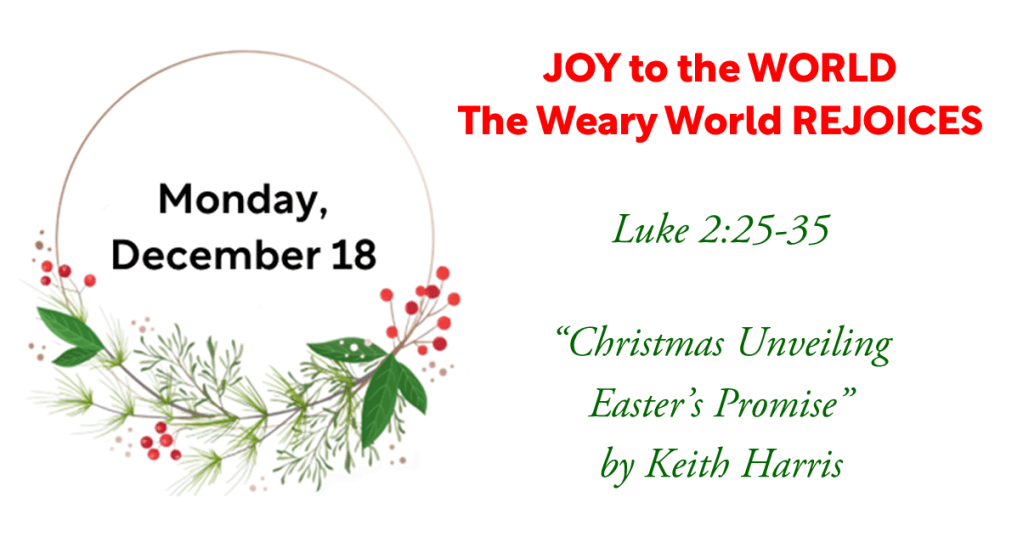
Luke 2:25-35
“Christmas Unveiling Easter’s Promise”
Cradling a newborn often leaves us grasping for words, yet, when Simeon embraced the infant Jesus in the temple, his words resounded with prophetic gravity. Simeon anticipated the fulfillment of God’s promise in this child, recognizing Jesus as the Savior not just for the Jewish nation but for the entire world (Luke 2:30-32).
Alongside this divine hope, Simeon foresaw a somber shadow of suffering. Amidst proclaiming salvation, he hinted at the division Jesus would bring, revealing the depths of people’s hearts. He tenderly forewarned Mary of the anguish she would endure because of her son’s destiny (Luke 2:34-35) – which reminds me of Good Friday and Easter
While Easter might not be the typical focus of Christmas, understanding the significance of Easter unlocks the very heart of Christmas itself. Simeon, with profound insight, pointed forward to the significance of Good Friday while welcoming the baby central to the Christmas narrative. His words connected the humble manger to the redemptive work accomplished on the rugged cross.
Christianity isn’t a moral code for self-improvement but the proclamation of Christ’s finished work. It isn’t about our merit but about God’s mighty ability to rescue, redeem, and restore. Much like the relief felt after settling a bill, God stamped “PAID” against our sins through the sacrificial death and resurrection of Jesus. The events that pierced Mary’s soul culminated in God’s unmistakable declaration: Jesus conquered death and paid the debt for all sinners (Luke 24:1-7).
Luke’s Gospel serves as a masterful bridge, connecting the Christmas story with Easter’s triumphant climax. Jesus, in his life and death, fulfilled Simeon’s prophecies—reaching out to the marginalized, facing opposition, and ultimately redeeming sinners through the sacrifice of the cross, all fueled by an unparalleled love for humanity.
Jesus, the embodiment of divine love, sacrificed himself for sinners like Simeon, Mary, Zechariah, the shepherds, and each of us—extending redemption despite our flaws and showcasing an immeasurable depth of love. This truth is the resounding heartbeat of Christmas, leading to the profound grace and unfathomable hope found in the resurrection of Easter.
Reflection Questions:
Reflecting on Simeon’s anticipation of Jesus connecting Christmas to Easter, how does this deepen your appreciation for the entire Story of Christ?
In what ways does Jesus’s sacrificial death resonate the idea of a fully paid debt, and how does this understanding impact the way you view God’s grace and forgiveness?
📖 Revelation 3:7–13We’re back!After a few months off, The King is Coming returns in 2026 with one of the most encouraging letters in Revelation — Jesus’s message to the faithful church in Philadelphia. In a world filled with opposition and weakness, Jesus opens a door no one can shut.In this episode, Keith Harris and Jamie Harrison explore:✔️ Jesus’s identity as the Holy One, the True One — God Himself✔️ What the “key of David” means and how Jesus alone opens and shuts✔️ The debated phrase “I will keep you from the hour of trial” — and how to read it biblically✔️ Why “little power” doesn’t disqualify faithfulness✔️ How being kept through the trial glorifies Christ’s strength in us✔️ What it means to be a pillar in God’s presence foreverThis church had no rebuke — only encouragement. And Jesus’s call still stands today: “Hold fast what you have, so that no one may seize your crown.” (Revelation 3:11, ESV)🔗 Missed earlier episodes in the series? You can click here to catch up and listen from the beginning.✍️ If you’d like to see a written version of this podcast, complete with footnotes and cross-references, you can find it here.
22 And when the time came for their purification according to the Law of Moses, they brought Him up to Jerusalem to present Him to the Lord 23 (as it is written in the Law of the Lord, “Every male who first opens the womb shall be called holy to the Lord”) 24 and to offer a sacrifice according to what is said in the Law of the Lord, “a pair of turtledoves, or two young pigeons.”
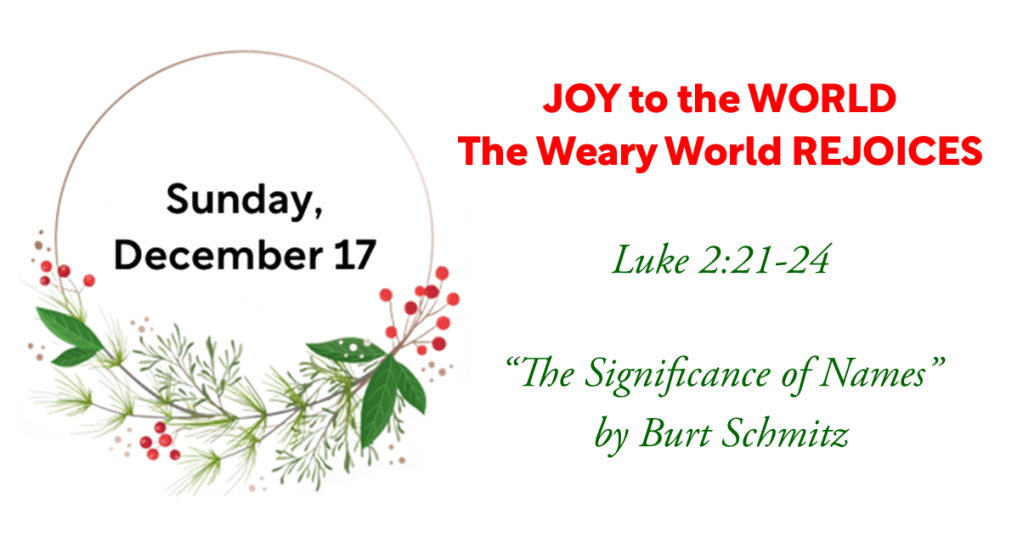
Luke 2:21-24
“The Significance of Names” by Burt Schmitz
Luke brings us from the rejoicing of the angels and shepherds to what seems to be a mundane event. A couple of things happen on the eighth day after His birth that are significant. First, He is circumcised. He receives the sign of the covenant as a descendent of Abraham (Genesis 17:7-12). The baby is now identified as a member of the household of faith. Second, the baby is given His name, Jesus. This is the name that the angel Gabriel told Mary to give her child (Luke 1:31). Jesus, “the Lord is salvation”, is His name. Matthew 1:21 tells us “For He will save His people from their sins.”
Names are significant. When we lived in Togo, we learned that the names that were given to children at their birth could be used to give the child identity as well as to indicate a significant event. My friend Lamoutidja’s name signified that he was born on a Thursday. His name literally means “Thursday’s man”. Lamoutidja had a lot of brothers. Another friend was the first born of his mother and was given the name Nanlieb, “Everyone envies me”. Having a son was very important and especially as a first born.
The name Jesus, “the Lord is salvation”, has great significance for us. It is Jesus, that even from His birth, is identified as the Savior of the world. Luke 2:11, the angels declare, “there has been born for you a Savior, who is Christ the Lord.” Christ, Messiah, Anointed One, all indicating that Jesus was the Son of God, born to accomplish the task of providing salvation.
Luke 2:29-32 identifies Jesus not only as the Savior of the Jews, but also of the Gentiles, the whole wide world. We see in the names and titles given to Jesus around His birth, circumcision, and purification in the temple that Jesus is the baby born to die. “And there is salvation in no one else; for there is no other name under heaven that has been given among men by which we must be saved.” (Acts 4:12).
What will you do with Jesus?
Reflection Questions:
Reflect on Acts 4:12. Since Jesus is the only way of salvation, how does that impact our desire to share the gospel – good news of great joy – with others?
Today’s devotion closed with a question: what will you do with Jesus? Belief in Him is supposed to impact one’s whole life. How does this question challenge the way our daily lives reflect (or do not reflect) Him?
📖 Revelation 3:7–13We’re back!After a few months off, The King is Coming returns in 2026 with one of the most encouraging letters in Revelation — Jesus’s message to the faithful church in Philadelphia. In a world filled with opposition and weakness, Jesus opens a door no one can shut.In this episode, Keith Harris and Jamie Harrison explore:✔️ Jesus’s identity as the Holy One, the True One — God Himself✔️ What the “key of David” means and how Jesus alone opens and shuts✔️ The debated phrase “I will keep you from the hour of trial” — and how to read it biblically✔️ Why “little power” doesn’t disqualify faithfulness✔️ How being kept through the trial glorifies Christ’s strength in us✔️ What it means to be a pillar in God’s presence foreverThis church had no rebuke — only encouragement. And Jesus’s call still stands today: “Hold fast what you have, so that no one may seize your crown.” (Revelation 3:11, ESV)🔗 Missed earlier episodes in the series? You can click here to catch up and listen from the beginning.✍️ If you’d like to see a written version of this podcast, complete with footnotes and cross-references, you can find it here.
8 And in the same region there were shepherds out in the field, keeping watch over their flock by night. 9 And an angel of the Lord appeared to them, and the glory of the Lord shone around them, and they were filled with great fear. 10 And the angel said to them, “Fear not, for behold, I bring you good news of great joy that will be for all the people. 11 For unto you is born this day in the city of David a Savior, who is Christ the Lord. 12 And this will be a sign for you: you will find a baby wrapped in swaddling cloths and lying in a manger.” 13 And suddenly there was with the angel a multitude of the heavenly host praising God and saying,
14 “Glory to God in the highest, and on earth peace among those with whom he is pleased!”
15 When the angels went away from them into heaven, the shepherds said to one another, “Let us go over to Bethlehem and see this thing that has happened, which the Lord has made known to us.” 16 And they went with haste and found Mary and Joseph, and the baby lying in a manger. 17 And when they saw it, they made known the saying that had been told them concerning this child. 18 And all who heard it wondered at what the shepherds told them. 19 But Mary treasured up all these things, pondering them in her heart. 20 And the shepherds returned, glorifying and praising God for all they had heard and seen, as it had been told them.
Luke 2:8-20
“Good News of Great Joy”
In our journey with Jesus, we often hear the refrain: in Him, we are new creations – born again (2 Corinthians 5:17, John 3:1-16). It’s a reminder that our old self is transformed by the Holy Spirit into something fresh and beautiful (Ephesians 4:22-24). But at times, this transformation might seem distant, especially when life’s challenges cloud our perspective.
Consider Israel in the Old Testament—a cycle of mistakes, repentance, and the certainty of God’s welcome upon repentance (Isaiah 55:7). They felt secure in God’s love, knowing they were chosen, set apart, and deeply cherished by Him (Deuteronomy 7:6; Jeremiah 31:3). But for those outside God’s chosen people, Gentiles, this language might feel alienating (Ephesians 2:11-13).
Understanding our identity in God’s eyes—realizing whose we are—is crucial (1 John 3:1). It means recognizing that we belong to a loving Father who chose and set us apart (1 Peter 2:9). When Jesus died, He knew us intimately—flaws and all (Romans 5:8). He not only chose us but transformed us to be His ambassadors (Ephesians 2:10). The terms used for God’s people—chosen, set apart, loved—are rooted in the Old Testament but remain equally true for us today (1 Peter 2:9). Like Israel, even amidst our failings, we can rest in God’s enduring love (Psalm 103:13-14). His correction is a sign of His care for us as beloved children (Hebrews 12:6).
This profound truth isn’t about our abilities or origins; it’s about God’s unwavering love, choosing us despite our imperfections (Romans 8:28-30). Personally, I’ve experienced this—I’m chosen not for my merit but to showcase what Jesus can accomplish in someone like me (Ephesians 2:8-9). Embracing this truth means embracing the Gospel—the good news of great joy (Luke 2:10). It’s about recognizing that God’s love, shown through Jesus’ sacrifice, offers us a new life (John 3:16). It’s an invitation for you, too, to experience this transformative love that surpasses our flaws and backgrounds (Romans 10:9-10).
Reflecting on the shepherds’ encounter in Luke 2:8-20 sheds light on this transformative message. Shepherds were often disregarded, yet they were the first witnesses to the Savior’s birth. The heavenly host announced His arrival to these practical men, not the religious elite, emphasizing God’s grace toward all humanity. Their encounter wasn’t just a revelation; it was a call to action. They responded by seeking the newborn Messiah and spreading the good news, glorifying and praising God. These humble shepherds, disregarded by society, became bearers of the greatest news—the arrival of the long-awaited Savior.
Just like these shepherds, we’re invited to embrace and share this good news—the gospel of Christ. Let’s join in proclaiming this good news to the world and find our purpose in embracing the Savior who came for us all.
Reflection Questions:
How does the encounter with between the shepherds and the angels demonstrate God’s choice to reveal His transformative love to those often overlooked in society?
Today’s devotion mentions how our identity in Christ is not determined by our abilities or background but by Him. How does this truth shape your perception of what God does for us in salvation? How does it impact our call to continue to share good news of great joy — the gospel – with all people?
📖 Revelation 3:7–13We’re back!After a few months off, The King is Coming returns in 2026 with one of the most encouraging letters in Revelation — Jesus’s message to the faithful church in Philadelphia. In a world filled with opposition and weakness, Jesus opens a door no one can shut.In this episode, Keith Harris and Jamie Harrison explore:✔️ Jesus’s identity as the Holy One, the True One — God Himself✔️ What the “key of David” means and how Jesus alone opens and shuts✔️ The debated phrase “I will keep you from the hour of trial” — and how to read it biblically✔️ Why “little power” doesn’t disqualify faithfulness✔️ How being kept through the trial glorifies Christ’s strength in us✔️ What it means to be a pillar in God’s presence foreverThis church had no rebuke — only encouragement. And Jesus’s call still stands today: “Hold fast what you have, so that no one may seize your crown.” (Revelation 3:11, ESV)🔗 Missed earlier episodes in the series? You can click here to catch up and listen from the beginning.✍️ If you’d like to see a written version of this podcast, complete with footnotes and cross-references, you can find it here.
1 In those days a decree went out from Caesar Augustus that all the world should be registered. 2 This was the first registration when Quirinius was governor of Syria. 3 And all went to be registered, each to his own town. 4 And Joseph also went up from Galilee, from the town of Nazareth, to Judea, to the city of David, which is called Bethlehem, because he was of the house and lineage of David, 5 to be registered with Mary, his betrothed, who was with child. 6 And while they were there, the time came for her to give birth. 7 And she gave birth to her firstborn son and wrapped him in swaddling cloths and laid him in a manger, because there was no place for them in the inn.
Luke 2:1-7
“The Quiet Birth That Changed the World” by Burt Schmitz
The birth of a child is always a joyous occasion. Here we have the birth of not just any child, but the birth of the Son of God, Jesus. This is a very significant moment in history. The Apostle Paul writes, “But when the fullness of the time came, God sent forth His Son, born of a woman, born under the law, so that He might redeem those who were under Law, that we might receive the adoption of sons.” (Galatians 4:4-5). Jesus’ birth is in fulfillment of the promise given in Genesis 3:15 of the one who shall crush the serpent’s head. And yet, the birth of the Son of God is recorded in these verses in a manner that is seems so insignificant.
Joseph and Mary travel to Bethlehem to be counted in a census “because he was of the house and family of David.” (Luke 2:4). The Scripture does not indicate that Joseph was moving to fulfill the prophecy in Micah 5:2 that the Messiah was to be born in Bethlehem. No, Joseph took his wife, Mary, so they could be counted, nothing less or nothing more. While there in Bethlehem, “the days were completed for her to give birth” (Luke 2:6) and Jesus is born. No fanfare for the birth of the King of Kings. There was no rejoicing by the multitudes. There was no one singing the Hallelujah Chorus, nor was there the reciting of Isaiah 9:6-7. “For a child will be born to us, a son will be given to us; and the government will rest on His shoulders; and His name will be called Wonderful Counselor, Mighty God, Eternal Father, Prince of Peace. There will be no end to the increase of His government or of peace, on the throne of David and over his kingdom, to establish it and to uphold it with justice and righteousness from then on and evermore.” No, Mary gave birth to Jesus and wrapped Him in cloths and laid Him in a manger because there was no room in the inn. A very quiet and unassuming birth, that changed the world.
Much in our lives seems exactly like Jesus’s birth. Our thoughts go something like this. It is just another boring day where nothing exciting happens. God why don’t You choose me to do something great in Your Kingdom? How come I am never recognized for what I do like…? God has not forgotten you. Ephesians 2:10 affirms that each of us is saved for a purpose. There are good works for us to do that God “prepared beforehand so that we would walk in them”. Just as Jesus’s birth was not an insignificant event, even though it looks that way in today’s passage, neither is your birth into the Kingdom of God. Jesus chooses us to follow Him and then to do His work (John 15:16). So here it is. Jesus came to save us and then to choose us to do His work.
Will you answer the call to follow Jesus first in salvation and then to do the good works to which He has called you?
What will you do with the Babe of Bethlehem?
Reflection Questions:
Reflecting on the quiet and humble birth of Jesus in Bethlehem, how does this challenge our culture’s expectations of grandeur and recognition for significant events?
How does Ephesians 2:10 encourage us to view our lives and the good works prepared for us?
📖 Revelation 3:7–13We’re back!After a few months off, The King is Coming returns in 2026 with one of the most encouraging letters in Revelation — Jesus’s message to the faithful church in Philadelphia. In a world filled with opposition and weakness, Jesus opens a door no one can shut.In this episode, Keith Harris and Jamie Harrison explore:✔️ Jesus’s identity as the Holy One, the True One — God Himself✔️ What the “key of David” means and how Jesus alone opens and shuts✔️ The debated phrase “I will keep you from the hour of trial” — and how to read it biblically✔️ Why “little power” doesn’t disqualify faithfulness✔️ How being kept through the trial glorifies Christ’s strength in us✔️ What it means to be a pillar in God’s presence foreverThis church had no rebuke — only encouragement. And Jesus’s call still stands today: “Hold fast what you have, so that no one may seize your crown.” (Revelation 3:11, ESV)🔗 Missed earlier episodes in the series? You can click here to catch up and listen from the beginning.✍️ If you’d like to see a written version of this podcast, complete with footnotes and cross-references, you can find it here.
1 The book of the genealogy of Jesus Christ, the son of David, the son of Abraham. 2 Abraham was the father of Isaac, and Isaac the father of Jacob, and Jacob the father of Judah and his brothers, 3 and Judah the father of Perez and Zerah by Tamar, and Perez the father of Hezron, and Hezron the father of Ram, 4 and Ram the father of Amminadab, and Amminadab the father of Nahshon, and Nahshon the father of Salmon, 5 and Salmon the father of Boaz by Rahab, and Boaz the father of Obed by Ruth, and Obed the father of Jesse, 6 and Jesse the father of David the king. And David was the father of Soloman by the wife of Uriah, 7 and Solomon the father of Rehoboam, and Rehoboam the father of Abijah, and Abijah the father of Asaph, 8 and Asaph the father of Jehoshaphat, and Jehoshaphat the father of Joram, and Joram the father of Uzziah, 9 and Uzziah the father of Jotham, and Jotham the father of Ahaz, and Ahaz the father of Hezekiah, 10 and Hezekiah the father of Manasseh, and Manasseh the father of Amos, and Amos the father of Josiah, 11 and Josiah the father of Jechoniah and his brothers, at the time of the deportation to Babylon. 12 And after the deportation to Babylon: Jechoniah was the father of Shealtiel, and Shealtiel the father of Zerubbabel, 13 and Zerubbabel the father of Abiud, and Abiud the father of Eliakim, and Eliakim the father of Azor, 14 and Azor the father of Zadok, and Zadok the father of Achim, and Achim the father of Eliud, 15 and Eliud the father of Eleazar, and Eleazar the father of Matthan, and Matthan the father of Jacob, 16 and Jacob the father of Joseph the husband of Mary, of whom Jesus was born, who is called Christ. 17 So all the generations from Abraham to David were fourteen generations, and from David to the deportation to Babylon fourteen generations, and from the deportation to Babylon to the Christ fourteen generations.
Matthew 1:1-17
“Unlikely Lineage: Sin and Redemption in Jesus’s Family Tree” by Keith Harris
Once upon a time, there was a great King. He was foretold of old to be a great hero who would come from His faraway country to win back His lost love. His story is one of romance as He left His palace to rescue His Bride. His lineage hailed back to other…great…well, um….
One of the things I love about God’s Word is how it does not fall into the temptation to pretty things up or rewrite/remix them to be more acceptable. Yes, Jesus is the great King – the King of kings who was prophesied for centuries to come from heaven and rescue His people. Yes, Jesus’s Story is one of romance where He left His throne on high and traded it for a lowly manger in a tumble-down stable. But His lineage? It was not filled with kings and queens, although there are a few sprinkled in toward the middle. It was not filled with great heroes with tragic flaws; well, the tragic flaws are many. No, Jesus’s family tree was filled with regular old sinners with real sin and problems – people like me and you.
This Bible study will look at some women emphasized in Jesus’s family tree in Matthew who point us to Jesus in very specific ways. We do not have time to go fully into their stories today, so I will give you the cross-reference so you can check it out directly from Scripture.
The first woman is Tamar (v. 3), and her story is found in Genesis 38. Tamar was Judah’s – as in lion of the tribe of Judah, the original – daughter-in-law. She was originally married to Judah’s oldest son Er until “the Lord put him to death” because Er was “wicked in the sight of the Lord” (Genesis 38:7). In those days, when the elder son died, it was the role of his younger brother to take his place and father children in his name. This fell to second-born son, Onan, but Onan was more sinful and selfish than his big brother, doing what was “wicked in the sight of the Lord” and being “put…to death, also” (Genesis 38:10). Poor Tamar. Her only hope at bearing children would fall on Judah’s youngest son Shelah. But Judah lied and had no intention of continuing with Tamar. What did she do? She decided to be wicked herself. She tricked Judah and tempted him. How did he respond but by being wicked himself? Judah and Tamar committed sin together that is so heinous that I won’t write on it here. So, why would they be included in Jesus’s official lineage – in the Bible no less?
The second woman is Rahab (v. 5), and her story is found throughout the Bible in Joshua 2:1-21, 6:17, 6:22-25; Hebrews 11:31; and James 2:25. Rahab wasn’t one of God’s chosen people, and before the Hebrew spies came to her house in Jordan, she was known for her sinful profession, a profession that, like Tamar isn’t something I am writing down here. Yet she had faith in the God she had heard of because of the mighty work He had done with His people. She kept the Hebrew spies safe by hiding them from her own people. She sided with the Lord. Despite her people and her own history, God rescued her by letting her put a scarlet cord in her window to mark her safe. But what about that earlier profession? Why would someone like her be included in Jesus’s official lineage – in the Bible no less?
The third woman is actually somewhat related to Rahab – she ended up marrying Rahab’s son Boaz. Her name is Ruth, and her story is told in the book of the Bible bearing her name. Like her mother-in-law, she wasn’t one of God’s chosen people. She was from the land of Moab (a people group started by a whole bunch of mess way back in Genesis 19:30-37). Her husband Mahlon came to Moab with his family during a famine in Israel, seeking help from their own strength and ingenuity rather than from the Lord. While they were in Moab, her father-in-law, husband, and brother-in-law all died. She alone decided to go back to Israel with her mother-in-law Naomi. God blessed her while she was there and took care of Ruth and Naomi. Eventually, she – not one of God’s chosen people – would be blessed to marry Boaz, Rahab’s son. This story has a happy ending, especially considering Ruth would be David’s great-grandmother, but doesn’t King Jesus deserve a more presentable bloodline?
The fourth woman isn’t even called by her name, but how she is listed tells the sadness and sin surrounding her: “And David was the father of Solomon by the wife of Uriah” (v. 6, 2 Samuel 11:1-25). King David is heralded as a hero but mainly for his worship of the Lord. He is also known as a sinner. Yes, the man who slew Goliath and wrote a good chunk of the psalms committed some of the most heinous sins: murder and adultery. David saw “the wife of Uriah”, a woman named Bathsheba, and decided that he wanted to make her his. His decisions led to a child between them. Rather than owning up and confessing his sin – to the Lord, to his wives, to Uriah, to Israel, David undertook a massive cover-up that ended in his arranging Uriah’s murder. He stole a man’s wife. He took a man’s life. It looks good to have a man who killed a giant who worshiped the Lord in your lineage, but why associate King Jesus with the wickedness of King David (and the same or worse from many of the kings listed after him in the family tree)?
In short, there are answers to those questions. Why would the Bible recognize all those sins and sinners in Jesus’s lineage? They all really happened. Sin happens. All people “have sinned and fall short of the glory of God” (Romans 3:23). None of us – not a single person in the history or future of the world – deserve to be in Jesus’s lineage, but faith in God – trusting in His work and His steadfast love and kindness – is woven through that lineage, marking like a scarlet cord those who are saved by trusting in Him. Looking at their sin and faith in Him reminds us that none of us are worthy of saving. But that is why He came. Jesus Himself said that He came to “seek and save the lost” (Luke 19:10). And how did He come to seek and to save? Christmas. The incarnation of God becoming flesh and dwelling among us (John 1:14). He came to earth to provide a way for people like Tamar, Rahab, David, you, and me to be saved – by grace through faith in Him alone.
So, as you gather with family and friends and notice some rough looking fruit in your family tree – or whether you notice the same by looking in your own mirror, realize that Jesus is more than the reason for the season – He came to seek and save sinners like you and me. Won’t you ask Him to save you?
Reflection Questions:
By God including Tamar, Rahab, Ruth, and David in Jesus’s family line, how do you see God’s grace and mercy at work despite their sins? How can that remind us of God’s redemption?
Consider the phrase Jesus used in Luke 19:10, that He came “to seek and save the lost”. How does that impact you personally?
📖 Revelation 3:7–13We’re back!After a few months off, The King is Coming returns in 2026 with one of the most encouraging letters in Revelation — Jesus’s message to the faithful church in Philadelphia. In a world filled with opposition and weakness, Jesus opens a door no one can shut.In this episode, Keith Harris and Jamie Harrison explore:✔️ Jesus’s identity as the Holy One, the True One — God Himself✔️ What the “key of David” means and how Jesus alone opens and shuts✔️ The debated phrase “I will keep you from the hour of trial” — and how to read it biblically✔️ Why “little power” doesn’t disqualify faithfulness✔️ How being kept through the trial glorifies Christ’s strength in us✔️ What it means to be a pillar in God’s presence foreverThis church had no rebuke — only encouragement. And Jesus’s call still stands today: “Hold fast what you have, so that no one may seize your crown.” (Revelation 3:11, ESV)🔗 Missed earlier episodes in the series? You can click here to catch up and listen from the beginning.✍️ If you’d like to see a written version of this podcast, complete with footnotes and cross-references, you can find it here.
1 In the beginning was the Word, and the Word was with God, and the Word was God. 2 He was in the beginning with God. 3 All things were made through Him, and without Him was not any thing made that was made. 4 In Him was life, and the life was the light of men. 5 The light shines in the darkness, and the darkness has not overcome it.
6 There was a man sent from God, whose name was John. 7 He came as a witness, to bear witness about the light, that all might believe through Him. 8 He was not the light, but came to bear witness about the light.
9 The true light, which gives light to everyone, was coming into the world. 10 He was in the world, and the world was made through Him, yet the world did not know Him. 11 He came to His own, and His own people did not receive Him. 12 But to all who did receive Him, who believed in His name, He gave the right to become children of God, 13 who were born, not of blood nor of the will of the flesh nor of the will of man, but of God.
14 And the Word became flesh and dwelt among us, and we have seen His glory, glory as of the only Son from the Father, full of grace and truth. 15 (John bore witness about Him, and cried out, “This was He of whom I said, ‘He who comes after me ranks before me, because He was before me.’”) 16 For from His fullness we have all received grace upon grace. 17 For the law was given through Moses; grace and truth came through Jesus Christ. 18 No one has ever seen God; the only God, who is at the Father’s side, He has made Him known.
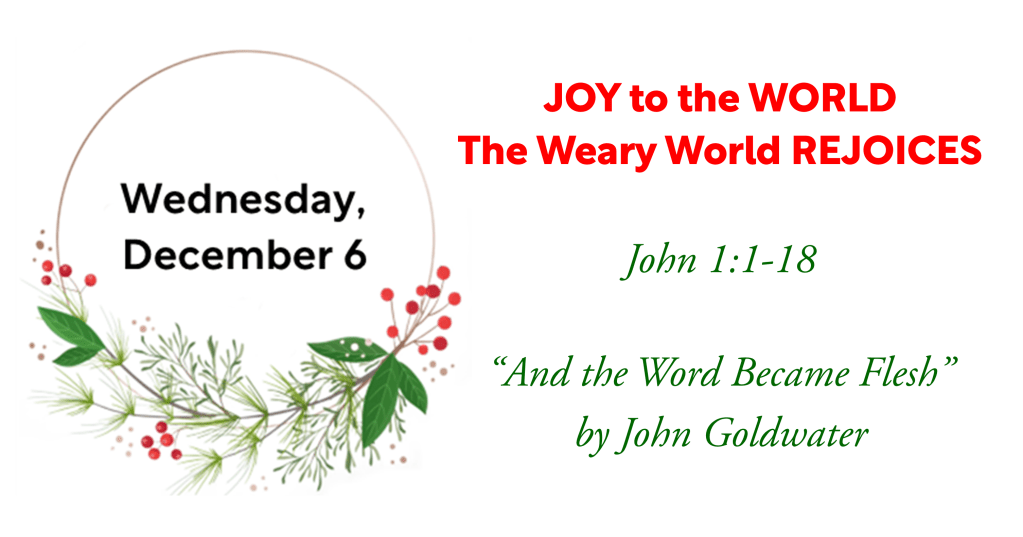
John 1:1-18
“And the Word Became Flesh” by John Goldwater
The greatness of the incarnation (an important doctrine expressing that Jesus, the only begotten Son of the Father, is God made flesh, emphasizing that Jesus is fully God and fully man[i])of JESUS Christ cannot be overstated. No one could ever rightly say, “Friend, you are putting too great an emphasis on this passage of Scripture.” John, the beloved apostle, writes concerning the greatest manifestation of all time and eternity when he writes, “In the beginning was the Word, and the Word was with GOD, and the Word was GOD…And the Word became flesh and dwelt among us” (John 1:1, 14).We who believe stand at the greatest vantage point, bask in the glory of the grace and truth of this majestic scene.
The Great GOD of creation, the GOD of the beginning, the GOD of light and life, has come to us. His light and life have touched all people, and all people owe their existence to their Creator. His light and life cannot be stopped or altered by darkness or rejection. Further, He has given witness to His to His arrival and His power to animate and regenerate mankind. There is no higher calling than “to bear witness of the Light, that all through him might believe” (John 1:7). There is no greater promise than to say, “But as many as received Him, to them He gave the right to become the children of GOD, those who believe in His name: who were born…of GOD” (John 1:12). This great privilege and great promise are by GOD’s gracious design.
The Word made flesh, the bringer of grace and truth, the only begotten of the Father, is clearly identified as JESUS Christ. This unmistakable identification of the Word with JESUS Christ leads to the greatest of confidence. Not even the Israelites, who followed Moses on dry ground through the Red Sea or stood at the foot of Mt Sinai as GOD’s voice boomed and the Mountain smoked, were afforded such confidence. JESUS is the Word that perfectly exegetes (analyzes/explains what something is by use of the Bible[ii]) the Father!
Personally, in all my study of the Bible, I don’t know of a more significant passage of Scripture. John 1:1-18 is an Everest among the greatest peaks of GOD’s Word. We who hold our deepest love, loyalty, trust, and hope in JESUS Christ do so for good reason considering this passage. So, this season go big. Go big with your worship. Go big with your witness. And go big with your confidence in JESUS. The all-powerful GOD showed up and showed out, and He will never stop being Him, being the only one, He will never stop being JESUS Christ the Word made flesh!
“Then sings my soul, my Savior GOD to Thee, how great Thou art!”[iii]
Reflection Questions:
Reflecting on John 1:1-18, why is the incarnation of Jesus considered so important?
How does v. 14 calling Jesus the “Word made flesh” help us understand why the incarnation is so important?
📖 Revelation 3:7–13We’re back!After a few months off, The King is Coming returns in 2026 with one of the most encouraging letters in Revelation — Jesus’s message to the faithful church in Philadelphia. In a world filled with opposition and weakness, Jesus opens a door no one can shut.In this episode, Keith Harris and Jamie Harrison explore:✔️ Jesus’s identity as the Holy One, the True One — God Himself✔️ What the “key of David” means and how Jesus alone opens and shuts✔️ The debated phrase “I will keep you from the hour of trial” — and how to read it biblically✔️ Why “little power” doesn’t disqualify faithfulness✔️ How being kept through the trial glorifies Christ’s strength in us✔️ What it means to be a pillar in God’s presence foreverThis church had no rebuke — only encouragement. And Jesus’s call still stands today: “Hold fast what you have, so that no one may seize your crown.” (Revelation 3:11, ESV)🔗 Missed earlier episodes in the series? You can click here to catch up and listen from the beginning.✍️ If you’d like to see a written version of this podcast, complete with footnotes and cross-references, you can find it here.
[i] Lisa Woicik, “Incarnation,” ed. John D. Barry et al., The Lexham Bible Dictionary (Bellingham, WA: Lexham Press, 2016).
[ii] Douglas Stuart, “Exegesis,” ed. David Noel Freedman, The Anchor Yale Bible Dictionary (New York: Doubleday, 1992), 682.
[iii] George Thomas Kurian, Nelson’s New Christian Dictionary: The Authoritative Resource on the Christian World (Nashville, TN: Thomas Nelson Publishers, 2001).
1 Who has believed what he has heard from us? And to whom has the arm of the Lord been revealed? 2 For He grew up before Him like a young plant, and like a root out of dry ground; He had no form or majesty that we should look at Him, and no beauty that we should desire Him. 3 He was despised and rejected by men, a man of sorrows and acquainted with grief; and as one from whom men hide their faces He was despised, and we esteemed Him not.
4 Surely He has borne our griefs and carried our sorrows; yet we esteemed Him stricken, smitten by God, and afflicted. 5 But He was pierced for our transgressions; He was crushed for our iniquities; upon Him was the chastisement that brought us peace, and with His wounds we are healed. 6 All we like sheep have gone astray; we have turned – every one – to His own way; and the Lord has laid on Him the iniquity of us all.
Isaiah 53:1-6
“An Old Testament Portrait of Christ” by Robert Morman
I remember going to various churches when I was in my teens, and it was always there. That one framed picture of Jesus. You know the one. I have jokingly called it the Swedish-Pageant-Sash Jesus. He is there with blue eyes and flowing hair. His robes are white, and he wears either a red or blue sash that goes from his shoulder across his chest and around his side. He looks like he is either in a pageant or in a commercial for some hair product. He looks amazing – almost heavenly. There is usually one other picture in most churches – Jesus on the cross. It is a sanitized picture of the crucifixion. It is usually Jesus nailed to the cross looking to Heaven. For the most part, he looks normal and in good physical condition, but when we read the words of Isaiah 53, we see a completely different Jesus described.
Verse 2 says, “He [Jesus] had no form or majesty that we should look at him, and no beauty that we should desire him.” Appearance wise, there was nothing that stood out about Jesus. In His time, He would look exactly like most normal working class or even poor people in that area of the world. He wouldn’t have stood out in the marketplace. Isaiah 53 doesn’t stop there with Jesus. This is a prophecy about what would occur to the Messiah. He is called “a man of sorrows” and one “acquainted with grief”, so well acquainted with grief that it is recorded that He sweat drops of blood in the garden because of what He knew was going to occur to Him. He carried our sins. Verse 4 says it best, “he has borne our griefs and carried our sorrows.” Every sin was on Him. A sinless Savior feeling the weight of an eternity of sin. That is tremendous grief and sorrow.
Verse 5 foretells what would occur to him. “He was pierced for our transgressions.” From the flogging to the crown of thorns, to the nails, to the spear in his side, every piercing was caused by us. “He was crushed for our iniquities.” Jesus most likely would have fallen as he carried the crossbeam he would soon be nailed to. This piece of the device of torment and death would have fallen on him. Depending on the source, the beam would have weighed 75-125 lbs. Imagine falling multiple times with that weight on you, then getting up and doing it again. All of this combined with the beating Jesus would have received and his lack of sleep, food, and water would have made Him look almost inhuman in appearance. But why? Why would this occur? Verse 6,” The Lord has laid on him the iniquity of us all.” Christ was sent to die because of what we have done. Every sin, big and small, was laid on Him by the Father. Jesus was mangled and marred for us at the will of the Father. This should drive us to adore Jesus more and more.
To close, let’s read the lyrics of the hymn “O Sacred Head, Sore Wounded”[i]:
“In thy most bitter passion My heart to share doth cry. With thee for my salvation Upon the cross to die. Ah, keep my heart thus moved To stand thy cross beneath, To mourn thee, well-beloved, Yet thank thee for thy death.”
Reflection Questions:
How do vv. 2-6 describe Jesus different than the pictures you are used to seeing of Him?
How does reading through these verses in Isaiah 53 help us understand why Jesus came to earth and why He died for our sins on the cross?
📖 Revelation 3:7–13We’re back!After a few months off, The King is Coming returns in 2026 with one of the most encouraging letters in Revelation — Jesus’s message to the faithful church in Philadelphia. In a world filled with opposition and weakness, Jesus opens a door no one can shut.In this episode, Keith Harris and Jamie Harrison explore:✔️ Jesus’s identity as the Holy One, the True One — God Himself✔️ What the “key of David” means and how Jesus alone opens and shuts✔️ The debated phrase “I will keep you from the hour of trial” — and how to read it biblically✔️ Why “little power” doesn’t disqualify faithfulness✔️ How being kept through the trial glorifies Christ’s strength in us✔️ What it means to be a pillar in God’s presence foreverThis church had no rebuke — only encouragement. And Jesus’s call still stands today: “Hold fast what you have, so that no one may seize your crown.” (Revelation 3:11, ESV)🔗 Missed earlier episodes in the series? You can click here to catch up and listen from the beginning.✍️ If you’d like to see a written version of this podcast, complete with footnotes and cross-references, you can find it here.
[i] F. L. Cross and Elizabeth A. Livingstone, eds., The Oxford Dictionary of the Christian Church (Oxford; New York: Oxford University Press, 2005), 670.
2 The people who walked in darkness have seen a great light; those who dwelt in a land of deep darkness, on them has light shone. 3 You have multiplied the nation; You have increased its joy; they rejoice before you as with joy at the harvest, as they are glad when they divide the spoil. 4 For the yoke of His burden, and the staff for His shoulder, the rod of His oppressor, You have broken as on the day of Midian. 5 For every boot of the tramping warrior in battle tumult and every garment rolled in blood will be burned as fuel for the fire. 6 For to us a child is born, to us a Son is given; and the government shall be upon His shoulder, and His name shall be called Wonderful Counselor, Mighty God, Everlasting Father, Prince of Peace. 7 Of the increase of His government and of peace there will be no end, on the throne of David and over his kingdom, to establish and to uphold it with justice and with righteousness from this time forth and forevermore. The zeal of the Lord of hosts will do this.
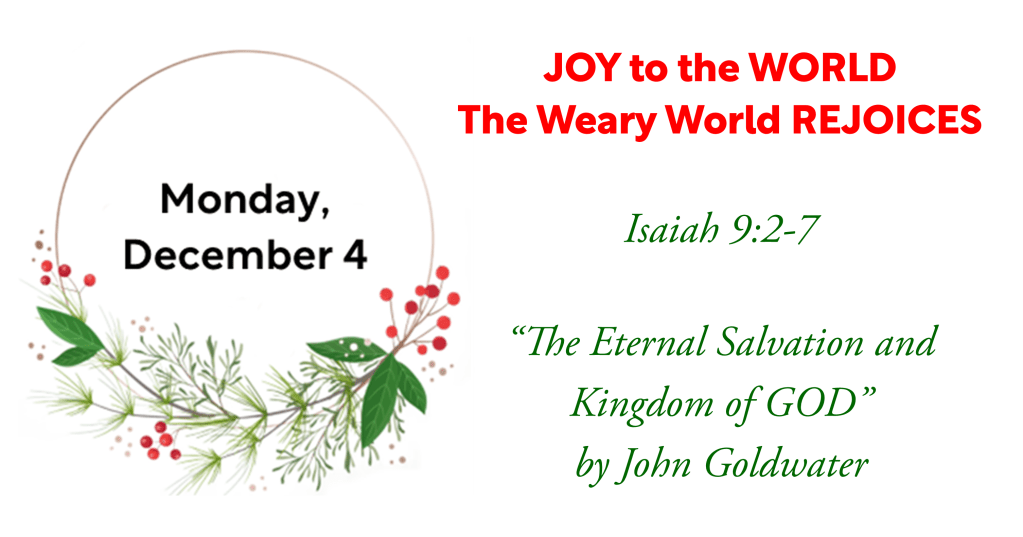
Isaiah 9:2-7
“The Eternal Salvation and Kingdom of GOD” by John Goldwater
Isaiah the prophet is given an incredible vision of the eternal salvation and kingdom that GOD will bring. GOD’s fight will bring light to darkness, hope to gloom, and victory to defeat. All these wonderful transformations will be accomplished by His power and experienced by His people. GOD Himself will accomplish all that He promises.
In Isaiah 8:19-22, the prophet describes those who have forsaken GOD and His Word in favor of occult practices. This practice of abandoning GOD and seeking spirits, sages, philosophies, religions, sciences, theories, or just man-centered feelings and wisdom, is still a practice prevalent in modern times. These twin sin of abandoning GOD and seeking others always and inevitably leads to darkness, hopelessness, and fruitlessness. And this is the backdrop into which GOD announces His coming eternal salvation and kingdom.
Isaiah 9:1-3 identifies the people and the place where GOD’s great initiative will first impact the earth. Ground zero of GOD’s great work will be the northern section of Israel, “Zebulun and the land of Naphtali…beyond the Jordan, in Galilee of the Gentiles” (Isaiah 9:1). These lands were devastated by the cruel Assyrian invaders and the residents there suffered greatly. The people described as the distressed, the lightly esteemed, the heavily oppressed, the Gentiles, the people who walked in darkness, and those who lived in death’s shadow. It’s just like GOD to take on the lowest people in toughest places during the darkest darkness, so that His light and glory will shine brightest.
This mighty and gracious act of GOD is meant to be experienced by His people. The light of GOD’s glory is meant to be seen and felt. They “have seen a great light…Upon them a light has shined” (Isaiah 9:2). The bright future of those who put their trust in GOD will not be hidden forever, eventually the darkness will flee in the light of the brilliant dawning of GOD’s saving power. GOD’s brilliant victory over darkness brings an ever-increasing joy. Joy like a bountiful harvest and joy like soldiers coming home from war will sweep away the years of want, suffering, and shame.
Isaiah 9:4-7 describe the perfect Savior and King in action. Verses 4, 5, and 6 all start with the word “For” to confirm that it is GOD alone who causes this victory, therefore it is to GOD alone to receive glory and honor. GOD will destroy the power of the enemy to oppress and burden His people. Just like the prophecy of Genesis 3:15, the special born Son who will crush the head of the serpent, implies, there cannot be lasting peace if there is a lasting enemy. Like when GOD struck down the Egyptians and the Midianites, He again will break the power of the His enemies. Furthermore, He brings an end to war itself. The uniforms and the gear used for war will become useless except for burning. This is all GOD’s doing.
GOD’s mission, His fight, is going to take place in close quarters and in the filth of this world. The Child born and the Son given will be none other than the Mighty GOD, God the Warrior, and Everlasting Father. These titles cannot rightfully and especially not biblically be address to any other being but GOD, the One True GOD. He will enter the fray and penetrate the darkness. He will be King at His birth and even His vulnerability is stronger than man’s strength (Isaiah 7:14, Matthew 2:1-2, 1 Corinthians 1:25). His wisdom and counsel will be unstoppable because He is the Wonderful Counselor. The idea of Wonderful here carries describes that which is beyond human and worldly understanding. He is the Prince, the Ruler, of peace (Genesis 14:18, Psalm 110:4, Hebrews 7:1-3). He manufactures peace like a car manufacturer makes cars (Colossians 1:19-20). GOD, the Wonderful Counselor, Mighty GOD, Everlasting Father, and Prince of Peace (note He is both Father and Son=Prince), will both Give His Son and the Child born will be GOD with us, Immanuel – God with us. Because of this mysterious, gracious, and glorious incarnation the victory is assured.
The loving governance that He brings will rest on His shoulders and will last forever. For those who hope for real justice and righteousness to rule this world, hold it is coming. GOD will fulfill His promises through His Son JESUS. JESUS was born of the tribe of Judah and of the family line of David (Genesis 49:10, 2 Samuel 7:12-16, Romans 1:2-4). JESUS is the Child born, He is the Son given, He is the Word made flesh (John 1:1, 14), and He is the personification of the “Zeal of the LORD of hosts” (Isaiah 9:7). Take time this season to think about how wonderful it is that GOD Himself, the perfect Savior and King, came to establish His Eternal Salvation and Kingdom.
“Joy to the world! The LORD is come; Let earth receive her King!”[i]
Reflection Questions:
Reflecting on v. 2, how does it describe the powerful impact of the light of Christ on places and people in darkness and despair?
Think on the titles and roles of Jesus in vv. 6-7. What do they tell us about who Jesus is?
📖 Revelation 3:7–13We’re back!After a few months off, The King is Coming returns in 2026 with one of the most encouraging letters in Revelation — Jesus’s message to the faithful church in Philadelphia. In a world filled with opposition and weakness, Jesus opens a door no one can shut.In this episode, Keith Harris and Jamie Harrison explore:✔️ Jesus’s identity as the Holy One, the True One — God Himself✔️ What the “key of David” means and how Jesus alone opens and shuts✔️ The debated phrase “I will keep you from the hour of trial” — and how to read it biblically✔️ Why “little power” doesn’t disqualify faithfulness✔️ How being kept through the trial glorifies Christ’s strength in us✔️ What it means to be a pillar in God’s presence foreverThis church had no rebuke — only encouragement. And Jesus’s call still stands today: “Hold fast what you have, so that no one may seize your crown.” (Revelation 3:11, ESV)🔗 Missed earlier episodes in the series? You can click here to catch up and listen from the beginning.✍️ If you’d like to see a written version of this podcast, complete with footnotes and cross-references, you can find it here.
[i] George Thomas Kurian, Nelson’s New Christian Dictionary: The Authoritative Resource on the Christian World (Nashville, TN: Thomas Nelson Publishers, 2001).






 Just Keith Harris