
John 16 on 3/14 | NT260 — Reading & Growing in Christ

Click here for John 16 audio:


Read it. Pray it. Share it. Live it.

Jesus tells His disciples these things so they will not fall away when persecution comes (John 16:1–4). They will be hated, put out of the synagogues, and even attacked by people who think they are serving God (John 16:2). That warning is painful, but it is also merciful. Jesus wants His followers to know beforehand that opposition does not mean He has failed or abandoned them. Their sorrow is real because He is going away, yet His departure is actually for their good, because the coming of the Helper depends on it (John 16:5–7). The Holy Spirit will continue Jesus’ ministry by convicting the world concerning sin, righteousness, and judgment (John 16:8–11). He will expose the true guilt of unbelief in Christ, the emptiness of false righteousness, and the defeat of Satan, the ruler of this world (John 16:9–11; cf. John 12:31).

Jesus also promises that the Spirit of truth will guide His followers into all the truth (John 16:12–15). The disciples are not ready in that moment to bear everything Jesus has yet to reveal, but the Spirit will teach them, remind them, and make known what belongs to Christ (John 16:12–15; cf. John 14:26). The Spirit’s work is not to draw attention to Himself but to glorify Jesus by taking what is His and declaring it to His people (John 16:14). This means believers are not left alone to guess their way through the Christian life. The risen Christ continues to shepherd His church by His Spirit through His word. The same disciples who are confused and sorrowful here will later understand more clearly because the Spirit will open their eyes to the meaning of Jesus’ death, resurrection, and exaltation.

Then Jesus speaks of a “little while” when the disciples will not see Him, and then a little while later when they will see Him again (John 16:16–19). His death will bring weeping and lament for them while the world rejoices, but that sorrow will not last. It will turn to joy, like the anguish of childbirth giving way to joy when the child is born (John 16:20–22). Jesus’ resurrection will bring a joy that no one can take away (John 16:22). From there He points them toward prayer, assuring them that the Father Himself loves them and that they may ask in Jesus’ name (John 16:23–27). Though they will soon scatter and leave Him alone, Jesus is not alone, because the Father is with Him (John 16:32). The chapter ends with one of the most comforting promises in all of Scripture: “In the world you will have tribulation. But take heart; I have overcome the world” (John 16:33). Jesus does not promise an easy path, but He does promise peace in Him and victory through Him.

🌀 Reflection:
Jesus never hides the reality that His followers will face sorrow, pressure, and tribulation in this world. But He also never leaves us with fear as the final word. Are you looking for peace in changed circumstances, or in Christ Himself? His victory does not erase hardship right away, but it does mean hardship never gets the last word.

💬 Mission Challenge:
Encourage someone who is hurting, discouraged, or under pressure today by reminding them of John 16:33 and pointing them to the peace and courage that are found in Jesus alone.

Continue reading in our NT260 plan in the rest of Phase 4 — That You May Believe.

John 15 on 3/13 | NT260 — Reading & Growing in Christ

Click here for John 15 audio:


Read it. Pray it. Share it. Live it.

In John 15, Jesus says, “I am the true vine” (John 15:1). In the Old Testament, Israel was often pictured as God’s vine, but she failed to bear the fruit God desired (Isa. 5:1–7; Ps. 80:8–16). Jesus is the true and faithful vine, and His disciples are the branches who must abide in Him if they are to have life and bear fruit (John 15:1–5). To abide in Jesus means to remain in close, living fellowship with Him through faith, obedience, and dependence on His word (John 15:4, 7, 10). Apart from Him, we can do nothing of eternal value (John 15:5). The Father, as the vinedresser, removes fruitless branches and lovingly prunes fruitful ones so they will bear more fruit (John 15:2). That pruning may be painful, but it is not pointless. God is at work in His people so that their lives increasingly reflect Christ and bring glory to Him (John 15:8; cf. Heb. 12:10–11).

Jesus also shows that abiding is not cold duty but joyful communion. He calls His disciples to abide in His love by keeping His commandments, just as He has obeyed the Father and abides in His love (John 15:9–10). This obedience is not meant to crush joy but to complete it: “that my joy may be in you, and that your joy may be full” (John 15:11). At the center of His command is love — “that you love one another as I have loved you” (John 15:12). The standard is no longer merely loving others as we love ourselves, but loving one another with the self-giving love of Christ, a love that lays down its life for friends (John 15:13; cf. John 13:34–35). Jesus calls His followers friends because He has made known to them what He heard from the Father (John 15:14–15). And He reminds them that this relationship began not with their initiative, but His: “You did not choose me, but I chose you and appointed you that you should go and bear fruit” (John 15:16).

The chapter closes with Jesus preparing His disciples for the world’s hatred. If the world hates them, it is because it hated Him first (John 15:18). Those who belong to Jesus no longer belong to the world’s system of rebellion against God, so the world does not treat them as its own (John 15:19). Their persecution will come because people do not know the Father who sent the Son (John 15:21). Jesus says His words and works have made people responsible; to reject Him is to reject the Father also (John 15:22–24). Yet His disciples will not be left alone in this hostile world. The Helper, the Spirit of truth, will come from the Father and bear witness about Jesus, and the disciples also must bear witness (John 15:26–27). So John 15 calls believers to stay close to Christ, love one another deeply, bear lasting fruit, and stand faithfully in a world that may oppose them.

🌀 Reflection:
It is easy to try to live the Christian life in our own strength, but Jesus makes it plain that fruitfulness only comes from abiding in Him. Are you merely busy, or are you staying close to Jesus through His word, prayer, and obedience? The life that glorifies God is not self-produced. It flows from union with Christ.

💬 Mission Challenge:
Encourage another believer today by a concrete act of Christlike love — a call, a prayer, a note, or a sacrifice — and remind them that lasting fruit comes from abiding in Jesus, not from trying harder on our own.


Continue reading in our NT260 plan in the rest of Phase 4 — That You May Believe.

John 14 on 3/12 | NT260 — Reading & Growing in Christ

Click here for John 14 audio:


Read it. Pray it. Share it. Live it.

John 14 begins with Jesus speaking peace into troubled hearts. The disciples are confused and shaken because Jesus has told them He is going away, but He tells them to trust Him just as they trust God (John 14:1). His departure is not abandonment. He is going to the Father’s house to prepare a place for His people, and He promises that He will come again and take them to Himself so that they may be with Him forever (John 14:2–3). When Thomas says they do not know the way, Jesus answers with one of the clearest and most glorious statements in all of Scripture: “I am the way, and the truth, and the life” (John 14:6). He does not merely show the way to God. He is the way. He does not simply teach truth. He is the truth. He does not merely offer life. He is the life. That is why no one comes to the Father except through Him (John 14:6; cf. Acts 4:12). Then Jesus tells Philip that to see Him is to see the Father, because He perfectly reveals the Father in His words and works (John 14:8–11).

Jesus goes on to comfort His disciples with the promise that His going away will actually lead to greater blessing. Because He is going to the Father, His followers will continue His work in the power of the Holy Spirit, and the gospel will go farther than it had during His earthly ministry alone (John 14:12). He also calls them to pray in His name — that is, in line with His character, will, and glory — promising to answer so that the Father may be glorified in the Son (John 14:13–14). At the center of this chapter is the promise of “another Helper,” the Holy Spirit, who will be with believers forever (John 14:16–17). Jesus will not leave His disciples as orphans (John 14:18). Through the Spirit, the presence of God will dwell in His people in a new covenant way, and the Father and the Son will make their home with those who love Christ and keep His word (John 14:21, 23; cf. Ezek. 36:26–27).

This chapter also makes clear that love for Jesus is not sentimental or merely verbal. Love shows itself in obedience (John 14:15, 21, 23–24). The Spirit will help the disciples by teaching them and bringing Jesus’ words to their remembrance (John 14:26), and Jesus leaves them not with the shaky peace the world gives, but with His own peace (John 14:27). Even His statement that “the Father is greater than I” does not deny His deity, but reflects His humble mission as the sent Son who obeys the Father and returns to the glory He shared with Him before (John 14:28; cf. John 1:1; 17:5). As the cross draws near, Jesus shows that Satan has no claim on Him (John 14:30). He is not being swept away by dark powers or tragic events. He is moving forward in loving obedience to the Father (John 14:31). John 14 reminds us that in a troubled world, believers have a prepared place, a present Helper, a living Savior, and a peace that cannot be taken away.

🌀 Reflection:
When life feels uncertain, Jesus does not merely give directions — He gives Himself. Our hearts are steadied not by having every answer, but by knowing that Christ is the way to the Father, the truth we can trust, and the life that cannot be destroyed. Because He lives and because His Spirit is with us, we do not face trouble alone (John 14:18–19, 27).

💬 Mission Challenge:
Encourage someone today who is anxious or hurting by sharing John 14:1–6 or John 14:27, and point them to the peace and hope that are found only in Jesus.


Continue reading in our NT260 plan in the rest of Phase 4 — That You May Believe.

John 13 on 3/11 | NT260 — Reading & Growing in Christ

Click here for John 13 audio:


Read it. Pray it. Share it. Live it.

John 13 opens the second major half of John’s Gospel and brings us into the upper room, where Jesus prepares His disciples for the cross. John tells us that Jesus loved His own “to the end” (John 13:1). Knowing that the Father had given all things into His hands, and knowing that He had come from God and was going back to God, Jesus took the place of a servant and washed His disciples’ feet (John 13:3–5). This was shocking because footwashing was a lowly task, yet Jesus used it to show both the humility of His love and the cleansing His people need. Peter at first resisted, but Jesus made clear that unless He washes us, we have no share with Him (John 13:6–8). The footwashing points beyond itself to the deeper cleansing Jesus would provide through His death. Those who belong to Him have been made clean, yet they still need daily cleansing as they walk through a sinful world (John 13:10; cf. 1 John 1:7–9).

After washing their feet, Jesus explained that He had given them an example (John 13:12–15). If their Lord and Teacher stooped low to serve, then His disciples must also humbly serve one another (John 13:13–17). Greatness in Christ’s kingdom is not found in demanding honor, but in gladly taking the low place for the good of others. Yet even in this tender scene, betrayal is already present. Jesus says that Scripture will be fulfilled in the one who lifted his heel against Him (John 13:18; cf. Ps. 41:9). Judas receives even a final act of kindness from Jesus, but his heart is hardened, and after taking the morsel, he goes out into the night (John 13:26–30). John’s words are simple but heavy: “And it was night” (John 13:30). Darkness is closing in, but Jesus is not losing control. With Judas gone, He says, “Now is the Son of Man glorified” (John 13:31). The cross will look like shame to the world, but it will actually reveal the glory of the Son and the glory of the Father (John 13:31–32).

Then Jesus gives His disciples a new commandment: “love one another: just as I have loved you” (John 13:34). The command to love was not new in itself (Lev. 19:18), but now the standard is new. Jesus does not merely tell them to love others as they love themselves, but to love one another as He has loved them — with humble, sacrificial, cross-shaped love (John 13:34–35). This kind of love is one of the clearest marks of true discipleship. Finally, Peter boldly promises loyalty, saying he will lay down his life for Jesus, but Jesus tells him that before the rooster crows, he will deny Him three times (John 13:36–38). John 13 reminds us that Jesus knows the weakness of His people completely, yet He still loves them fully. He cleanses them, teaches them, and prepares them for what is ahead.

🌀 Reflection:
Jesus did not show His love merely with words, but by stooping low to serve and by moving steadily toward the cross. That means Christian love is not mainly about feelings or kind intentions. It is humble, costly, practical, and shaped by the love of Jesus Himself. We do not outgrow our need for His cleansing, and we never move beyond His call to serve others.

💬 Mission Challenge:
Look for one practical way today to serve another believer in a humble, unnoticed, Christlike way — especially in a task that feels small or beneath you (John 13:14–15, 34–35).


Continue reading in our NT260 plan in the rest of Phase 4 — That You May Believe.

John 12 on 3/10 | NT260 — Reading & Growing in Christ

Click here for John 12 audio:


Read it. Pray it. Share it. Live it.

John 12 moves us from the sign of Lazarus’s resurrection to the final approach of the cross. In Bethany, Mary anoints Jesus with costly perfume and wipes His feet with her hair, showing humble, sacrificial love (John 12:1–3). Judas complains, pretending concern for the poor, but John reveals his greed and unbelief (John 12:4–6). Jesus defends Mary because her act points ahead to His burial (John 12:7–8). Already the shadow of the cross is falling across everything. At the same time, the miracle of Lazarus keeps spreading, so much so that the chief priests now want to kill Lazarus too, because his very life is a witness that leads many to believe in Jesus (John 12:9–11). Sin is so irrational that instead of submitting to the truth, it tries to destroy the evidence.

The next day, Jesus enters Jerusalem as the promised King. The crowds wave palm branches and cry, “Hosanna! Blessed is he who comes in the name of the Lord, even the King of Israel!” (John 12:12–13). Yet Jesus comes not on a war horse, but on a young donkey, fulfilling Zechariah’s prophecy of a humble King (John 12:14–15; cf. Zech. 9:9). The people are right to call Him King, but many still misunderstand what kind of King He is. He has not come first to overthrow Rome, but to give His life. That becomes even clearer when some Greeks come wanting to see Jesus. Their arrival signals that His mission is opening to the nations, and Jesus responds by saying, “The hour has come for the Son of Man to be glorified” (John 12:20–23). But this glory will come through death. Like a grain of wheat that must fall into the earth and die in order to bear much fruit, Jesus must die so that many may have life (John 12:24). Those who follow Him must also lose their lives in this world in order to keep them for eternal life (John 12:25–26).

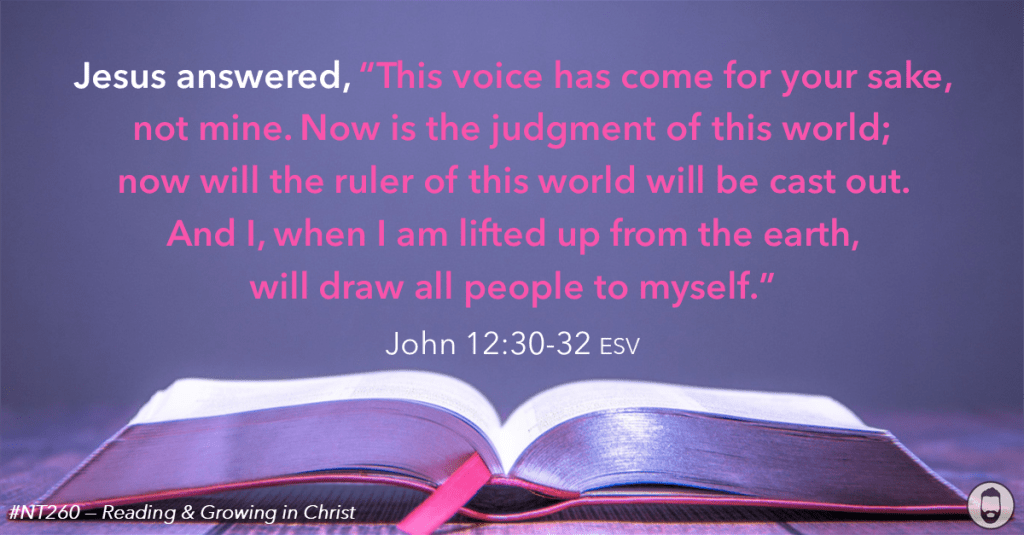
Jesus then speaks openly about the cross. His soul is troubled, but He does not turn away from the hour for which He came (John 12:27). Instead, He prays, “Father, glorify your name,” and the Father answers from heaven (John 12:28). At the cross, the world will be judged, Satan — the ruler of this world — will be cast down, and Jesus, when lifted up, will draw all kinds of people to Himself (John 12:31–33). Still, many refuse to believe even after so many signs (John 12:37). John explains that this unbelief fulfills Isaiah’s words about a hardened people (John 12:38–41). Yet even here there is a warning and an invitation: some authorities believed, but would not confess Christ because they loved the praise of man more than the glory of God (John 12:42–43). The chapter closes with Jesus crying out that to believe in Him is to believe in the Father who sent Him, and to reject His word is to stand under judgment on the last day (John 12:44–50). John 12 shows us that King Jesus is moving steadily to the cross, and that His death is not a tragedy outside God’s plan, but the very path by which He will save His people and gather a harvest from the nations.

🌀 Reflection:
John 12 reminds us that Jesus’ glory is seen most clearly in His willing sacrifice. He is the true King, but His crown comes through the cross. That means following Jesus will never simply be about admiration from a distance. It calls for surrendered love, bold confession, and a willingness to value His glory above the praise of people.

💬 Mission Challenge:
Speak openly about Jesus to someone today, even in a small way, and refuse to hide your faith for fear of what others may think (John 12:42–43).


Continue reading in our NT260 plan in the rest of Phase 4 — That You May Believe.

John 11 on 3/9 | NT260 — Reading & Growing in Christ

Click here for John 11 audio:


Read it. Pray it. Share it. Live it.

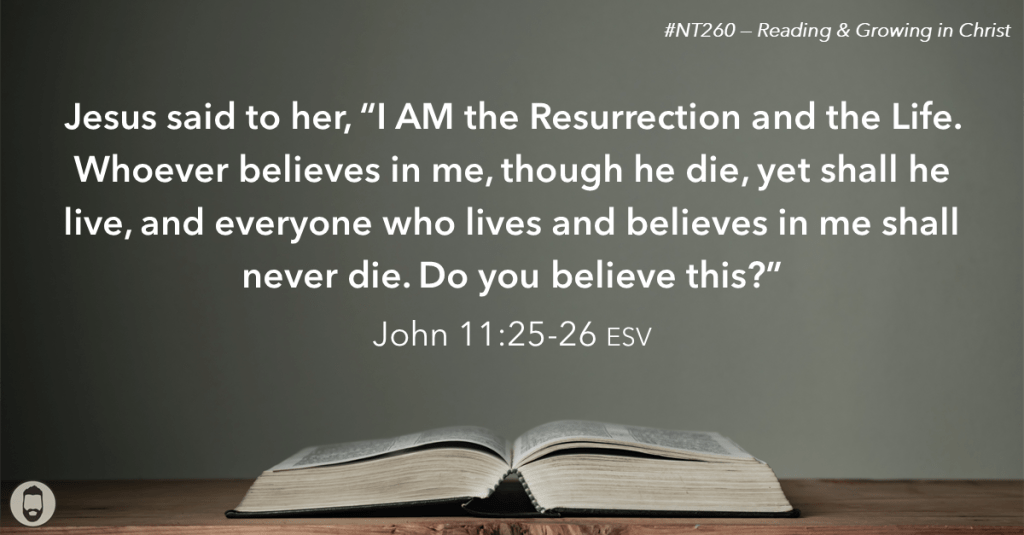
John 11 brings us to one of the most powerful signs in the whole Gospel. Lazarus, the beloved brother of Mary and Martha, becomes sick, and the sisters send word to Jesus (John 11:1–3). Yet Jesus does not rush there immediately. Because He loves them, He delays, so that the glory of God might be displayed and the faith of His disciples might be strengthened (John 11:4–6, 15). By the time Jesus arrives, Lazarus has been in the tomb four days (John 11:17). Both Martha and Mary say the same grieving words: “Lord, if you had been here, my brother would not have died” (John 11:21, 32). They know Jesus could have healed him, but they do not yet understand what He is about to reveal. Jesus then speaks one of the greatest truths in Scripture: “I am the resurrection and the life” (John 11:25). Resurrection is not merely an event at the end of time; it is bound up in the person of Jesus Himself.

As Jesus speaks with Martha, He calls her to personal faith, not just belief in a doctrine (John 11:23–27). Martha responds with a beautiful confession that Jesus is the Christ, the Son of God (John 11:27). Then Jesus comes to the tomb, sees the grief around Him, and is deeply moved (John 11:33, 38). He weeps (John 11:35). These are not tears of helplessness, but of holy sorrow in a world broken by sin and death. Then, after praying aloud so the people may know the Father sent Him, Jesus cries out, “Lazarus, come out” (John 11:41–43). And the man who had died comes out of the tomb (John 11:44). The One who is the light of the world now shows Himself as Lord even over the grave. This sign points beyond Lazarus to the greater victory that is coming through Jesus’ own death and resurrection (John 11:25–26; cf. John 5:25–29).

But as often happens in John, the miracle brings both faith and opposition. Many believe in Jesus because of what they have seen (John 11:45), yet others go to the Pharisees, and the miracle becomes the event that pushes the leaders toward a final decision to kill Him (John 11:46, 53). Caiaphas, meaning only political expediency, says it is better for one man to die for the people than for the whole nation to perish (John 11:49–50). Yet John shows that God is overruling even this wicked plan: Jesus really will die for the nation, and not for the nation only, but to gather into one the children of God scattered abroad (John 11:51–52). John 11 reminds us that Jesus’ path to glory runs through death — but not death as defeat. He is the resurrection and the life, and even the grave must obey His voice.

🌀 Reflection:
John 11 reminds us that Jesus is not absent in our grief, even when His timing is hard to understand. He may delay in ways that confuse us, but He never stops loving His people. The same Savior who wept at Lazarus’s tomb also stood before it in power. That means our sorrow is real, but it is never hopeless for those who belong to Christ.

💬 Mission Challenge:
Comfort someone who is hurting today by sharing John 11:25–26 with them and reminding them that for all who believe in Jesus, death is not the end.


Continue reading in our NT260 plan in the rest of Phase 4 — That You May Believe.

John 10 on 3/8 | NT260 — Reading & Growing in Christ

Click here for John 10 audio:


Read it. Pray it. Share it. Live it.

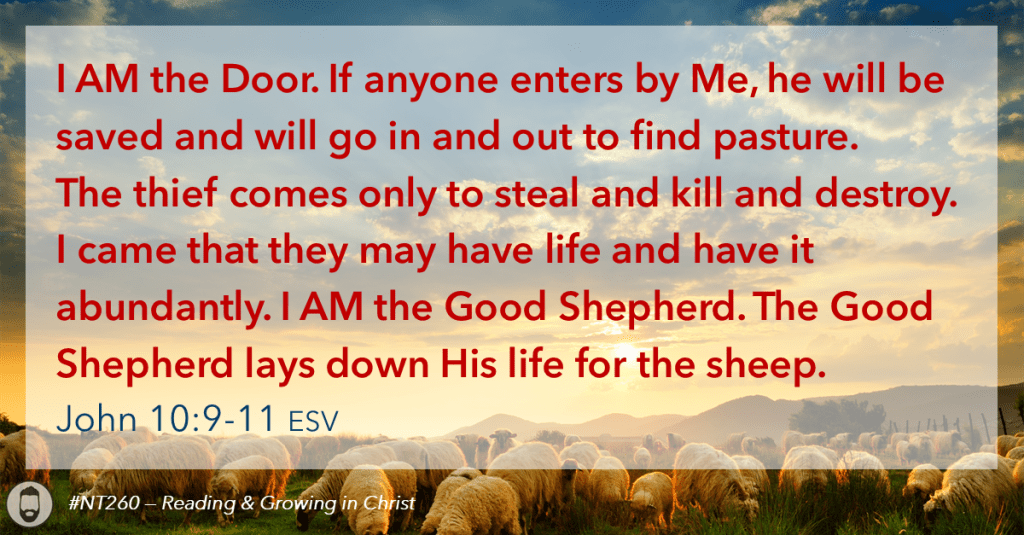
John 10 continues the tension from chapter 9, where the Pharisees proved themselves to be false shepherds who cared more about power and rules than about God’s sheep. Jesus now contrasts Himself with them by using the picture of a sheepfold. He says that the true shepherd enters by the door, calls his own sheep by name, and leads them out, while thieves and robbers come only to harm the flock (John 10:1–5). Then Jesus makes two great “I am” statements. First, He says, “I am the door,” meaning He is the only way into salvation, safety, and pasture (John 10:7–9). Then He says, “I am the good shepherd,” meaning He is the true shepherd promised in the Old Testament who does not abandon the sheep, but lays down His life for them (John 10:11; cf. Ps. 23:1; Ezek. 34:11–16). Unlike a hired hand who runs when danger comes, Jesus knows His sheep, cares for them, and gives Himself for them in love (John 10:12–15).

Jesus also says He has “other sheep” who are not of this fold, meaning His saving mission will reach beyond Israel to gather Gentiles too into one flock under one shepherd (John 10:16; cf. Isa. 56:8; Eph. 2:13–18). His death will not be an accident or defeat. He lays down His life willingly and has authority to take it up again (John 10:17–18). That is why His words continue to divide people. Some say He has a demon and is out of His mind, while others ask how someone empowered by a demon could open the eyes of the blind (John 10:19–21). Later, at the Feast of Dedication, the Jewish leaders demand that He tell them plainly whether He is the Christ, but Jesus answers that He already has — through both His words and His works (John 10:22–25).

The real issue is not that Jesus has been unclear, but that they do not believe because they are not His sheep (John 10:26). In contrast, His sheep hear His voice, follow Him, and are known by Him (John 10:27). Jesus then gives one of the strongest promises of security in all of Scripture: He gives His sheep eternal life, they will never perish, and no one can snatch them from His hand or from the Father’s hand (John 10:28–29). Then the chapter reaches its climax when Jesus says, “I and the Father are one” (John 10:30). The leaders understand that He is claiming equality with God, so they take up stones again for blasphemy (John 10:31–33). Yet Jesus points them again to His works as evidence that the Father is in Him and He is in the Father (John 10:37–38). When He leaves and goes back across the Jordan, many remember John the Baptist’s testimony and believe in Him there (John 10:40–42). John 10 shows us that Jesus is not merely a teacher among many. He is the only door, the good shepherd, and the Son who is one with the Father.

🌀 Reflection:
John 10 is deeply comforting because it reminds us that Jesus does not treat His people like a crowd, but like sheep He knows by name. He does not use us, neglect us, or abandon us. He protects us, leads us, and gave His life for us. In a world full of false voices, real safety is found in staying close to the Shepherd and listening for His voice.

💬 Mission Challenge:
Encourage someone today with John 10:27–28 by reminding them that Jesus knows His sheep, holds them securely, and will not let them be lost.


Continue reading in our NT260 plan in the rest of Phase 4 — That You May Believe.

John 9 on 3/7 | NT260 — Reading & Growing in Christ

Click here for John 9 audio:


Read it. Pray it. Share it. Live it.

John 9 begins with Jesus seeing a man who had been blind from birth, and the disciples immediately ask whose sin caused his condition (John 9:1–2). Jesus corrects their thinking. The man’s blindness was not the direct result of his own sin or his parents’ sin, but an occasion for the works of God to be displayed (John 9:3). Then Jesus again declares, “I am the light of the world,” and gives sight to the man by an act that points beyond itself to a deeper truth: the One who made the world has power to re-create what is broken (John 9:5–7). The healed man obeys Jesus, goes to wash in the pool of Siloam, and returns seeing (John 9:7). What follows is not only a miracle of physical sight, but a growing revelation of who Jesus is.

The neighbors are confused, the Pharisees are troubled, and the controversy grows because the healing took place on the Sabbath (John 9:8–16). While the religious leaders become increasingly hardened, the healed man grows increasingly clear. At first he simply calls Jesus “the man called Jesus” (John 9:11). Then he says, “He is a prophet” (John 9:17). Later, under pressure, he boldly argues that no one could open the eyes of a man born blind unless he were from God (John 9:30–33). His parents are afraid to speak openly because the leaders have already decided to cast out anyone who confesses Jesus as the Christ (John 9:22). The Pharisees claim to know Moses, but in their pride and unbelief they refuse the plain evidence in front of them (John 9:24, 28–29). In the end, they throw the healed man out (John 9:34).

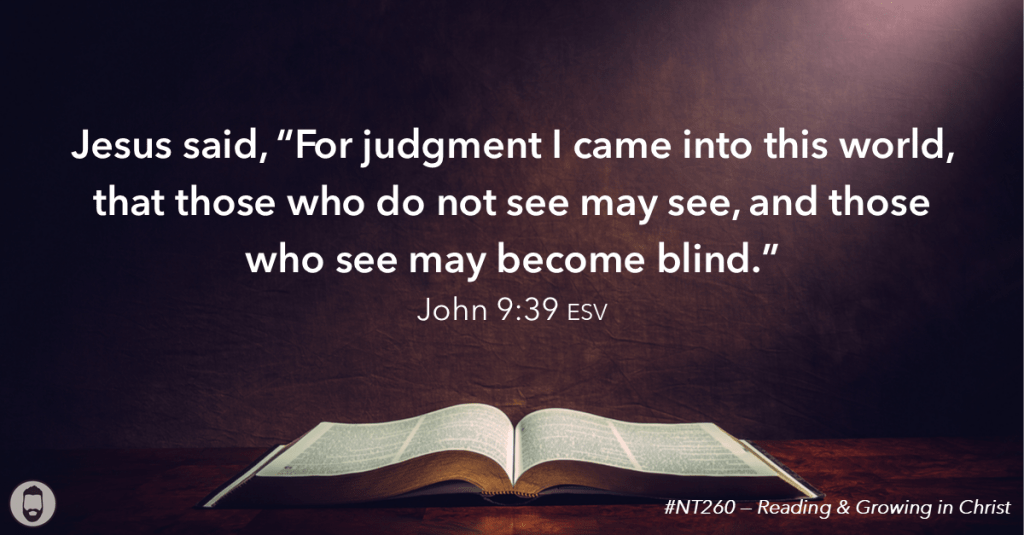
But the man cast out by the synagogue is sought out by Jesus Himself (John 9:35). Jesus asks him, “Do you believe in the Son of Man?” and then reveals that He is the One speaking to him (John 9:35–37). The man responds with the clearest vision in the chapter: “Lord, I believe,” and he worships Him (John 9:38). Then Jesus explains the deeper issue: His coming brings a division in which those who know they are blind are given sight, while those who boast that they see are exposed as blind (John 9:39–41). John 9 is not just about one man receiving sight. It is about the light of Christ exposing the blindness of proud religion and giving true sight to those who know they need Him.

🌀 Reflection:
Spiritual blindness is more dangerous than physical blindness. The blind man knew he needed help, and Jesus gave him sight. The Pharisees thought they already saw clearly, and that pride kept them in darkness. The safest place to be is not pretending we have it all together, but coming honestly to Jesus and asking Him to help us see.

💬 Mission Challenge:
Pray today for someone who seems spiritually blind, then look for an opportunity to gently point them to Jesus as the Light of the world who opens eyes and gives true sight.


Continue reading in our NT260 plan in the rest of Phase 4 — That You May Believe.

John 8 on 3/6 | NT260 — Reading & Growing in Christ

Click here for John 8 audio:


Read it. Pray it. Share it. Live it.

John 8 begins with the well-known account of the woman caught in adultery, though most likely that section was not part of John’s original Gospel, even if it may preserve a true event from Jesus’ life (John 7:53–8:11). The main flow of the chapter begins in verse 12, where Jesus again speaks during the Feast of Booths and declares, “I am the light of the world” (John 8:12). In a feast filled with lamp-lighting and celebration, Jesus says that He is the true light promised in Scripture, the One who leads people out of darkness into life (John 8:12; cf. Isa. 9:2; 42:6). The Pharisees challenge His testimony, but Jesus answers that His witness is true because He knows where He came from and where He is going, and because the Father Himself bears witness to Him (John 8:13–18). Their real problem is not lack of evidence, but that they do not know the Father because they do not know the Son (John 8:19).

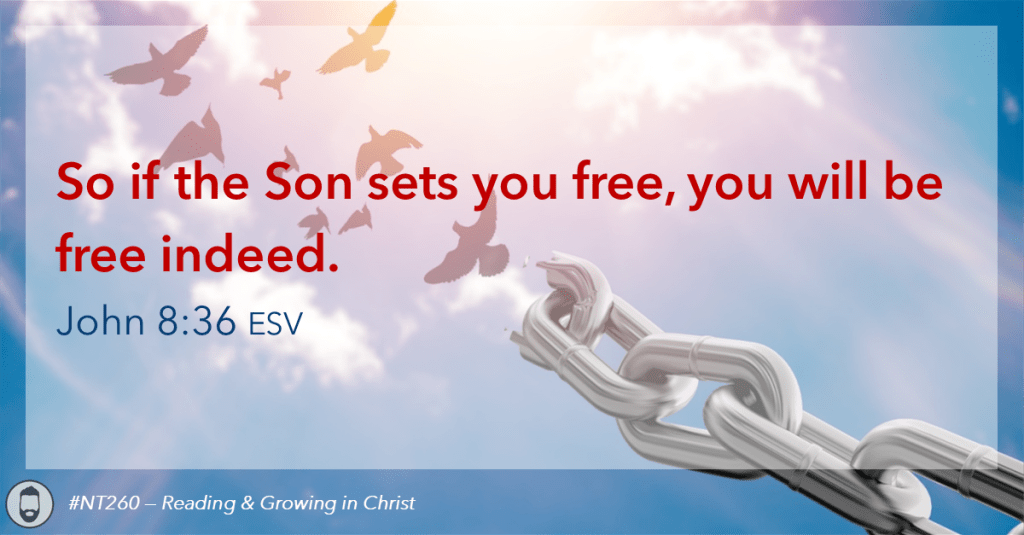
Jesus then warns them that unless they believe in Him, they will die in their sins (John 8:21, 24). He tells them that He is from above while they are from below, and that when He is “lifted up” they will know that He is exactly who He has been claiming to be (John 8:23, 28). Many appear to believe, but Jesus shows that genuine faith is proven by abiding in His word (John 8:30–31). True disciples continue with Him, know the truth, and are set free by that truth (John 8:31–32). The people protest that they are Abraham’s descendants and have never been enslaved, but Jesus explains that everyone who practices sin is a slave to sin, and only the Son can set a sinner free indeed (John 8:33–36). Physical descent from Abraham is not enough. The real children of Abraham are those who respond to God in faith, while those who reject Jesus reveal a different father altogether (John 8:37–47; cf. Gen. 15:6).

That is why the conversation becomes so sharp. Jesus tells them that if God were truly their Father, they would love Him, because He came from God (John 8:42). Instead, their rejection of the truth shows that they are following the devil, who is a murderer and the father of lies (John 8:44–45). When Jesus says that whoever keeps His word will never see death, they mock Him and ask whether He is greater than Abraham (John 8:51–53). Jesus answers by declaring that Abraham rejoiced to see His day (John 8:56). Then the chapter reaches its climax: “Before Abraham was, I am” (John 8:58). Jesus does not merely say He existed before Abraham, but uses the very language that points to the divine name (cf. Ex. 3:14). The people understand what He is claiming and pick up stones to kill Him for blasphemy (John 8:59). John 8 leaves us with no small view of Jesus. He is the Light of the world, the giver of true freedom, and the eternal Son of God.

🌀 Reflection:
John 8 reminds us that freedom is not found in heritage, morality, religion, or self-definition. Apart from Jesus, we are slaves to sin even if we do not feel enslaved. But when the Son sets us free, He frees us not only from guilt, but from the rule of sin and the darkness that once defined us.

💬 Mission Challenge:
Share with someone this week what Jesus has freed you from, and point them to John 8:12 or John 8:36 as a reminder that true light and true freedom are found only in Him.


Continue reading in our NT260 plan in the rest of Phase 4 — That You May Believe.

John 7 on 3/5 | NT260 — Reading & Growing in Christ

Click here for John 7 audio:


Read it. Pray it. Share it. Live it.

John 7 takes place during the Feast of Booths, a joyful celebration of God’s provision in the wilderness and of His harvest blessing (John 7:2). But even in the middle of that feast, tension surrounds Jesus. His own brothers urge Him to go public in a worldly way, but they do not yet believe in Him (John 7:3–5). Jesus refuses to move according to human pressure because He is living by the Father’s timetable, not man’s expectations (John 7:6–8). When He does go to Jerusalem, He goes quietly, and soon the crowds are divided over Him — some saying He is good, others calling Him a deceiver (John 7:10–13). As He teaches in the temple, Jesus makes clear that His teaching comes from the One who sent Him, and that people’s real problem is not lack of evidence but resistance to doing God’s will (John 7:16–18). He exposes the hypocrisy of leaders who claim to honor Moses while plotting murder and judging only by appearances (John 7:19–24).

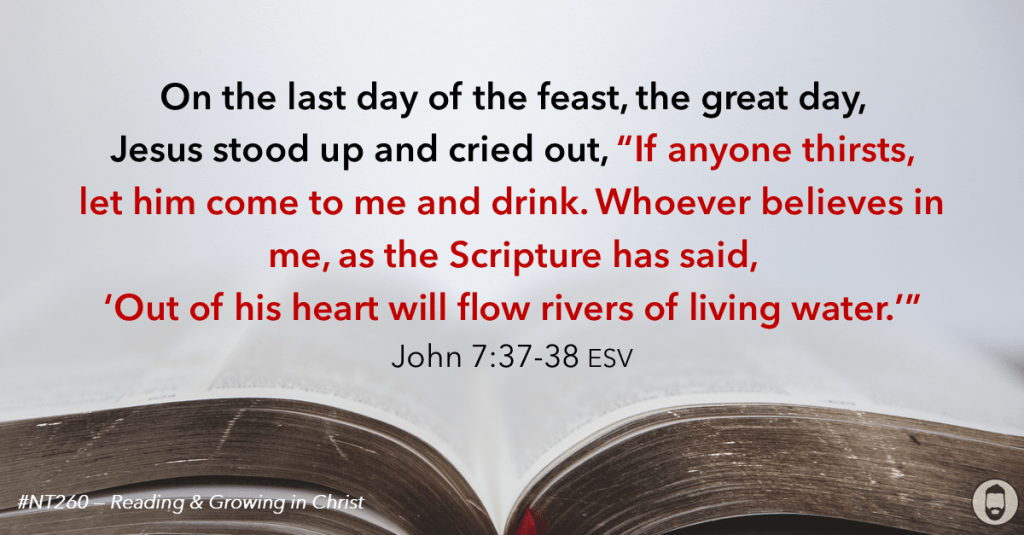
As the chapter continues, confusion about Jesus grows. Some wonder if the authorities secretly know He is the Christ, while others dismiss Him because they think they know where He comes from (John 7:25–27). But Jesus tells them they do not truly know Him or the Father who sent Him (John 7:28–29). Though some seek to arrest Him, no one can lay a hand on Him because His hour has not yet come (John 7:30, 44). Others begin to believe because of His signs (John 7:31). Then, on the last and greatest day of the feast — when water rituals reminded Israel of God’s provision — Jesus stands and cries out, “If anyone thirsts, let him come to me and drink” (John 7:37). He presents Himself as the true source of living water, speaking of the Holy Spirit who would be given after His glorification (John 7:38–39; cf. Isa. 55:1; Ezek. 36:26–27). What the feast pointed toward, Jesus fulfills.

That claim brings even more division. Some say He is the Prophet, others say He is the Christ, and others reject Him because they wrongly assume He cannot be the Messiah if He is from Galilee (John 7:40–42). The irony is that they do not know the full truth: Jesus really was born in Bethlehem as Scripture foretold (Mic. 5:2). The temple officers sent to arrest Him return empty-handed, amazed: “No one ever spoke like this man!” (John 7:45–46). The Pharisees answer with pride and contempt, but Nicodemus quietly raises the issue of justice and due process (John 7:47–51). John 7 shows that Jesus forces a response. No one can remain neutral forever. He is either rejected, misunderstood, feared, or believed — but He will not simply be ignored.

🌀 Reflection:
John 7 reminds us that spiritual thirst cannot be satisfied by religion, tradition, or public opinion. The crowd had arguments, assumptions, and debates, but Jesus alone offered living water. Real life is found not in figuring Him out on our own terms, but in coming to Him in faith and receiving what only He can give.

💬 Mission Challenge:
Ask someone this week where they turn when their soul feels dry, then share with them Jesus’ invitation in John 7:37 and point them to Him as the only true source of living water.


Continue reading in our NT260 plan in the rest of Phase 4 — That You May Believe.