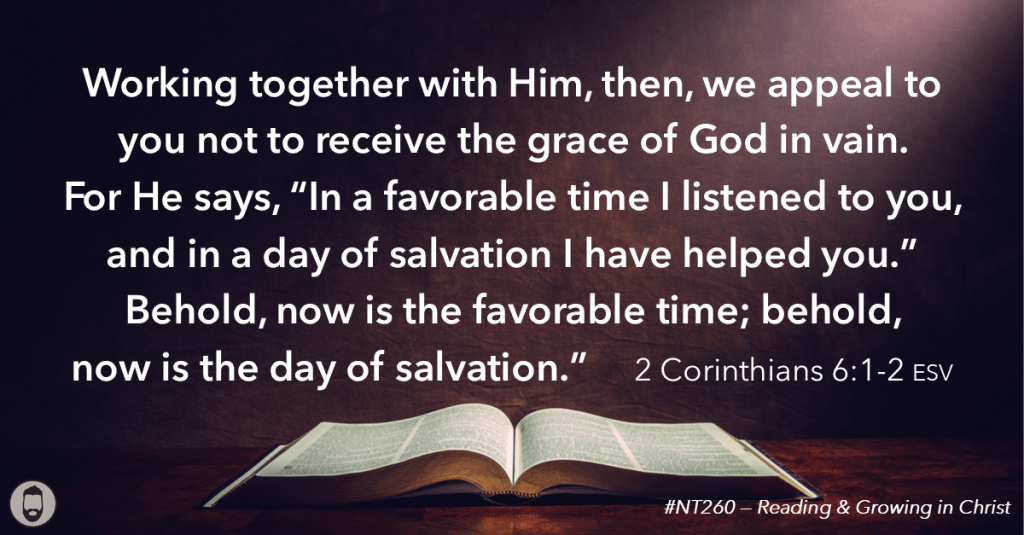
Paul pleads with the Corinthians not to receive God’s grace “in vain,” reminding them that now is the favorable time and now is the day of salvation (vv. 1–2). As a minister of reconciliation, he works hard to give no obstacle to the gospel, commending himself not by comfort or success but by patient endurance through afflictions, hardships, beatings, imprisonments, and sleepless nights (vv. 3–5). At the same time, his life is marked by purity, knowledge, patience, kindness, the Holy Spirit, sincere love, truthful speech, and the power of God (vv. 6–7). He holds together sorrow and joy, poverty and spiritual riches, being treated as nothing and yet known and loved by God (vv. 8–10). All of this is Paul saying, “You can trust my heart and my message—I am suffering for your good.”
Because of this, Paul tells them that his heart is wide open toward them and urges them to “widen” their hearts in return (vv. 11–13). Then he calls them to holy separation: they must not be unequally yoked with unbelievers in ways that compromise their loyalty to Christ, because righteousness and lawlessness, light and darkness, Christ and Belial, God’s temple and idols simply do not belong together (vv. 14–16). Paul reminds them that they are the temple of the living God, and God Himself has promised to dwell among them, walk with them, receive them, and be a Father to them, making them His sons and daughters (vv. 16–18). The grace that saves also calls God’s people to live distinctly for Him in the middle of a watching world.
🌀 Reflection: Are there places in your life where you might be “receiving the grace of God in vain” (v. 1)—enjoying gospel words but resisting gospel change? Ask the Lord to show you where your heart needs to “widen” toward Him and His people (vv. 11–13), and where you may need to come out from unhealthy, spiritually shaping influences so you can live more clearly as His beloved son or daughter (vv. 16–18).
💬 Mission Challenge: Examine one close relationship, habit, or partnership this week and honestly ask: “Is this helping me follow Jesus, or pulling me away?” If it’s pulling you away, take one concrete step—have a hard conversation, set a boundary, or make a change—so that your life more clearly reflects that you are God’s temple.
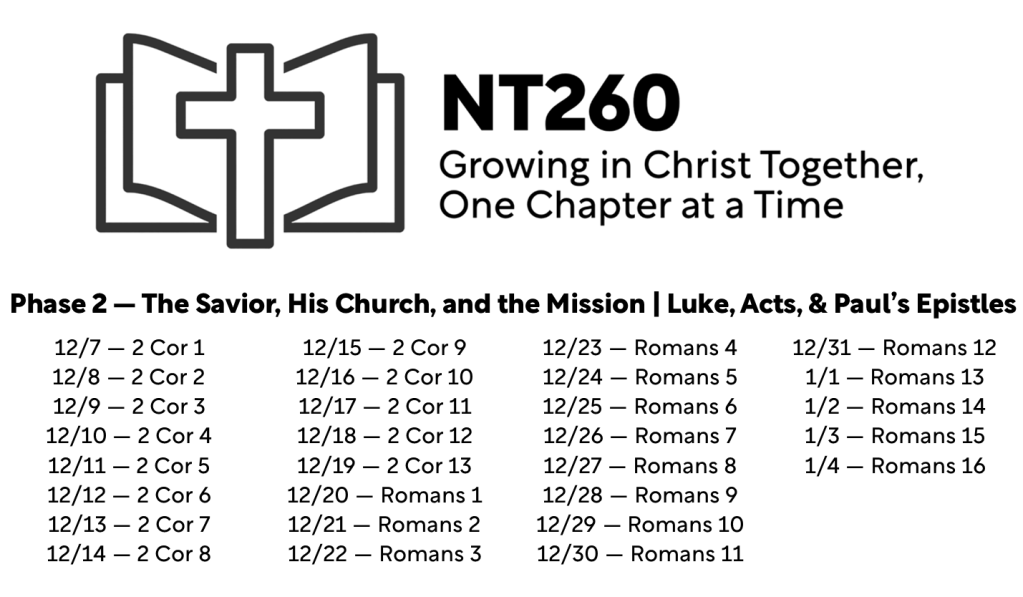
This phase will have us reading about Jesus’s life in the gospel of Luke, the formation of the Church in Acts, and walk through the theology found in Paul’s letters that the Church needs to know about and live out the eternal life given by grace through faith in Jesus.
Below, you’ll find brief synopses of each book in this phase to help you understand the scope of the book and most importantly, how it fits into the full Story of the Bible.
When you click on each day’s link, you will find a link to audio, a summary of the chapter, a key verse from the chapter, and opportunities for reflection and outreach.
We’re moving into Paul’s epistles, which we’ll go through chronologically rather than in the order they appear in our Bibles.
2 Corinthians
Paul writes 2 Corinthians after a painful season with the church in Corinth. Some had challenged his integrity and authority, and the church was divided. When Titus brought news that many had repented, Paul responded with this deeply personal letter (2 Corinthians 7:5–16). He defends his ministry not by boasting in strength but by pointing to his suffering and God’s comfort: “the Father of mercies and God of all comfort” meets us in affliction so we can comfort others (2 Corinthians 1:3–7). Paul explains that his trials don’t disprove his calling—they display Christ’s life in a fragile jar of clay (2 Corinthians 4:7–12, 12:9–10).
The letter moves through pastoral appeals and rich teaching. Paul announces the glory of the new covenant, where the Spirit gives life and transforms believers into Christ’s image (2 Corinthians 3:6, 17–18). He proclaims reconciliation: in Christ, God makes us new and entrusts to us the message of reconciliation—“be reconciled to God” (2 Corinthians 5:17–21). He urges holiness and wholehearted devotion to the Lord (2 Corinthians 6:14–7:1), calls the church to forgive and restore the repentant (2 Corinthians 2:5–8), and encourages generous giving for the saints in need (2 Corinthians 8–9). In the closing chapters, he confronts false apostles and “boasts” in his weaknesses so that Christ’s power might be seen (2 Corinthians 11:23–30, 12:9).
In the story of salvation, 2 Corinthians shows how God’s strength shines through human weakness. The crucified and risen Christ brings a new creation, writes His law on our hearts by the Spirit, and sends us as ambassadors of His grace (2 Corinthians 3:3, 5:17–20). Until we stand before Christ’s judgment seat, we live by faith—not by sight—seeking to please Him, comfort His people, and spread the aroma of His gospel in the world (2 Corinthians 5:7–10, 2:14–17).
Paul wrote Romans around A.D. 57 while he was in Corinth, near the end of his third missionary journey (Romans 16:1–2, 23; Acts 20:2–3). He addressed the letter to believers in Rome—a church he had not yet visited but deeply desired to see (Romans 1:10–13). The Roman church was made up of both Jews and Gentiles, and tensions had developed over how God’s law, faith, and daily Christian living fit together (Romans 14:1–15:7). Paul wrote to explain the gospel clearly, to unite the church around that gospel, and to prepare them to partner with him in future mission work, especially his planned journey to Spain (Romans 15:22–24).
At the heart of Romans is the gospel—the good news that God’s righteousness is revealed through Jesus Christ (Romans 1:16–17). Paul shows that all people, without exception, are sinners in need of salvation—both Jews under the law and Gentiles without it (Romans 1:18–3:20). No one is made right with God by works; instead, sinners are justified by grace through faith in Christ alone (Romans 3:21–26, 4:16). Using Abraham as an example, Paul explains that God’s promise has always been received by faith, not earned by obedience (Romans 4:1–5, 23–25). Jesus’s death and resurrection stand at the very center of God’s saving plan (Romans 5:6–11).
Romans also explains what the gospel accomplishes in the life of the believer. Those who are united to Christ are no longer slaves to sin but are given new life through the Holy Spirit (Romans 6:4–14, 8:1–11). Believers now live with peace with God, assurance of salvation, and a certain hope of future glory—even in suffering (Romans 5:1–5, 8:18–39). Paul addresses the difficult question of Israel’s place in God’s plan, showing that God is faithful to His promises and sovereign in salvation, working all things according to His mercy and wisdom (Romans 9–11).
In the story of salvation, Romans shows how God’s Old Testament promises are fulfilled in Jesus and how the gospel creates one new people—Jew and Gentile together—united by faith (Genesis 12:3, Romans 15:8–13). This gospel does not merely save; it transforms. Because of God’s mercy, believers are called to live holy lives marked by humility, love, service, and hope (Romans 12:1–2, 13:8–10). Romans helps us understand both what the gospel is and how to live it out, all for the glory of God among the nations (Romans 11:33–36, 15:5–6).
Paul looks honestly at life, death, and eternity. Our bodies are like fragile “tents” that will one day be taken down, but believers have the sure promise of a permanent, resurrection “building from God” that is eternal and secure (vv. 1–4). Because God has given us the Spirit as a guarantee, we can be confident—even as we groan in weakness now—that to be away from the body is to be at home with the Lord (vv. 5–8). This future hope shapes our present purpose: whether we are here or with Him, our aim is to please Christ, knowing that we will all appear before His judgment seat to receive what is due for what we have done, whether good or evil (vv. 9–10).
This leads straight into Paul’s description of the gospel and our mission. The “fear of the Lord” and the love of Christ together drive him to serve and persuade others (vv. 11, 14). Because Christ died and was raised, those who belong to Him no longer live for themselves but for Him (vv. 14–15). In Christ, we are a new creation—the old has passed away and the new has come (v. 17). God has reconciled us to Himself through Christ and entrusted to us the ministry and message of reconciliation, so that we now serve as ambassadors for Christ, pleading with the world: “Be reconciled to God” (vv. 18–20). At the heart of this message is the staggering truth that God made Him who knew no sin to be sin for us, so that in Him we might become the righteousness of God (v. 21).
🌀 Reflection: Where do you feel the “groaning” of life in your earthly tent right now (vv. 2–4)? Bring that place honestly to Jesus, and ask Him to help you live today with two things in view: the aim of pleasing Him (v. 9) and the privilege of representing Him as His reconciled, new-creation ambassador (vv. 17–20).
💬 Mission Challenge: Initiate one gospel-shaped conversation this week—share with someone (briefly and in your own words) what it means that God is reconciling sinners to Himself through Christ, and use 2 Corinthians 5:21 as the verse that anchors what you say.
Paul explains why he does not lose heart in ministry: God has given him the mercy of serving the new covenant, so he refuses to twist or dilute God’s Word to please people, but sets the truth out plainly before God and others (vv. 1–2). If the gospel seems “veiled,” it is because unbelievers are blinded by “the god of this world” and cannot see “the light of the gospel of the glory of Christ, who is the image of God” (vv. 3–4). Paul doesn’t preach himself, but “Jesus Christ as Lord,” and himself as the Corinthians’ servant for Jesus’ sake (v. 5). The same God who said, “Let light shine out of darkness,” has shone in believers’ hearts to give “the light of the knowledge of the glory of God in the face of Jesus Christ” (v. 6).
This glorious gospel is a treasure carried in “jars of clay”—weak, ordinary people—so that it is clear the power belongs to God and not to us (v. 7). Paul is “afflicted … but not crushed,” “perplexed, but not driven to despair,” continually carrying in his body the death of Jesus so that Jesus’ life may also be seen in him (vv. 8–11). He believes and therefore speaks, knowing that the God who raised Jesus will also raise him and present him with the Corinthians (vv. 13–14). So he still does not lose heart: even though his “outer self” is wasting away, his “inner self” is being renewed every day (v. 16). Present troubles are “light” and “momentary” compared to the “eternal weight of glory” God is preparing, so believers fix their eyes not on what is seen and temporary, but on what is unseen and eternal (vv. 17–18).
🌀 Reflection: Where do you most feel like a “jar of clay” right now—fragile, tired, or limited (vv. 7–9, 16)? Instead of seeing those weaknesses as proof that God is far away, ask Him to help you see them as places where His resurrection power can shine through, teaching you to look beyond what is seen today to the unseen glory He is preparing (vv. 14, 17–18).
💬 Mission Challenge: Share a brief word of hope with someone who is discouraged—maybe a text, call, or quick conversation—reminding them that present troubles are “momentary” compared to the eternal glory in Christ, and include 2 Corinthians 4:16–18 to point them to what is unseen and lasting.
Paul pushes back against the idea that he needs letters of recommendation by pointing to the Corinthians themselves—their changed lives are his “letter,” written not with ink but with the Spirit of the living God on human hearts (vv. 1–3). His confidence in ministry doesn’t come from his own ability but from God, who has made him a minister of the new covenant, “not of the letter but of the Spirit. For the letter kills, but the Spirit gives life” (vv. 4–6). The old covenant, written on stone, was a real “ministry of death” and “condemnation” because it showed God’s holy standard without giving the power to obey, yet even it came with glory on Moses’ shining face (vv. 7–9). If that fading glory was real, Paul says, how much greater is the glory of the new covenant, which brings righteousness and is permanent (vv. 9–11).
Because this new covenant is so glorious, Paul speaks with boldness, not like Moses, who put a veil over his face so Israel wouldn’t see that the glory was fading (vv. 12–13). To this day, many in Israel still read Moses with a “veil” over their hearts, unable to see how the law points to Christ—but when one turns to the Lord, that veil is removed (vv. 14–16). Where the Spirit of the Lord is, there is freedom—freedom from condemnation, from a hard heart, and from trying to earn righteousness by the law (v. 17). Now all believers, with unveiled faces, behold the glory of the Lord and are being transformed into His image “from one degree of glory to another” by the Spirit (v. 18). The Christian life is not self-improvement; it is the Spirit slowly making us look more like Jesus as we keep looking to Him.
🌀 Reflection: Are you living like someone who still has a veil over your heart—trying to be “good enough” by your own effort—or like someone set free by the Spirit to trust Christ and be changed from the inside out (vv. 6, 14–18)? Bring your failures and self-reliance to the Lord today and ask Him to help you behold His glory in Christ, trusting the Spirit to do the slow, deep work of transformation.
💬 Mission Challenge: Encourage a fellow believer who is discouraged about their growth. Remind them that transformation is a process—“from one degree of glory to another”—and share 2 Corinthians 3:18 with them, pointing them back to Jesus and the Spirit’s ongoing work.
Paul explains why he chose not to make another painful visit to Corinth—he didn’t want to come only to cause them sorrow again, but wanted his next visit to be marked by mutual joy (vv. 1–3). Instead, he wrote a “severe” letter with many tears, not to crush them, but to show how deeply he loved them and to call them to repentance (v. 4, 7:8–9). True love sometimes wounds in order to heal, and Paul wants them to see even his hard words as an expression of Christlike care.
He then turns to the man who had caused grief in the church and likely opposed Paul publicly (vv. 5–6). Discipline from “the majority” had done its work; now it was time to forgive, comfort, and reaffirm love so that the brother would not be swallowed up by excessive sorrow (vv. 7–8). Paul reminds them that refusing to forgive gives Satan an opportunity to divide and devour the church (vv. 10–11). From there, Paul describes how even in his anxiety in Troas over not finding Titus, God still leads him in “triumphal procession” in Christ and uses him to spread “the fragrance of the knowledge of him everywhere” (vv. 12–14). The gospel is like an aroma—life to those who receive it and death to those who reject it (vv. 15–16). Knowing how weighty this is, Paul insists he is no peddler of God’s word, but speaks with sincerity, “as commissioned by God, in the sight of God in Christ” (v. 17).
🌀 Reflection: Where have you been more ready to punish than to restore? Ask the Lord to show you if there’s someone you’re holding at a distance even though they’ve repented. God comforted you in your sin and sorrow; His grace now calls you to reflect that same forgiving, restoring heart to others (vv. 6–8)
💬 Mission Challenge: Extend concrete grace this week. Reach out to someone who has failed or who feels on the outside—send a text, make a call, or have a face-to-face conversation that communicates forgiveness, comfort, and renewed love in Christ (vv. 7–8, 10–11).
Paul opens this letter by praising “the God and Father of our Lord Jesus Christ, the Father of mercies and God of all comfort” (v. 3). He explains that God meets him in his sufferings so that he can then comfort others with the same comfort he has received (vv. 4–5). Paul’s hardships are not a sign that God has abandoned him; instead, they become a channel of grace for the church. As he suffers for Christ and is comforted by Christ, the Corinthians share both in the sufferings and in the comfort, and their endurance is strengthened (vv. 6–7).
Paul then tells them about a severe trial he faced in Asia, where he was “so utterly burdened beyond our strength that we despaired of life itself” (v. 8). God allowed him to feel like he had received a “sentence of death” so that he would not rely on himself but on “God who raises the dead” (v. 9). God delivered him, and Paul is confident He will continue to deliver, especially as the Corinthians help through their prayers (vv. 10–11). From there, Paul begins to defend his integrity: his conscience is clear that he has behaved toward them with holiness and sincerity from God, not with worldly wisdom (vv. 12–14). His change of travel plans was not because he is fickle, but because he wanted to spare them and act in line with God’s faithfulness (vv. 15–18).
To anchor this, Paul reminds them that all of God’s promises are “Yes” in Jesus (vv. 19–20). God is the One who establishes them in Christ, has anointed them, has put His seal on them, and has given His Spirit in their hearts as a guarantee of what is to come (vv. 21–22). That means their future with Him is secure, even when circumstances are hard. Finally, Paul calls God as his witness that he delayed his visit “to spare you,” because he does not want to lord it over their faith but to work with them for their joy, since they stand firm by faith (vv. 23–24). This is the heart of a true pastor: willing to suffer, eager to be misunderstood if needed, so that Christ’s people might be comforted, strengthened, and helped to stand.
🌀 Reflection: Where have you felt “burdened beyond your strength” lately (v. 8)? Bring that specific place of weakness to the Lord and ask Him to use it to loosen your grip on self-reliance and deepen your trust in “God who raises the dead” (v. 9). Then ask Him to show you one way He might use your story of His comfort to encourage someone else who is hurting.
💬 Mission Challenge: Reach out today to someone you know who is walking through a hard season. Let them know you are praying for them, share a verse from this chapter (such as vv. 3–4 or 10), and ask how you can keep praying specifically—be a living channel of the comfort you have received.
As Paul closes his letter, he moves from big doctrines to very practical details. He gives instructions about a collection for believers in Jerusalem who are in need, asking each person to set something aside on “the first day of every week”—the day believers gathered in honor of Jesus’s resurrection (vv. 1–2). Giving is to be regular, intentional, and proportionate, not random or forced (v. 2). Paul also shares his travel plans and explains why he is staying in Ephesus for a while longer: “a wide door for effective work has opened to me, and there are many adversaries” (vv. 5–9). Even in opposition, God is at work. He also urges the church to receive Timothy without fear and notes that Apollos will come when he has opportunity (vv. 10–12).
Then Paul gives a series of short but powerful commands: “Be watchful, stand firm in the faith, act like men, be strong. Let all that you do be done in love” (vv. 13–14). The church is to live alert and courageous, but always with a heart of love. He commends the household of Stephanas, “the first converts in Achaia,” as faithful servants and urges the church to be subject to such godly leaders and to honor those who labor among them (vv. 15–18). The letter closes with warm greetings from the churches in Asia, including Aquila and Prisca and the church that meets in their house, and with the reminder that believers should greet one another with a “holy kiss”—a sign of genuine family love in Christ (vv. 19–20).
Paul signs the ending with his own hand and gives both a sober warning and a hopeful cry: “If anyone has no love for the Lord, let him be accursed. Our Lord, come!” (vv. 21–22). Love for Jesus is not optional—it marks those who truly belong to Him. Yet even as he warns, Paul ends on grace and love: “The grace of the Lord Jesus be with you. My love be with you all in Christ Jesus” (vv. 23–24). Truth, warning, grace, and affection all come together in this closing, showing a pastor’s heart that longs for his people to stand firm in the gospel and live in love until Jesus returns.
🌀 Reflection: Where do you most need these closing commands today—to stay alert, stand firm, be courageous and strong, and do everything in love (vv. 13–14)? Ask the Lord to help you hold onto truth without losing tenderness, and to shape your giving, your serving, and your relationships so that they clearly flow from love for Jesus and His people.
💬 Mission Challenge: Set aside a specific gift or act of generosity this week—financial or otherwise—to bless a believer or ministry in need, and let them know you are doing it “in love” because of Jesus (vv. 2, 14).
Paul turns to the heart of the gospel—the resurrection of Jesus—and shows why everything we believe depends on it. He reminds the Corinthians of the message they “received” and on which they “stand”: that Christ died for our sins, was buried, and was raised on the third day “in accordance with the Scriptures” (vv. 1–4; cf. Isa. 53:5–12; Ps. 16:10; Hos. 6:2). This isn’t myth or rumor—Jesus appeared to Peter, the Twelve, more than 500 at once, James, all the apostles, and finally to Paul himself (vv. 5–8). These eyewitnesses were living proof that the tomb was empty and Christ is alive. By God’s grace, this risen Christ transformed Paul from a persecutor into an apostle, and this same gospel is what all the apostles proclaim together (vv. 9–11).
Some in Corinth believed Jesus rose but denied that believers will be raised (v. 12). Paul shows that you cannot separate the two: if there is no resurrection for us, then Christ Himself has not been raised (vv. 13, 16). And if Christ is not raised, the consequences are devastating—our preaching is empty, our faith is useless, we remain in our sins, and those who have died in Christ are gone forever (vv. 14–18). But Christ has been raised—the “firstfruits” of a harvest that guarantees our own resurrection when He returns (vv. 20–23). In Adam, death spread to all, but in Christ all His people will be made alive (v. 22; cf. Rom. 5:12–21). When Jesus finally destroys every enemy—finishing with death itself—He will hand the kingdom to the Father, bringing God’s plan to its perfect completion (vv. 24–28).
To those who question how resurrection could work, Paul uses pictures from creation. A seed must die to be raised in a new, glorious form (vv. 35–38). In the same way, our earthly bodies are perishable, weak, and natural, but the resurrection body will be imperishable, glorious, powerful, and fully animated by the Spirit (vv. 42–44). Adam was the first man, made from the dust; Christ is the last Adam, the life-giving Spirit from heaven (vv. 45–49). What is sown mortal will be raised immortal (vv. 50–53). When Christ returns, death will be swallowed up in victory, fulfilling God’s promises (vv. 54–55; cf. Isa. 25:8; Hos. 13:14). Through Jesus, God has removed sin’s sting and broken death’s power forever (vv. 56–57). Therefore, because resurrection is certain, our labor for Christ is never wasted or forgotten (v. 58).
🌀 Reflection: Where does the hope of resurrection shape the way you live today? Ask the Lord to help you see your body, your work, and your daily struggles in light of the victory Christ has already won—and the glory He has promised at His return.
💬 Mission Challenge: Encourage someone today who is grieving, suffering, or weary by sharing a verse or truth from this chapter. Remind them that in Christ, death is defeated and their labor is not in vain.
After lifting our eyes to the beauty of love, Paul brings that “more excellent way” (13:1, 13) right into the worship gathering. He urges the church to pursue love and still be eager for the gifts of the Spirit—especially prophecy, because it clearly builds up the church (vv. 1–5). Speaking in tongues is real prayer and praise to God, but when no one understands or interprets, it only benefits the one speaking (vv. 2, 4, 14–17). Prophecy, however, is intelligible speech that strengthens, encourages, and comforts others (vv. 3–5). The repeated question is: does this help other people understand and grow? Edification and clarity are the main tests for what should happen in the gathering (vv. 6–12, 19).
Paul also shows how these gifts affect unbelievers who visit the church. Uninterpreted tongues can make outsiders think Christians are out of their minds, which becomes a kind of judgment on their unbelief (vv. 21–23). But when God’s Word is clearly spoken, prophecy can expose the secrets of the heart, bring conviction, and lead someone to fall on their face, worship God, and confess that “God is really among you” (vv. 24–25). Because of this, Paul gives practical instructions: only a few should speak in tongues, and only if there is an interpreter; otherwise, they should be silent and pray quietly (vv. 27–28). Likewise, only a few should prophesy while the others carefully weigh what is said (vv. 29–31). Everything must be self-controlled, peaceful, and orderly because God is not a God of confusion but of peace (vv. 32–33). In that same spirit, Paul calls married women in Corinth to honor their husbands and not disrupt the weighing of prophecies in a way that overturns God’s good order in the church (vv. 34–35).
Paul closes by reminding them that his words are a command of the Lord, not just personal advice (v. 37). So the church should be eager for prophecy, should not forbid tongues when used rightly, and must make sure that “all things should be done decently and in order” (vv. 39–40). Love, clarity, and building up the body are to shape everything we do when we gather in Jesus’s name.
🌀 Reflection: When you think about Sunday worship, do you primarily ask, “What will I get out of it?” or, “How can I help build others up today?” Ask the Lord to reshape your heart so that your prayers, words, and service—whether seen or unseen—aim at helping others understand God’s Word and experience His presence.
💬 Mission Challenge: Before your next church gathering, pray intentionally for one way you can build up someone else—through a clear word of encouragement, a Scripture shared at the right time, or a quiet act of service—and then do it for Jesus’s sake and the good of His body.






 Just Keith Harris