Holy Monday, April 11, 2022

12 Jesus entered the temple area and drove out all who were buying and selling there. He overturned the tables of the money changers and the benches of those who were selling doves. 13 “It is written,” He said to them, “‘My house will be called a house of prayer,’ but you are making it a ‘den of robbers.’”

14 The blind and the lame came to Him at the temple, and He healed them. 15 But when the chief priests and the teachers of the law saw the wonderful things He did and the children shouting in the temple area, “Hosanna to the Son of David,” they were indignant. 16 “Do you hear what these children are saying?” they asked Him.

“Yes,” replied Jesus, “have you never read,

                “‘From the lips of children and infants you have ordained praise’?”

17 And He left them and went out of the city to Bethany, where He spent the night.

Matthew 21:12-17 (NIV84)

Jerusalem was a busy place. Thousands had traveled there to celebrate Passover. The city had overflowed into the surrounding communities, and, again, there was no room at the inn. Jesus left the city at night and stayed in Bethany. But, in the morning, he returned to everyone’s focus, the Temple.

The Temple of God in Jerusalem was high and lifted-up, literally. It stood on a hill, and, as you approached it’s walls, you went up. As you entered each court you went up. The highest place was the Holy of Holies, the inner sanctuary of the Tabernacle where God’s presence appeared. There, one could find peace and forgiveness and hope. But, unfortunately, that was not what Jesus found when He entered the temple that day.

He found a marketplace where they were changing money and selling animals intended for sacrifice, not realizing the perfect sacrifice had just entered the Temple. What was Jesus’ reaction?

So He made a whip out of cords and drove all from the temple area, both sheep and cattle; He scattered the coins of the money changers and overturned their tables.

John 2:15 (NIV84)

Jesus was indignant. His Father’s house was to be a place of prayer and worship, and they had turned it into a den of thieves. In His righteous anger, He kicked them all out. Then, He continued ministering to those in need. He healed the blind and lame who came to Him while the praise of the children rang out saying, “Hosanna to the Son of David”.

We no longer have the Temple in Jerusalem. It was destroyed nearly 2000 years ago, but we still have Jesus. And we have His church, the body of Christ, who meets to pray and worship and serve. But what about the temple? Well, it has become new – in fact, we are the temple.

Don’t you know that you yourselves are God’s temple and that God’s Spirit lives in you?

1 Corinthians 3:16 (NIV84)

How does that make you feel? Is God’s temple in you a house of prayer? Were you aware that God’s Spirit lives in you?

As we approach Easter, it is a good time to consider God’s temple in us. Maybe, there are some things that need to be driven out. Or, maybe, someOne is to be let in.

From the first dramatic demonstrations of Jesus’ miracle-working power, the crowds wanted to take Him by force and make Him king (John 6:15). Their intent, of course, was for Him to be a king of their own liking who would fulfill their own aspirations of deliverance from the yoke of Rome. But the Lord consistently refused to be that kind of king and perform that kind of deliverance. His coronation processional into Jerusalem the day before was marked by simplicity rather than pomp – humility rather than splendor. He was not accompanied by influential dignitaries and a powerful army but by unarmed, powerless nobodies, just as He had predicted.

18 “We are going up to Jerusalem, and the Son of Man will be betrayed to the chief priests and the teachers of the law. They will condemn Him to death 19 and will turn Him over to the Gentiles to be mocked and flogged and crucified. On the third day He will be raised to life!”

Matthew 20:18-19 (NIV84)

Jesus did not come as a military, economic, political, or social savior from injustice and oppression. These are not man’s greatest problem; our greatest problem is sin. Jesus came as the spiritual Savior from sin and death.

He would soon demonstrate that “He had come not to reign but to die, not to be crowned but to be crucified, and not for the purpose of delivering Israel from the power of Rome but of delivering all men from the power of sin.”[1]

His second coming will deal with all those other problems, but, before He comes as King of kings and Lord of lords, He had to come as Savior.

So, I leave you on this Monday of Holy Week to consider something for yourself: is He my Savior?


[1] John F. MacArthur Jr., Matthew, Volume 3, MacArthur New Testament Commentary (Chicago: Moody Press, 1988), 266.

Palm Sunday, April 10, 2022

Now when they drew near to Jerusalem and came to Bethphage, to the Mount of Olives, then Jesus sent two disciples, saying to them, “Go into the village in front of you, and immediately you will find a donkey tied, and a colt with her. Untie them and bring them to me. If anyone says anything to you, you shall say, ‘The Lord needs them,’ and he will send them at once.” This took place to fulfill what was spoken by the prophet, saying,

     “Say to the daughter of Zion,
       ‘Behold, your king is coming to you,
humble, and mounted on a donkey,
on a colt, the foal of a beast of burden.’”

The disciples went and did as Jesus had directed them. They brought the donkey and the colt and put on them their cloaks, and he sat on them. Most of the crowd spread their cloaks on the road, and others cut branches from the trees and spread them on the road. And the crowds that went before him and that followed him were shouting, “Hosanna to the Son of David! Blessed is he who comes in the name of the Lord! Hosanna in the highest!” 10 And when he entered Jerusalem, the whole city was stirred up, saying, “Who is this?” 11 And the crowds said, “This is the prophet Jesus, from Nazareth of Galilee.”

Matthew 21:1-11

21 For our sake he made him to be sin who knew no sin, so that in him we might become the righteousness of God.

2 Corinthians 5:21

20 Behold, I stand at the door and knock. If anyone hears my voice and opens the door, I will come in to him and eat with him, and he with me.

Revelation 3:20

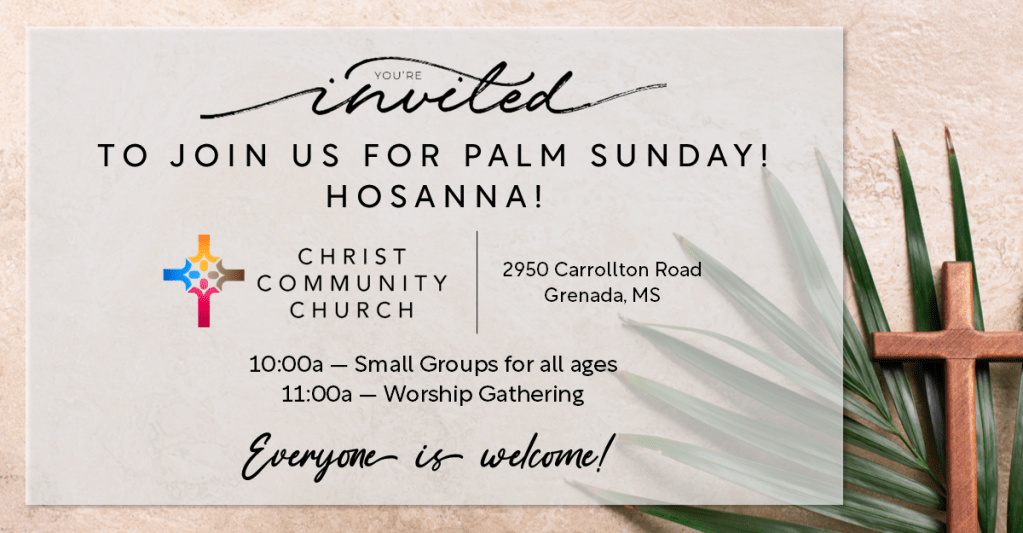
It’s Palm Sunday – the anniversary of what is known as Jesus’ triumphal entry into Jerusalem. This is how Jesus’ last week on earth began, with people shouting “Hosanna!” and praising Him while celebrating His entrance into Jerusalem. The city streets were packed and overwhelmed with crowds of people waiting for His arrival.

This is usually the way that Holy Week (Palm Sunday through Easter) goes for the Church. For most of my lifetime and many years prior to it, it has been the busiest time for churches – Palm Sunday, Ash Wednesday, Maundy Thursday, Good Friday, and Easter Sunday. Easter Sunday, in a typical year, would see crowds cheerfully gathering in church buildings, dressed in bright, pastel colors, and joyfully singing and celebrating the Resurrection. But this past year has been anything but typical.

2020 saw church buildings empty or nearly empty on Easter Sunday. At Christ Community, we gathered in the rain with services led under the front porch and people praising through cracked windows or huddled under umbrellas; it was the best we could do to gather (separately) at the beginning of the pandemic. We then hurried home in fearful anticipation of the coming storms that knocked out power for many and damaged homes for others. It did not feel like Easter. But, maybe, that was what we needed to truly grasp what it means to cry “hosanna” to the King Jesus as we await His second coming!

This may seem overly simplistic, but we have had a unique opportunity to truly grasp the need for Easter, and, specifically on this Palm Sunday, to live out this out. “Hosanna” is an Aramaic cry/shout of praise. It means “Help! I pray!” or “Save! I pray!”. Somewhere through the passage of time, that cry for help or salvation became a cry that meant “praise be to God!” Think about it: God’s people cried out to Him for help and salvation, He helped/saved them time and again, and they praised Him out of a spirit of thanksgiving. This happened enough in their history that it formed part of their culture so that their cries for help transformed into shouts of praise.

That is what we needed for Easter 2020 and every other day, week, and year of our lives. It is what we need today.

If we have learned anything this past year, it is that life is precious, and that time spent together is too. We cannot look to Capital Hill for salvation or trust in a stimulus. We need to look to the hill called Golgotha – the place of the skull where the celebrated King died for in our place. We need to trust in the Savior who answered the cries of “Help us, we pray! Save us!” in the form of “Hosanna!”, even when the people knew not what they were saying. After all, He knows what we need, and only He can carry us through because He has been through it Himself.

God is clear in His Word that He has made a Way for us (John 14:6) so that we can be saved from our sins. If we trust in Him as Savior, He takes our sins and trades it for His righteousness (2 Corinthians 5:21). That is quite a trade off!

There is perhaps no greater image for God inviting us to Himself than that of Him standing at a door and knocking (Revelation 3:20), especially coming out of a year when many of us have neither visited others nor received visitors ourselves. But, our whole lives have been interrupted by a virus, we need to rejoice in the fact that Christ is, in fact, immune – it cannot kill Him because He has already died and risen from the grave!

So, on this Palm Sunday, I invite you to look toward the coming of the King. This time, He will not be riding a donkey into a crowded street. No, this time, He will come in all His glory and resurrected divine splendor and bring His people home. But there is good news for us even while we wait: He has promised that He is with us “always, even to the end of the age” (Matthew 28:20). And “He who promised is faithful” (Hebrews 10:24).

Cry out to Him – “Hosanna!” Call upon His name and pour out your heart saying “Help me, I pray! Save me!” And know that He hears you and will save all who cry out to Him (Romans 10:13).

Hosanna!

Holy Week 2022

We are happy to be able to provide Bible readings and devotions for Holy Week in conjunction with Christ Community Church in Grenada, MS!

Click on the link for each day below to access them:


Palm Sunday, April 10, 2022


Holy Monday, April 11, 2022


Holy Tuesday, April 12, 2022


Holy (or Spy) Wednesday, April 13, 2022


Maundy Thursday, April 14, 2022


Good Friday, April 15, 2022


Black Saturday, April 16, 2022


For the KiddosThe Resurrection Story told by a kid for kids!


Songs for Palm Sunday, April 10, 2022


Here are our Scriptures and songs:

  • Scripture | Matthew 21:6-11

The disciples went and did as Jesus had directed them. They brought the donkey and the colt and put on them their cloaks, and he sat on them. Most of the crowd spread their cloaks on the road, and others cut branches from the trees and spread them on the road. And the crowds that went before him and that followed him were shouting, “Hosanna to the Son of David! Blessed is he who comes in the name of the Lord! Hosanna in the highest!” 10 And when he entered Jerusalem, the whole city was stirred up, saying, “Who is this?” 11 And the crowds said, “This is the prophet Jesus, from Nazareth of Galilee.”

  • Scripture | Hebrews 9:11-14

11 But when Christ appeared as a high priest of the good things that have come, then through the greater and more perfect tent (not made with hands, that is, not of this creation) 12 he entered once for all into the holy places, not by means of the blood of goats and calves but by means of his own blood, thus securing an eternal redemption. 13 For if the blood of goats and bulls, and the sprinkling of defiled persons with the ashes of a heifer, sanctify for the purification of the flesh, 14 how much more will the blood of Christ, who through the eternal Spirit offered himself without blemish to God, purify our conscience from dead works to serve the living God.

  • Offertory | His Mercy is More

If you have not been gathering, consider gathering with your church family again. Various variants are still issues in this prolonged pandemic, but prayerfully consider gathering in the 10:00 Bible study where there is plenty of room for social distancing and one could slip out before the worship crowd comes in for the 11:00 service.


Songs for Sunday, August 29, 2021

Sunday.

For some, it means the last day of the weekend before jumping back into the grind of the week. For others, it is a peaceful first day in preparation for whatever the week may bring. Across the United States, it will be filled with brunches, golf games, traveling, sporting events, and diversions of every shape and kind. Yet for those who belong to Jesus – those He has saved and redeemed, those He has brought from death to life (Ephesians 2:4-5) – it is a day of joyful remembrance and expectation.

For centuries before the birth of Christ, Saturday – the Sabbath day of rest – was the centerpiece of worship. It was a day of rest following the example of God Himself (Genesis 2:2) and set aside as holy (Genesis 2:3, Exodus 20:8). The shift of focus from Saturday to Sunday was as simple as shifting from Sabbath to celebration – from resting to rejoicing. Just as on that original Easter Sunday when the stone rolled away from Jesus’ tomb and He walked out alive and well – shaking off the pangs of death and crucifixion in His own resurrection power, Sunday became a day for the people of God to gather together in worship and joy at His resurrection and recognition that Jesus “is not in [the grave], for He is risen (still today) as He said” (Matthew 28:6)!

Every Sunday since then, followers of Jesus have gathered. They have gathered through persecution. They have gathered through prohibitions against gathering. And they have even gathered during plagues (and even pandemics)!

There has been a piece of a quote from Martin Luther floating around social media, but it lacked context. It has been used to spur gatherings and to spurn them. Being a lover of context and authorial intent, I looked further for the context of the quote. Here are a few quotes (with the typical social media selection italicized, and, should you desire, you can read the original letter in its entirety):

“You wish to know whether it is proper for a Christian to run away from a deadly plague. I should have answered long ago, but God has for some time disciplined and scourged me so severely that I have been unable to do much reading or writing. Furthermore, it occurred to me that God, the merciful Father, has endowed you so richly with wisdom and truth in Christ that you yourself should be well qualified to decide this matter or even weightier problems in his Spirit and grace without our assistance.”


“To begin with, some people are of the firm opinion that one need not and should not run away from a deadly plague. Rather, since death is God’s punishment, which he sends upon us for our sins, we must submit to God and with a true and firm faith patiently await our punishment. They look upon running away as an outright wrong and as lack of belief in God. Others take the position that one may properly flee, particularly if one holds no public office.

“I cannot censure the former for their excellent decision. They uphold a good cause, namely, a strong faith in God, and deserve commendation because they desire every Christian to hold to a strong, firm faith. It takes more than a milk faith to await a death before which most of the saints themselves have been and still are in dread.”


“In the case of children who are orphaned, guardians or close friends are under obligation either to stay with them or to arrange diligently for other nursing care for their sick friends. Yes, no one should dare leave his neighbor unless there are others who will take care of the sick in their stead and nurse them. In such cases we must respect the word of Christ, “I was sick and you did not visit me …” (Matt. 25:41–46). According to this passage we are bound to each other in such a way that no one may forsake the other in his distress but is obliged to assist and help him as he himself would like to be helped.”


“Now if a deadly epidemic strikes, we should stay where we are, make our preparations, and take courage in the fact that we are mutually bound together (as previously indicated) so that we cannot desert one another or flee from one another.”


“It is even more shameful for a person to pay no heed to his own body and to fail to protect it against the plague the best he is able, and then to infect and poison others who might have remained alive if he had taken care of his body as he should have. He is thus responsible before God for his neighbor’s death and is a murderer many times over. Indeed, such people behave as though a house were burning in the city and nobody were trying to put the fire out. Instead they give leeway to the flames so that the whole city is consumed, saying that if God so willed, he could save the city without water to quench the fire.

“No, my dear friends, that is no good. Use medicine; take potions which can help you; fumigate house, yard, and street; shun persons and places wherever your neighbor does not need your presence or has recovered, and act like a man who wants to help put out the burning city. What else is the epidemic but a fire which instead of consuming wood and straw devours life and body? You ought to think this way: “Very well, by God’s decree the enemy has sent us poison and deadly offal. Therefore I shall ask God mercifully to protect us. Then I shall fumigate, help purify the air, administer medicine, and take it. I shall avoid places and persons where my presence is not needed in order not to become contaminated and thus perchance infect and pollute others, and so cause their death as a result of my negligence. If God should wish to take me, he will surely find me and I have done what he has expected of me and so I am not responsible for either my own death or the death of others. If my neighbor needs me, however, I shall not avoid place or person but will go freely, as stated above. See, this is such a God-fearing faith because it is neither brash nor foolhardy and does not tempt God.”


As you can see, there is context in history regarding plague and pestilence. Martin Luther wrote this in the midst of the second pandemic of the Bubonic Plague, also known as the Black Death. The first wave in the 1300s had a survival rate of about 50%! Knowing that, it is interesting the perspectives that Luther held regarding this. Trying to be as objective as I possibly can, here is what I got from reading the entire letter (especially the quotes above):

  • Ultimately, there is grace for needing to avoid gathering for the purpose of protecting one’s self and family in times of deadly pestilence.
  • Consequently, there is also grace for consciously deciding to forsake one’s health to care for the sick and serve the Lord even in times of pestilence.
  • Even pastors and those active in ministry get to choose whether to stay/gather or flee/quarantine as long as there are still pastors and ministers to carry on the work.
  • He spends a significant amount of time clarifying the difference between external persecution and personal decisions for safety, even governmental decisions to try to help keep people safe and the support of such things from Scripture. My understanding of his points in those sections says that 1) there is a difference between persecution and personal/governmental decisions and 2) none of them excuse God’s people from carrying out His work. Personal safety does not excuse obedience to His commands, especially regarding caring for one’s neighbor.
    • Interestingly, this does a lot for both camps – gather & separate, but what it does not do is leave room for complete isolation from God’s calling on the lives of those He has saved. Both camps have something to learn here!
  • The last section has a few gems that I find quite interesting:
    • If you need medical help or have medical reasons for not gathering, don’t be foolish! This should go without saying, but, even in the midst of so much talking, it should be recognized that God’s Holy Spirit is sufficient for the wisdom individual believers need.
    • There is nothing wrong with measures for safety in gathering. He speaks of fumigating. Later this afternoon, that’s exactly what will happen to Christ Community (and, consequently, it has happened nearly every Sunday since the onset of the pandemic – every, single chair and all high traffic areas/surfaces, and increasing with every aspect we have reopened/started again). If you want to wear a mask, wear one. If you want to sit in the back away from others, do it. If you want to come to 10:00a Bible Study, sit away from others, and slip out the side door before the worship crowd comes in – do that!
    • Know that God is ultimately in control. He has called us to love our neighbors and our families. Yet He has called us to serve Him and give our lives for Him. And He called us to all that fully knowing everything ahead of time!

I know this has been longer than usual, but I felt it would do us good to hear from a voice from Church history instead of the talking heads from contemporary media. Ultimately, all of us need to be seeking the Lord regarding all of this. And we need to look to Him in faith before we make any decisions in fear.

Basically, that’s what we’re singing to Him tomorrow. We are going to seek that He give us insightful wisdom by His Spirit to help us lift up His name. We are going to consider the awe worthy to His greatness and majesty. And we are going to beseech Him to come quickly!

I hope your voice will be lifted with ours!

Here are our Scriptures and songs:

  • Ephesians 1:7-14

In him we have redemption through his blood, the forgiveness of our trespasses, according to the riches of his grace, which he lavished upon us, in all wisdom and insight making known to us the mystery of his will, according to his purpose, which he set forth in Christ 10 as a plan for the fullness of time, to unite all things in him, things in heaven and things on earth.

11 In him we have obtained an inheritance, having been predestined according to the purpose of him who works all things according to the counsel of his will, 12 so that we who were the first to hope in Christ might be to the praise of his glory. 13 In him you also, when you heard the word of truth, the gospel of your salvation, and believed in him, were sealed with the promised Holy Spirit, 14 who is the guarantee of our inheritance until we acquire possession of it, to the praise of his glory.

  • Open the Eyes of My Heart
  • Great I Am
  • Ephesians 1:15-21

15 For this reason, because I have heard of your faith in the Lord Jesus and your love toward all the saints, 16 I do not cease to give thanks for you, remembering you in my prayers, 17 that the God of our Lord Jesus Christ, the Father of glory, may give you the Spirit of wisdom and of revelation in the knowledge of him, 18 having the eyes of your hearts enlightened, that you may know what is the hope to which he has called you, what are the riches of his glorious inheritance in the saints, 19 and what is the immeasurable greatness of his power toward us who believe, according to the working of his great might 20 that he worked in Christ when he raised him from the dead and seated him at his right hand in the heavenly places, 21 far above all rule and authority and power and dominion, and above every name that is named, not only in this age but also in the one to come.

  • Forever Reign
  • Come, Jesus, Come
  • (invitation) Battle Belongs

We invite you to join us this Sunday at Christ Community Church in Grenada, MS!

We have Sunday School classes for all ages at 9:30a and worship – everyone is welcome – at 11:00a!

If you are concerned about social distancing or are at-risk, consider gathering with us at 10:00a for a small group Bible study in our worship center. There is plenty of room to spread out, but there is also opportunity to gather with others at the same time! No one will crowd you, and you can exit out of our side door and avoid the crowd coming in to worship after the Bible study!

We also continue to live stream from Pastor John Goldwater’s facebook page and have current and past services on the CCC YouTube page.

Easter 2021 — He is Risen!

What is the first thing you think of when you hear the word Easter? It is probably things like…Easter Bunny, eggs, chocolate, candy, and baskets, right? But that is not what Easter is all about. Easter is all about how Jesus died for our sins and rose from the dead!

The Bible says that this is the most important thing:

For I passed on to you as most important what I also received: that Christ died for our sins according to the Scriptures, that He was buried, that He was raised on the third day according to the Scriptures….

1 Corinthians 15:3-4

Judas was one of Jesus’ disciples. He betrayed Jesus by leading an army to Him. Some people did not believe Jesus was the Son of God, so they paid Judas to lead them to Jesus. Since the Romans were the only people allowed to kill prisoners, the leaders told them about Jesus claiming to be the Son of God. Jesus is the Son of God!

The leaders thought if Jesus was the Son of God, He could save Himself. He could have called an army of angels to save Him, but He knew that dying on the cross was the only way for us to be saved.

After beating Jesus, Roman soldiers gave Him a crown made out of thorns, made fun of Him, and made Him carry the cross they nailed Him to. Even though Jesus was perfect, He chose to die on the cross to rescue us from our sins.

Three days later on the first Easter, Jesus rose from the dead!

Mary and some other women went to the tomb to wash Jesus’ body. When they got there, though, the stone was rolled away from the tomb, and Jesus was gone. There was an angel that said, “Do not be afraid; Jesus is alive!” Mary ran because she was scared and confused. Then, she saw Jesus! He told her to tell everyone that He was alive again! He is still alive today and will always be alive!

By dying and raising from the dead, Jesus made everything new. It is almost like the world was starting all over. Everything sad could be happy. And, one day, all of the sadness will – POOF! – disappear right out of the world when Jesus comes back again!

Holy Week 2021 — Black Saturday, April 3

For I delivered to you as of first importance what I also received: that Christ died for our sins in accordance with the Scriptures, that he was buried, that he was raised on the third day in accordance with the Scriptures, and that he appeared to Cephas, then to the twelve.

14 And if Christ has not been raised, then our preaching is in vain and your faith is in vain. 15 We are even found to be misrepresenting God, because we testified about God that he raised Christ, whom he did not raise if it is true that the dead are not raised. 16 For if the dead are not raised, not even Christ has been raised. 17 And if Christ has not been raised, your faith is futile and you are still in your sins. 18 Then those also who have fallen asleep in Christ have perished. 19 If in Christ we have hope in this life only, we are of all people most to be pitied.

1 Corinthians 15:3-5, 12-20

I think that Saturday’s title in Holy Week is quite misleading. “Black Saturday” sounds so terrible. But only one Saturday in the last nearly 2,000 years could be called “Black Saturday” – the one when Jesus was actually in the tomb, when the Savior of the world was dead in the grave.

The good news for us is that no Saturday – or any day for that matter – has been the same since! As we read earlier in the week, the borrowed tomb has been returned! Jesus is the only person in history to walk out of His own tomb, and, since He did, death, hell, and Satan have been defeated.

So, today, I want you to contemplate the resurrection. Tomorrow will be busy and exciting – the first Easter for a gathering of the church since 2019.  As sad as it is to say, we could miss Jesus – the resurrected King of kings – in all of the hullabaloo of the holiday. May it not be so for us!

Let us use today’s verses to meditate on King Jesus and the power of His resurrection:

  • (v. 3) The gospel – good news – of Jesus’ death burial and resurrection is supposed to be of “first importance” in our lives.
  • (vv. 3-4) Everything that Jesus went through was “in accordance with the Scriptures”. It all happened exactly as God had planned it from before the beginning.
  • (v. 14) Jesus’ resurrection from the dead is the basis for our faith.
  • (v. 15) Belief in Jesus’ resurrection from the dead is a non-negotiable belief for Christians. Not believing in the resurrection means not believing in Christ.
  • (vv. 16-18) If Jesus stayed in the tomb, our salvation would be in there with Him. Every other religion has faith in a dead man. Our resurrected Savior continues to save and redeem!
  • (v. 19) Because of the resurrection of Jesus, we have a hope that endures and lives. Hope is more than an idea or a belief; hope is a Person, and He is alive!

Songs for Easter Sunday 2021

I am immensely excited for Sunday, and I usually am. But this Sunday is different.

It is not different because it is a holiday. It is different because it is a genuine holy day. It is set apart because it is a day that changed everything. It is a day that took the great sadness and loss of Good Friday, the crucifixion, and death and gave eternal context through Jesus’ resurrection.

I love the way that the prophet Isaiah foretold it centuries before that first Easter morning:

He will swallow up death forever;
and the Lord GOD will wipe away tears from all faces,
and the reproach of His people He will take away
from all the earth,
for the LORD has spoken.
It will be said on that day,
“Behold, this is our God;
we have waited for Him, that He might save us.
This is the LORD; we have waited for Him;
let us be glad and rejoice in His salvation.”

Isaiah 25:8-9

Everything that He promised, He has done, “for He who promised is faithful” (Hebrews 10:23).

From the beginning, it was foretold that Jesus would trample Satan victoriously (Genesis 3:15), and, bearing our sin on the cross, He “disarmed the rulers and authorities and put them to open shame, by triumphing over them” (Colossians 2:15).

He promised eternal life to those who believe in Him (John 3:16), and, in His resurrection, He cancelled the death we deserve with the gift of Life He promised (Romans 6:23), showing us forevermore that

“Death is swallowed up in victory.”
“O death, where is your victory?
O death where is your sting?”
The sting of death is sin, and the power of sin is the law. But thanks be to God, who gives victory through our Lord Jesus Christ.

1 Corinthians 15:54-57

The symmetry of what He promised and how He brought it all to pass in His great love, grace, and mercy is a thing of beauty that is greater than anything we could have hoped for. It is greater than anything we could accomplish. It is greater than our sin. It is greater than the power of Satan. And it is all wrapped up in who He is.

I think back to Jesus’ words to Lazarus’ sister Martha when she was grieving Lazarus’ death. Her heart was hurting – as was Jesus’, even to the point of weeping Himself. She stood in the presence of God in flesh and heard words that give hope in the midst of death and grief even two millennia later:

Jesus said to her, “I AM the Resurrection and the Life. Whoever believes in me, though he die, yet shall he live, and everyone who lives and believes in me shall never die. Do you believe this?”

John 11:25-26

You see, it is as I said earlier. Easter is not just a holiday. Easter is a person. Resurrection Sunday is not just our weekly gatherings as Christ’s Church – His bride. He is the Resurrection. Eternal life is not something we earn or accomplish or just receive because of a prayer prayed — He is Life.

So, this Easter Sunday, we will seek to not make it about the gathering. We will seek to have more than a special gathering. We will seek and celebrate Him. We will gather in the midst of His Spirit. We will gather in His presence “for He has risen, as He said” (Matthew 28:6)! He is alive!

Do you believe this?

Here are our songs:

  • Because He Lives
  • Luke 24:1-9

But on the first day of the week, at early dawn, they went to the tomb, taking the spices they had prepared. And they found the stone rolled away the tomb, but when they went in they did not find the body of the Lord Jesus. While they were perplexed about this, behold, two men stood by them in dazzling apparel. And as they were frightened and bowed their faces to the ground, the men said to them, “Why do you seek the living among the dead? He is not here, but has risen. Remember how He told you, while He was still in Galilee, that the Son of Man must be delivered into the hands of sinful men and be crucified on the third day rise.” And they remembered His words, and returning from the tomb they told all these things to the eleven and to all the rest.

  • Death Was Arrested
  • 1 Corinthians 1:3-5

For I delivered to you as of first importance what I also received: that Christ died for our sins in accordance with the Scriptures, that He was buried, that He was raised on the third day in accordance with the Scriptures, and that He appeared to Cephas, then to the twelve.

  • Thank You Jesus for the Blood
  • Forever (We Sing Hallelujah)
  • 1 Corinthians 15:26-27, 54-57

The last enemy to be destroyed is death. For “God has put all things in subjection under his feet.” But when it says, “all things are put in subjection,” it is plain that he is excepted who put all things in subjection under him.

When the perishable puts on the imperishable, and the mortal puts on immortality, then shall come to pass the saying that is written:

“Death is swallowed up in victory.”
“O death, where is your victory?
O death, where is your sting?”

The sting of death is sin, and the power of sin is the law. But thanks be to God, who gives us the victory through our Lord Jesus Christ.

  • Resurrecting
  • Ain’t No Grave
  • (invitation) Come Jesus Come

We invite you to join us for Easter this Sunday at Christ Community Church in Grenada, MS!

We have two services Sunday morning!

  • 8:00a for those who prefer greater social distancing and masks worn by all
  • 11:00a for everyone else

Holy Week 2021 — Good Friday, April 2

Today, we have a chronological reading[1] of the events that took place on the first Good Friday from all four Gospels.

No commentary, no devotion – only His Word to describe what our sin cost and the unparalleled depth of His love.

John 18:1-2 —

1 When he had finished praying, Jesus left with his disciples and crossed the Kidron Valley. On the other side there was an olive grove, and he and his disciples went into it.

2 Now Judas, who betrayed him, knew the place, because Jesus had often met there with his disciples.


Mark 14:32-45 —

32 They went to a place called Gethsemane, and Jesus said to his disciples, “Sit here while I pray.” 33 He took Peter, James and John along with him, and he began to be deeply distressed and troubled. 34 “My soul is overwhelmed with sorrow to the point of death,” he said to them. “Stay here and keep watch.”

35 Going a little farther, he fell to the ground and prayed that if possible the hour might pass from him. 36 “Abba, Father,” he said, “everything is possible for you. Take this cup from me. Yet not what I will, but what you will.”

37 Then he returned to his disciples and found them sleeping. “Simon,” he said to Peter, “are you asleep? Could you not keep watch for one hour? 38 Watch and pray so that you will not fall into temptation. The spirit is willing, but the body is weak.”

39 Once more he went away and prayed the same thing. 40 When he came back, he again found them sleeping, because their eyes were heavy. They did not know what to say to him.

41 Returning the third time, he said to them, “Are you still sleeping and resting? Enough! The hour has come. Look, the Son of Man is betrayed into the hands of sinners. 42 Rise! Let us go! Here comes my betrayer!”

43 Just as he was speaking, Judas, one of the Twelve, appeared. With him was a crowd armed with swords and clubs, sent from the chief priests, the teachers of the law, and the elders.

44 Now the betrayer had arranged a signal with them: “The one I kiss is the man; arrest him and lead him away under guard.”           

45 Going at once to Jesus, Judas said, “Rabbi!” and kissed him.


John 18:4-24 —

4 Jesus, knowing all that was going to happen to him, went out and asked them, “Who is it you want?”

5 “Jesus of Nazareth,” they replied.

“I am he,” Jesus said. (And Judas the traitor was standing there with them.) 6 When Jesus said, “I am he,” they drew back and fell to the ground.

7 Again he asked them, “Who is it you want?”

And they said, “Jesus of Nazareth.”

8 “I told you that I am he,” Jesus answered. “If you are looking for me, then let these men go.” 9 This happened so that the words he had spoken would be fulfilled: “I have not lost one of those you gave me.”

10 Then Simon Peter, who had a sword, drew it and struck the high priest’s servant, cutting off his right ear. (The servant’s name was Malchus.)

11 Jesus commanded Peter, “Put your sword away! Shall I not drink the cup the Father has given me?”

12 Then the detachment of soldiers with its commander and the Jewish officials arrested Jesus. They bound him 13 and brought him first to Annas, who was the father-in-law of Caiaphas, the high priest that year. 14 Caiaphas was the one who had advised the Jews that it would be good if one man died for the people.

15 Simon Peter and another disciple were following Jesus. Because this disciple was known to the high priest, he went with Jesus into the high priest’s courtyard, 16 but Peter had to wait outside at the door. The other disciple, who was known to the high priest, came back, spoke to the girl on duty there and brought Peter in.

17 “You are not one of his disciples, are you?” the girl at the door asked Peter.

He replied, “I am not.”

18 It was cold, and the servants and officials stood around a fire they had made to keep warm. Peter also was standing with them, warming himself.

19 Meanwhile, the high priest questioned Jesus about his disciples and his teaching.

20 “I have spoken openly to the world,” Jesus replied. “I always taught in synagogues or at the temple, where all the Jews come together. I said nothing in secret. 21 Why question me? Ask those who heard me. Surely they know what I said.”

22 When Jesus said this, one of the officials nearby struck him in the face. “Is this the way you answer the high priest?” he demanded.

23 “If I said something wrong,” Jesus replied, “testify as to what is wrong. But if I spoke the truth, why did you strike me?” 24 Then Annas sent him, still bound, to Caiaphas the high priest.


Matthew 26:57-68 —

57 Those who had arrested Jesus took him to Caiaphas, the high priest, where the teachers of the law and the elders had assembled. 58 But Peter followed him at a distance, right up to the courtyard of the high priest. He entered and sat down with the guards to see the outcome.

59 The chief priests and the whole Sanhedrin were looking for false evidence against Jesus so that they could put him to death.   60 But they did not find any, though many false witnesses came forward.

Finally two came forward 61 and declared, “This fellow said, ‘I am able to destroy the temple of God and rebuild it in three days.’”

62 Then the high priest stood up and said to Jesus, “Are you not going to answer? What is this testimony that these men are bringing against you?” 63 But Jesus remained silent.

The high priest said to him, “I charge you under oath by the living God: Tell us if you are the Christ, the Son of God.”

64 “Yes, it is as you say,” Jesus replied. “But I say to all of you: In the future you will see the Son of Man sitting at the right hand of the Mighty One and coming on the clouds of heaven.”

65 Then the high priest tore his clothes and said, “He has spoken blasphemy! Why do we need any more witnesses? Look, now you have heard the blasphemy. 66 What do you think?”

“He is worthy of death,” they answered.

67 Then they spit in his face and struck him with their fists. Others slapped him 68 and said, “Prophesy to us, Christ. Who hit you?”


Luke 22:54-62 —

54 Then seizing him, they led him away and took him into the house of the high priest. Peter followed at a distance. 55 But when they had kindled a fire in the middle of the courtyard and had sat down together, Peter sat down with them. 56 A servant girl saw him seated there in the firelight. She looked closely at him and said, “This man was with him.”

57 But he denied it. “Woman, I don’t know him,” he said.

58 A little later someone else saw him and said, “You also are one of them.”

“Man, I am not!” Peter replied.

59 About an hour later another asserted, “Certainly this fellow was with him, for he is a Galilean.”

60 Peter replied, “Man, I don’t know what you’re talking about!” Just as he was speaking, the rooster crowed. 61 The Lord turned and looked straight at Peter. Then Peter remembered the word the Lord had spoken to him: “Before the rooster crows today, you will disown me three times.” 62 And he went outside and wept bitterly.


Mark 15:1 —

1 Very early in the morning, the chief priests, with the elders, the teachers of the law and the whole Sanhedrin, reached a decision. They bound Jesus, led him away and handed him over to Pilate.


John 18:29-38 —

29 So Pilate came out to them and asked, “What charges are you bringing against this man?”

30 “If he were not a criminal,” they replied, “we would not have handed him over to you.”

31 Pilate said, “Take him yourselves and judge him by your own law.”

“But we have no right to execute anyone,” the Jews objected. 32 This happened so that the words Jesus had spoken indicating the kind of death he was going to die would be fulfilled.

33 Pilate then went back inside the palace, summoned Jesus and asked him, “Are you the king of the Jews?”

34 “Is that your own idea,” Jesus asked, “or did others talk to you about me?”

35 “Am I a Jew?” Pilate replied. “It was your people and your chief priests who handed you over to me. What is it you have done?”

36 Jesus said, “My kingdom is not of this world. If it were, my servants would fight to prevent my arrest by the Jews. But now my kingdom is from another place.”

37 “You are a king, then!” said Pilate.

Jesus answered, “You are right in saying I am a king. In fact, for this reason I was born, and for this I came into the world, to testify to the truth. Everyone on the side of truth listens to me.”

38 “What is truth?” Pilate asked. With this he went out again to the Jews and said, “I find no basis for a charge against him.


Matthew 27:15-25 —

15 Now it was the governor’s custom at the Feast to release a prisoner chosen by the crowd. 16 At that time they had a notorious prisoner, called Barabbas. 17 So when the crowd had gathered, Pilate asked them, “Which one do you want me to release to you: Barabbas, or Jesus who is called Christ?” 18 For he knew it was out of envy that they had handed Jesus over to him.

19 While Pilate was sitting on the judge’s seat, his wife sent him this message: “Don’t have anything to do with that innocent man, for I have suffered a great deal today in a dream because of him.”

20 But the chief priests and the elders persuaded the crowd to ask for Barabbas and to have Jesus executed.

21 “Which of the two do you want me to release to you?” asked the governor.

“Barabbas,” they answered.

22 “What shall I do, then, with Jesus who is called Christ?” Pilate asked.

They all answered, “Crucify him!”

23 “Why? What crime has he committed?” asked Pilate.

But they shouted all the louder, “Crucify him!”

24 When Pilate saw that he was getting nowhere, but that instead an uproar was starting, he took water and washed his hands in front of the crowd. “I am innocent of this man’s blood,” he said. “It is your responsibility!”

25 All the people answered, “Let his blood be on us and on our children!”


Luke 23:23-25 —

23 But with loud shouts they insistently demanded that he be crucified, and their shouts prevailed. 24 So Pilate decided to grant their demand. 25 He released the man who had been thrown into prison for insurrection and murder, the one they asked for, and surrendered Jesus to their will.


John 19:1-16 —

1 Then Pilate took Jesus and had him flogged. 2 The soldiers twisted together a crown of thorns and put it on his head. They clothed him in a purple robe 3 and went up to him again and again, saying, “Hail, king of the Jews!” And they struck him in the face.

4 Once more Pilate came out and said to the Jews, “Look, I am bringing him out to you to let you know that I find no basis for a charge against him.” 5 When Jesus came out wearing the crown of thorns and the purple robe, Pilate said to them, “Here is the man!”

6 As soon as the chief priests and their officials saw him, they shouted, “Crucify! Crucify!”

But Pilate answered, “You take him and crucify him. As for me, I find no basis for a charge against him.”

7 The Jews insisted, “We have a law, and according to that law he must die, because he claimed to be the Son of God.”

8 When Pilate heard this, he was even more afraid, 9 and he went back inside the palace. “Where do you come from?” he asked Jesus, but Jesus gave him no answer. 10 “Do you refuse to speak to me?” Pilate said. “Don’t you realize I have power either to free you or to crucify you?”

11 Jesus answered, “You would have no power over me if it were not given to you from above. Therefore the one who handed me over to you is guilty of a greater sin.”

12 From then on, Pilate tried to set Jesus free, but the Jews kept shouting, “If you let this man go, you are no friend of Caesar. Anyone who claims to be a king opposes Caesar.”

13 When Pilate heard this, he brought Jesus out and sat down on the judge’s seat at a place known as the Stone Pavement (which in Aramaic is Gabbatha). 14 It was the day of Preparation of Passover Week, about the sixth hour.

“Here is your king,” Pilate said to the Jews.

15 But they shouted, “Take him away! Take him away! Crucify him!”

“Shall I crucify your king?” Pilate asked.

“We have no king but Caesar,” the chief priests answered.

16 Finally Pilate handed him over to them to be crucified.


Mark 15:21 —

21 A certain man from Cyrene, Simon, the father of Alexander and Rufus, was passing by on his way in from the country, and they forced him to carry the cross.


Luke 23:32-43 —

32 Two other men, both criminals, were also led out with him to be executed. 33 When they came to the place called the Skull, there they crucified him, along with the criminals—one on his right, the other on his left. 34 Jesus said, “Father, forgive them, for they do not know what they are doing.” And they divided up his clothes by casting lots.

35 The people stood watching, and the rulers even sneered at him. They said, “He saved others; let him save himself if he is the Christ of God, the Chosen One.”

36 The soldiers also came up and mocked him. They offered him wine vinegar 37 and said, “If you are the king of the Jews, save yourself.”

38 There was a written notice above him, which read: this is the king of the jews.

39 One of the criminals who hung there hurled insults at him: “Aren’t you the Christ? Save yourself and us!”

40 But the other criminal rebuked him. “Don’t you fear God,” he said, “since you are under the same sentence? 41 We are punished justly, for we are getting what our deeds deserve. But this man has done nothing wrong.”

42 Then he said, “Jesus, remember me when you come into your kingdom.”

43 Jesus answered him, “I tell you the truth, today you will be with me in paradise.”


John 19:25-27 —

25 Near the cross of Jesus stood his mother, his mother’s sister, Mary the wife of Clopas, and Mary Magdalene. 26 When Jesus saw his mother there, and the disciple whom he loved standing nearby, he said to his mother, “Dear woman, here is your son,”  27 and to the disciple, “Here is your mother.” From that time on, this disciple took her into his home.


Matthew 27:45-46 —

45 From the sixth hour until the ninth hour darkness came over all the land. 46 About the ninth hour Jesus cried out in a loud voice, “Eloi, Eloi, lama sabachthani?”—which means, “My God, my God, why have you forsaken me?”


John 19:28-30 —

28 Later, knowing that all was now completed, and so that the Scripture would be fulfilled, Jesus said, “I am thirsty.” 29 A jar of wine vinegar was there, so they soaked a sponge in it, put the sponge on a stalk of the hyssop plant, and lifted it to Jesus’ lips. 30 When he had received the drink, Jesus said, “It is finished.” With that, he bowed his head and gave up his spirit.


Matthew 27:51-52 —

51 At that moment the curtain of the temple was torn in two from top to bottom. The earth shook and the rocks split. 52 The tombs broke open and the bodies of many holy people who had died were raised to life.


Luke 23:47-49 —

47 The centurion, seeing what had happened, praised God and said, “Surely this was a righteous man.” 48 When all the people who had gathered to witness this sight saw what took place, they beat their breasts and went away. 49 But all those who knew him, including the women who had followed him from Galilee, stood at a distance, watching these things.


John 19:31-37 —

31 Now it was the day of Preparation, and the next day was to be a special Sabbath. Because the Jews did not want the bodies left on the crosses during the Sabbath, they asked Pilate to have the legs broken and the bodies taken down. 32 The soldiers therefore came and broke the legs of the first man who had been crucified with Jesus, and then those of the other. 33 But when they came to Jesus and found that he was already dead, they did not break his legs. 34 Instead, one of the soldiers pierced Jesus’ side with a spear, bringing a sudden flow of blood and water.     35 The man who saw it has given testimony, and his testimony is true. He knows that he tells the truth, and he testifies so that you also may believe. 36 These things happened so that the scripture would be fulfilled: “Not one of his bones will be broken,” 37 and, as another scripture says, “They will look on the one they have pierced.”


[1] These passages have been quoted from the NIV84.

Holy Week 2021 — Maundy Thursday

17 Now on the first day of Unleavened Bread the disciples came to Jesus, saying, “Where will you have us prepare for you to eat the Passover?” 18 He said, “Go into the city to a certain man and say to him, ‘The Teacher says, My time is at hand. I will keep the Passover at your house with my disciples.’” 19 And the disciples did as Jesus had directed them, and they prepared the Passover.

26 Now as they were eating, Jesus took bread, and after blessing it broke it and gave it to the disciples, and said, “Take, eat; this is my body.” 27 And he took a cup, and when he had given thanks he gave it to them, saying, “Drink of it, all of you, 28 for this is my blood of the covenant, which is poured out for many for the forgiveness of sins. 29 I tell you I will not drink again of this fruit of the vine until that day when I drink it new with you in my Father’s kingdom.” 30 And when they had sung a hymn, they went out to the Mount of Olives.

Matthew 26:17-19, 26-30

Thursday before the cross was marked with fervent desire, great betrayal, insecure arguments, foot washing, and anguished prayer. Of course, one would expect a roller coaster of emotions on the eve of the Son of God’s death.

The anticipation of a thing can often be worse than the thing itself, but, unfortunately, that was not the case for Jesus the Messiah. He knew exactly what was awaiting Him in the coming hours, yet He said, “I have fervently desired to eat this Passover with you before I suffer” (Luke 22:15).

That emotionally charged Thursday before the cross found Jesus and His apostles celebrating the Passover meal. During that last supper, the Lord gave instructions that would unify the people of God for all time. By using the timing of the Passover, Jesus reached all the way back to Exodus and the redemption of the Israelites from Egypt. He also unlocked the secret of the New Covenant, prophesied by Jeremiah, to those who drank of the cup after supper. The New Covenant, in His blood, is the one covenant for all God’s people – “for I will forgive their wrongdoing and never again remember their sin” (Jeremiah 31:34, Hebrews 8:12). Jesus also stretches forward throughout the entire church age by giving believers the mandate to “do this in remembrance of Me” (Luke 22:19). Jesus brings all His people together.

Thursday before the cross was the night that Jesus taught His apostles about the Person and the work of the Holy Spirit. His teaching on that night is the most extensive teaching on the Holy Spirit in all of God’s Word. Jesus fearlessly juxtaposed His own departure and death with the arrival and work of the Holy Spirit. Jesus said,

“It is for your benefit that I go away, because if I don’t go the Counselor will not come to you. If I go I will send Him to you.” (John 16:7)

Jesus is the perfect model of grace under pressure, and He did not shirk His responsibility to teach His people about the Holy Spirit, who would continue His ministry in His place: “The Holy Spirit…will teach you all things and remind you of everything I have told you” (John 14:26). Jesus is our Teacher, especially when the lesson is costly.

The Thursday before the cross is often called Maundy Thursday. It is called this because Jesus, before He was mocked, tried, and crucified, commanded His people to take love to a whole new level. Love has always been a great virtue in the Scripture, but never had the bar been raised so high as when Jesus said,

“I give you a new command: Love one another. Just as I have loved you, you must love one another.” (John 13:34)

To love as Jesus loves is the highest ethical standard in the universe. Jesus, facing His final hours, stands firm as our Commander and King and declares a life-giving mandate that has changed the world. All that has been done – and all that will be done – through the inspiration of the love of Jesus will be the shining glory in the crown of our great God and Savior. Jesus is Lord. And His law is love.

Thursday before the cross demonstrates why Jesus is so worthy of our worship. The Son of God did not seek out selfish indulgences or hide out in isolation, pouting, on the night before His death. Jesus chose to unite His people, teaching them to rely on the Holy Spirit, while raising the ethical bar of love through the roof.

Jesus is awesome!

Will you worship Jesus today? Will you look at the One who set Himself aside for you and say, “Thank you, Lord! Help me obey your command, Lord! Unite Your people, Lord!” It is Thursday before the cross. Follow Jesus!