For the month of October, we are answering the challenge John Goldwater, pastor of Christ Community Church in Grenada, MS, laid out — the #DailyWisdomChallenge. Each day, we are going to read through a chapter of Proverbs corresponding to the day of the month.
This fits with what we have studied in Colossians, specifically Colossians 3:1-2, namely that we should seek “the things that are above, where Christ is” and set our minds like a thermostat “on things that are above, not on things that are on earth”. Imagine what a month meditating on God’s Word daily can do for us.
Won’t you join us on this #DailyWisdomChallenge and set your minds on Christ?
Proverbs 21:2 reminds us of how easy it is to assume our actions are good just because they feel right to us. We want to believe our choices are pleasing to God, but we often judge ourselves too favorably. Yet, while we look at our outward actions, God sees deeper. He knows our true motives and attitudes, seeing through any attempts to justify or excuse ourselves. Scripture tells us that God “weighs the heart”—a reminder that He alone discerns our intentions, even when we might not fully understand them ourselves (1 Samuel 16:7, Jeremiah 17:9).
In Proverbs 21:3, God shows us what truly pleases Him: a life lived with justice and righteousness. He values sincere obedience over empty ritual. Even in the Old Testament, God reminded His people that religious ceremonies and sacrifices weren’t enough on their own. These rituals were only meaningful when done with a heart dedicated to love, mercy, and truth (Isaiah 1:12-17, Hosea 6:6). Jesus echoed this when He criticized religious leaders who focused on appearing righteous rather than practicing true compassion. They missed the heart of worship, going through the motions while failing to love others as God commanded.
For us, this means worshiping God with our whole lives, not just through outward actions. True devotion goes beyond attending church or saying prayers; it’s about living each day with a heart that desires to honor God and serve others.
As we strive to follow Jesus, let’s invite God to examine our hearts and guide us to live in ways that reflect His love and justice. May our worship be more than words or rituals, but a genuine expression of our love for God and commitment to His ways. In living this way, we bring true honor to the Lord, fulfilling His desire for righteousness and justice in the world.
For the month of October, we are answering the challenge John Goldwater, pastor of Christ Community Church in Grenada, MS, laid out — the #DailyWisdomChallenge. Each day, we are going to read through a chapter of Proverbs corresponding to the day of the month.
This fits with what we have studied in Colossians, specifically Colossians 3:1-2, namely that we should seek “the things that are above, where Christ is” and set our minds like a thermostat “on things that are above, not on things that are on earth”. Imagine what a month meditating on God’s Word daily can do for us.
Won’t you join us on this #DailyWisdomChallenge and set your minds on Christ?
One of the greatest joys I have had while walking through the Proverbs in this #DailyWisdomChallenge is finding little gospel nuggets like Proverbs 20:6. I have to remind myself, still after years of knowing Christ and studying His Word, that learning Him is not an academic exercise or wisdom for wisdom’s sake (Ephesians 4:20-21). No, time spent in study of God’s Word is time spent with Him. And as we walk through it, Old Testament or New, it is Jesus we know more and more.
Proverbs 20:6 does not directly point to Jesus, but He is such a stark contrast to this rhetorical question that He appears. Before the question of “a faithful man who can find?” comes a statement: “Many a man proclaims his own steadfast love…”. That word translated “steadfast love” here is the Hebrew word hesed (or chesed depending on your pronunciation). It, like the NT word agape is used throughout the OT to describe the great love of God – His never failing, never giving up, eternal love that He has for His people. This is where the contrast comes in: the proverb states that there are “many” men who are proclaiming their own “steadfast love”.
I don’t know about you, but any time I go to proclaiming my excellence or how good I have something or can do something is right about the time that I am humbled (or humiliated). For many to profess their own steadfast love is recipe for a letdown. That is the reason for the question about who can find a “faithful man”.
Human beings are not capable of “steadfast love” on their own. Our love is all too often the opposite of steadfast. If agape is “unconditional love”, our human love is conditional. Sadly, our love for our own selves outweighs our love for others. Our love for comfort outweighs love for others. Our love for our own honor and what we deserve or feel entitled to outweighs our love for others. I could keep going, but I am guessing you get the picture.
The “steadfast love” of God is different. He is kind of defined by His “steadfast love” as it is part of the way He introduced Himself to Moses in Exodus 34:6 – that He is a God who is “merciful and gracious, slow to anger, and abounding in steadfast love and faithfulness”. We see that identity solidified in the NT in 1 John that “God is love” (1 John 4:8) and that He shows us His love by sending “His only Son into the world, so that we might live through Him” (1 John 4:9). His love motivated Him becoming the “propitiation” – the wrath-bearing atoning sacrifice – for our sins (1 John 4:10). And, if we are to be capable of that kind of love it is because “He first loved us” (1 John 4:19)!
You may have experienced hurt from someone who proclaims love for you and disappoints. It’s a pretty common thing. People fail at this, even people who have experienced the saving love of God in Jesus. You may have been – or are now – at a point when you found yourself asking like Proverbs 20:6 who can find “a faithful man”. Rest assured, Jesus is the “faithful man”! He described this great love Himself on His last night with His disciples before He was crucified for our sin: “Greater love has no one than this, that someone lay down His life for His friends” (John 15:13).
Thankfully then, in Jesus we can turn the question in Proverbs 20:6 into a definitive declaration of God’s love and faithfulness. God proclaims His own steadfast love, and He is truly faithful!
For the month of October, we are answering the challenge John Goldwater, pastor of Christ Community Church in Grenada, MS, laid out — the #DailyWisdomChallenge. Each day, we are going to read through a chapter of Proverbs corresponding to the day of the month.
This fits with what we have studied in Colossians, specifically Colossians 3:1-2, namely that we should seek “the things that are above, where Christ is” and set our minds like a thermostat “on things that are above, not on things that are on earth”. Imagine what a month meditating on God’s Word daily can do for us.
Won’t you join us on this #DailyWisdomChallenge and set your minds on Christ?
I love this proverb because it shows hope in a couple of ways that I think we really need to see in this day and age.
First, there is hope to be found in Jesus that is greater than any darkness or depression or depravity. Hope in Jesus is not hypothetical hope, but it is instead fixed and sure, resting on the foundation of what Jesus has done, is doing, and will surely do. His victory transcends everything that remains unknown because He has already “overcome the world” (John 16:33).
In the context of Proverbs 19:18, there is obvious reference to trouble. Why else would there be need to discipline one’s son? Whatever trouble is pointed to here, it must be bad or represents the sum total of the bad a kid can get into because God in His wisdom advises the parent not “set [their] heart on putting him to death”. Kids, just like their parents, get sideways in sin sometimes. All of them, just like all parents, do. But when you are in the midst of having to discipline this child that you have raised and tried to point in the right direction, some trouble seems like it leaves no room for hope.
The Jesus-hope this proverb’s God-wisdom points to is pictured well in Romans 5:1-5: “Therefore, since we have been justified by faith, we have peace with God through our Lord Jesus Christ. Through Him we have also obtained access by faith into this grace in which we stand, and we rejoice in the hope of the glory of God. Not only that, but we rejoice in our sufferings, knowing that suffering produces endurance, and endurance produces character, and character produces hope, and hope does not put us to shame, because God’s love has been poured out in our hearts through the Holy Spirit who has been given to us.”
This sort of hope – hope only found by those who have been “justified by faith”, those who have received “peace” from God stemming from standing in His grace – works differently than worldly hope. Wordly hope is hypothetical and fails when suffering hits. Jesus-hope starts with suffering and grows as God’s Spirit gives endurance. That endurance produces fruit of the Spirit that defines one’s character. And once God has worked Himself into and out through your character, hope is a way of life. It is a byproduct of the eternal life He gives those who believe in Him.
The second hope is one that many do not agree with: as long as a child lives, I believe there is hope. Are there troubles and sins and crimes that have longlasting consequences? Absolutely. Are there things that can happen and be committed that can forever alter the life of a child? Yes. But the hope shown above is for sinners. It is hope for the ones who messed up. It is hope for those whose works earn death. It is hope for children like me – and children like you.
I find myself having to remind myself of this often as I work with students.
I find myself having to remind myself of this often as I parent my kiddos.
I find myself having to remind myself of this often because of my parent’s oldest kid (and to a lesser degree my inlaws youngest).
So, if you find yourself in the rough times of parenting and you wonder whether its worth keeping on keeping on with your kiddo, it is. God tells us here in His wisdom that there is hope in bearing with them in discipline. Things may look hopeless from your vantage point, but from the throne of the King of kings, He sees what we can’t. He sees and tells us to hope. And as He told us in Romans, hope will not put us to shame.
For the month of October, we are answering the challenge John Goldwater, pastor of Christ Community Church in Grenada, MS, laid out — the #DailyWisdomChallenge. Each day, we are going to read through a chapter of Proverbs corresponding to the day of the month.
This fits with what we have studied in Colossians, specifically Colossians 3:1-2, namely that we should seek “the things that are above, where Christ is” and set our minds like a thermostat “on things that are above, not on things that are on earth”. Imagine what a month meditating on God’s Word daily can do for us.
Won’t you join us on this #DailyWisdomChallenge and set your minds on Christ?
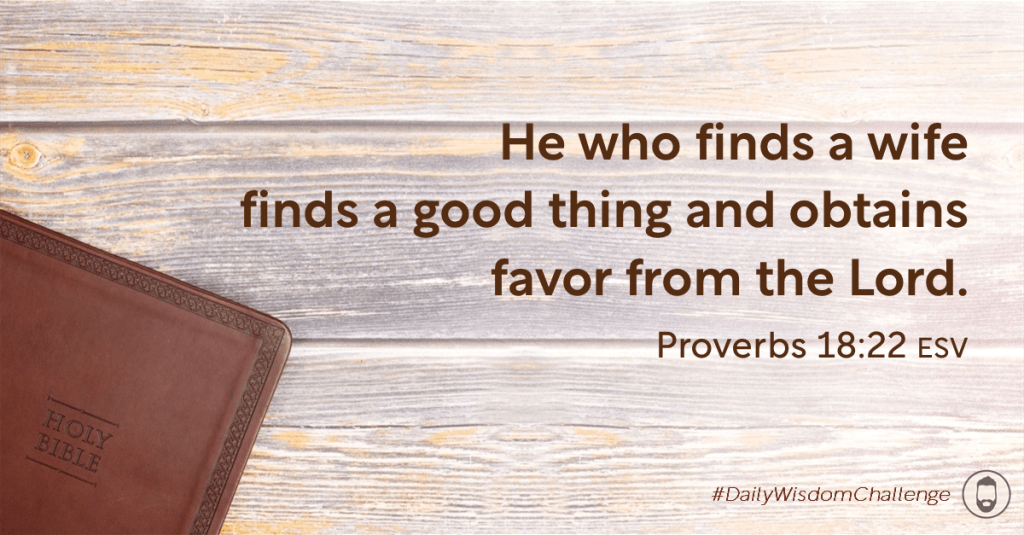
Outside of God saving me, the single greatest blessing in my life is God allowing me to be married to Candice. It does not take much thought or thinking through our relationship over the last twenty-three years to confirm that she is definitely my “good thing” and an example of God’s grace and “favor” in my life. And none who know or care for me would disagree.
But Proverbs 18:22 is not just about me and Candice. It, like so many other proverbs, finds its meaning not only in its own words but in contrast to others. As we looked at when discussing the “forbidden woman” v. the wife of one’s youth in Proverb 5, there is a contrast between the life that God prescribes and the paths that forge on their own. In the coming chapters of Proverbs (21:19 and 25:24), there is a contrast between wives who seek to be something other than a good thing or godly favor but to drive their husbands to be better off living “in a desert land” (Proverbs 21:19) or on “a corner of the housetop than in a house” (Proverbs 25:24).
Proverbs 18:22 represents living according to God’s wisdom in contrast to the anti-wisdom of the temptations of the forbidden woman or the plight of a quarrelsome marriage. God has a specific design for marriage and, as He Himself invented marriage, His design works best.
God’s design for marriage began when He remarked in the Garden of Eden that it was “not good” that Adam “should be alone” and decided to “make him a helper fit for him” (Genesis 2:18). God performed the first surgery and the first marriage in quick succession. He created Eve from Adam’s rib and joined them together as man and wife. Their union was to be the example for those marriages moving forward — in intimacy as well as how it was set apart (Genesis 2:23-25).
Many try and abuse God’s design for marriage by citing the term “helper” (Genesis 2:18) and the call to submission in Ephesians 5:22, but those picture something different for marriage — something better. You see, God did not create marriage for a man’s benefit but also for women.
While it is “favor from the Lord” for man to find a wife, it is not a curse for the wife. The husband is to love and care for his wife “as Christ loved the church and gave Himself up for her” (Ephesians 5:25). Marriage is to be a picture of the gospel (Ephesians 5:32).
To find God’s purpose for your life is a good thing. If it is singleness, that is a good and godly pursuit. If it is marriage, that is a good and godly pursuit. But both should be sought as God prescribes.
Marriage works best the way God intended with husbands caring for and loving their wives and wives caring for and loving their husbands. When I think specifically of how God has blessed me and shown favor to me in my wife, I think of the rib He used to make Eve (Genesis 2:21). God did not just design marriage; He also designed the human body. He made the rib cage to protect the most vital human organs like the heart and lungs. My wife is small, but she is fiercely protective of those she loves. She is protective of me even when I think I do not need protection. She looks to care for me even when I think I am the only one doing the caring and providing.
She has also taught me what it is to be a “helper” in the Genesis 2:18 sense. Everything that I do is enhanced because God has put her in my life. He has changed and grown me immensely over the years by His indwelling Spirit, and He has given me a desire to change, grown, and be better for the wife He has given me.
If you are reading this and married, take time and thank God for the spouse He has given you. Then, talk to your spouse and tell them you are thankful for them. Know that God has a plan for your marriage as surely as He has a plan for you (Ephesians 2:10), and see to it that you represent God’s favor to your spouse rather than husband-ing or wife-ing in such a way that they are headed for the desert or the roof! As Martin Luther said centuries ago, “Let the wife make the husband glad to come home, and let him make her sorry to see him leave.”
Thank you, Lord, for the gift of marriage. Thank you for the way that Your relationship with Your church gives us the perfect example of love and a high standard to live up to — a standard worth striving for. Thank you for Candice and make me a man worth being married to!
For the month of October, we are answering the challenge John Goldwater, pastor of Christ Community Church in Grenada, MS, laid out — the #DailyWisdomChallenge. Each day, we are going to read through a chapter of Proverbs corresponding to the day of the month.
This fits with what we have studied in Colossians, specifically Colossians 3:1-2, namely that we should seek “the things that are above, where Christ is” and set our minds like a thermostat “on things that are above, not on things that are on earth”. Imagine what a month meditating on God’s Word daily can do for us.
Won’t you join us on this #DailyWisdomChallenge and set your minds on Christ?
This proverb his my right square in my heart.
I spent the bulk of my childhood being the butt of many jokes, and made fun of quite mercilessly. I was beat up and often bullied. The bruises faded and broken glasses were replaced, but the scars — physical and emotional — remain.
This is one of the reasons I wanted to become a teacher. Throughout those years of being bullied, there were a handful that took notice, but most, for whatever reason, were oblivious or chalked it up to that’s just the way kids are. If you have never been treated like this (or were on the giving side of these sorts of encounters rather than the receiving), you do not know what a relief it is when someone notices and helps you. Carrie Mack and Linda Bumpers at Willa Wilson Elementary were blessings from God that helped me see my value despite the efforts of bus riders and drivers who were glad to see it stomped out. These ladies still to this day look for and out for me and are encouragements in my life. Seeing either of them today fills my heart with joy and encouragement and reminds me of light in the midst of darkness.
In middle school, I know teachers saw me being bullied. The example that first comes to mind is Mike Miles. He knew what I was going through without being told. He went and had my schedule changed so that I would be out of the study hall where my misery was always the subject of study to his study hall. He taught me how to play chess. He encouraged me to read books if that’s what I liked to do. In fact, that was the gist of what he taught me (other than the math he was tasked with): he taught me to be who God had made me to be and not let others diminish that. When I see him even today, I never hesitate to tell him how thankful I am that God used him to save my life — that when others worked to convince me my life had no value, God used him to remind me who and Whose I was.
There was one particular memory that came to mind when I read this verse that convicts me still to this day. When I think of this particular memory, I am filled with nauseating guilt even though it has been over twenty years ago.
In sixth grade, Carolyn Swanson saw that I had been bullied and mistreated as well. She also noticed other students who endured the same. Sixth grade back then meant mandatory PE a few days a week (some days library or music). For me, that was like painting a giant bullseye because that meant either getting picked last for teams or not at all (this was the 1990s; participation was not mandatory, and exclusion/mockery were allowed). Even though I did not want to be picked because that would mean I could go up into the stands and read rather than embarrassing myself athletically in a very public way, I really wanted to be picked. Well, I really wanted to belong.
One particular day, a group of the more popular guys approached me and pointed out one of my classmates. Me and this other guy were basically tied for least popular in the sixth grade as well as in who could be made fun of more. Neither of us were athletic. Neither of us came from families with much money. Both of us were quiet and clothed differently than others. The guys convinced me that the surest way to be one of them — to get picked for teams and get to hang out with them — was to make fun of the other guy. He had just gotten some new boots that he was proud of and had worn them to school. It made me sick to my stomach to think of doing that to someone else, but this could have meant that I got bumped up a level and got a reprieve from being made fun of. So, right there in the middle school gym, I let the other guy have it. I was ugly. It was shameful. He cried. And then the other guys started in — on me.
Their plan all along was to embarrass me and show that I was fake. They knew I professed to be a Christian and saw this as an opportunity to cast aspersions on that profession of faith. They gave me every bit of what I gave the other guy and worse. I cried, too, but not so much for what I was receiving but that I had allowed myself to do to the other guy what I knew was terrible.
Mrs. Swanson somehow found out about this, and I can remember what she said to me about it like it was yesterday. She told me that it was worse for me to do that than the others because I truly knew what it felt like to be treated like that. This was not a means for her to belittle me but to invest in me. She fussed at me, and I deserved it. She told me that she expected more out of me and knew that I would learn from this and grow into the man she knew I could be — despite my failure and because I would learn from it.
I am ashamed to say that it took months for me to get the courage to apologize to the other guy, and before I could, he moved away. It took nearly twenty years to get in contact with him again. I won’t tell you a story of apology and reconciliation here because I do not want to paint myself as a good guy for any of this. I want to help you understand Proverbs 17:5.
Everyone you come into contact with is made in the image of God. He created them and formed them in their mother’s womb. Each of us is unique, with unique features and personalities. Some of us, like myself, are more different than societal norms than others. And it is all too easy to make fun rather than to show care and respect.
This is not wrong merely for the human life you did not respect. It is a slap in the face of their “Maker”.
If someone is going through a tough time — some “calamity” — whether it is their fault, someone else’s fault, or nobody’s fault, it is not a time for mockery. Even if you think someone is getting the “calamity” they deserve, it is not a time to mock and make fun; we sure don’t enjoy it when calamities of our own making find us.
I guess this is really a plea to be kind to others and recognize that the same God who made you made them. There is never a time to mock or insult. There is always time to show love and care.
For me, this drove me to become a teacher. The examples of those who took up for me influence how I interact with kids — all of them I have and all that I can — on a daily basis. The example of the one who saw me becoming like the others and intervened has a daily impact, too, on the man God made me to be as well as in ways that I can watch out for others as well. I pray that this little bit of testimony helps you along the way, whether you are the bully, the bullied, or the bystander. Let us look out for others and look to God for how He would have us to treat folks.
For the month of October, we are answering the challenge John Goldwater, pastor of Christ Community Church in Grenada, MS, laid out — the #DailyWisdomChallenge. Each day, we are going to read through a chapter of Proverbs corresponding to the day of the month.
This fits with what we have studied in Colossians, specifically Colossians 3:1-2, namely that we should seek “the things that are above, where Christ is” and set our minds like a thermostat “on things that are above, not on things that are on earth”. Imagine what a month meditating on God’s Word daily can do for us.
Won’t you join us on this #DailyWisdomChallenge and set your minds on Christ?
Today’s proverb is another example of how we can see the gospel clearly pictured in the proverbs. This shows the beauty of God’s wisdom showing us how to come to Him and the danger of the anti-wisdom of the world that leads us away from Him.
We have looked at the “fear of the LORD” in most every chapter of Proverbs so far. To understand the “fear of the LORD” in the context of the gospel is especially important in present-day America when many preachers use fear as a means for convincing people to walk an aisle and make a decision for Jesus. This sort of fear-driven invitation time leads can lead to confusion and false conversion — and people wanting to be “re-saved” every time they sin and find themselves afraid of God’s wrath. When it comes to Biblical “fear of the LORD”, this definitely ain’t that!
The “fear of the LORD” described in the Bible (Proverbs 1:29, 2:4-6, 3:7, 8:13, 9:10, 14:26-27, 15:33, 16:6; Job 28:28; Psalm 34:11; Ecclesiastes 12:13; Acts 9:31) is best described as having deep respect, admiration, and awe for God. It is the basis for truly understanding and knowing Him and comes from having a relationship with Him because He saved and redeemed you. It changes your life and is fueled by having His Spirit within you and seeing Him influence your desires, attitudes, choices, feelings, actions, and goals. Knowing Him this way understands that He has a frightening level of power and wrath, but you do not have to live in fear of Him because He cares for you and His Son bore His wrath on your behalf.
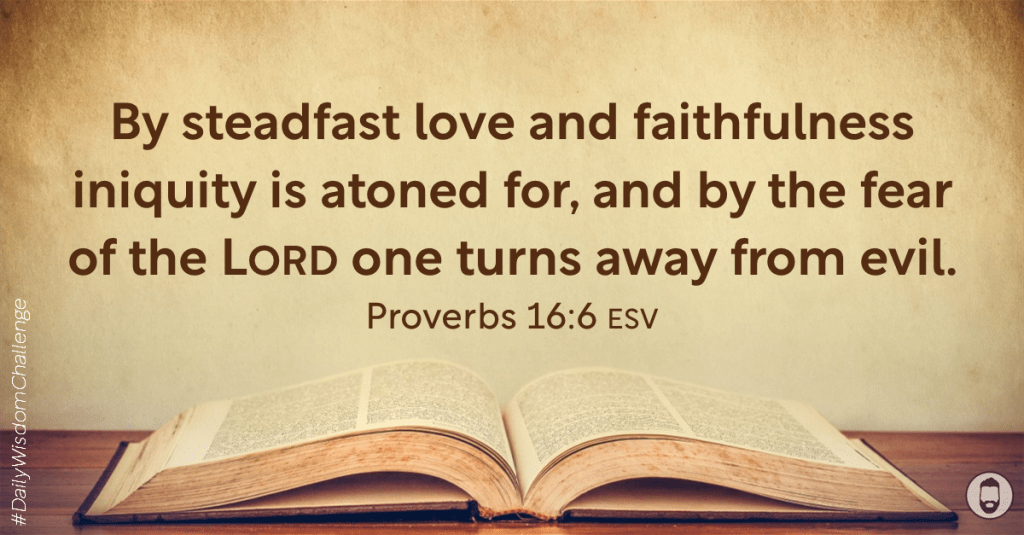
This “fear of the LORD” gives us a desire to turn “away from evil” because you see Him and “the surpassing worth of knowing Christ Jesus [as] Lord” (Philippians 3:8). This “fear of the LORD” is fueled by His “steadfast love and faithfulness” despite our “iniquity”, knowing that He atones for sin for those He saves.
For those who do not turn to Him, those who reject Him and put their trust in themselves, there is much to fear, in the traditional, literal sense of fear, but this fear does not see people turn from their sin. People may curb their behaviors or hide their desires because of fear, but no real change happens. The change God brings in people through His steadfast love and faithful salvation brings real change, from the inside out.
What about you?
Do you fear the Lord in the Biblical sense, or are you merely scared of His wrath?
Is He the God of the universe or some vengeful and distant deity?
One is the God who saves as presented in the Bible. His name is Jesus.
It is my prayer that you see Him for who He is, confess Him as Lord, and believe in Him.
For the month of October, we are answering the challenge John Goldwater, pastor of Christ Community Church in Grenada, MS, laid out — the #DailyWisdomChallenge. Each day, we are going to read through a chapter of Proverbs corresponding to the day of the month.
This fits with what we have studied in Colossians, specifically Colossians 3:1-2, namely that we should seek “the things that are above, where Christ is” and set our minds like a thermostat “on things that are above, not on things that are on earth”. Imagine what a month meditating on God’s Word daily can do for us.
Won’t you join us on this #DailyWisdomChallenge and set your minds on Christ?
Today’s proverb reminds me of an old Mac Davis song, “It’s Hard to Be Humble”. Check out the chorus, a satire of a prayer:
“Oh, Lord, it’s hard to be humble / When you’re perfect in every way / I can’t wait to look in the mirror / Cause I get better looking each day / To know me is to love me / I must be a [heck] of a man / Oh, Lord, it’s hard to be humble / But I’m doing the best that I can”
Mac Davis was right about one thing, it is hard to be humble, but it’s not difficult because of our perfection. No, it is difficult because we do not want to face our imperfections.
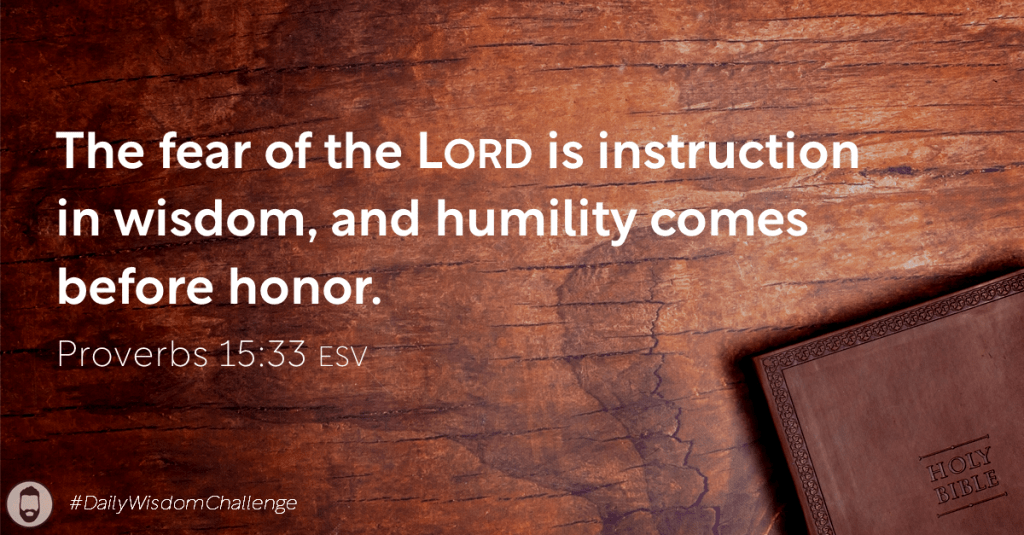
As it has been with so many of the proverbs we have read and those we have covered here in the #DailyWisdomChallenge, there is a contrast here, almost like a seesaw. In Proverbs 15:33, one side of the seesaw is the fear of the LORD learned from His “instruction and wisdom”; on the other is humility — that may or may not produce honor. The seesaw illustration helps us because, as it has been on every playground since its invention, balance is unlikely because one side is invariably heavier than the other.
Talk of “instruction and wisdom” here is likely referencing what needs to be learn to correct one’s way of life. Receiving instruction can be a humbling experience, especially when you get old enough to apply what you have learned. For example, I can remember in my teens and twenties being so frustrated with people, like my parents and some in authority, who could not see how much I knew despite my youth. Growing older and having to put my knowledge to work saw times when I learned the hard way that I did not know as much as I thought, and even in times when I was right, I was too inexperienced and foolish to apply what I knew correctly. This is not to say that everyone with more age always knows more or is wiser. No, unfortunately, foolishness hangs on with a death grip until, well, death. I find it much more humbling to find that some younger have wisdom beyond their years and I learn from their instruction.
The “humility” side of the seesaw gives the opportunity for honor — to gain “fear of the LORD” and bow to His “wisdom and instruction”. Essentially, this is the opportunity to both learn that you have been a fool and have an avenue to either stop being foolish or dive head-long into being a fool. This is a conundrum people have to deal with throughout their whole lives. As bad as I hate it, being humbled — which often means humiliation, comes around time and time again. Choosing to be a fool when confronted with your foolishness is called willful ignorance; it is not actual ignorance (not knowing) but living in a way where you try to fool yourself into not seeing you are a fool. That is a dangerous way to live. Or, you can choose to submit to God and walk in His ways, which is honorable.
Up and down, back and forth, the seesaw goes up and down. Sin and conviction. Correction and being humbled. Fear of God and willful ignorance. But this is real life and not a playground.
Which side will you give weight to: the instruction that comes from the “fear of the LORD” and leads to honor, or foolishness and fighting against humility?
For the month of October, we are answering the challenge John Goldwater, pastor of Christ Community Church in Grenada, MS, laid out — the #DailyWisdomChallenge. Each day, we are going to read through a chapter of Proverbs corresponding to the day of the month.
This fits with what we have studied in Colossians, specifically Colossians 3:1-2, namely that we should seek “the things that are above, where Christ is” and set our minds like a thermostat “on things that are above, not on things that are on earth”. Imagine what a month meditating on God’s Word daily can do for us.
Won’t you join us on this #DailyWisdomChallenge and set your minds on Christ?
Today’s proverb is such a beautiful picture of what what Paul describes as being found in Christ, “not having a righteousness of [our] own that comes from the law, but that which comes through faith in Christ, the righteousness from God that depends on faith” (Philippians 3:9).
So often, talk of the righteousness and wickedness fuels complaints about religious people thinking they are better than others or even fuels the self-righteousness of some church folks. I wish I could say this never has applied to me, but as I wrote in the #DailyWisdomChallenge post for Proverb 11, it is too easy to forget we are all sinners — all wicked, as many of the Proverbs say.
If it were not for Jesus saving me, I would have no righteousness to speak of (Romans 3:10); all I would have is my sin and the death that my sin has earned (Romans 6:23). To clarify, I am not a righteous man. My heart is wicked. And, well, not to be a downer, but yours is too. All of us sin and “fall short of the glory of God” (Romans 3:23). He is righteous. He is perfect. He is sinless. The rest of us are not.
There will come a day when I will stand before this righteous, perfect, sinless God and be faced with my wickedness and sin. Everything I have ever done will be evidence of that. Everything I have ever said will make the case for my guilt. The Bible tells us that Satan is the Accuser — one who accuses us day and night “before our God” (Revelation 12:10). He is bringing to God’s attention, and not having to lie despite his great knack for deception, our sin and failures. And, scarier still, none of this is news to God, because He knew all that we would do and all that we would say before the foundation of the world.
For those who have been saved, however, a “guilt offering” has been made on our behalf. Those who confess Jesus as Lord and believe in His resurrection are saved (Romans 10:9), and God places our sin and guilt on Jesus, His sinless Son, in order that we can be made righteous (2 Corinthians 5:21). Jesus paid our sin debt “by cancelling the record…that stood against us with its legal demands” by “nailing it to the cross” — by allowing the sinless Savior to be nailed to the cross that we deserved (Colossians 2:14).
That’s good news!
What’s more is that God did not merely satisfy some legal demand. He did not issue some writ or declaration that can be passed to the accuser who is trying to prosecute us and shame God with our failures. No, the Bible tells us that we have an “advocate” who has taken our case, and his name and credentials are “Jesus Christ the Righteous” (1 John 2:1)! Think of every dramatic courtroom drama you have ever watched or read about, and know that they pale in comparison to the rich finality with which Jesus handles the case of those He has saved. When the accuser taunts and mocks, reminding us of sin and failure, Jesus answers with His own righteousness! He declares that by His blood and sacrifice — and the fact that He died and is now living and interceding on our behalf (Hebrews 7:25, Romans 8:34) — our sin has been removed “as far as the east is from the west” (Psalm 103:12) and “cast…into the depths of the sea” (Micah 7:19)!
Before the Accuser can plead his case any further, God smacks the gavel with finality and declares innocent based on the righteousness of Christ!
Proverbs say that fools “mock the guilt offering”. One thing I can surely testify to here today is that I “enjoy” God’s “acceptance” BECAUSE I know how serious my sin is and how eternally grateful I am that He would save a wretch such as me.
How about you?
Do you see Jesus’s death and resurrection as necessary, or do you find it silly and unnecessary?
Do you think you will stand before God and have acceptance through any other means — wealth, prosperity, good works?
Let me plead with you today to look to Jesus to save you!
And, if you have, rejoice in the acceptance that will never be taken away, and do not fear the accuser. He knows “his time is short” and is lashing out in anger, trying to hurt those God has saved and thereby hurt Him (Revelation 12:12). Be encouraged and fear not, because the same proclamation that brings news of the accuser also proclaims God’s victory and Satan’s doom:
“Now the salvation and the power and the Kingdom of our God and the authority of His Christ have come, for the accuser of our brothers HAS BEEN THROWN DOWN, who accuses them day and night before our God. And they have CONQUERED him BY THE BLOOD OF THE LAMB and the word of their testimony, for they loved not their lives even unto death.” (Revelation 12:10-11)
For the month of October, we are answering the challenge John Goldwater, pastor of Christ Community Church in Grenada, MS, laid out — the #DailyWisdomChallenge. Each day, we are going to read through a chapter of Proverbs corresponding to the day of the month.
This fits with what we have studied in Colossians, specifically Colossians 3:1-2, namely that we should seek “the things that are above, where Christ is” and set our minds like a thermostat “on things that are above, not on things that are on earth”. Imagine what a month meditating on God’s Word daily can do for us.
Won’t you join us on this #DailyWisdomChallenge and set your minds on Christ?
First, let me add a disclaimer that this is not a proverb or post advocating child abuse or the beating of children. God did not mean that in Proverbs 13:24. God is a loving Father who knows what appropriate discipline is for His children — and thereby ours.
Raising children is hard, but it is such a worthwhile thing. I thought I knew what love was until I met Candice; then, I found that my heart had the capacity for more love than I thought possible. Then, I heard Keri’s heartbeat for the first time in the doctor’s office and realized I knew nothing. Then, came Xander and I found yet more room and capacity for love. Add to them my nieces and nephew. I have discovered more love than I knew existed.
If you talk to me for very long or often, my wife and kiddos come up. I write a lot about Candice and our marriage as illustration for various Bible studies, but I try to lay off the kids because, well, the internet and to keep from them thinking their lives are nothing but sermon fodder. My children bring me more joy than I am capable of expressing in words, either spoken or written. Both of them are unique and special. I, of course, am biased. I am their biggest fan (by size only and second only to their mama). They are good kids. And they are bad kids, too.
My kids are not perfect, and I try to live with the understanding that I can never say what they will never do because, like their father, they have the capacity to sin and mess things up. That brings in my least favorite part of parenting: discipline. I hate having to do it. Read that again: HAVING to do it.
I have to discipline them because I want to protect them from dangers outside and inside of them.
I have to discipline them because they need to learn from their mistakes (and ones I have made in the past, too).
I have to discipline them because that is the way God set up parenting in this fallen world. It is the model He gives in the way that He parents us (Hebrews 12:5-8).
Our proverb today says that parents discipline out of love (Proverbs 13:24), and it mirrors the way that “the Lord disciplines the one He loves” (Hebrews 12:6).
I definitely don’t have all of the answers to how to discipline children, and I don’t claim to. What I do know is that the discipline that has to be done is supposed to be borne out of love. If it seems that I am repeating myself, it is because I am. I am repeating for emphasis, and not in a way pointed at others, but as a reminder for myself.
I can remember my daddy telling someone once that he was glad to be in the stage of life when my sister, brother, and I were grown. He said that once the parenting was over, he had gained friends in his children. The person he was talking to asked something, signifying that they thought his comment was odd. What he said after that is what is so poignant for our subject today. Daddy said that he loved spending time with us when we were growing up, but that he loved us too much to try and be our friends when we needed a daddy more than a friend.
When I look at Keri and Xander (and Sophie, Krislyn, Penelope, Caleb, Sunday, and Mae), my heart swells with love that I cannot describe. I love to spend time with them. I love to hear their jokes and their dreams and their complaints and whatever they want to tell me. I am so glad when they talk to me because I know it will not always be the case. As they grow, I will not always be a favorite person. When correction is needed, I am not what they want. But, Lord willing, I will have the Spirit-filled courage to be who they need. Then, when they are all grown up, I can rejoice in what the Lord has done in them and who He has made them to be.
In the meantime, the tough love of discipline is worth it because they are worth it.
For the month of October, we are answering the challenge John Goldwater, pastor of Christ Community Church in Grenada, MS, laid out — the #DailyWisdomChallenge. Each day, we are going to read through a chapter of Proverbs corresponding to the day of the month.
This fits with what we have studied in Colossians, specifically Colossians 3:1-2, namely that we should seek “the things that are above, where Christ is” and set our minds like a thermostat “on things that are above, not on things that are on earth”. Imagine what a month meditating on God’s Word daily can do for us.
Won’t you join us on this #DailyWisdomChallenge and set your minds on Christ?
Today’s verse immediately brings a quote by fictional character Dwight Shrute. In an episode of The Office, Dwight was responding to the the faux documentary crew asking what the best advice his boss, Michael Scott, had ever given him. Here’s his response:
“Whenever I’m about to do something, I think, ‘Would an idiot do that?’ And if they would, I do not do that thing.”
While that is quippy and meant to be funny, it fits well with Proverbs 12:1.
I had to read this verse twice, which led me to choose this for the 12th installation in the #DailyWisdomChallenge. After having the above quote come to mind, I asked myself who in their right mind “loves discipline”? Well, this is why we are seeking wisdom from God in this challenge – to get in the right mind and thereby set our minds on things that are above rather than on the things of this world and the false or anti-wisdom that comes with it (Colossians 3:2).
My views on discipline have changed drastically over the years. As a kid, I hated it. I genuinely hated everything about getting in trouble. The older I got, the more the discipline and correction changed. The things that did not embed in me through quick punishment required longer punishment. There were lengthy conversations and explanations of why right was right and the dangers of the wrong. When I thought I knew better (and was “stupid” by hating my parents’ “reproof”), the discipline hurt all the more as I got to see my parents disappointed in me, knowing that I was supposed to know better.
As I got older and began working with kids – whether it be at church or my time spent tutoring at the Reedy Acres campus of the Baptist Children’s Village, my views on discipline changed. There were times that “reproof” needed to happen, and I found myself on the side of doling out discipline. All my thoughts of wanting to try my parents’ side of discipline quickly evaporated as I learned that it was not at all enjoyable to work and repeat “reproof” often enough for it to have the opportunity to sink in.
Now, I have kids of my own and classrooms full of kiddos at work. Discipline is part of it. It is a responsibility. It is not to be taken lightly. But it is necessary as it is how we learn.
Who in their right mind “loves discipline”, then? Well, the man or woman who has received discipline and grown from it. This, of course, fits with the parental and teacherly discipline I spoke of above, but it fits even better when we look at the grace and love our heavenly Father shows us when He bears with us and disciplines us. Read that again: the discipline of the Father is a gift of grace borne out of His love for us.
“My son, do not regard lightly the discipline of the Lord, nor be weary when reproved by Him. For the Lord disciplines the one He loves, and chastises every son whom He receives.”
It is easier to love discipline when you know what it is to be loved by the Father. It is easier to love the tough-love He gives from time to time when we realize that in so doing He is “treating [us] as sons” (Hebrews 12:7).
If you are struggling with this, you are not alone. But, if you’ll forgive one more fictional character quote, Forrest Gump’s mother spoke true when she taught him, “Stupid is as stupid does.” In the case of Proverbs 12:1, stupid is hating reproof and learning nothing. God graciously offers the opportunity to repent and learn from Him.
May we learn to love His discipline more than we desire to do what we want to do!
May we learn that it comes from His love and lean into His discipline rather than kicking against it!






 Just Keith Harris