
“The Joy of Forgiveness” from Psalm 32 (#dailyPSALMSchallenge)

Blessed is the one whose transgression is forgiven, whose sin is covered.

Psalm 32:1

Psalm 32 is a joyful song of relief – the rejoicing of a sinner who has experienced the forgiving and redeeming grace of God! David begins this psalm with a double blessing – blessed is “the one whose transgression is forgiven” and blessed is “the man against whom the Lord counts no iniquity” (vv. 1-2). The word translated “blessed” here means happy, but it is not the surface-level happiness people often think of. It is the deep joy of knowing that sin has been wiped away and the burden of guilt lifted.

David speaks here from experience. When he tried to conceal his sin, his “bones wasted away through…groaning all day long” (v. 3). He gives the illustration of God’s hand pressing on him as an image of conviction that led from exhaustion and despair (v. 4) to finally coming out of hiding and confessing, immediately finding forgiveness when he “acknowledged his sin” (v. 5). This psalm teaches us a crucial lesson about joy and blessing: it doesn’t come from us trying to cover our sin but by God covering it. 

When we humble ourselves and confess, we are not met with condemnation but with mercy. This is why David calls us to respond by offering prayer to God in a time when He may be found (v. 6). Sin hardens our hearts – especially that which we try to hide or ignore – making confession more difficult. Instead of resisting and trying to hide, we should run to God who is our hiding place and protector in trouble (v. 7). Rather than being like a stubborn mule that resists correction (v. 9), we should trust in the Lord, for “steadfast love surrounds the one who trusts in the Lord” (v. 10).

The psalm ends with a call to celebration and reminds us again that the forgiven heart is a joyful heart.

Seeing Jesus in Psalm 32

Psalm 32 finds its fulfillment in Jesus. Paul quotes Psalm 32 in Romans 4:7-8 to show that justification comes by faith in Him and not by our works. 

The blessing of forgiveness is only possible because of Him. He bore our iniquities and covered our sin with His own righteousness. Jesus endured the penalty for our transgressions on the cross so that we can receive the blessing of forgiveness. And when we confess our sins to Him, we do so in confidence that “if we confess our sins, He is faithful and just to forgive us our sins and to cleanse us from all unrighteousness” (1 John 1:9).

Reflection

Have you ever tried to ignore or hide your guilt or, like David, live carrying unconfessed sin? That’s an easy question to answer for every one of us: yes – too often. God’s invitation for us here is clear: “Let everyone who is godly offer prayer…at a time when [He] may be found” (v. 6). 

Don’t wait.

Come to the Lord in confession and receive the joy of His forgiveness. Meditate on the double blessing of vv. 1-2 and know that, if you are in Christ, your transgressions are forgiven, your sin is governed, and God does not count your iniquity against you.

That’s good news and reason for rejoicing!

The #dailyPSALMSchallenge gives us the opportunity to start 2025 in God’s Word by digging into a psalm a day. Each day will identify a key passage for us to meditate on as well as seeking to help us see Jesus in the psalm and reflect on what we have read.

Won’t you take the challenge?

“Placing Our Times in God’s Sure and Steady Hands” from Psalm 31 (#dailyPSALMSchallenge)

But I trust in You, O LORD; I say, “You are my God.” My times are in Your hand; rescue me from the hand of my enemies and from my persecutors!

Psalm 31:14-15

Psalm 31 is a deeply emotional and personal psalm showing David’s trust for the Lord as he sought refuge amidst life-threatening circumstances. This psalm moves from David’s desperate cries for deliverance to an unwavering declaration in God’s sovereignty and goodness. In v. 5, David proclaims, “Into Your hand I commit my spirit”, words later echoed by Jesus on the cross (Luke 23:46), showing Psalm 31 to be a testament to the reality of suffering, the sufficiency of God’s grace, and the assurance of His steadfast love for His people.

David begins with the heartfelt plea for God to never let him “be put to shame” and for God to deliver him (v. 1). He describes God as his rock and fortress, emphasizing his complete dependence on the Lord for guidance, rescue, and protection (v. 3). In the midst of overwhelming affliction, David places his life in God’s hands.

David’s honesty about his pain is striking: “For my life is spent with sorrow, and my years with sighing”, citing his failing strength and bones wasting away (v. 10). He feels forgotten and rejected, yet he does not lose sight of God’s faithfulness. Instead, he declares his trust for the Lord and confess that He is his God (vv. 14-15). This declaration of faith reveals David’s confidence in God’s control over his times – literally every moment of his life, even and especially the darkness seasons and moments.

Psalm 31 concludes with a call to worship: “Love the Lord, all you His saints! The Lord preserves the faithful but abundantly repays the one who acts in pride. Be strong, and let your heart take courage, all you who wait for the Lord!” (vv. 23-24). 

Seeing Jesus in Psalm 31

Psalm 31 points us directly to Jesus, who embodied perfect trust in the Father even in His most excruciating moment on the cross. When Jesus quoted v. 5, He demonstrated complete dependence on the Father, trusting Him even in death. His resurrection assures us that God’s goodness and steadfast love triumph over sin, suffering and death. 

Reflection

Psalm 31 challenges us to entrust every aspect of our lives to God’s sovereign care. Through Jesus, we can confidently declare, “My times are in Your hand”, knowing that our lives are secure in Him, both now and forever. 

Are there areas where you struggle to trust God’s timing or provision?

How does Jesus’s example committing His spirit to His Father encourage you to trust God, even in seasons of uncertainty or pain?

Take time today to entrust your burdens to the Lord, knowing that His steadfast love is abundant, His goodness is stored up for His people, and His plans for you are always perfect.

The #dailyPSALMSchallenge gives us the opportunity to start 2025 in God’s Word by digging into a psalm a day. Each day will identify a key passage for us to meditate on as well as seeking to help us see Jesus in the psalm and reflect on what we have read.

Won’t you take the challenge?

“Rejoicing in God’s Deliverance from Mourning to Dancing” from Psalm 30 (#dailyPSALMSchallenge)

For His anger is but for a moment, and His favor is for a lifetime. Weeping may tarry for the night, but joy comes with the morning.

Psalm 30:5

Psalm 30 is a psalm of thanksgiving written for the dedication of the temple – a temple that would not be built until after his lifetime (1 Kings 8:63). The psalm is rich with imagery of deliverance, restoration, and eternal praise, offering both personal testimony from David about God’s faithfulness and invitation for everyone to worship the Lord.

David begins by praising the Lord for rescuing him from the brink of death, declaring, “O Lord my God, I cried to You for help, and You have healed me” (v. 2). This cry for deliverance illustrates God’s power to lift His people from the depths of despair – whether that be death or the grip of overwhelming circumstances. 

This psalm reveals the beautiful truth that God’s anger is not everlasting but that His favor is (v. 5). In this, David reminds us that God’s discipline is never without purpose but leading us to restoration and joy. Even when we endure hardship, we can trust in the hope of morning’s light – a symbol of God’s faithful presence and renewed mercies. 

David’s journey through pride and self-reliance is also highlighted (v. 6). Yet, when God hid His face, David was dismayed, recognizing his complete dependence on God’s sustaining hand and presence (v. 7). This moment of discipline humbled David, leading him to plead for mercy and restoration (vv. 8-10). Psalm 30 ends with a profound series of reversals: mourning turned into dancing, sackcloth exchanged for gladness, and silence replaced with eternal praise (vv. 11-12). 

Seeing Jesus in Psalm 30

Psalm 30 finds its ultimate fulfillment in Jesus. The imagery of the resurrection in vv. 3 and 5 anticipates Jesus’s resurrection, who was brought out of the grace and now lives eternally. He endured the momentary wrath of God on the cross, bearing the penalty for sin, so that we might experience God’s favor and eternal joy. As David wrote, “Weeping may tarry for the night, but joy comes with the morning” (v. 5) – a hope fully realized in Christ’s victory over death on Resurrection Sunday morning.

Moreover, Jesus described His own body as a temple (John 2:19-21), making His death and resurrection the ultimate act of dedication. His suffering and exaltation enable us to approach God with boldness, clothed not in mourning, but in the gladness of salvation.

Reflection

Psalm 30 reminds us to praise God in every season – through grief and joy, discipline and restoration. How has God turned your mourning into dancing? In what ways can you use your own personal story of deliverance to encourage others to join in the praise of God’s holy name?

Take time today to reflect on the promise that “joy comes with the morning” (v. 5) and meditate on how the hope of Jesus’s resurrection shapes your perspective on suffering and the trials that you face.

The #dailyPSALMSchallenge gives us the opportunity to start 2025 in God’s Word by digging into a psalm a day. Each day will identify a key passage for us to meditate on as well as seeking to help us see Jesus in the psalm and reflect on what we have read.

Won’t you take the challenge?

“The Thundering Power of God’s Voice” from Psalm 29 (#dailyPSALMSchallenge)

The LORD sits enthroned over the flood; the LORD sits enthroned as King forever.

Psalm 29:10

Psalm 29 is a majestic hymn that calls us to worship God for His unrivaled power and glory. Using the imagery of a powerful thunderstorm, David declares the might of the Lord’s voice, His sovereign rule over creation, and His eternal kingship.

David opens with a call to worship for the “heavenly beings” to “ascribe to the LORD glory and strength” (v. 1). Whether this is a reference to angels or to false gods, David is compelling them to acknowledge the Lord’s supremacy and preeminence. The repeated call to “ascribe to the Lord” emphasizes God’s inherent glory, strength, and holiness. As worshipers, we are invited to recognize His matchless greatness and bow in reverence before Him (vv. 1-2).

The middle portion of the psalm (vv. 3-9) describes the “voice of the Lord” as it moves across creation, bring both destruction and awe. From the “mighty waters” of the sea (v. 3) to the forests of Lebanon and the wilderness of Kadesh (vv. 5-8), God’s voice shakes the earth and demonstrates His unrivaled power. Even the majestic cedars of Lebanon, symbols of strength and stability, are shattered at His command (v. 5). This vivid imagery reminds us that no force – indeed nothing in creation – is beyond God’s reach or control. 

Psalm 29 culminates with a declaration of God’s eternal rule: “The LORD sits enthroned as King forever” (v. 10). The reverence to the “flood” in v. 10 recalls the great flood in Noah’s time, a powerful reminder of God’s sovereignty over creation as well as His might in judgment. Yet, alongside this display of power is the promise of peace for God’s people (v. 11).

Psalm 29 is the revelation of the dual reality of God’s greatness and goodness – His fearsome power contrasted with His blessing and protective care for His people.

Seeing Jesus in Psalm 29

Psalm 29 points to Jesus as the ultimate Word of God (John 1:1-3), describing the voice of the Lord as powerful and majestic. As God incarnate, Jesus spoke with authority over creation, calming storms with a word (Mark 4:39) and demonstrating His sovereignty as King of kings (Revelation 19:11-16).

The imagery of a storm also reminds us of the judgment and salvation accomplished through Jesus. At the cross, the earth trembled (Matthew 27:51) as Jesus bore God’s wrath against sin. Through His resurrection, He conquered death and now reigns eternally as King. Psalm 29 concludes with a prayer for strength and peace, which are both fully realized in Jesus, who offers peace with God through His sacrifice (Romans 5:1).

Reflection

Psalm 29 invites us to worship the Lord for His power, holiness, and eternal reign. Consider these following questions to help you reflect. 

When you see displays of God’s power in nature, are you reminded of God’s power and majesty? How can those moments move you to praise?

In what areas of your life do you need to remember God’s sovereignty and trust in His control?


Take time today to marvel at God’s power and glory, expressed both in creation and in the person of Jesus. Let your heart respond with the same cry as the worshipers in the temple: Glory! (v. 9)

The #dailyPSALMSchallenge gives us the opportunity to start 2025 in God’s Word by digging into a psalm a day. Each day will identify a key passage for us to meditate on as well as seeking to help us see Jesus in the psalm and reflect on what we have read.

Won’t you take the challenge?
“Finding Refuge in the Arms of the Good Shepherd” from Psalm 28 (#dailyPSALMSchallenge)

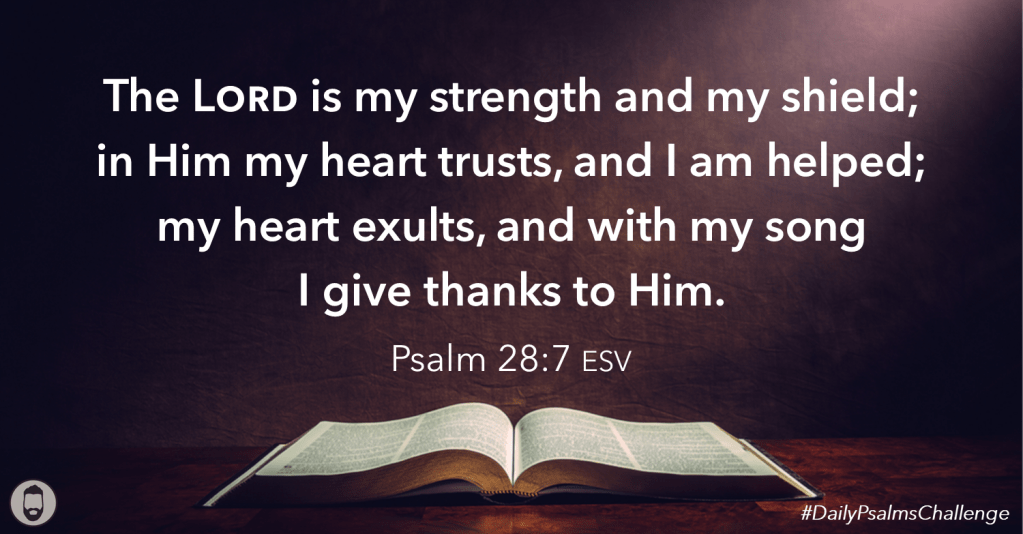
The LORD is my strength and my shield; in Him my heart trusts, and I am helped; my heart exults, and with my song I give thanks to Him.

Psalm 28:7

Psalm 28 begins with a cry for help and ends as a song of praise. David again finds himself in a desperate situation, pleading with God to hear, deliver, and protect him from the wicked people. His journey from lament to joy is an example for believers to be able to bring their burdens to God with confidence in His faithful provision.

David starts out by crying out to God: “To You, O LORD, I call; my rock, be not deaf to me” (v. 1). His plea is urgent – he lifts his hands toward God’s sanctuary, pleading for mercy and divine intervention (v. 2). He fears being counted among the wicked, whose outwards show of peace is meant to mask the evil in their hearts (v. 3). These workers of iniquity disregard God’s works and will ultimately stand under His judgment (vv. 4-5).

In v. 6, David shifts from lament to praise, declaring, “Blessed be the LORD! For He has heard the voice of my pleas for mercy”. David  proclaims that the Lord is his strength and shield, the source of his help and joy. Trusting in God brings him peace, and his gratitude moves him to song (v. 7).

As king, David concludes Psalm 28 with a prayer for his people: “Oh, save your people and bless Your heritage! Be their shepherd and carry them forever” (v. 9). This prayer reflects his role as a representative of the nation of Israel as well as his dependence on God as his faithful Shepherd who guides and protects His people.

Seeing Jesus in Psalm 28

Psalm 28 points to Jesus as the ultimate fulfillment of David’s prayer. Jesus is the Good Shepherd who carries His people in His arms (John 10:11-18). He is our strength and shield, providing eternal salvation and protection for those who trust in Him.

The cry for justice in vv. 3-5 finds its resolution in Jesus, who perfectly executes righteousness and will one day judge the wicked (2 Timothy 4:1). The final prayer in v. 9 echoes Jesus’s role as the Shepherd-King who leads His people. Through Him, God’s people are not only saved but also blessed and carried into eternal joy and rest in Him (Revelation 7:17).

Reflection

Psalm 28 teaches us to bring our desperation, pleas, and fears to God, trusting that He hears us and will respond. Reflect on the following questions.

What burdens or fears are you carrying today? How can you bring them to God in prayer?

How has God demonstrated His faithfulness in your life in times of difficulty?

In what ways should you respond to God in gratitude and worship?

Take some time today to cry out to God with your needs and concerns, trusting in His strength and protection. Let David’s prayer here remind you that God is faithful to hear, help, and carry us through every trial. As you reflect on His goodness, allow your heart to overflow with thanksgiving and song!

The #dailyPSALMSchallenge gives us the opportunity to start 2025 in God’s Word by digging into a psalm a day. Each day will identify a key passage for us to meditate on as well as seeking to help us see Jesus in the psalm and reflect on what we have read.

Won’t you take the challenge?

“Whom Shall I Fear If the Lord is My Stronghold?” from Psalm 27 (#dailyPSALMSchallenge)

The LORD is my light and my salvation; whom shall I fear? The LORD is the stronghold of my life; of whom shall I be afraid?

Psalm 27:1

Psalm 27 reflects confident trust in the Lord, even in the face of fear, opposition, and uncertainty. David declares that God is his light, salvation, and stronghold, assuring him ultimate safety and peace. This psalm is a beautiful and powerful tapestry of praise, prayer, and hope.

David begins by proclaiming unshakable confidence in God (vv. 1-3). He asks twice, “whom shall I fear?” (v. 1). He describes God as his light and salvation but also as his stronghold – a fortress in whom he can find refuge when his enemies rise up against him. He trusts God to protect him as well as causing his enemies to stumble and fall. 

David’s heart’s desire is revealed in v. 4: “One thing I have asked of the Lord…that I may dwell in the house of the Lord all the days of my life.” He longs for uninterrupted communion with God – eternally dwelling with him rather than seeking temporary shelter. For him, being in God’s presence – gazing upon His beauty and inquiring of His temple – is the ultimate source of joy and security.

David rejoices in the protective care of God who hides him in His shelter and also lifts him high upon a rock (vv. 5-6). David’s response to God’s care is to praise Him with shouts of joy and songs. 

In vv. 7-12, the psalm takes an intimate turn as David cries out to God for continued grace and deliverance. He pleads with Him not to hide His face or abandon Him, expressing a deep dependence on God as his help and salvation. Even when forsaken by all others, David has confidence that “The Lord will take [him] in” (v. 10).

Psalm 27 concludes with a bold statement and encouragement to wait on the Lord: “I believe that I shall look upon the goodness of the Lord in the land of the living!” (v. 13). The way the KJV translates v. 13 is helpful: “I had fainted, unless I had believed to see the goodness of the Lord in the land of the living”, meaning that David knew that he would have despaired and been hopeless without his belief and faith in God, faith that knew and trusted that he would see God’s goodness in the world and not as something he would have to wait on in heaven. Because of that he could encourage people to “Wait for the Lord; be strong, and let your heart take courage” (v. 14).

Seeing Jesus in Psalm 27

Psalm 27 points to Jesus as the ultimate fulfillment of David’s longing for light, salvation, and communion with God. Jesus declared that He was “the Light of the World” (John 8:12). He is the true light who dispels the darkness of sin and death, bringing salvation to all who believe in Him. Jesus is also our stronghold, the One who secures our place in the presence of God. Through His death and resurrection, He opened the way to His heavenly sanctuary, where we can dwell with God forever (Hebrews 10:19-22).

David’s desire to “dwell in the house of the Lord” (v. 4) finds its fulfillment in Jesus, who enables believers to experience God’s presence through His Holy Spirit. In eternity, we will gaze upon the beauty of the Lord and worship Him face-to-face (Revelation 22:4).

When David cries, “My father and my mother have forsaken me, but the Lord will take me in” (v. 10), we are reminded of Jesus’s promise to never leave or forsake His people (Matthew 28:20, Hebrews 13:5). He is the faithful Savior who sustains us through every trial and assures us of eternal life in His presence. 

Reflection

Psalm 27 invites us to trust God in every circumstance, finding confidence, joy, and peace in His presence. Consider the following questions to help you reflect on what you’ve read.

How can you remind yourself of God’s light and salvation in times of fear and certainty?

Do you, like David, have a desire to dwell in the presence of God? What steps can you take to cultivate this desire?

In what ways has God demonstrated His faithfulness to you, even when others have let you down?

Take time today to praise God for being your light and salvation. Ask Him to increase your confidence in His care and help you wait patiently for His perfect will to unfold. Let the truth of this psalm strengthen your heart and encourage your soul as you continue to trust in Him!

The #dailyPSALMSchallenge gives us the opportunity to start 2025 in God’s Word by digging into a psalm a day. Each day will identify a key passage for us to meditate on as well as seeking to help us see Jesus in the psalm and reflect on what we have read.

Won’t you take the challenge?

“Walking Faithfully in a Wicked World” from Psalm 26 (#dailyPSALMSchallenge)

But as for me, I shall walk in my integrity; redeem me, and be gracious to me. My foot stands on level ground; in the great assembly I will bless the LORD.

Psalm 26:11-12

Psalm 26 is a prayer of confidence and commitment to walking in integrity before God. David appeals to God for vindication, affirming his trust and faithfulness in the midst of a corrupt world. His prayer reflects a heart committed to holiness, worship, and reliance on God’s steadfast love and faithfulness (without which neither David nor us would be able to be holy or stand before God).

David begins with a declaration of his integrity and trust (v. 1). His pleas that follow are not self-righteous boasting but again a plea to God based on God’s consistent character and faithfulness. David knows God and understands how God had worked and was currently working in his life. This is why David openly invited God to test his heart and mind, knowing that God’s steadfast love and faithfulness are ever before him (vv. 2-3).

In vv. 4-5, Psalm 26 transitions to a rejection of worldly wickedness and hypocrisy (similar to the contrast in Psalm 1). He refuses to associate with evildoers and hypocrites, distancing himself from their schemes. His separation of sin is paired with his love for worshiping the Lord. His heart is set on the “habitation of God’s house” and the glory of God’s presence (vv. 6-8). He declares his innocence symbolically through the washing of his hands and offering thanksgiving to God.

David also expresses his confidence in God’s justice, asking to be separated from sinners in judgment (vv. 9-10). His trust in God leads him to reaffirm his commitment to walk in integrity. He concludes with further confidence that his feet stand on level ground and that he will bless the Lord in the great assembly (vv. 11-12).

Seeing Jesus in Psalm 26

Psalm 26 ultimately points to Jesus as the true Man of integrity. While David’s integrity was obviously imperfect, Jesus perfectly fulfilled God’s standard of holiness and righteousness. He lived without sin, fully trusting in His Father and walking blamelessly.

Jesus also fulfills David’s longing for the “habituation of God’s house” and the “place where [His] glory dwells” (v. 8). In Christ – Emmanuel (God with us), we have access to the presence of God, believers becoming the temple where His Spirit dwells (Ephesians 2:22). 

Reflection

As followers of Jesus, we are called to live lives of integrity, not on our own merits or abilities but empowered by His Spirit. Our confidence is not in our own righteousness but in the perfect righteousness of Christ, who enables us to walk faithfully before God.

Psalm 26 challenges us to live that life of integrity. Ask yourself the following questions and reflect on them.

Are you willing to invite God to examine your heart and mind as David did?

Do you distance yourself from sin while pursuing the joy of worship and fellowship with God’s people?

How does the integrity of Jesus encourage and empower you to walk faithfully before God?

Take time to pray, asking God to test your heart, deepen your love for Him, and guide you in integrity. Rejoice in Jesus’s righteousness, which covers and sustains you as you bless the Lord in the assembly of His people.

The #dailyPSALMSchallenge gives us the opportunity to start 2025 in God’s Word by digging into a psalm a day. Each day will identify a key passage for us to meditate on as well as seeking to help us see Jesus in the psalm and reflect on what we have read.

Won’t you take the challenge?

“Trusting the God of Our Salvation” from Psalm 25 (#dailyPSALMSchallenge)

Make me to know Your ways, O LORD; teach me Your paths. Let me in Your truth and teach me, for You are the God of my salvation; for You I wait all the day long.

Psalm 25:4-5

Psalm 25 is a heartfelt prayer of dependence on God’s guidance, forgiveness, and protection. David pours out his soul, expressing trust in God while seeking to be delivered from enemies, wisdom for life, and mercy for past sin. This is an acrostic poem, meaning that (for the most part) each verse beginning with a Hebrew letter A-Z (actually aleph א to tav ת), and emphasizes themes like trust, humility, and God’s covenant faithfulness.

David opens the psalm by lifting his soul to the Lord and declaring His trust in Him (vv. 1-2). This is active trust, not passive – a confident reliance on God’s character and promises. He boldly asks that he not be put to shame, knowing that those who wait on the Lord will not be disappointed in that regard (v. 3).

The heart of Psalm 25 is David’s plea for guidance and instruction. He desires to know God’s ways, to walk in His truth, and to live in obedience to Him (vv. 4-5). This humble plea reflects an awareness of his (and our) limitations and the need for God’s wisdom. David’s cry also reveals his teachable spirit, acknowledging that true wisdom comes only from the Lord.

David transitions to seeking forgiveness for his sins, particularly the sins of his youth (vv. 6-7). People often remark that it seems odd that David would be known as a man after God’s own heart when he very clearly is a sinner; vv. 6-7 give a good indication for what set him apart, namely repenting of his sin and seeking God’s mercy and steadfast love. David consistently holds to the consistency of God’s character and His steadfast love. It is also important to note that David acknowledges that God’s forgiveness is given and not earned – that it flows from God’s goodness and covenant faithfulness (v. 11).

In vv. 8-14, David highlights God’s character as good, upright, and faithful. He notes that God teaches sinners, leads the humble, and reveals His covenant to those who fear Him. This reverent fear fosters intimacy with God, described in v. 14 as “the friendship of the LORD”.

Psalm 25 concludes with David praying for deliverance from his troubles, enemies, and sins. He asks God to guard his soul and to preserve him through integrity and uprightness as he waits on the Lord (vv. 15-21). Finally, David expands his prayer to include all of Israel, asking God to redeem His people from their troubles (v. 22).

Seeing Jesus in Psalm 25

Psalm 25 finds its ultimate fulfillment in Jesus. David’s plea for forgiveness points us to the cross, where Jesus bore the penalty for sin and secured mercy for sinners. Only Jesus lived with perfect trust, humility, and obedience to God’s will, walking the path of righteousness without flaw or error.

As the God of our salvation, Jesus delivers us from sin and leads us in paths of righteousness. Like David, we can lift our souls to Him, confident that He will guide us, forgive us, and guard our lives for His glory.

Reflection

Psalm 25 calls us to trust God fully, seek His guidance, and rest in His mercy. As you do so, reflect on the following questions. 

Are you daily asking God to teach you His ways and lead you in His truth? 

Do you trust in God’s forgiveness, even for the sins of your youth? 

How does the promise of God’s friendship encourage you to walk in humility and obedience?

Lift your soul to the Lord today. Confess your need for His guidance, forgiveness, and protection. Wait on Him, knowing that He is faithful to answer and to redeem. Through Christ, you can walk in His paths with confidence and hope.

The #dailyPSALMSchallenge gives us the opportunity to start 2025 in God’s Word by digging into a psalm a day. Each day will identify a key passage for us to meditate on as well as seeking to help us see Jesus in the psalm and reflect on what we have read.

Won’t you take the challenge?
“His Name is Jesus” from Psalm 24 (#dailyPSALMSchallenge)

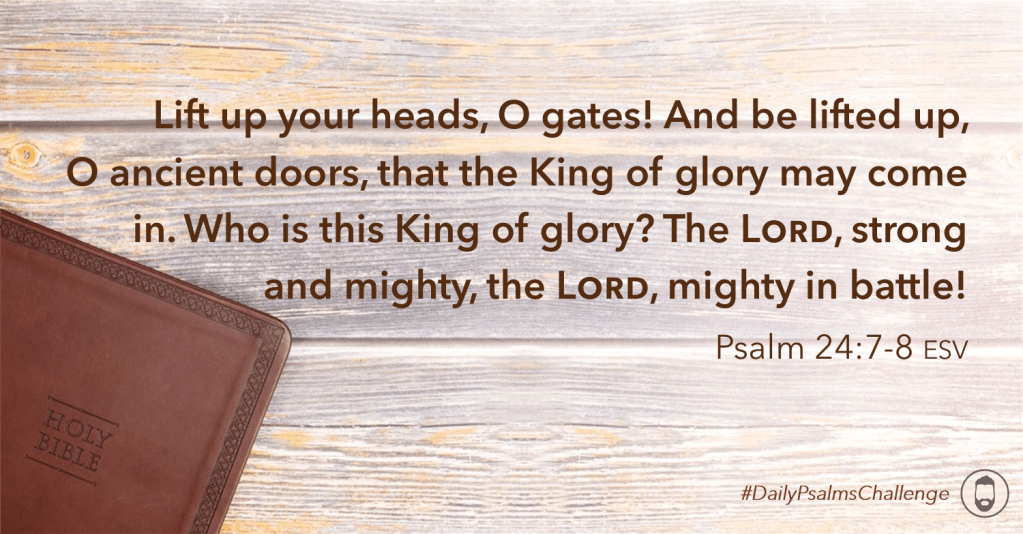
Lift up your heads, O gates! And be lifted up, O ancient doors, that the King of glory may come in. Who is this King of glory? The LORD, strong and mighty, the LORD, mighty in battle!

Psalm 24:7-8

Psalm 24 is a majestic declaration of God’s greatness, His rightful place as ruler over all creation, and the glory of His presence. Traditionally, this psalm is connected to the Ark of the Covenant arriving in Jerusalem in 2 Samuel 6. The Ark of the Covenant symbolized God’s presence among His people (especially the Mercy Seat on its top), but this psalm transcends the Ark and Israel because we know the answer to Psalm 24’s question of “Who is this King of Glory?” – His name is Jesus!

David begins Psalm 24 by asserting that the earth and everything in it belongs to the Lord because He founded and established it (vv. 1-2). He is the Creator and therefore the rightful owner of everything that is, including every person. This foundational truth reminds us that our lives are not our own; we belong to God who made us for His purposes.

In vv. 3-6, David asks an important question: “Who shall ascend the hill of the LORD? And who shall stand in His holy presence?” (v. 3). Then, David promptly answers by saying that only those with “clean hands” and a “pure heart” may enter into God’s holy presence (v. 4). These qualifications reveal two things: 1)God is immensely holy, pure, and perfect, and 2)humanity is immensely, well, not. It is impossible for sinful humanity to stand before God on our own merit. Clean hands refers to righteous actions and deeds, and a pure heart references cleanliness in our motives and minds. Religion cannot produce this; only a life fully devoted to God in truth and righteousness.

Psalm 24 then crescendos in vv. 7-10 with a triumphant call to open the gates for the King of Glory. The repetition of the question referenced above – “Who is this King of Glory?” – underscores His unmatched majesty. He is “the LORD, strong and mighty, the LORD, mighty in battle” (v. 8). This imagery celebrates God as the victorious Warrior-King who reigns supreme over all creation. Ultimately, this points to Jesus, the King of Glory.

Seeing Jesus in Psalm 24

As stated multiple times above, this psalm very clearly points to Jesus. He is the Creator through whom all things were made (John 1:1-3). He is the sinless Son of God who alone has clean hands and a pure heart. He not only can ascend the hill of the Lord but descended down to where we are, making Himself like us so that He can carry us up the hill – which is essential for us to understand because He is the only Way we will make it (John 1:14, 14:6)!

Potentially the most important connection in Psalm 24 is its ties to the Ark of the Covenant entering the city. The Ark was never meant to be more than a representation of God’s presence going before them and being among them. Jesus is the better Ark. After His victory over sin, Jesus entered the heavenly sanctuary – ascended the holy hill – as the victorious King (Hebrews 9:24). More than that, Jesus Himself IS the mercy seat!

The mercy seat was where the priest sprinkled the blood on Yom Kippur, the day of atonement. The word the author of Hebrews used in Hebrews 9:5 for mercy seat is the exact same word Paul used in Romans 3:25 for propitiation – atoning sacrifice. Jesus is the better Ark because He is not a shadow or symbol but the substance; His sacrifice was once for all (Hebrews 7:27, 10:10). He is the King of Glory! He is the atoning sacrifice for our sins! He is God! And He is good!

The gates of heaven open wide for Him, and He now reigns as the exalted Lord. Revelation 19:11-16 vividly portrays Jesus as the rider on the white horse, leading the armies of heaven in final victory. When He returns, the King of Glory will bring the fullness of His kingdom to earth, and every knee will bow before Him!

Reflection

Psalm 24 challenges us to examine our hearts and lives. Are our hands clean and our hearts pure before God? On our own, we fall short of His holy standard. But the gospel assures us that through Jesus, we can be washed clean and made new.

As you reflect on this psalm, consider these question. Are you living as though your life belongs to God? Are you seeking His presence daily with a heart devoted to Him?

Take time to marvel at Jesus’s majesty, the King of Glory who reigns in power and grace. Lift up your heart in worship, for He is worthy. Let the gates of your life be opened wide to welcome Him in.

The King of Glory has come, and He is coming again. Are you ready to meet Him?


Here’s a good song to help you meditate on Jesus, the “King of Glory”:

“Trusting the Good Shepherd in Green Pastures and Dark Valleys” from Psalm 23 (#dailyPSALMSchallenge)

The LORD is my shepherd; I shall not want…. Surely goodness and mercy shall follow me all the days of my life, and I shall dwell in the house of the LORD forever.

Psalm 23:1, 6

Psalm 23 is among the most beloved and often quoted passages of Scripture, offering profound comfort and hope. It uses two main illustrations: the Lord as Shepherd (vv. 1-4) and the Lord as Host (vv. 5-6). These metaphors vividly illustrate God’s care, guidance, protection, and provision for His people.

David begins with the declaration that “The Lord is [his] shepherd” and that because He is he “shall not want” (v. 1). This is not just a statement of confidence but more of a deep personal affirmation of David’s trust in his Lord. In the ancient world, kings were often compared to shepherds, tasked with providing for and protecting their people. Here, David, Israel’s literal shepherd-king, acknowledges that he himself is a sheep under the care of the Chief Shepherd.

God provides abundantly for His flock. The “green pastures” and “still waters” (v. 2) symbolize rest, nourishment, and peace. The Shepherd knows what His sheep need and leads them accordingly. Even in “the valley of the shadow of death” (v. 4), the darkest and most dangerous of places, the sheep are secure. Why? Because the Shepherd is there. His rod (used for protection) and His staff (used for guidance) bring comfort and assurance.

Psalm 23 then shifts from the image of a shepherd to that of a host preparing a large and lavish banquet. The phrase “You prepare a table before me in the presence of my enemies” (v. 5) speaks of victory, provision, and honor. In the face of opposition and perceived danger, God sustains and blesses His people. Anointing the head with oil was a sign of hospitality and joy, and the overflowing cup reflects the abundance of God’s blessings.

It concludes with the confidence that God’s goodness and mercy (His steadfast love, His chesed) will pursue His people all the days of their lives, culminating in their dwelling with Him forever (v. 6), when He will no longer pursue because we will be safe in His presence. 

Seeing Jesus in Psalm 23

Jesus is the fulfillment of Psalm 23. He is the Good Shepherd who laid down His life for His sheep (John 10:11). Just as David declared, “He restores my soul” (v. 3), Jesus restores the lives of those He saves, leading them on paths of righteousness for His name’s sake.

In the New Testament, Jesus embodies both Shepherd and Host. He leads His followers through the trials and dangers of life, offering His constant presence and peace as Emmanuel (God with us). Through His death and resurrection, He conquered the ultimate valley of death, not merely its shadow (v. 4), ensuring that His sheep will never be abandoned or forsaken.

The table prepared “in the presence of…enemies” (v. 5) points forward to the victory banquet (marriage supper) of the Lamb (Revelation 19:9), where Jesus invites His people to eternal fellowship with Him, dwelling in His house forever and His goodness and mercy will no longer follow but be the ambiance of God’s glory in His house forevermore (v. 6)!

Reflection

Psalm 23 invites us to rest in the care of the Good Shepherd. Are you weary, burdened, or fearful? Remember that Jesus not only walks you through life’s green pastures but also through its darkest valleys. His presence and protection are enough.

Take time today to reflect on God’s abundant provision and steadfast love in your life. Trust Him to lead, sustain, and guide you – even when the path ahead seems uncertain or fraught with danger or death. He is a Shepherd who never leaves His sheep, a Host who welcomes His people with joy, and a King who reigns with goodness and mercy.

Are you following the Shepherd’s voice today? Rest in the assurance that you are His, and He will guide you safely home.

The #dailyPSALMSchallenge gives us the opportunity to start 2025 in God’s Word by digging into a psalm a day. Each day will identify a key passage for us to meditate on as well as seeking to help us see Jesus in the psalm and reflect on what we have read.

Won’t you take the challenge?