
Romans 6 on 12/25 | NT260 — Reading & Growing in Christ

Click here for Romans 6 audio:


Read it. Pray it. Share it. Live it.

After saying that grace abounds where sin increases (5:20), Paul answers the obvious objection: “So should we keep sinning?” His response is strong and clear: By no means! (vv. 1–2). Grace isn’t permission to stay the same—it’s power to live new. Believers have died to sin in the sense that sin no longer has absolute rule over us (vv. 2, 6, 14). Paul points to our union with Christ: we were baptized into Christ’s death and buried with Him, so that just as Christ was raised, we too might walk in newness of life (vv. 3–4). Our “old self” (who we were in Adam) was crucified with Christ so we would no longer be enslaved to sin (v. 6; cf. Gal. 2:20).

Because Christ has been raised and will never die again, His victory is permanent—and our union with Him changes everything (vv. 8–10). That’s why Paul tells us to consider ourselves dead to sin and alive to God in Christ Jesus (v. 11). Then he calls for action: don’t let sin reign in your mortal body, and don’t offer yourself to sin as an instrument for unrighteousness. Instead, present yourself to God as someone brought from death to life, and offer your life to Him for righteousness (vv. 12–13). The promise underneath the command is hope-giving: sin will have no dominion over you, because you are not under law but under grace (v. 14; cf. Ezek. 36:25–27).

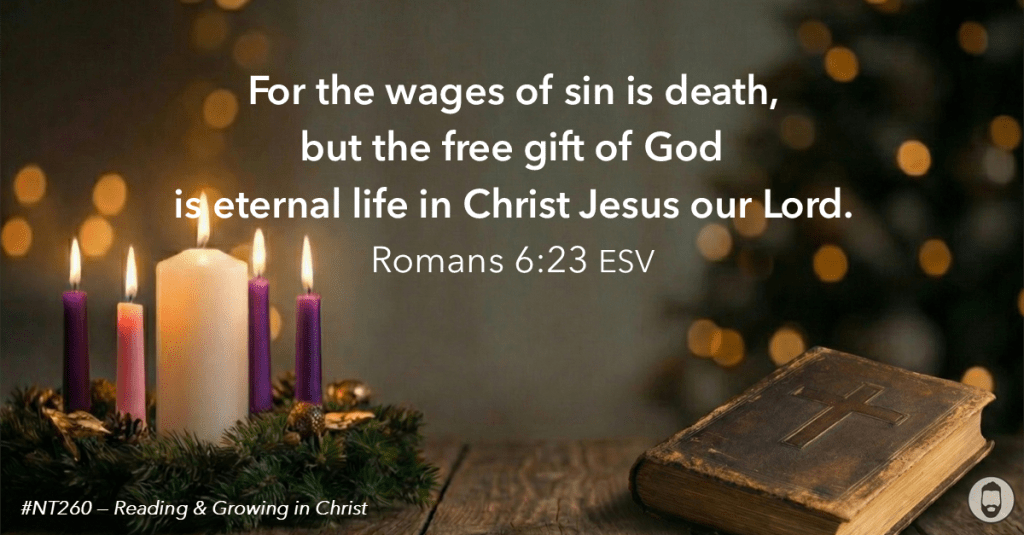
Paul pushes the point further: being “under grace” does not mean we can casually sin (v. 15). Everyone is serving a master—either sin (which leads to death) or obedience (which leads to righteousness) (v. 16). But Christians have been changed from the inside out. We were slaves to sin, but God has made us obedient from the heart to the gospel-shaped pattern of teaching, and we’ve been set free to become slaves of righteousness (vv. 17–18). Sin’s path produces shame and ends in death, but serving God bears fruit that leads to sanctification, and its end is eternal life (v. 21–22). Paul ends with a famous contrast: sin pays wages—death—but God gives a gift—eternal life in Christ Jesus our Lord (v. 23; cf. Eph. 2:8–9).

🌀 Reflection:
Where do you feel sin trying to “reign” again—your thoughts, temper, habits, secret compromises (v. 12)? Don’t argue with it like it’s your master. In Christ, you’ve died and risen to a new life—so start today by believing what God says is true: you are alive to Him (v. 11).

🎄 Christmas Reflection:
Christmas celebrates more than Jesus coming into the world—it celebrates why He came. The Son of God was born so that we could die to sin and live to God. The manger points forward to a cross and an empty tomb, where Jesus breaks sin’s power and gives new life to all who are united to Him. Because Christ has come, grace doesn’t just forgive us—it raises us to walk in newness of life (vv. 4, 11).

💬 Mission Challenge:
Tell someone this week that grace doesn’t just forgive—it frees. Share Romans 6:23 and explain the difference between what sin pays (“wages”) and what God gives (“free gift”), and invite them to trust Christ for new life (v. 23, 5:8–9).

Click here to return to the contents page for Phase 2.3 — The Savior, His Church, and the Mission.
Romans 5 on 12/24 | NT260 — Reading & Growing in Christ

Click here for Romans 5 audio:


Read it. Pray it. Share it. Live it.

Because we have been justified by faith, we now have peace with God through Jesus—not just a calm feeling, but a real change in our relationship with God where the hostility of sin is ended (vv. 1, 10–11). Through Christ we have access into grace and a secure place to stand, and that security produces hope—the certain expectation that we will share in the glory God has promised (v. 2). Even our sufferings aren’t meaningless for the believer. God uses them to form endurance, proven character, and deeper hope (vv. 3–4). And this hope will not put us to shame on the day of judgment, because God has already poured His love into our hearts through the Holy Spirit (v. 5; cf. Eph. 1:13–14).

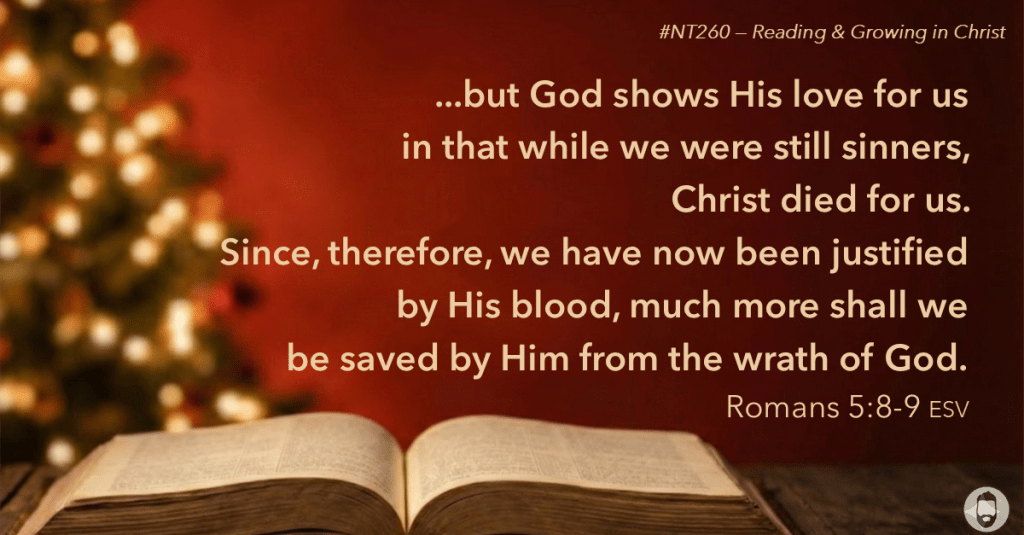
Paul grounds that inner assurance in a rock-solid, historical proof: Christ died for us while we were still weak, ungodly, and sinners (vv. 6–8). Human love might rarely die for someone “good,” but God’s love is in a category all its own—Jesus died for enemies (v. 10). That’s why Paul argues “much more”: if God has already justified us by Christ’s blood and reconciled us through His death, we can be confident He will finish what He started—saving us from wrath and keeping us by Christ’s resurrected life (vv. 9–10; cf. 4:25). So our boasting isn’t in ourselves; it’s in God, because we have received reconciliation through our Lord Jesus Christ (v. 11).

Then Paul widens the lens to show why this hope is so sure: everyone is either in Adam or in Christ. Through Adam, sin entered the world and death spread to all (vv. 12, 14). Adam’s one trespass brought condemnation, and the law later highlighted and even multiplied our trespasses by exposing sin more clearly (vv. 16, 20). But Christ is the “second Adam”—and His gift is not like Adam’s trespass. Where Adam’s one act brought death’s reign, Christ’s one act of righteousness and obedience brings an abundance of grace, justification, and life to all who receive Him by faith (vv. 15–19). Sin once reigned in death, but grace now reigns through righteousness leading to eternal life through Jesus Christ our Lord (v. 21).

🌀 Reflection:
Where do you feel most “weak” right now—tired, tempted, anxious, discouraged? Romans 5 doesn’t tell you to prove yourself to God; it tells you to look at the cross. If God loved you when you were His enemy, you don’t have to wonder whether He’ll hold you now as His child (vv. 8–10).

🎄 Christmas Reflection:
On Christmas Eve, we remember that God’s love did not begin at the cross—it moved toward the cross through the cradle. The child born in Bethlehem came for the weak, the ungodly, and the undeserving. Christmas proclaims that God did not wait for us to love Him first; He came near while we were still sinners, to make peace and give us hope that will never put us to shame (vv. 6–8).

💬 Mission Challenge:
Share Romans 5:8 with someone today and put it in plain words: “God didn’t wait for me to get better—Jesus came for me when I was still a sinner.” Invite them to receive the free gift of grace and life found in Christ (vv. 15–17, 21).


Click here to return to the contents page for Phase 2.3 — The Savior, His Church, and the Mission.


Romans 4 on 12/23 | NT260 — Reading & Growing in Christ

Click here for Romans 4 audio:


Read it. Pray it. Share it. Live it.

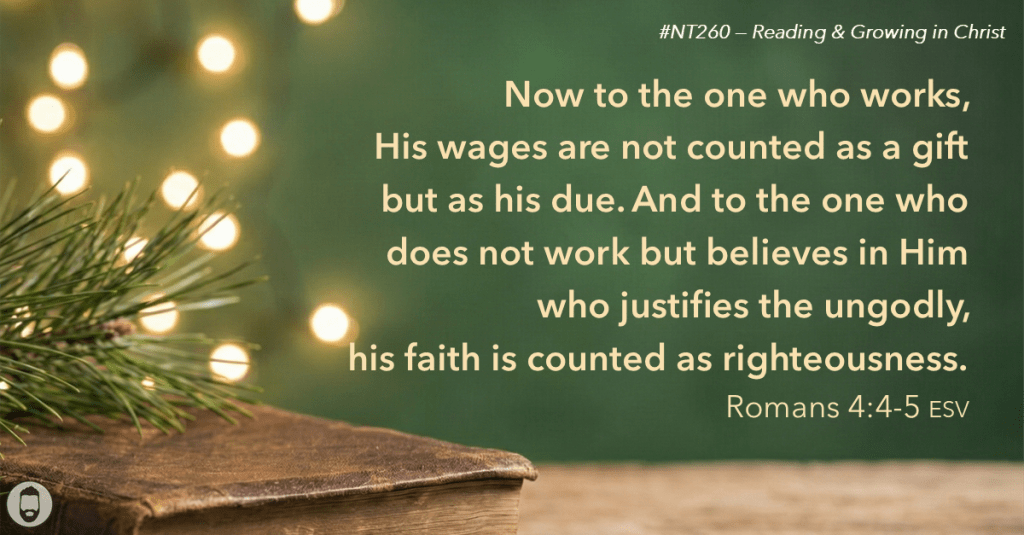
Paul points to Abraham—the great father of Israel—to prove that God has always made sinners right with Him by faith, not by works. If Abraham had been justified by what he did, he could boast. But Scripture says the opposite: “Abraham believed God, and it was counted to him as righteousness” (vv. 2–3, Gen. 15:6). Paul explains the difference with a simple picture: wages are earned, but a gift is received. That’s why the gospel is so shocking—and so hopeful—God “justifies the ungodly” who stop trying to earn righteousness and instead trust Him (vv. 4–5). David backs this up by celebrating the blessedness of forgiven people whose sins are not counted against them (vv. 6–8, Ps. 32:1–2).

Then Paul tackles circumcision, because many assumed the outward sign was the doorway into God’s blessing. But the timeline matters: Abraham was counted righteous before he was circumcised (vv. 9–10). Circumcision was a sign and seal of a righteousness he already had by faith, not the cause of it (v. 11). That means Abraham is the father of all who believe—Gentiles who believe without circumcision and Jews who are not merely marked outwardly but who “walk in the footsteps” of Abraham’s faith (vv. 11–12).

Paul goes further: the promise didn’t come through the law (which arrived centuries later) but through the righteousness of faith (v. 13). If inheritance came through law-keeping, faith would be emptied and the promise would collapse, because the law exposes sin and brings wrath on lawbreakers (vv. 14–15). That’s why the promise rests on grace and is guaranteed through faith, so it can include all Abraham’s offspring—Jew and Gentile alike (vv. 16–17). Abraham’s faith wasn’t denial of reality; he faced his aged body and Sarah’s barrenness, yet trusted God’s power to give life and keep His word (vv. 18–21). That same kind of faith is what God counts as righteousness for us as we believe in Him who raised Jesus—“delivered up for our trespasses and raised for our justification” (vv. 22–25).

🌀 Reflection:
Romans 4 presses a hard question: are you treating God like an employer who pays wages, or like a Father who gives grace? Real faith lays down boasting, stops bargaining, and simply trusts God to do what He promised in Christ (vv. 4–5, 20–21).

🎄 Christmas Reflection:
At Christmas, we celebrate a gift that cannot be earned. Jesus is not a reward for good behavior but God’s gracious answer to human helplessness. Just as Abraham believed God’s promise against all odds, we are called to receive Christ the same way—not by working, but by trusting. The birth of Jesus declares that salvation has always been, and will always be, by grace through faith (vv. 4–5, 16).

💬 Mission Challenge:
Encourage someone who feels “too far gone” by sharing the heart of Romans 4: God justifies the ungodly who believe. Tell them you don’t clean yourself up to come to Jesus—you come to Jesus to be made new (vv. 5, 24–25).


Click here to return to the contents page for Phase 2.3 — The Savior, His Church, and the Mission.

Romans 3 on 12/22 | NT260 — Reading & Growing in Christ

Click here for Romans 3 audio:


Read it. Pray it. Share it. Live it.

Paul continues answering objections from his Jewish dialogue partner. Yes, the Jews had real advantages—chiefly that they were entrusted with the very words of God (vv. 1–2). Yet Israel’s unfaithfulness does not cancel God’s faithfulness. God remains true, righteous, and just in His judgments, even when every human proves false (vv. 3–6). Paul also rejects the twisted logic that says sin should be excused because it “shows” God’s righteousness or “brings” Him glory; that argument is slander against the gospel, and it deserves condemnation (vv. 7–8).

Then Paul delivers the courtroom verdict on all humanity: Jews and Gentiles alike are under sin—no one is righteous, no one seeks God, and sin reaches into our words, our actions, and even our inner posture toward the Lord (vv. 9–18). The law does not provide a ladder to climb into God’s favor; it speaks to expose guilt, silence excuses, and hold the whole world accountable (v. 19). That’s why no human being will be justified by works of the law—because the law’s role is to reveal sin, not remove it (v. 20).

But now—after the guilty verdict—God reveals His saving righteousness apart from the law, though the Old Testament always pointed to it (v. 21). This right standing with God comes through faith in Jesus Christ for all who believe, because all have sinned and fall short of God’s glory (vv. 22–23). We are justified by grace as a gift through the redemption found in Christ, whom God put forward as the atoning sacrifice—satisfying God’s wrath and dealing with our sins (vv. 24–25). In the cross, God shows Himself to be both just and the One who justifies the sinner who trusts Jesus (v. 26). Therefore, boasting is excluded; Jew and Gentile are saved the same way—by faith—and this faith does not overthrow the law but upholds it by fulfilling its purpose: exposing sin and pointing us to Christ (vv. 27–31).

🌀 Reflection:
Romans 3 knocks the last prop out from under self-reliance. If the law can only expose our sin, then our hope can’t be our effort—it must be God’s gift. Are you resting today in what Christ has done, or still trying to earn what can only be received by faith (vv. 24–26)?

🎄 Christmas Reflection:
Christmas reminds us that God did not wait for humanity to fix itself before acting. When every mouth was silenced and every heart exposed as guilty, God sent His Son into the world—not to condemn it, but to save it. The child in the manger is God’s answer to the verdict of Romans 3: we cannot make ourselves righteous, so God came to give righteousness as a gift through Jesus Christ (vv. 21–24).

💬 Mission Challenge:
Share the “But now…” of the gospel with someone this week: you can’t justify yourself, but God justifies sinners freely by grace through faith in Jesus (vv. 21–24).


Click here to return to the contents page for Phase 2.3 — The Savior, His Church, and the Mission.


Romans 2 on 12/21 | NT260 — Reading & Growing in Christ

Click here for Romans 2 audio:


Read it. Pray it. Share it. Live it.

After exposing the sin of the Gentile world in Romans 1, Paul turns to those who are quick to judge others. He warns that judging does not place anyone above God’s judgment, because the judge often practices the very same things (vv. 1–3). God’s judgment is always righteous and true, and His kindness, patience, and restraint are not permission to continue in sin but an invitation to repent (v. 4). Those who refuse to repent are not escaping judgment—they are storing it up for the day when God’s righteous judgment will be revealed (v. 5). God will judge each person according to their deeds, showing no favoritism to Jew or Gentile alike (vv. 6–11).

Paul then explains that judgment is based on response to the light a person has received. Gentiles without the written law are still accountable because God’s moral law is written on their hearts, witnessed by conscience (vv. 14–15). Jews, though privileged with God’s law, are not justified by hearing it but by doing it (vv. 12–13). Ultimately, God’s judgment reaches beyond outward actions to the hidden motives and secrets of the heart—and it will be carried out through Jesus Christ (v. 16).

Paul goes on to address Jews directly, exposing the danger of religious confidence without obedience. Having God’s law and teaching it to others is meaningless if it is not lived out (vv. 17–24). Circumcision, the covenant sign, has value only when joined with obedience; without it, the outward sign is empty (v. 25). True belonging to God is not marked by outward identity or ritual but by an inward change—a heart transformed by the Spirit (vv. 28–29). What matters most is not human approval but praise from God.

🌀 Reflection:
Romans 2 presses us to examine not just what we know or how we appear, but who we truly are before God. Where might you be relying on spiritual knowledge, background, or reputation instead of humble repentance and a heart changed by the Spirit (vv. 4, 29)?

💬 Mission Challenge:
Repent intentionally today—thank God for His kindness, confess areas of hidden pride or hypocrisy, and ask the Spirit to keep shaping your heart to match your confession of faith (vv. 4–5).


Click here to return to the contents page for Phase 2.3 — The Savior, His Church, and the Mission.


Romans 1 on 12/20 | NT260 — Reading & Growing in Christ

Click here for Romans 1 audio:


Read it. Pray it. Share it. Live it.

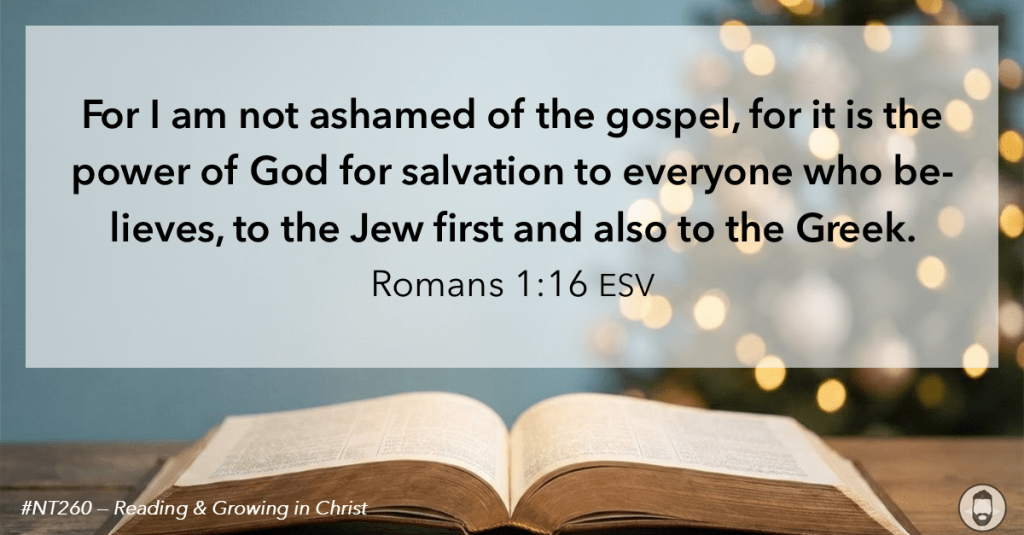
Paul opens Romans by introducing himself as a servant of Christ Jesus, called and set apart for the gospel God promised long ago in the Scriptures (vv. 1–2). That gospel centers on God’s Son—Jesus, the promised King from David’s line and the risen Lord declared to be the Son of God in power (vv. 3–4). Paul writes to believers in Rome (whom he hasn’t met yet) with gratitude for their faith and with a deep desire to visit so they can strengthen and encourage one another (vv. 8–12). He feels a holy obligation to take the good news to all kinds of people, and he’s eager to preach it in Rome too (vv. 13–15). Then he states the heartbeat of the letter: the gospel is God’s power to save everyone who believes, revealing God’s righteousness from start to finish by faith (vv. 16–17).

Right away, Paul also explains why the world needs saving. God’s wrath is being revealed against human sin because people suppress the truth and refuse to honor and thank the Creator, even though God’s power and divine nature are clearly seen through what He has made (vv. 18–21). Instead of worshiping God, people exchange His glory for idols—created things in place of the Creator (vv. 22–25). As an act of judgment, God “gave them up” to the consequences of their rebellion, and the result is deep moral confusion and a flood of many kinds of evil—both in actions and in approving what is wrong (vv. 24–32). Romans 1 leaves us with no room for pride: we need rescue, and only God can provide it.

🌀 Reflection:
Where are you tempted to be quiet, careful, or “ashamed” of the gospel—not necessarily in what you say, but in what you avoid? Ask the Lord to renew your confidence that the good news isn’t your power to fix people; it’s God’s power to save (v. 16)—and it starts by turning us from worshiping created things back to worshiping the Creator (v. 25).

💬 Mission Challenge:
Share one simple, gospel-centered sentence with someone this week—who Jesus is and what He does to save—and invite them to read Romans with you (vv. 16–17).


Click here to return to the contents page for Phase 2.3 — The Savior, His Church, and the Mission.