2 Timothy 4 on 2/1 | NT260 — Reading & Growing in Christ

Click here for 2 Timothy 4 audio:


Read it. Pray it. Share it. Live it.

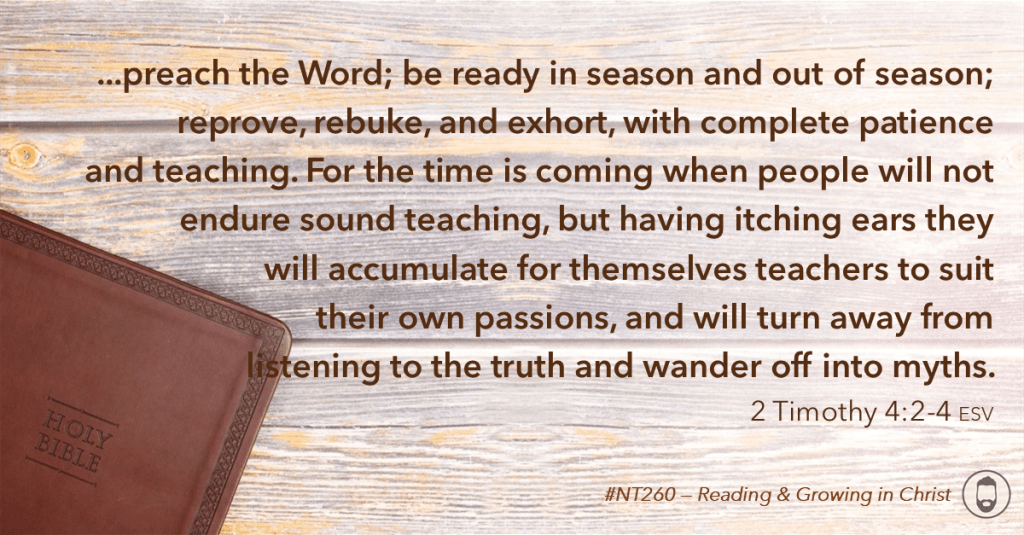
Paul ends this letter with a weighty, end-times charge. Timothy’s ministry happens “in the presence of God and of Christ Jesus,” the coming Judge of all, and under the certainty of Christ’s appearing and kingdom (v. 1). Because of that reality, Timothy must preach the Word — ready when it’s welcome and when it’s not — using Scripture to correct, confront, and encourage with steady patience and careful teaching (v. 2). Paul knows what’s coming (and already happening): many won’t tolerate sound doctrine. Instead, they’ll chase teachers who tell them what they want to hear, swapping truth for myths because their desires are driving the steering wheel (vv. 3–4). So Timothy must stay clear-minded, endure suffering, keep doing gospel work, and finish what God has given him to do (v. 5).

Then Paul explains why the urgency is so intense: he is near the end. He speaks of his life like an offering being poured out, and he says plainly that his “departure” is at hand (v. 6). Looking back, Paul isn’t boasting — he’s testifying to God’s sustaining grace: he fought the good fight, finished the race, and guarded the faith entrusted to him (v. 7; cf. 1:14). Looking ahead, he expects the “crown of righteousness” from the Lord, the righteous Judge — not only for himself, but for all believers who love and long for Christ’s appearing (4:8). In other words: perseverance isn’t for “super-Christians”; it’s what Christ produces in His people as they keep their eyes on His coming kingdom (v. 8).

The final section turns personal, but the themes keep echoing. Paul asks Timothy to come soon, and he names the pain of desertion (Demas loving this present world), the scattering of coworkers to ministry fields, and the comfort of faithful companions like Luke (vv. 9–11). He asks for Mark — proof that past failure doesn’t have to be the final chapter when grace restores (v. 11). Even facing opposition and legal danger, Paul entrusts justice to the Lord (vv. 14–15). And though people abandoned him at his first defense, the Lord did not: Christ stood by him, strengthened him, and kept the gospel moving forward (vv. 16–17). Paul’s confidence is settled: whether by life or by death, the Lord will bring him safely into His heavenly kingdom — so Paul ends where every weary servant needs to end: with worship and grace (vv. 18, 22).

🌀 Reflection:
Where are you most tempted right now to “soften” truth to keep peace — or, on the other side, to speak truth without patience — and how does Paul’s charge call you back to both courage and gentleness (vv. 2–5)?

💬 Mission Challenge:
Pray for one specific person who seems to be drifting toward “itching ears,” then reach out with a kind, non-combative invitation: offer to read a short passage of Scripture together and ask, “What does this show us about Jesus, and what would it look like to obey it?” (vv. 2–4).

Click here to continue reading in our NT260 plan with Phase 3 — Persevering in the Last Day.

2 Timothy 3 on 1/31 | NT260 — Reading & Growing in Christ

Click here for 2 Timothy 3 audio:


Read it. Pray it. Share it. Live it.

Paul tells Timothy to face reality with open eyes: in “the last days” there will be seasons that feel brutal — times of difficulty marked by people who love themselves, money, and pleasure more than God (vv. 1–4). The danger isn’t only obvious wickedness; it’s religion without repentance — “the appearance of godliness” while denying the transforming power of God (v. 5). These influences don’t just stay “out there.” They infiltrate, manipulate, and keep people trapped in an endless cycle of learning without ever coming to a true knowledge of the truth (vv. 6–7). Like the opponents of Moses, these teachers oppose God’s truth, but Paul promises they won’t win forever — God will expose their folly in time (vv. 8–9).

Then Paul turns and says, “You, however…” — Timothy has seen a different pattern in Paul’s life: faithful teaching, steady character, clear purpose, and love that endures suffering (v. 10). Timothy also knows Paul’s story of persecution in Antioch, Iconium, and Lystra, and how the Lord rescued him — not by removing every hardship, but by preserving him and keeping him faithful through it (v. 11). Paul doesn’t sugarcoat it: everyone who desires to live a godly life in Christ Jesus will face opposition, while evil and deception keep intensifying (vv. 12–13). So Timothy must not drift. He must continue in what he has learned, remembering both who taught him and how God used “the sacred writings” to make him wise for salvation through faith in Christ (vv. 14–15).

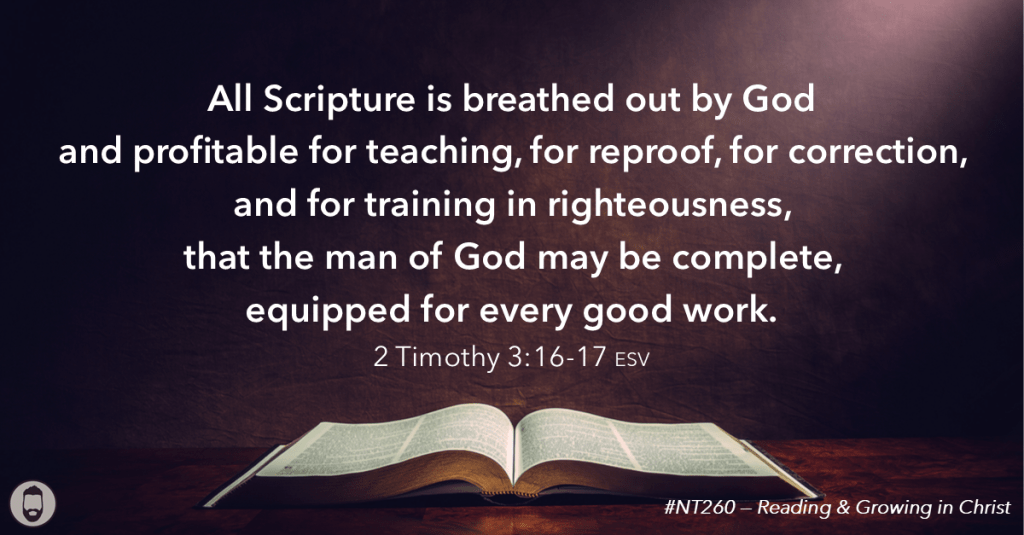
Finally, Paul anchors everything in one of the clearest statements in the Bible about Scripture: All Scripture is breathed out by God and is deeply useful — teaching what is true, exposing what is wrong, correcting what has gone crooked, and training us to live rightly (v. 16). God doesn’t give His Word to fill our heads only; He gives it to form us, mature us, and equip us for the good works He calls us to do (v. 17). In difficult times, the church doesn’t survive by trendiness or toughness — it survives by clinging to Christ through His Word (vv. 15–17).

🌀 Reflection:
Where do you feel the pressure most right now to settle for “the appearance of godliness” instead of real, Spirit-shaped life — and what is one specific way you can “continue” in Scripture this week rather than drifting (vv. 5, 14–17)?

💬 Mission Challenge:
Encourage one person today (a friend, student, family member, or church member) by sharing why God’s Word matters to you, and invite them to read a short passage with you — asking God to use it to teach, correct, and strengthen both of you (vv. 15–17).


Click here to return to the contents page for Phase 2.4 — The Savior, His Church, and the Mission.


2 Timothy 2 on 1/30 | NT260 — Reading & Growing in Christ

Click here for 2 Timothy 2 audio:


Read it. Pray it. Share it. Live it.

Paul calls Timothy to keep going — strong not in his personality or circumstances, but “by the grace that is in Christ Jesus” (v. 1). Then Paul gives a generational mission: Timothy is to pass on what he has received to faithful people who can teach others too (v. 2). This is how the gospel keeps moving when leaders suffer and seasons change. Paul reinforces that ministry will include hardship, and he uses three pictures — soldier, athlete, farmer — to show what faithful service looks like: focused devotion that aims to please the Commander (vv. 3–4), obedience that won’t cut corners (2:5), and steady labor that trusts God for the harvest (vv. 6–7).

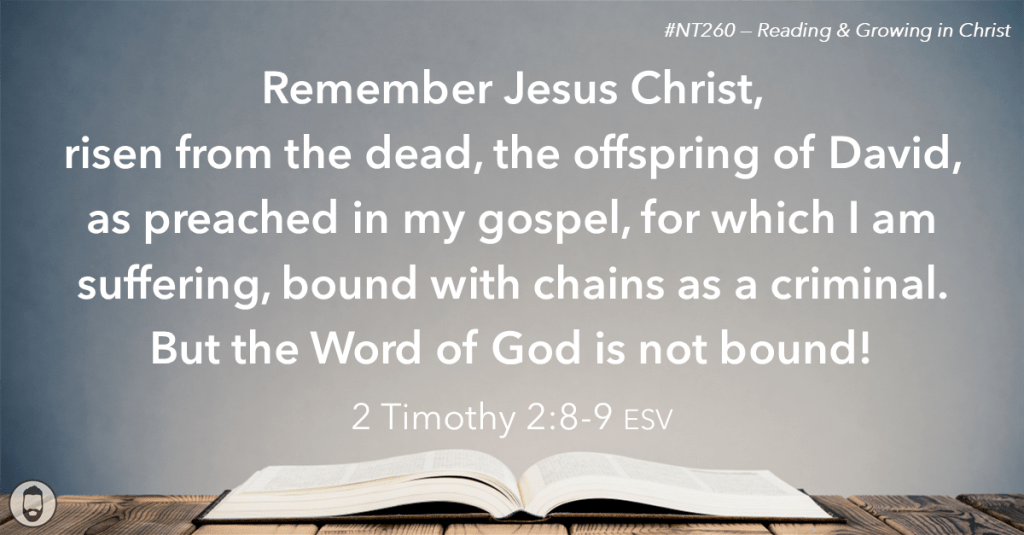
At the center of it all, Paul says: Remember Jesus Christ — risen from the dead, the offspring of David (2:8). Paul may be chained, but God’s word is not (v. 9). So he endures everything so that God’s chosen will obtain salvation with eternal glory (v. 10). Then comes a “trustworthy saying” that both comforts and warns: union with Christ means life beyond death (v. 11), endurance leads to reigning with Him (v. 12), denial is deadly serious (v. 12), and even when we are faithless, God remains faithful to His own character (v. 13). The gospel produces perseverance — and perseverance proves the gospel has truly taken root (vv. 11–13).

From there, Paul turns to how Timothy must lead in a confused and argumentative environment. He must warn the church away from word-quarrels that ruin hearers (v. 14) and instead labor to be “approved,” unashamed, and careful with Scripture — handling the word of truth rightly rather than twisting it (v. 15). False teaching is not harmless; it spreads like disease and can overturn shaky faith, as seen in Hymenaeus and Philetus, who claimed the resurrection had already happened (vv. 16–18). Still, God’s foundation stands: He knows who are His, and those who name Him must depart from sin (v. 19). Paul pictures the church as a great house with different vessels, and urges Timothy (and believers) to cleanse themselves from what is dishonorable so they can be useful, holy, and ready for every good work (vv. 20–21). That means fleeing youthful passions, pursuing Christlike character with other believers, avoiding foolish controversies, and correcting opponents with gentleness — because God can grant repentance and rescue people from the devil’s snare (vv. 22–26).

🌀 Reflection:
Where are you most tempted right now — distraction, shortcuts, or needless arguing — and what would it look like for you to “remember Jesus Christ” and pursue faithfulness with steady endurance (vv. 8, 14–16, 22–25)?

💬 Mission Challenge:
Choose one conversation this week where you would normally “win the argument,” and instead aim to be kind, patient, and gentle while speaking truth clearly — praying that God would use your posture to open a door for repentance (vv. 24–25).


Click here to return to the contents page for Phase 2.4 — The Savior, His Church, and the Mission.


2 Timothy 1 on 1/29 | NT260 — Reading & Growing in Christ

Click here for 2 Timothy 1 audio:


Read it. Pray it. Share it. Live it.

Paul writes to Timothy from prison in this last letter before his martyrdom with the weight of eternity in view. He opens by reminding Timothy that his apostleship — and Timothy’s calling — rests on “the promise of the life that is in Christ Jesus” (v. 1). Though chained and nearing death, Paul expresses deep affection and gratitude for Timothy, recalling his tears, his sincere faith, and the godly heritage passed down through his grandmother Lois and his mother Eunice (vv. 3–5). This faith, Paul insists, is living and active, meant to be stirred and strengthened, not allowed to fade (v. 6).

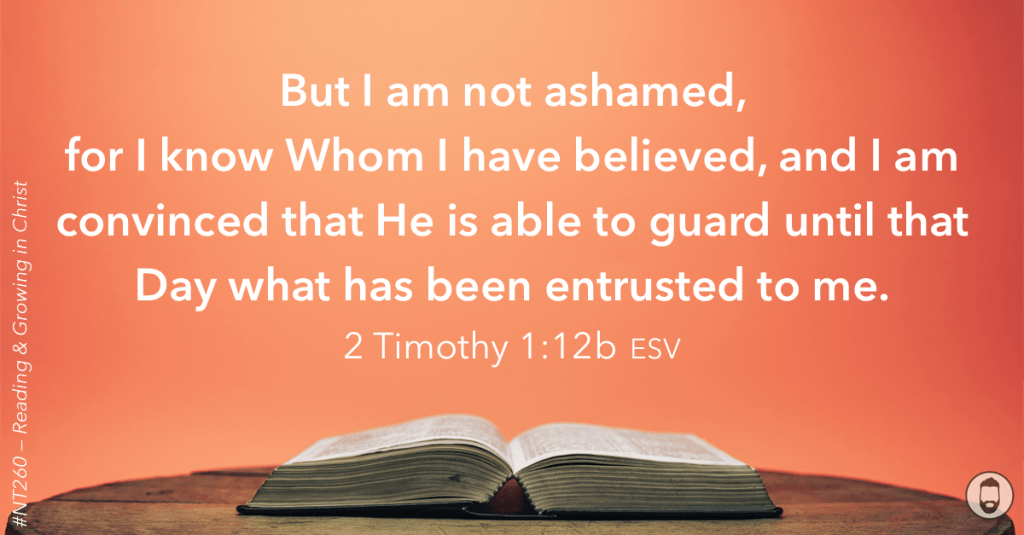
Paul urges Timothy toward bold endurance. God has not given His people a spirit of fear, but of power, love, and self-control — strength that comes from the Holy Spirit, not personal resolve (v. 7). Because of this, Timothy must not be ashamed of the gospel or of Paul’s imprisonment, but must be willing to suffer for the gospel by God’s power (1:8). Paul grounds this call in the heart of the gospel itself: salvation is rooted in God’s eternal purpose and grace, revealed in Christ, who has broken the power of death and brought life and immortality to light (vv. 9–10). Paul’s own suffering flows from this calling, yet he remains unashamed because he knows whom he has believed and trusts God to guard what has been entrusted to Him until the final day (vv. 11–12).

Paul then charges Timothy to hold firmly to the pattern of sound teaching he has received and to guard the gospel deposit by the Holy Spirit who dwells within believers (vv. 13–14). The chapter closes with real-life examples — some who deserted Paul out of fear, and one faithful servant, Onesiphorus, who courageously sought Paul out and refreshed him without shame (vv. 15–18). Faithfulness, Paul shows, is costly — but it is sustained by God’s power and crowned with mercy on “that day.”

🌀 Reflection:
Where might fear, discouragement, or pressure be tempting you to shrink back from faithfulness — and how does God’s promise of power, love, and self-control speak into that place (vv. 6–8)?

💬 Mission Challenge:
Encourage a fellow believer who is serving faithfully but unseen — send a message, offer prayer, or show practical support, following the example of Onesiphorus (vv. 16–18).


Click here to return to the contents page for Phase 2.4 — The Savior, His Church, and the Mission.