
1 Peter 5 on 2/22 | NT260 — Reading & Growing in Christ

Click here for 1 Peter 5 audio:


Read it. Pray it. Share it. Live it.

Peter closes his letter by speaking first to the leaders of the church—especially important when believers are suffering. He urges the elders/pastors to shepherd God’s flock with the right heart: not forced into the work, not chasing money, and not using authority to dominate, but serving willingly, eagerly, and visibly as examples (vv. 1–3). The church doesn’t belong to the pastors—it’s “the flock of God” (v. 2). And Peter lifts their eyes to the finish line: when the Chief Shepherd—Jesus—appears, faithful shepherds/pastors will receive an unfading crown of glory (v. 4; cf. John 21:15–17). Then Peter speaks to the whole church: younger believers are to respect and submit to godly leadership, and everyone is to “clothe” themselves with humility toward one another, because God opposes proud hearts but gives grace to the humble (v. 5; cf. Proverbs 3:34, James 4:6).

That humility shows up in two very practical ways. First, we humble ourselves “under the mighty hand of God,” trusting that His timing is wise—even when the season is painful—and that He will lift up His people at the proper time (v. 6). Second, we cast our anxieties on Him, because He truly cares for us (v. 7; cf. Psalm 55:22). Peter doesn’t call suffering Christians to denial or bravado; he calls them to trust. But he also calls them to vigilance. Be sober-minded and watchful because the devil is real and relentless—like a roaring lion looking for someone to devour (v. 8). The way we resist him isn’t with special formulas, but by standing firm in the faith—anchored in God’s truth—remembering we’re not alone; believers around the world face the same kinds of suffering (v. 9; cf. Ephesians 6:10–18).

Peter ends with a promise that feels like a deep breath: after we’ve suffered “a little while,” the God of all grace—who called us to eternal glory in Christ—will Himself restore, confirm, strengthen, and establish us (v. 10). Suffering is real, but it is not forever, and it is not the final word (vv. 10–11). In his closing lines, Peter says he’s written to testify to “the true grace of God”—and his final command is simple and steady: stand firm in it (v. 12). He sends greetings from “Babylon” (a veiled way of speaking about Rome) and from Mark—closely connected to Peter—and closes with a call to warm affection in the church and a blessing of peace for all who are in Christ (vv. 13–14).

🌀 Reflection:
What anxiety are you still gripping like it’s yours to carry? Humility doesn’t just bow low—it lets go, handing the weight to the Father who cares (vv. 6–7).

💬 Mission Challenge:
Encourage a fellow believer who is suffering: send a message, make a call, or show up in person—and remind them (and yourself) that they’re not alone, and that God will restore and strengthen His people (vv. 9–10).

Continue reading in our NT260 plan in the rest of Phase 3 — Persevering in the Last Day.

1 Peter 4 on 2/21 | NT260 — Reading & Growing in Christ

Click here for 1 Peter 4 audio:


Read it. Pray it. Share it. Live it.

Peter calls suffering believers to think like Jesus. Since Christ suffered in the flesh, we “arm” ourselves with the same mindset: obedience to God is worth the cost (v. 1). When we’re willing to suffer rather than sin, it reveals a real break with our old way of life—we’re no longer living for human passions but for the will of God (vv. 1–2). Peter is blunt about what that old life looked like: sensuality, drunkenness, wild living, and idolatry (v. 3). And when you stop running with the crowd, the crowd notices. They may be shocked, offended, and even malicious—because your new life quietly exposes what they still love (v. 4). But Peter reminds us: the final verdict doesn’t belong to critics; everyone will give account to the Judge of the living and the dead (v. 5). Even Christians who have since died are not “lost” or disproven—death doesn’t cancel the gospel. Though judged in the flesh like all people (they die), they live in the spirit by God’s power (v. 6).

Because “the end of all things is at hand,” Peter doesn’t tell the church to panic—he tells them to pray. Be self-controlled and sober-minded so your prayers aren’t choked out by frenzy, fear, or distraction (v. 7). Then he turns to what sustains a church under pressure: earnest love that’s quick to forgive and slow to keep score (v. 8; cf. Proverbs 10:12). Keep opening your lives and your homes—hospitality without grumbling—because suffering has a way of making people either selfish or sacrificial (v. 9). And don’t hoard your gifts. God has given every believer grace to steward—some in speaking, some in serving—so that the whole body is strengthened and, in the end, God gets the glory through Jesus Christ (vv. 10–11; cf. Romans 12:6–8, 1 Corinthians 12:4–7).

Finally, Peter addresses the “fiery trial” head-on. Don’t treat persecution as strange, accidental, or unfair—as though something random is happening (v. 12). If you suffer because you belong to Christ, you are blessed, and the Spirit of glory rests upon you (vv. 13–14). But Peter also insists we examine ourselves: don’t suffer as an evildoer—or even as a meddler—because there is no honor in suffering for sin (v. 15). Yet if you suffer “as a Christian,” don’t be ashamed; glorify God in that name (v. 16). Peter frames these trials as a purifying “judgment” that begins with God’s household—not condemnation, but refining (vv. 17–18; cf. Ezekiel 9:1–6, Malachi 3:1–4). And he closes with the posture that sums up the letter: keep doing good, and entrust your soul to a faithful Creator—depositing yourself with God for safe keeping, just as Jesus did (v. 19; cf. 2:23).

🌀 Reflection:
Where are you most tempted to blend in so you won’t be misunderstood—or to lash out when you are? Ask the Lord for Christ’s mindset: a steady resolve to obey God even when it costs you (vv. 1–2, 16, 19).

💬 Mission Challenge:
Use your gift to serve the church this week: encourage someone with God’s Word or meet a practical need—do it intentionally “by the strength that God supplies,” so God gets the glory (vv. 10–11).


Continue reading in our NT260 plan in the rest of Phase 3 — Persevering in the Last Day.

1 Peter 3 on 2/20 | NT260 — Reading & Growing in Christ

Click here for 1 Peter 3 audio:


Read it. Pray it. Share it. Live it.

Peter continues showing how exiles live out the gospel in everyday relationships. Wives are called to a respectful, pure, Christ-first posture toward their own husbands—so that even an unbelieving husband might be “won without a word” by a life that quietly shows the beauty of the gospel (vv. 1–2). Peter isn’t banning hairstyles, jewelry, or nice clothes; he’s warning against living for appearances and urging a deeper beauty—the “hidden person of the heart,” marked by a gentle and quiet spirit that God calls precious (vv. 3–4). He points to holy women who “hoped in God” as examples, including Sarah’s respectful honor toward Abraham, and he calls wives to do good without being controlled by fear (vv. 5–6). Husbands, meanwhile, are commanded to live with their wives in an understanding way—honoring them, protecting rather than intimidating, and remembering they are spiritual equals: “heirs with you of the grace of life” (v. 7; cf. Genesis 1:27, Galatians 3:28). A husband’s neglect here doesn’t just harm his marriage—it can hinder his prayers (v. 7).

From the home, Peter widens to the whole church: unity of mind, sympathy, brotherly love, tender hearts, and humility—especially when suffering hits (v. 8). Instead of paying back insult for insult, believers are called to bless, because we ourselves were called by grace and will receive God’s blessing (v. 9). Peter roots this in Psalm 34: real “good days” aren’t found by winning every conflict, but by guarding the tongue, turning from evil, pursuing peace, and living under the attentive eyes and ears of the Lord (vv. 10–12; cf. Psalm 34:12–16). Even so, doing good doesn’t guarantee we won’t suffer. But if we suffer for righteousness, we are blessed—so we refuse fear, honor Christ as Lord in our hearts, and stay ready to explain the hope we have with gentleness and respect (vv. 13–16; cf. Isaiah 8:12–13). Peter’s logic is simple: it’s better to suffer for doing good (if God wills it) than to suffer for doing evil (v. 17).

Then Peter anchors everything in Jesus. Christ suffered once for sins—the righteous for the unrighteous—to bring us to God (v. 18). His unjust suffering was not defeat but the pathway to victory: resurrection, proclamation of triumph over evil powers, and ascension to God’s right hand where all authorities are subject to Him (vv. 18–22). Peter connects Noah’s day to baptism: just as God saved a small remnant through judgment, baptism points to salvation—not by washing dirt off the body, but as an appeal/pledge to God for a good conscience, grounded in the resurrection of Jesus Christ (vv. 20–21; cf. Titus 3:5, Ephesians 2:8). So when believers are slandered or pressured, we remember: the risen Jesus reigns, and our suffering will not be the final word (v. 22).

🌀 Reflection:
When you feel misunderstood or mistreated, what’s your “default response”—retaliation, fear, silence, or steady hope? Ask the Lord to make your life (and your words) a calm, clear witness that honors Christ as holy—even under pressure (vv. 9, 14–16).

💬 Mission Challenge:
Bless someone who has been sharp with you: pray for them by name, speak well of them where you normally wouldn’t, and look for one concrete way to do them good this week (vv. 9, 11; cf. Romans 12:17–21).


Continue reading in our NT260 plan in the rest of Phase 3 — Persevering in the Last Day.

1 Peter 2 on 2/19 | NT260 — Reading & Growing in Christ

Click here for 1 Peter 2 audio:


Read it. Pray it. Share it. Live it.

Peter begins with the basic rhythm of Christian growth: put off what destroys love and community—malice, deceit, hypocrisy, envy, slander—and crave what nourishes new life (vv. 1–2). Like a newborn who wants milk, believers should hunger for the “pure spiritual milk” of God’s Word, because the Word is how God grows His people up in salvation (v. 2; cf. 1:23–25). And if we’ve truly “tasted that the Lord is good,” that hunger won’t feel forced—it will feel like the normal appetite of someone made new (v. 3; cf. Psalm 34:8).

Then Peter lifts our eyes to who we are together in Christ. Jesus is the living Stone—rejected by people but chosen and precious to God—and everyone who comes to Him is being built into God’s new temple: living stones becoming a spiritual house and a holy priesthood offering spiritual sacrifices through Jesus (vv. 4–5). Christ is the cornerstone God laid in Zion, the One who will never shame those who trust Him (v. 6; cf. Isaiah 28:16). But the same Stone becomes a stumbling block to those who reject Him, fulfilling Scripture (vv. 7–8; cf. Psalm 118:22, Isaiah 8:14). For believers, though, the identity is stunning: a chosen race, a royal priesthood, a holy nation, God’s own possession—rescued from darkness into light so we can proclaim His excellencies (vv. 9–10; cf. Exodus 19:5–6, Hosea 2:23).

Because we belong to God, we live differently in a world that treats us like outsiders. As sojourners and exiles, we must fight the inward war—refusing sinful desires that wage war against the soul—and aim for outward witness: honorable conduct that even enemies can’t ignore (vv. 11–12; cf. Matthew 5:16). Peter applies that exile-witness to everyday life: submit to governing authorities “for the Lord’s sake,” do good to silence foolish accusations, and live as free people who use freedom to serve God (vv. 13–17; cf. Romans 13:1–7). He also speaks to those with the least social power—servants suffering unjustly—calling them to endure with God in view, because this is part of the Christian calling (vv. 18–20). And here’s the heart: we endure by looking at Jesus—sinless, non-retaliating, entrusting Himself to the just Judge—who not only modeled righteous suffering but bore our sins on the tree to free us from sin and bring us to righteousness (vv. 21–24; cf. Isaiah 53:5–9, Deuteronomy 21:22–23, Romans 12:19). Once we were wandering sheep, but now we’ve returned to the Shepherd and Overseer of our souls (v. 25; cf. Isaiah 53:6, John 10:11).

🌀 Reflection:
Where are you most tempted to “blend in” as an exile—by feeding old sins, chasing comfort, or answering hostility with retaliation? Ask the Shepherd to re-align your life with the Cornerstone so your choices make His light visible (vv. 1–3, 11–12, 21–23).

💬 Mission Challenge:
Do good on purpose today: choose one practical act of kindness toward someone who may misunderstand you, criticize you, or overlook you—and do it “for the Lord’s sake,” praying God uses it to point them to Him (vv. 12, 15–16).


Continue reading in our NT260 plan in the rest of Phase 3 — Persevering in the Last Day.

1 Peter 1 on 2/18 | NT260 — Reading & Growing in Christ

Click here for 1 Peter 1 audio:


Read it. Pray it. Share it. Live it.

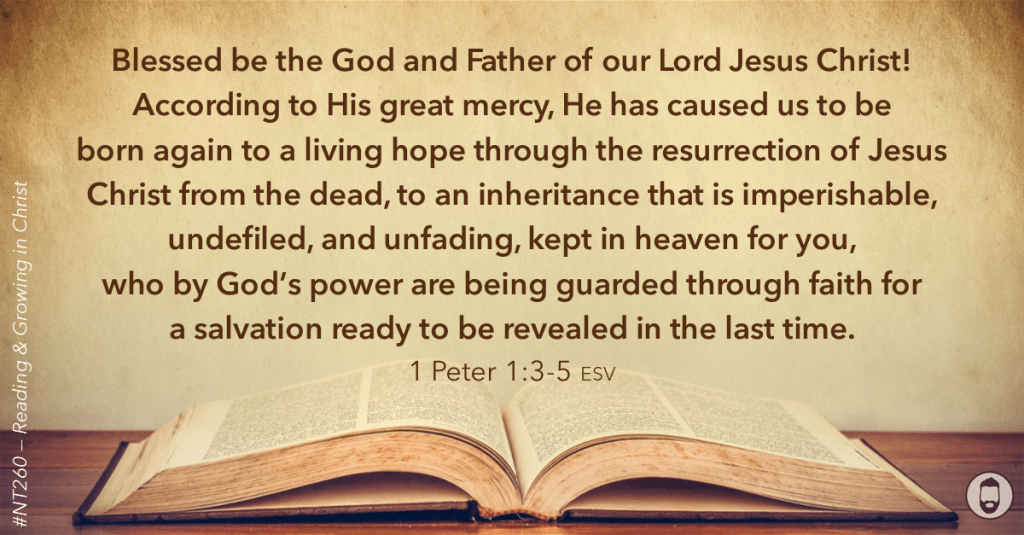
Peter writes to believers who are “elect exiles”—chosen by God, yet scattered in a world that doesn’t fully feel like home (vv. 1–2). Their salvation is the work of the triune God: the Father set His covenant love on them beforehand, the Spirit set them apart as God’s holy people, and the Son brought them into the covenant through His cleansing blood (v. 2; cf. Exodus 24:3–8). Because of God’s great mercy, they have been born again into a living hope through the resurrection of Jesus—an unbreakable future inheritance that cannot perish, stain, or fade, guarded in heaven while God also guards them by His power through faith until that salvation is fully revealed when Christ returns (vv. 3–5).

That sure hope doesn’t erase suffering, but it changes what suffering means. Trials are real and painful, yet temporary, and God uses them like fire that refines gold—proving faith genuine and preparing believers for praise, glory, and honor at Jesus’s revelation (vv. 6–7). Even without seeing Jesus now, Christians love Him, trust Him, and rejoice with a joy that is deeper than circumstances because the gospel is already bringing them toward the “outcome” God promised—full salvation (vv. 8–9). This salvation was the long-awaited plan of God: the prophets searched and spoke of the sufferings of Christ and the glories to follow, and now, by the Holy Spirit, that good news has been announced to us—so amazing that even angels long to look into it (vv. 10–12).

Because this future grace is certain, Peter calls believers to live like who they are in Christ. They must set their hope fully on Christ’s return, fight the old desires of former ignorance, and pursue holiness because their Father is holy (vv. 13–16; cf. Leviticus 19:2). And they should walk with reverent fear—not dread, but awe and seriousness—because they were ransomed from empty ways not with silver or gold but with the precious blood of Christ, the spotless Lamb planned before the foundation of the world and revealed “for your sake” (vv. 17–21; cf. Exodus 12, Isaiah 53:7, John 1:29). Having been born again through God’s living, abiding word, Christians are to love one another earnestly from a pure heart—because people fade like grass, but the Word that preached the gospel to us endures forever (vv. 22–25; cf. Isaiah 40:6–8).

🌀 Reflection:
Where have you been acting like this world is your permanent home—letting fear, old desires, or pressure shape you more than your living hope? Ask the Lord to steady your heart in your “exile” and to make your life look like someone ransomed by Jesus’s precious blood (vv. 14–19).

💬 Mission Challenge:
Encourage an “exile” today: text or call someone who is weary or suffering and point them to their living hope in the risen Jesus—reminding them that God is guarding them and their inheritance until Christ returns (vv. 3–5, 7).


Continue reading in our NT260 plan in the rest of Phase 3 — Persevering in the Last Day.