Today’s post includes a brief overview of the chapter and a focused look at what it reveals about Jesus (Rev. 1:1) — so our eyes stay fixed on Him.
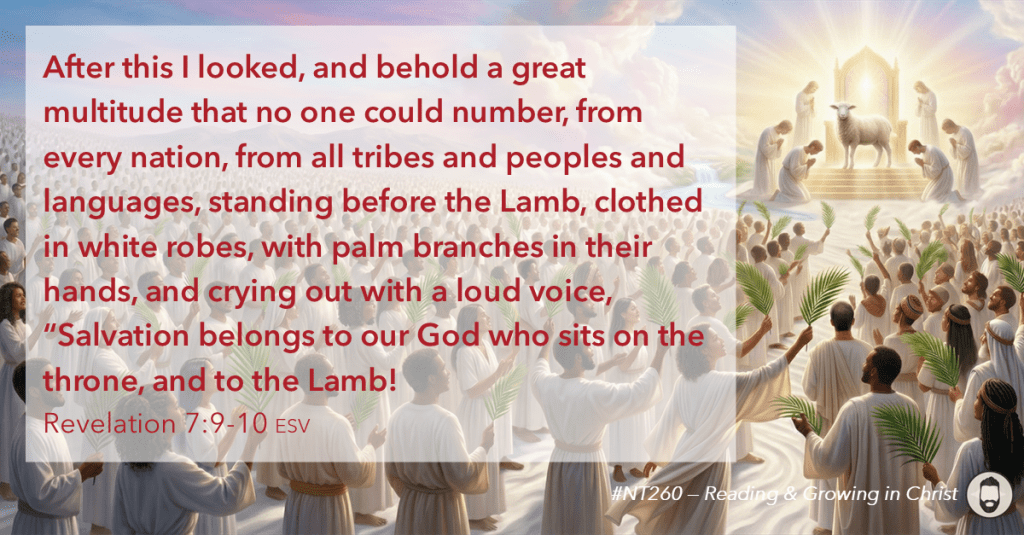
Chapter Overview: Revelation 7 pauses between the sixth and seventh seals to answer the question, “Who can stand?” (6:17). Before judgment continues, God seals His servants, symbolizing His ownership and protection over them (7:1–3). John hears of 144,000 sealed from the tribes of Israel (7:4–8), then sees a great multitude from every nation standing before the throne and the Lamb, worshiping and declaring that salvation belongs to God (7:9–10). These are those who have come out of great tribulation, cleansed by the blood of the Lamb, now serving God and experiencing His presence, provision, and comfort forever (7:14–17).
Seeing Jesus in This Chapter: Revelation 7 shows Jesus as the Lamb who saves, shepherds, and secures His people. Those standing before the throne are there because of Him — they have washed their robes and made them white in His blood (7:14). Salvation belongs not to human effort, but to God and to the Lamb (7:10). And this Lamb is not only Savior — He is also Shepherd. He leads His people, provides for them, and brings them to springs of living water (7:17). In Him, suffering gives way to comfort, hunger to fullness, and sorrow to joy. The Lamb who was slain now reigns, and His people are safe with Him forever, held securely in His presence and care.
🌀 Reflection: Jesus doesn’t just save His people — He keeps them and cares for them. How does that truth give you hope in the middle of difficulty or uncertainty?
💬 Mission Challenge: Encourage someone today with the hope that Jesus is both Savior and Shepherd, and He will never let His people go.
Today’s post includes a brief overview of the chapter and a focused look at what it reveals about Jesus (Rev. 1:1) — so our eyes stay fixed on Him.
Chapter Overview: Revelation 6 shows the Lamb opening the first six seals of the scroll, unleashing a series of judgments on the earth (vv. 1–17). The first four seals reveal riders on horses symbolizing conquest, war, famine, and death — forces allowed by the Lamb to bring judgment on a broken world (vv. 1–8). The fifth seal reveals the souls of martyrs crying out for justice, and they are told to rest until God’s purposes are complete (vv. 9–11). The sixth seal brings cosmic upheaval — earthquakes, darkened skies, and collapsing creation — causing people of every status to hide in fear, recognizing that the day of God’s wrath has come (vv. 12–17).
Seeing Jesus in This Chapter: Revelation 6 reveals Jesus as the sovereign Judge who carries out God’s righteous justice. The Lamb is the One opening the seals, showing that even judgment is under His authority and unfolds according to His will (v. 1). The chaos of conquest, war, famine, and death is not outside His control — it is permitted and directed as part of God’s purposes (vv. 2–8). He hears the cries of His people who have suffered and been killed for their faith, assuring them that justice will come in His perfect timing (vv. 9–11). And when judgment fully breaks in, people recognize that it is not random — it is “the wrath of the Lamb” (v. 16). This is the same Jesus who was slain in love, now revealed as the righteous Judge. His holiness demands justice, and His authority ensures that evil will not have the final word.
🌀 Reflection: The same Jesus who saves is also the One who judges. How does that truth shape the way you view sin, justice, and your need for grace?
💬 Mission Challenge: Turn from any known sin today and thank Jesus for saving you from the judgment you deserve.
Today’s post includes a brief overview of the chapter and a focused look at what it reveals about Jesus (Rev. 1:1) — so our eyes stay fixed on Him.
Chapter Overview: Revelation 5 continues the heavenly scene as a scroll in God’s hand is introduced, but no one is found worthy to open it (vv. 1–4). John weeps until he is told that the Lion of Judah has conquered (v. 5). When he looks, he sees a Lamb standing as though slain, who alone is worthy to take the scroll (vv. 6–7). As the Lamb takes it, heaven erupts in worship — first from the elders and living creatures, then from countless angels, and finally from all creation — declaring His worth because He was slain and has redeemed a people from every nation (vv. 8–13). The scene ends with unified worship of both the One on the throne and the Lamb (v. 14).
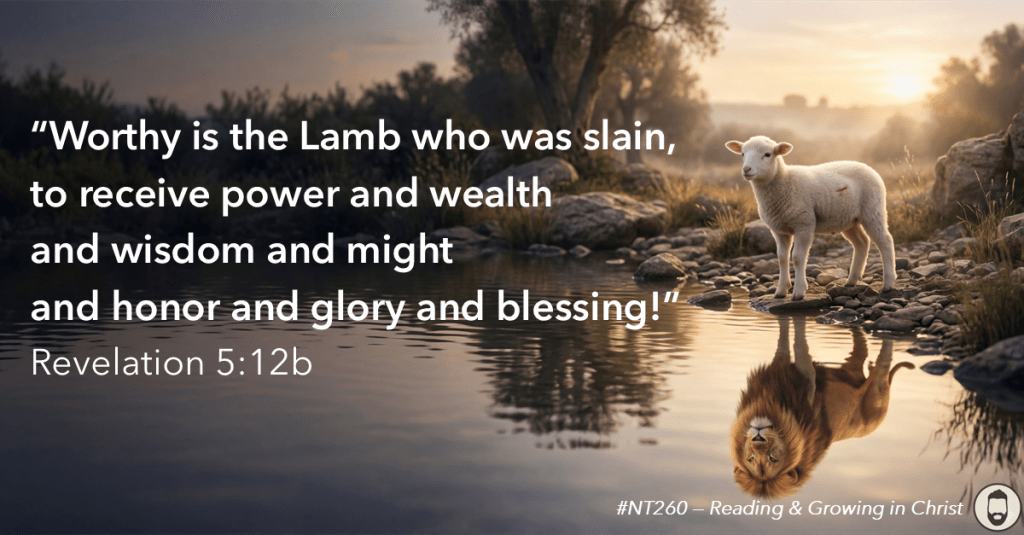
Seeing Jesus in This Chapter: Revelation 5 reveals Jesus as the worthy Lamb and conquering King. He is the Lion of the tribe of Judah and the Root of David — the promised Messiah who has conquered (v. 5). Yet His victory is not through force, but through sacrifice — He is the Lamb who was slain, standing alive, bearing the marks of His death (v. 6). Because of His death and resurrection, He alone is worthy to take the scroll and carry out God’s redemptive plan for history (v. 7). His blood has ransomed people for God from every tribe, language, people, and nation, making them a kingdom and priests who will reign with Him (vv. 9–10). Heaven declares His worth in fullness — power, wealth, wisdom, might, honor, glory, and blessing belong to Him (v. 12). And in the end, all creation joins in worship, showing that Jesus is not only Savior but Lord over all. The Lamb who was slain is the King who reigns.
🌀 Reflection: Jesus is worthy not just because of who He is, but because of what He has done. Does your worship reflect the worth of the Lamb who was slain for you? 💬 Mission Challenge: Worship Jesus today specifically for His sacrifice, and share with someone how His death has changed your life.
Today’s post includes a brief overview of the chapter and a focused look at what it reveals about Jesus (Rev. 1:1) — so our eyes stay fixed on Him.
Chapter Overview: Revelation 4 shifts the scene from earth to heaven as John is called up to see what will take place next (vv. 1–2). At the center of everything is a throne with God seated on it, surrounded by dazzling glory, lightning, and worship (vv. 2–5). Around the throne are twenty-four elders and four living creatures who continually praise God, declaring His holiness and eternal nature (vv. 4–8). Day and night, heaven resounds with worship as all creation honors the One who lives forever, and the elders fall down before Him, casting their crowns and declaring that He alone is worthy because He created all things (vv. 9–11).
Seeing Jesus in This Chapter: While Revelation 4 focuses on the One seated on the throne, it reveals the sovereign rule and worthiness of God that sets the stage for Jesus’ work. The throne reminds us that God reigns over all things — nothing in heaven or on earth is outside His authority (v. 2). He is surrounded by glory, power, and holiness, worshiped without ceasing as “the Lord God Almighty, who was and is and is to come” (v. 8). Every creature and every authority ultimately answers to Him. The worship of heaven centers on His worthiness — He alone deserves glory, honor, and power because He is the Creator and sustainer of all things (v. 11). This chapter prepares us to see that everything that follows — including judgment, redemption, and the return of Christ — flows from the throne of God. And as we move into the next chapter, we will see that Jesus, the Lamb, is the One worthy to carry out God’s purposes.
🌀 Reflection: Heaven is centered on worship of the One on the throne. Is your life centered on Him in the same way?
💬 Mission Challenge: Take time today to worship God for who He is as Creator and King, not just for what He gives.
Today’s post includes a brief overview of the chapter and a focused look at what it reveals about Jesus (Rev. 1:1) — so our eyes stay fixed on Him.
Chapter Overview: Revelation 3 continues Jesus’ messages to the churches, addressing Sardis, Philadelphia, and Laodicea (vv. 1–22). Sardis has a reputation for being alive but is spiritually dead, and Jesus calls them to wake up, repent, and return to what they received (vv. 1–3). Philadelphia, though weak and persecuted, is commended for faithfulness and promised an open door and secure place in God’s kingdom (vv. 8–12). Laodicea, however, is rebuked for being lukewarm — self-sufficient in appearance but spiritually poor, blind, and needy — and is called to repent and return to true dependence on Christ (vv. 15–18). Across each message, Jesus calls His people to hear, repent, and overcome, promising eternal life and fellowship to those who remain faithful (vv. 5, 12, 21).
Seeing Jesus in This Chapter: In Revelation 3, Jesus is revealed as the holy and true King who sees clearly, rules completely, and calls His people to real faith. He is the One who has the seven spirits and the seven stars, meaning He has full authority and gives true spiritual life (v. 1). He is the holy and true One who holds the key of David — what He opens no one can shut, and what He shuts no one can open (v. 7). He sees beyond appearances, exposing empty reputation in Sardis and lukewarm self-deception in Laodicea, while honoring quiet faithfulness in Philadelphia (vv. 1, 8, 15–17). As the faithful and true witness, His words are trustworthy, even when they confront and correct (v. 14). Yet He is also gracious — loving enough to discipline, calling His people to repentance, and inviting them into fellowship: “I stand at the door and knock” (vv. 19–20). He promises that those who overcome will share in His victory and reign with Him (v. 21). Jesus is not impressed by appearances — He desires true faith, real dependence, and enduring devotion.
🌀 Reflection: Jesus sees what is real, not just what appears to be. Are you relying on reputation or truly walking with Him in faith and dependence?
💬 Mission Challenge: Turn from self-reliance today and intentionally depend on Jesus in one specific area of your life.
Today’s post includes a brief overview of the chapter and a focused look at what it reveals about Jesus (Rev. 1:1) — so our eyes stay fixed on Him.
Chapter Overview Revelation 2 records Jesus’ messages to four churches — Ephesus, Smyrna, Pergamum, and Thyatira — each following a pattern: He knows their condition, speaks truthfully about it, calls them to respond, and promises reward to those who overcome (vv. 1–29). Ephesus is commended for truth and endurance but rebuked for losing their first love and called to repent (vv. 2–5). Smyrna, though suffering and poor, is declared spiritually rich and urged to remain faithful even to death (vv. 9–10). Pergamum is praised for holding fast to Jesus in a hostile place but warned to repent of tolerating false teaching and compromise (vv. 13–16). Thyatira is commended for growing in love and service but rebuked for allowing false teaching and immorality, with a call to hold fast and remain faithful (vv. 19–25).
Seeing Jesus in This Chapter: In Revelation 2, Jesus is revealed as the Lord of His church who knows, searches, and rules over His people. He walks among the churches and holds them in His hand, meaning He is present, attentive, and sovereign over them (v. 1). He declares again and again, “I know” — He sees their works, their suffering, their faithfulness, and their sin (vv. 2, 9, 13, 19). He is the One who died and came to life, giving hope to those who suffer and face death (v. 8). He speaks with the authority of the sharp two-edged sword, confronting false teaching and calling His people to repentance (vv. 12, 16). His eyes are like fire, searching hearts and minds, and He judges rightly according to what is true (vv. 18, 23). Yet He is also gracious — giving time to repent and calling His people to endure, promising life, victory, and fellowship with Him to those who remain faithful (vv. 7, 10, 17, 26–28). Jesus is not distant from His church — He is present, holy, and actively leading His people toward faithfulness.
🌀 Reflection: Jesus sees both what is right and what is lacking in His people. Where might He be calling you to repent or remain faithful today?
💬 Mission Challenge: Examine your life before the Lord today and take one step of obedience in response to what He reveals.
Sunday’s coming, and I’m excited. And on this Palm Sunday, we remember our King.
Psalm 118:19-29 gives us the language of a people longing for salvation and rejoicing in the One who brings it: “Blessed is He who comes in the name of the LORD!” (Psalm 118:26). It’s a song/psalm of victory, rescue, and the steadfast love of God that endures forever.
The people cried out “Hosanna!” to Jesus, which is the Hebrew word used in Psalm 118:25 that is translated, “Save us, we pray”. In the time between Psalm 118 being written and Jesus’s Triumphal Entry, “hosanna” had shifted from “Save us, we pray” to a cry of praise to the Lord who had saved them time and again and whose track record led them to believe He would and could save them in their time of need.
While they were crying out “Hosanna”, they also quoted Psalm 118:26: “Blessed is He who comes in the name of the Lord!” They laid down palm branches and their own cloaks as they cried out to Jesus with joy, welcoming Him as King. What Psalm 118 anticipated, Jesus was fulfilling right before their eyes (Luke 24:44).
But something even greater was happening.
Psalm 118 speaks of the festal sacrifice being bound with cords to the horns of the altar (Psalm 118:27). Yet when Jesus came, He wasn’t bound or forced. He came willingly, submitting to His Father’s redemptive plan. He is the true and better sacrifice — the Lamb of God who would take away the sin of the world (John 1:29), the propitiation, atoning sacrifice, to bear the wrath of God on behalf of those He saves (1 John 2:1-2, Romans 3:25). The King they proclaimed was riding into Jerusalem to be the Savior they needed on the cross (Luke 19:10).
Essentially, this is why we gather in worship — not just to remember or commemorate a moment but to respond to Jesus (Romans 12:1). He came to seek and save the lost, to bear our sin, and to make a way for us who are far off to be brought near (1 Peter 2:24, Ephesians 2:13). We get to fix our eyes on our King (Hebrews 12:2) and cry out “Hosanna!”, praising God for saving us by grace through faith in Jesus (Ephesians 2:8-9)! Palm Sunday is not a mere holiday (or holy day) but a reminder of who Jesus is, what He has done, and call us to faith in Him (John 20:31).
That’s also why these “Songs of Sunday” posts exist — to help us prepare our hearts to gather in worship. As we read, reflect, and sing ahead of time, we’re asking the Lord to ready our hearts to worship, to receive His Word, and to respond with faith and joy.
Sunday’s coming.
Jesus is coming again.
Let’s be ready to welcome our King, not just with our lips but with our lives, trusting, rejoicing, and worshiping.
Come and gather with us. Lift your voice and sing out to the Lord. Listen as John points us to Jesus in the Word. Let’s make much of Jesus together.
19 Open to me the gates of righteousness, that I may enter through them and give thanks to the LORD. 20 This is the gate of the LORD; the righteous shall enter through it. 21 I thank you that You have answered me and have become my salvation. 22 The stone that the builders rejected has become the Cornerstone. 23 This is the LORD’s doing; it is marvelous in our eyes. 24 This is the day that the LORD has made; let us rejoice and be glad in it.
25 Save us, we pray, O LORD! O Lord, we pray, give us success!
26 Blessed is He who comes in the name of the LORD! We bless you from the house of the LORD. 27 The LORD is God, and He has made His light to shine upon us. Bind the festal sacrifice with cords, up to the horns of the altar!
28 You are my God, and I will give thanks to You; You are my God; I will extol You. 29 Oh give thanks to the LORD, for He is good; for His steadfast love endures forever!
32 So those who were sent went away and found it just as he had told them. 33 And as they were untying the colt, its owners said to them, “Why are you untying the colt?” 34 And they said, “The Lord has need of it.” 35 And they brought it to Jesus, and throwing their cloaks on the colt, they set Jesus on it. 36 And as he rode along, they spread their cloaks on the road. 37 As he was drawing near—already on the way down the Mount of Olives—the whole multitude of his disciples began to rejoice and praise God with a loud voice for all the mighty works that they had seen, 38 saying, “Blessed is the King who comes in the name of the Lord! Peace in heaven and glory in the highest!” 39 And some of the Pharisees in the crowd said to him, “Teacher, rebuke your disciples.” 40 He answered, “I tell you, if these were silent, the very stones would cry out.”
Today’s post includes a brief overview of the chapter and a focused look at what it reveals about Jesus (Rev. 1:1) — so our eyes stay fixed on Him.
Chapter Overview: Revelation opens as “the revelation of Jesus Christ” — a message from God, given to Jesus, delivered through John to the church (vv. 1–2). It promises blessing to those who hear and obey because “the time is near” (v. 3). John greets the churches with grace and peace and points to Jesus, who loves us, freed us from our sins, and made us a kingdom of priests (vv. 4–6). The chapter announces that Jesus is coming again in glory (vv. 7–8) and then records John’s vision of the risen Christ — standing among His churches in power and authority (vv. 12–16). When John falls in fear, Jesus reassures him and declares His victory over death, commissioning him to write what he sees (vv. 17–20).
Seeing Jesus in This Chapter: Revelation 1 shows us Jesus not in humility, but in glory and authority. He is the faithful witness, the firstborn from the dead, and the ruler of kings on earth (v. 5). He is the One who loves us and has freed us from our sins by His blood, making us a kingdom and priests to God (vv. 5–6). He is the coming King who will return with the clouds, and every eye will see Him — both those who trust Him and those who rejected Him (v. 7). As the Son of Man, He stands among His churches — present, watchful, and sovereign — holding His people securely and knowing their true condition (vv. 12–13, 16). His blazing eyes see all, His voice carries authority, and His word brings both judgment and truth (vv. 14–16). Yet this same glorious Jesus comforts His people, saying, “Fear not.” He is the eternal One — “the first and the last” — who died and now lives forever (vv. 17–18). Because He has conquered death and holds its keys, His people can live with confidence, endurance, and hope.
🌀 Reflection: Seeing Jesus in His glory reminds us that He is not only Savior but King. How does that truth shape the way you face fear, uncertainty, or suffering today?
💬 Mission Challenge: Worship Jesus as your risen King today, and share that hope with someone who needs it.
John writes this short letter to a man named Gaius, and it gives us a clear picture of what faithful Christian living looks like in everyday life. John rejoices because Gaius is “walking in the truth,” meaning his life matches the gospel he believes (3 John 3–4). Truth is not just something we say—it shapes how we live. John even prays that Gaius’s physical health would match his strong spiritual condition, showing that faithfulness to Christ is the most important measure of a person’s life.
One of the clearest ways Gaius lives out the truth is through hospitality. He faithfully supports traveling gospel workers, even those he does not personally know (3 John 5–6). In the early church, these workers depended on believers for encouragement and provision, and John says supporting them is a way of partnering in the truth (3 John 7–8). Not everyone is called to go, but everyone is called to play a part in the mission of the gospel. When we support those who are faithfully serving Christ, we share in that work.
In contrast, John warns about a man named Diotrephes, who loves to be first and refuses to welcome others or submit to apostolic authority (3 John 9–10). His pride leads him to oppose faithful believers and even push them out of the church. John tells Gaius not to imitate what is evil, but what is good (3 John 11). Instead, he points to Demetrius as a faithful example—someone whose life and reputation align with the truth (3 John 12). The letter closes with a reminder that Christian relationships are personal and meaningful, rooted in truth and love, not control or selfish ambition (3 John 13–15).
🌀 Reflection: Whose example are you following right now—Gaius, Diotrephes, or Demetrius? Your daily choices reveal whether you are walking in truth or drifting toward pride and self-focus.
💬 Mission Challenge: Support someone who is faithfully serving the Lord—through encouragement, prayer, or practical help—and become a partner with them in the work of the gospel.
John’s short letter brings together two themes that must stay together in the Christian life: truth and love. He rejoices that some in the church are “walking in the truth,” and then urges them to continue loving one another in obedience to Christ’s command (2 John 4–6). Truth is not cold doctrine, and love is not mere sentiment. John shows that real Christian love is shaped by God’s truth, and real Christian truth is lived out in love. Grace, mercy, and peace are found “in truth and love,” and John wants the church to keep walking in both.
But this little letter is also a warning. Many deceivers had gone out into the world, denying that Jesus Christ has come in the flesh (2 John 7). That means this is not a minor disagreement. It is a rejection of the true Christ. John says such a person is “the deceiver and the antichrist,” and he tells the church to watch carefully so they do not lose what they have worked for (2 John 8). Anyone who runs ahead of apostolic truth and does not abide in the teaching of Christ does not have God, but the one who abides in that teaching has both the Father and the Son (2 John 9). Truth must not be traded away for novelty, popularity, or the appearance of kindness.
That is why John gives such strong instruction about hospitality. If traveling teachers come without the true doctrine of Christ, the church must not receive or endorse them, because to support false teaching is to share in its wicked work (2 John 10–11). John is not telling believers to be harsh toward unbelievers in general, but to refuse any partnership that would make it seem like false teaching is acceptable. He closes by saying he hopes to come and speak face to face, because faithful fellowship in truth leads to full joy (2 John 12). This letter reminds us that guarding the gospel is not unloving. It is one of the most loving things we can do for Christ’s church.
🌀 Reflection: Are you holding truth and love together, or are you tempted to separate them? Jesus calls us to love people deeply without compromising the truth about who He is.
💬 Mission Challenge: Encourage another believer to stand firm in the truth about Jesus, and look for one practical way to show Christlike love without surrendering biblical conviction.


 Just Keith Harris