
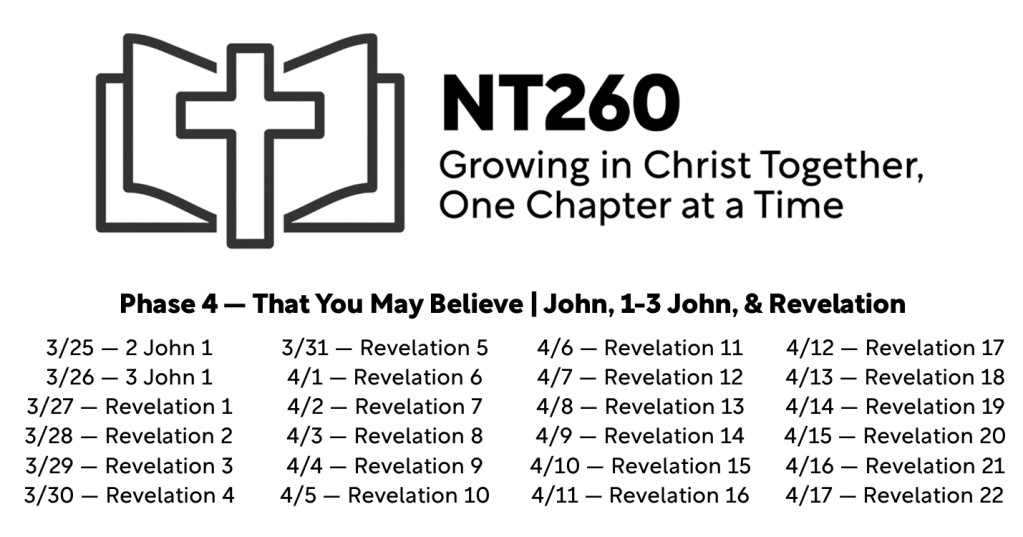
This phase reflects contains the apostle John’s writings. His gospel and letters teach us how to walk in truth in love. Revelation closes the New Testament with a powerful vision of Jesus’s return and eternal reign.
Phase 4 is the embodiment of two passages from the end of John’s gospel, so we’ll let the Holy Spirit through John explain:
John 20:30-31 —
Now Jesus did many other signs in the presence of the disciples, which are not written in this book; but these are written so that you may believe that Jesus is the Christ, the Son of God, and that by believing you may have life in his name.
John 21:24-25 —
This is the disciple who is bearing witness about these things, and who has written these things, and we know that his testimony is true.
Now there are also many other things that Jesus did. Were every one of them to be written, I suppose that the world itself could not contain the books that would be written.
These verses not only represent John’s aim when writing as he was “carried along by the Holy Spirit” (2 Peter 1:21); they represent our heart in seeking to get folks into God’s Word — “so that you may believe that Jesus is the Christ, the Son of God, and that by believing you may have life in his name
(John 20:31). Our goal isn’t clicks or likes or to give ribbons for finishing a reading plan. We want to see Jesus high and lifted up. And while there are many books written about Him and “the world itself could not contain the books that would be written” (John 21:25) if every moment of His life on earth were recorded, there is no books greater than those of holy Scripture to introduce us God in flesh than the New Testament.
Let’s dig in together and finish well — let us seek and see Jesus together!
Below, you’ll find brief synopses of each book in this phase to help you understand the scope of the book and most importantly, how it fits into the full Story of the Bible.
When you click on each day’s link, you will find a link to audio, a summary of the chapter, a key verse from the chapter, and opportunities for reflection and outreach.
We’re moving into Paul’s epistles, which we’ll go through chronologically rather than in the order they appear in our Bibles.
2-3 John
Revelation
The book of Revelation opens with these words: “The revelation of Jesus Christ” (Rev. 1:1). This is not first a book about timelines, symbols, or end-times speculation—it is an unveiling of Jesus. Through vivid imagery and powerful visions, Revelation pulls back the curtain to show what is really true: Jesus is risen, reigning, and returning. Much of its language and imagery draw from the Old Testament—especially books like Daniel, Ezekiel, and Zechariah—so that what may seem strange at first is actually deeply rooted in God’s earlier promises. Because of this, Revelation is not always meant to be read in a strictly literal or step-by-step way like other New Testament books. It is a picture-rich, symbol-heavy book meant to reveal truth, not hide it.
At the center of everything Revelation shows us is Jesus Himself. He is the Son of Man walking among His churches (1:12–13), the Lamb who was slain and yet stands victorious (5:6), the King of kings who rules over history (19:16), and the One who will make all things new (21:5). Revelation reminds us that behind the visible world is a greater reality—one where Christ has already secured the victory through His death and resurrection (Col. 2:15), and where every enemy will ultimately be defeated. No matter how chaotic things may appear, Jesus is not absent. He is reigning now, and He will return to judge evil, rescue His people, and establish His kingdom forever.
Revelation was written to real churches facing real pressure—persecution, compromise, and the temptation to give up. Like the Gospel of John, it calls us to believe—but here, that belief is strengthened in the face of suffering and uncertainty. As we read, we are not trying to decode every symbol or map out every detail. Instead, we are looking to see Jesus more clearly, trust Him more fully, and follow Him more faithfully. This book calls us to endure, to remain faithful, and to worship the One who holds all things in His hands. In the end, Revelation is not meant to confuse us, but to anchor us: Jesus wins—and all who belong to Him will share in His victory.
- To help, Jamie Harrison and I (Keith) have been walking through Revelation in a series of Bible studies called The KING is Coming; check them out!
Because Revelation is unique, our daily reading helps will look a little different than the rest of NT260. Instead of only summarizing each chapter, each day will include (1) a brief overview of the chapter to help you follow the flow, and (2) a focused paragraph highlighting what that chapter reveals about Jesus. From there, we’ll continue with a key verse, a personal reflection, and a mission challenge just like the rest of the plan. The goal is not to untangle every detail, but to keep our eyes fixed on Christ—to see Him clearly in every chapter and respond in faith, worship, and obedience.
- March 27 — Revelation 1
- March 28 — Revelation 2
- March 29 — Revelation 3
- March 30 — Revelation 4
- March 31 — Revelation 5
- April 1 — Revelation 6
- April 2 — Revelation 7
- April 3 — Revelation 8
- April 4 — Revelation 9
- April 5 — Revelation 10
- April 6 — Revelation 11
- April 7 — Revelation 12
- April 8 — Revelation 13
- April 9 — Revelation 14
- April 10 — Revelation 15
- April 11 — Revelation 16
- April 12 — Revelation 17
- April 13 — Revelation 18
- April 14 — Revelation 19
- April 15 — Revelation 20
- April 16 — Revelation 21
- April 17 — Revelation 22
Thanks for joining us in the NT260 readings! It is our prayer that the time in God’s Word has led your heart to worship Jesus and grow close to Him.
Our next Bible reading plan is called See JESUS in the Old Testament — won’t you consider continuing in the Word to worship Jesus and continually grow closer to Him?

 Just Keith Harris
25 Comments