
Click here for John 18 audio:
Read it. Pray it. Share it. Live it.
John 18 shows Jesus moving steadily toward the cross, but not as a helpless victim. He goes with His disciples into the garden, fully knowing what is about to happen (John 18:1–4). When the soldiers and officers come looking for Him, Jesus steps forward and identifies Himself, and they fall backward to the ground at His word (John 18:5–6). Even in His arrest, Jesus is in control. He protects His disciples, fulfilling His promise that He would lose none the Father had given Him (John 18:8–9; cf. John 6:39; 17:12). When Peter tries to defend Jesus with a sword, Jesus stops him and speaks of drinking the cup the Father has given Him (John 18:10–11). Jesus will not avoid the suffering appointed for Him. He will willingly bear the cup of God’s wrath so His people can be saved.
The chapter then contrasts Jesus’ faithfulness with Peter’s weakness. Jesus is questioned before Annas and remains calm, truthful, and righteous under unjust treatment (John 18:19–23). Peter, however, denies three times that he knows Jesus, and the rooster crows just as Jesus had said (John 18:17, 25–27; cf. John 13:38). John places these scenes side by side so we can feel the difference: Jesus stands firm while Peter falls apart. Yet even here, Peter’s failure is not the end of his story. John wants us to see that our hope does not rest in our courage but in Christ’s obedience. Where we fail, Jesus stands. Where we deny, Jesus remains true.
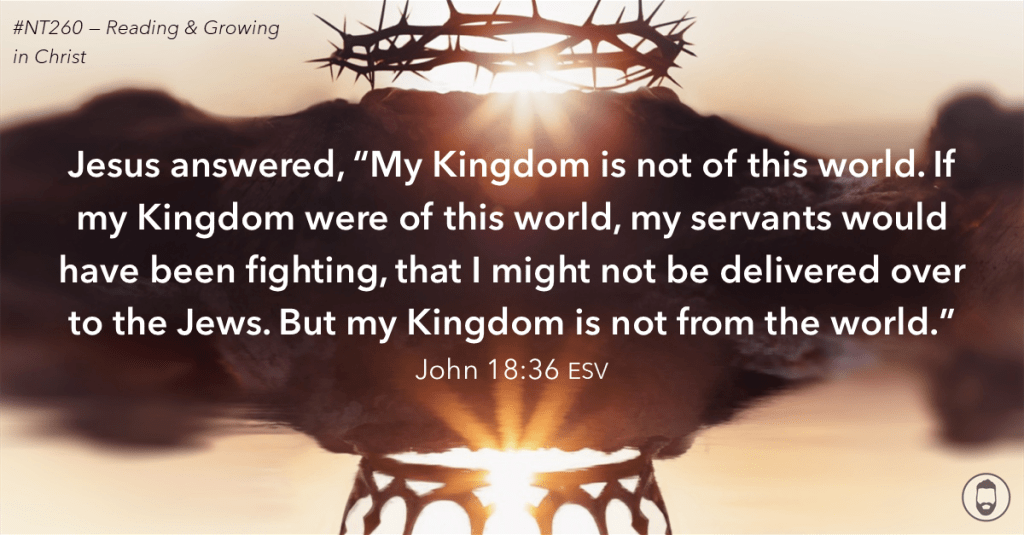
The final part of the chapter centers on Jesus before Pilate. The Jewish leaders want Him executed, but Pilate repeatedly finds no guilt in Him (John 18:28–29, 38). Jesus makes clear that He is indeed a King, but His kingdom is “not of this world” (John 18:36). He did not come to build an earthly political movement by force, but to bear witness to the truth and lay down His life (John 18:36–37). In bitter irony, the crowd rejects the innocent Son of the Father and asks for Barabbas, a robber and insurrectionist, to be released instead (John 18:39–40). The sinless King is condemned while the guilty man goes free. That exchange points us to the heart of the gospel: Jesus takes the place of sinners so that the guilty may be released.
🌀 Reflection:
John 18 reminds us that Jesus was never trapped by events. He chose the path of obedience all the way to the cross. At the same time, Peter’s denials remind us how weak we really are apart from grace. Are you trusting more in your own strength, loyalty, or resolve than in the faithfulness of Christ? Let this chapter humble you, but also comfort you: your salvation rests in the obedient King who stood firm when everyone else failed.
💬 Mission Challenge:
Encourage someone today who feels ashamed of failure by pointing them to Jesus in John 18 — especially the One who stood firm for weak disciples and went to the cross for guilty people.
Continue reading in our NT260 plan in the rest of Phase 4 — That You May Believe.

 Just Keith Harris
1 Comment