
Click here for John 12 audio:
Read it. Pray it. Share it. Live it.
John 12 moves us from the sign of Lazarus’s resurrection to the final approach of the cross. In Bethany, Mary anoints Jesus with costly perfume and wipes His feet with her hair, showing humble, sacrificial love (John 12:1–3). Judas complains, pretending concern for the poor, but John reveals his greed and unbelief (John 12:4–6). Jesus defends Mary because her act points ahead to His burial (John 12:7–8). Already the shadow of the cross is falling across everything. At the same time, the miracle of Lazarus keeps spreading, so much so that the chief priests now want to kill Lazarus too, because his very life is a witness that leads many to believe in Jesus (John 12:9–11). Sin is so irrational that instead of submitting to the truth, it tries to destroy the evidence.
The next day, Jesus enters Jerusalem as the promised King. The crowds wave palm branches and cry, “Hosanna! Blessed is he who comes in the name of the Lord, even the King of Israel!” (John 12:12–13). Yet Jesus comes not on a war horse, but on a young donkey, fulfilling Zechariah’s prophecy of a humble King (John 12:14–15; cf. Zech. 9:9). The people are right to call Him King, but many still misunderstand what kind of King He is. He has not come first to overthrow Rome, but to give His life. That becomes even clearer when some Greeks come wanting to see Jesus. Their arrival signals that His mission is opening to the nations, and Jesus responds by saying, “The hour has come for the Son of Man to be glorified” (John 12:20–23). But this glory will come through death. Like a grain of wheat that must fall into the earth and die in order to bear much fruit, Jesus must die so that many may have life (John 12:24). Those who follow Him must also lose their lives in this world in order to keep them for eternal life (John 12:25–26).
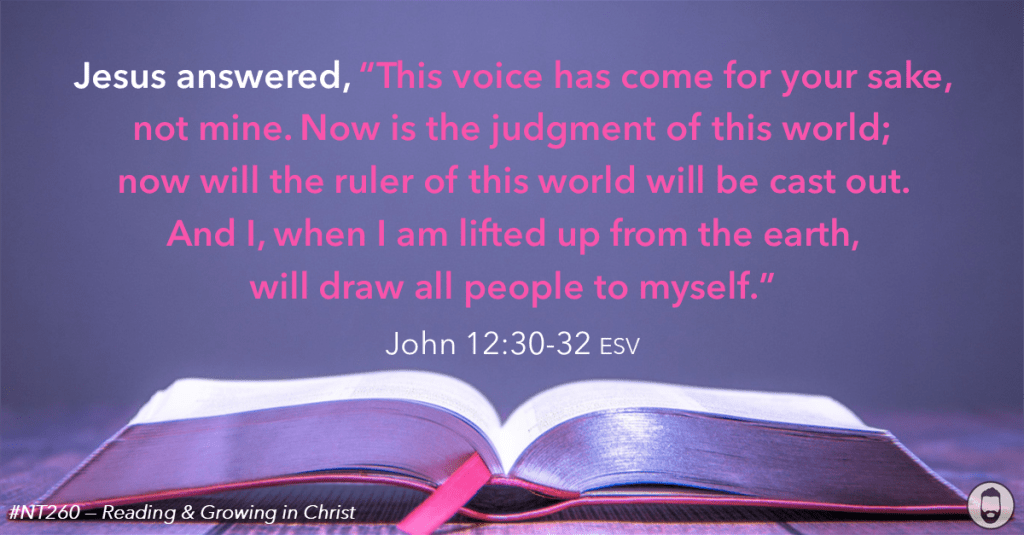
Jesus then speaks openly about the cross. His soul is troubled, but He does not turn away from the hour for which He came (John 12:27). Instead, He prays, “Father, glorify your name,” and the Father answers from heaven (John 12:28). At the cross, the world will be judged, Satan — the ruler of this world — will be cast down, and Jesus, when lifted up, will draw all kinds of people to Himself (John 12:31–33). Still, many refuse to believe even after so many signs (John 12:37). John explains that this unbelief fulfills Isaiah’s words about a hardened people (John 12:38–41). Yet even here there is a warning and an invitation: some authorities believed, but would not confess Christ because they loved the praise of man more than the glory of God (John 12:42–43). The chapter closes with Jesus crying out that to believe in Him is to believe in the Father who sent Him, and to reject His word is to stand under judgment on the last day (John 12:44–50). John 12 shows us that King Jesus is moving steadily to the cross, and that His death is not a tragedy outside God’s plan, but the very path by which He will save His people and gather a harvest from the nations.
🌀 Reflection:
John 12 reminds us that Jesus’ glory is seen most clearly in His willing sacrifice. He is the true King, but His crown comes through the cross. That means following Jesus will never simply be about admiration from a distance. It calls for surrendered love, bold confession, and a willingness to value His glory above the praise of people.
💬 Mission Challenge:
Speak openly about Jesus to someone today, even in a small way, and refuse to hide your faith for fear of what others may think (John 12:42–43).
Continue reading in our NT260 plan in the rest of Phase 4 — That You May Believe.

 Just Keith Harris
1 Comment