
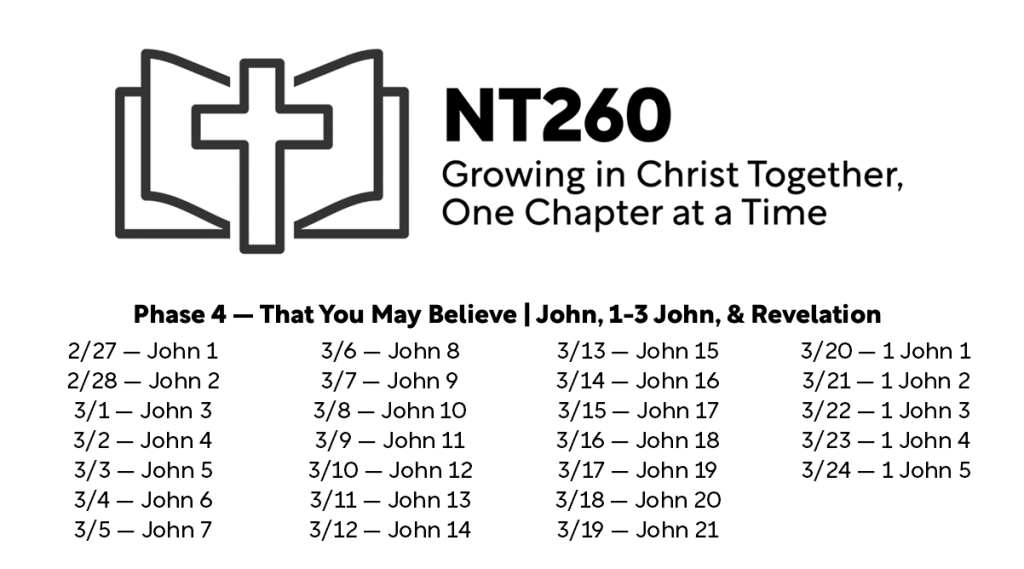
This phase reflects contains the apostle John’s writings. His gospel and letters teach us how to walk in truth in love. Revelation closes the New Testament with a powerful vision of Jesus’s return and eternal reign.
Phase 4 is the embodiment of two passages from the end of John’s gospel, so we’ll let the Holy Spirit through John explain:
John 20:30-31 —
Now Jesus did many other signs in the presence of the disciples, which are not written in this book; but these are written so that you may believe that Jesus is the Christ, the Son of God, and that by believing you may have life in his name.
John 21:24-25 —
This is the disciple who is bearing witness about these things, and who has written these things, and we know that his testimony is true.
Now there are also many other things that Jesus did. Were every one of them to be written, I suppose that the world itself could not contain the books that would be written.
These verses not only represent John’s aim when writing as he was “carried along by the Holy Spirit” (2 Peter 1:21); they represent our heart in seeking to get folks into God’s Word — “so that you may believe that Jesus is the Christ, the Son of God, and that by believing you may have life in his name
(John 20:31). Our goal isn’t clicks or likes or to give ribbons for finishing a reading plan. We want to see Jesus high and lifted up. And while there are many books written about Him and “the world itself could not contain the books that would be written” (John 21:25) if every moment of His life on earth were recorded, there is no books greater than those of holy Scripture to introduce us God in flesh than the New Testament.
Let’s dig in together and finish well — let us seek and see Jesus together!
Below, you’ll find brief synopses of each book in this phase to help you understand the scope of the book and most importantly, how it fits into the full Story of the Bible.
When you click on each day’s link, you will find a link to audio, a summary of the chapter, a key verse from the chapter, and opportunities for reflection and outreach.
We’re moving into Paul’s epistles, which we’ll go through chronologically rather than in the order they appear in our Bibles.
John
The Gospel of John was written by John the son of Zebedee—one of the twelve apostles — and the author identifies himself as “the disciple whom Jesus loved” (John 13:23, 19:26, 21:24). Early church testimony strongly supports this, and John’s Gospel reads like the work of an eyewitness who carefully chose what to include so readers would see Jesus clearly. John likely wrote from Ephesus in Asia Minor (modern-day Turkey), and the date is commonly placed late in the first century (often around AD 70–100, with many suggesting roughly AD 80–90). John writes with both Jews and Gentiles in mind, often explaining Jewish customs and terms, and he aims for wide circulation beyond one local church setting.
John’s purpose is stated plainly: these things “have been written so that you may believe that Jesus is the Christ, the Son of God, and that by believing you may have life in his name” (John 20:30–31). In the story of salvation, John presents Jesus as God in the flesh—the Word who “became flesh” (John 1:14) — who reveals the Father perfectly (John 14:9) and fulfills the hopes and promises of the Old Testament. John highlights Jesus as the true center of worship and redemption, especially powerful in light of the temple’s destruction, showing that God’s saving presence is found in Jesus himself (John 2:19–21). The climax of that fulfillment comes through Jesus’ crucifixion and resurrection, where the Lamb of God gives His life to save sinners and to bring eternal life to all who believe (John 1:29, 3:16).
John builds his Gospel around powerful “signs” and deep conversations that point beyond miracles to who Jesus truly is. Again and again, Jesus shows that He is not merely a teacher but the divine Savior: the “I Am” who gives light, life, and a sure hope that begins now and lasts forever (John 8:12, 11:25–26, 14:6). John also stresses that believing is not just agreeing with facts — it is trusting Jesus personally, receiving Him, and resting in His saving work (John 1:12, 5:24). The Gospel calls readers to a decision: to come to the Son, to know the Father, and to live—because in Jesus, God has come near to rescue, redeem, and restore.
- February 27 — John 1
- February 28 — John 2
- March 1 — John 3
- March 2 — John 4
- March 3 — John 5
- March 4 — John 6
- March 5 — John 7
- March 6 — John 8
- March 7 — John 9
- March 8 — John 10
- March 9 — John 11
- March 10 — John 12
- March 11 — John 13
- March 12 — John 14
- March 13 — John 15
- March 14 — John 16
- March 15 — John 17
- March 16 — John 18
- March 17 — John 19
- March 18 — John 20
- March 19 — John 21
1 John
1 John was written by the apostle John — the “beloved disciple” who witnessed Jesus’ life, death, resurrection, and post-resurrection appearances (1 John 1:1–3; cf. John 13:23; 20:2–10; 21:7, 20). The strong early church testimony and the striking overlap in vocabulary, themes, and tone with John’s Gospel point to the same author, writing with the authority of an elder statesman who is well-known to his readers. John likely wrote from Ephesus to a network of churches in Asia Minor, sometime late in the first century (often dated in the early-to-mid 90s), after the Gospel of John but before the close of John’s life.
John writes to strengthen believers who have been shaken by false teachers and by a painful “going out” from within the church (1 John 2:19). These opponents denied core truths about Jesus — especially that He is the Christ, the Son of God come in the flesh — and their theology spilled into twisted living and broken love (1 John 2:22–23, 4:2–3, 3:10–18). Rather than offering speculation, John calls Christians back to the basics: true doctrine about Christ, obedient living, and sincere love for one another — because “God is light” and “God is love” (1 John 1:5, 4:8). His aim is not to crush tender consciences but to steady them, so they can know they truly belong to God and rejoice in the gospel God has accomplished.
At the heart of 1 John is assurance grounded in what God has done in His Son: Jesus is the atoning sacrifice for our sins and the advocate for believers when we sin (1 John 2:1–2, 4:10). Those who truly know God will not be perfect, but they will be marked over time by walking in the light, confessing sin, obeying Christ’s commands, and loving the brothers and sisters in practical ways (1 John 1:7–9, 2:3–6, 3:16–18). John’s repeated “tests” are not a ladder to earn salvation but a way to recognize real life — because eternal life is found “in his Son,” and John writes “that you may know that you have eternal life” (1 John 5:11–13).
FINISH reading in our NT260 plan with the final section, the second part of Phase 4 — That You May Believe.

 Just Keith Harris
26 Comments