
Click here for John 9 audio:
Read it. Pray it. Share it. Live it.
John 9 begins with Jesus seeing a man who had been blind from birth, and the disciples immediately ask whose sin caused his condition (John 9:1–2). Jesus corrects their thinking. The man’s blindness was not the direct result of his own sin or his parents’ sin, but an occasion for the works of God to be displayed (John 9:3). Then Jesus again declares, “I am the light of the world,” and gives sight to the man by an act that points beyond itself to a deeper truth: the One who made the world has power to re-create what is broken (John 9:5–7). The healed man obeys Jesus, goes to wash in the pool of Siloam, and returns seeing (John 9:7). What follows is not only a miracle of physical sight, but a growing revelation of who Jesus is.
The neighbors are confused, the Pharisees are troubled, and the controversy grows because the healing took place on the Sabbath (John 9:8–16). While the religious leaders become increasingly hardened, the healed man grows increasingly clear. At first he simply calls Jesus “the man called Jesus” (John 9:11). Then he says, “He is a prophet” (John 9:17). Later, under pressure, he boldly argues that no one could open the eyes of a man born blind unless he were from God (John 9:30–33). His parents are afraid to speak openly because the leaders have already decided to cast out anyone who confesses Jesus as the Christ (John 9:22). The Pharisees claim to know Moses, but in their pride and unbelief they refuse the plain evidence in front of them (John 9:24, 28–29). In the end, they throw the healed man out (John 9:34).
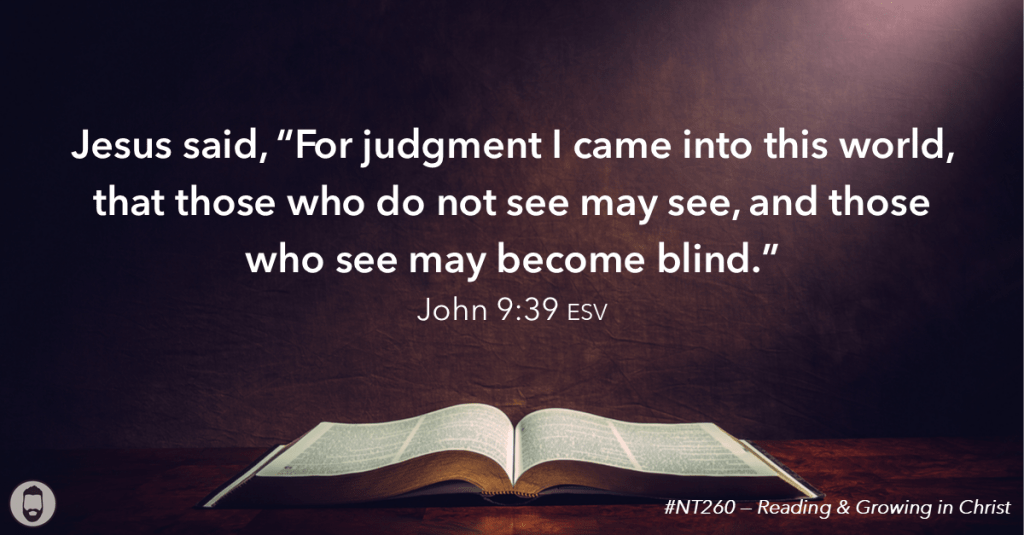
But the man cast out by the synagogue is sought out by Jesus Himself (John 9:35). Jesus asks him, “Do you believe in the Son of Man?” and then reveals that He is the One speaking to him (John 9:35–37). The man responds with the clearest vision in the chapter: “Lord, I believe,” and he worships Him (John 9:38). Then Jesus explains the deeper issue: His coming brings a division in which those who know they are blind are given sight, while those who boast that they see are exposed as blind (John 9:39–41). John 9 is not just about one man receiving sight. It is about the light of Christ exposing the blindness of proud religion and giving true sight to those who know they need Him.
🌀 Reflection:
Spiritual blindness is more dangerous than physical blindness. The blind man knew he needed help, and Jesus gave him sight. The Pharisees thought they already saw clearly, and that pride kept them in darkness. The safest place to be is not pretending we have it all together, but coming honestly to Jesus and asking Him to help us see.
💬 Mission Challenge:
Pray today for someone who seems spiritually blind, then look for an opportunity to gently point them to Jesus as the Light of the world who opens eyes and gives true sight.
Continue reading in our NT260 plan in the rest of Phase 4 — That You May Believe.

 Just Keith Harris
1 Comment