
Click here for John 8 audio:
Read it. Pray it. Share it. Live it.
John 8 begins with the well-known account of the woman caught in adultery, though most likely that section was not part of John’s original Gospel, even if it may preserve a true event from Jesus’ life (John 7:53–8:11). The main flow of the chapter begins in verse 12, where Jesus again speaks during the Feast of Booths and declares, “I am the light of the world” (John 8:12). In a feast filled with lamp-lighting and celebration, Jesus says that He is the true light promised in Scripture, the One who leads people out of darkness into life (John 8:12; cf. Isa. 9:2; 42:6). The Pharisees challenge His testimony, but Jesus answers that His witness is true because He knows where He came from and where He is going, and because the Father Himself bears witness to Him (John 8:13–18). Their real problem is not lack of evidence, but that they do not know the Father because they do not know the Son (John 8:19).
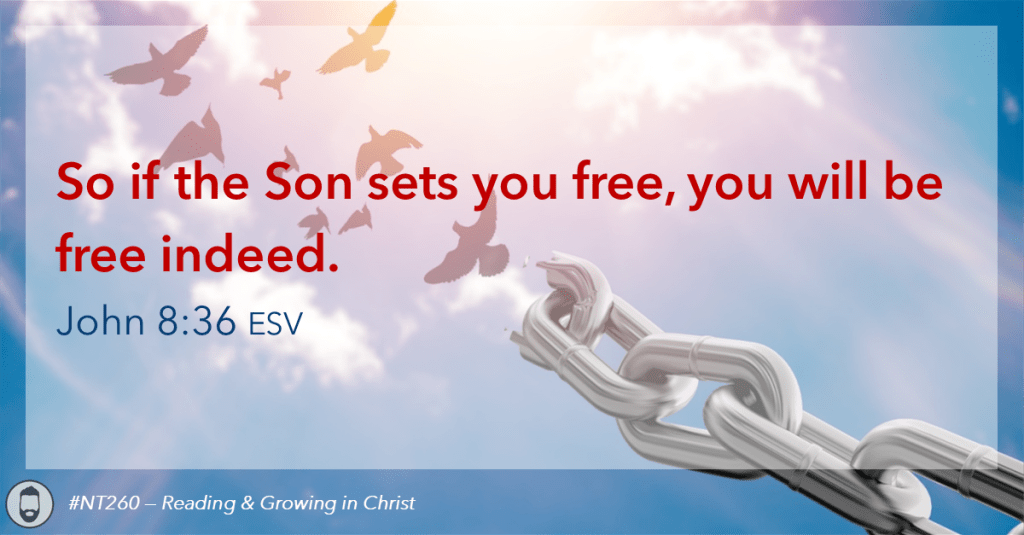
Jesus then warns them that unless they believe in Him, they will die in their sins (John 8:21, 24). He tells them that He is from above while they are from below, and that when He is “lifted up” they will know that He is exactly who He has been claiming to be (John 8:23, 28). Many appear to believe, but Jesus shows that genuine faith is proven by abiding in His word (John 8:30–31). True disciples continue with Him, know the truth, and are set free by that truth (John 8:31–32). The people protest that they are Abraham’s descendants and have never been enslaved, but Jesus explains that everyone who practices sin is a slave to sin, and only the Son can set a sinner free indeed (John 8:33–36). Physical descent from Abraham is not enough. The real children of Abraham are those who respond to God in faith, while those who reject Jesus reveal a different father altogether (John 8:37–47; cf. Gen. 15:6).
That is why the conversation becomes so sharp. Jesus tells them that if God were truly their Father, they would love Him, because He came from God (John 8:42). Instead, their rejection of the truth shows that they are following the devil, who is a murderer and the father of lies (John 8:44–45). When Jesus says that whoever keeps His word will never see death, they mock Him and ask whether He is greater than Abraham (John 8:51–53). Jesus answers by declaring that Abraham rejoiced to see His day (John 8:56). Then the chapter reaches its climax: “Before Abraham was, I am” (John 8:58). Jesus does not merely say He existed before Abraham, but uses the very language that points to the divine name (cf. Ex. 3:14). The people understand what He is claiming and pick up stones to kill Him for blasphemy (John 8:59). John 8 leaves us with no small view of Jesus. He is the Light of the world, the giver of true freedom, and the eternal Son of God.
🌀 Reflection:
John 8 reminds us that freedom is not found in heritage, morality, religion, or self-definition. Apart from Jesus, we are slaves to sin even if we do not feel enslaved. But when the Son sets us free, He frees us not only from guilt, but from the rule of sin and the darkness that once defined us.
💬 Mission Challenge:
Share with someone this week what Jesus has freed you from, and point them to John 8:12 or John 8:36 as a reminder that true light and true freedom are found only in Him.
Continue reading in our NT260 plan in the rest of Phase 4 — That You May Believe.

 Just Keith Harris
1 Comment