
Click here for John 7 audio:
Read it. Pray it. Share it. Live it.
John 7 takes place during the Feast of Booths, a joyful celebration of God’s provision in the wilderness and of His harvest blessing (John 7:2). But even in the middle of that feast, tension surrounds Jesus. His own brothers urge Him to go public in a worldly way, but they do not yet believe in Him (John 7:3–5). Jesus refuses to move according to human pressure because He is living by the Father’s timetable, not man’s expectations (John 7:6–8). When He does go to Jerusalem, He goes quietly, and soon the crowds are divided over Him — some saying He is good, others calling Him a deceiver (John 7:10–13). As He teaches in the temple, Jesus makes clear that His teaching comes from the One who sent Him, and that people’s real problem is not lack of evidence but resistance to doing God’s will (John 7:16–18). He exposes the hypocrisy of leaders who claim to honor Moses while plotting murder and judging only by appearances (John 7:19–24).
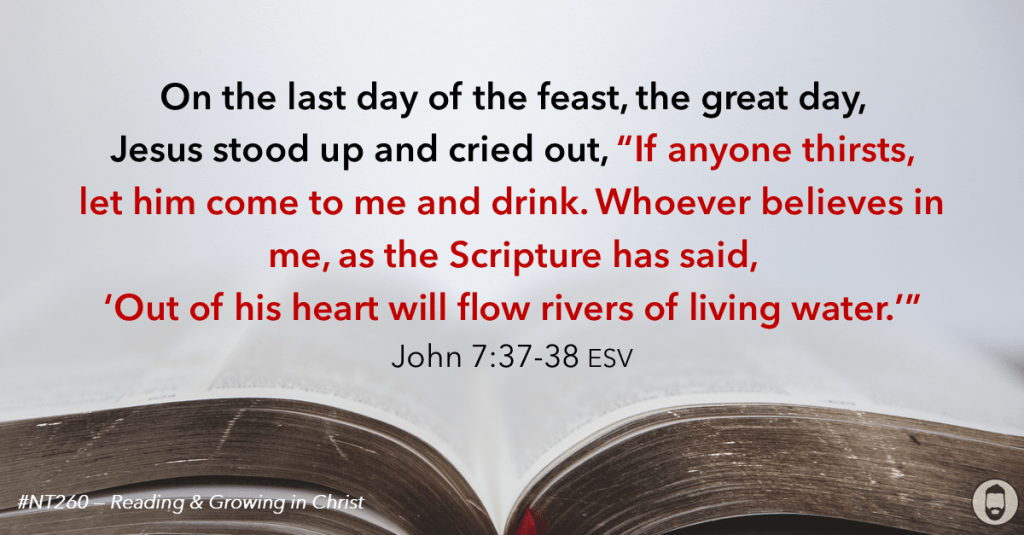
As the chapter continues, confusion about Jesus grows. Some wonder if the authorities secretly know He is the Christ, while others dismiss Him because they think they know where He comes from (John 7:25–27). But Jesus tells them they do not truly know Him or the Father who sent Him (John 7:28–29). Though some seek to arrest Him, no one can lay a hand on Him because His hour has not yet come (John 7:30, 44). Others begin to believe because of His signs (John 7:31). Then, on the last and greatest day of the feast — when water rituals reminded Israel of God’s provision — Jesus stands and cries out, “If anyone thirsts, let him come to me and drink” (John 7:37). He presents Himself as the true source of living water, speaking of the Holy Spirit who would be given after His glorification (John 7:38–39; cf. Isa. 55:1; Ezek. 36:26–27). What the feast pointed toward, Jesus fulfills.
That claim brings even more division. Some say He is the Prophet, others say He is the Christ, and others reject Him because they wrongly assume He cannot be the Messiah if He is from Galilee (John 7:40–42). The irony is that they do not know the full truth: Jesus really was born in Bethlehem as Scripture foretold (Mic. 5:2). The temple officers sent to arrest Him return empty-handed, amazed: “No one ever spoke like this man!” (John 7:45–46). The Pharisees answer with pride and contempt, but Nicodemus quietly raises the issue of justice and due process (John 7:47–51). John 7 shows that Jesus forces a response. No one can remain neutral forever. He is either rejected, misunderstood, feared, or believed — but He will not simply be ignored.
🌀 Reflection:
John 7 reminds us that spiritual thirst cannot be satisfied by religion, tradition, or public opinion. The crowd had arguments, assumptions, and debates, but Jesus alone offered living water. Real life is found not in figuring Him out on our own terms, but in coming to Him in faith and receiving what only He can give.
💬 Mission Challenge:
Ask someone this week where they turn when their soul feels dry, then share with them Jesus’ invitation in John 7:37 and point them to Him as the only true source of living water.
Continue reading in our NT260 plan in the rest of Phase 4 — That You May Believe.

 Just Keith Harris
1 Comment