
Click here for John 6 audio:
Read it. Pray it. Share it. Live it.
John 6 begins with one of the most well-known miracles in the Gospels. A large crowd follows Jesus because they have seen His signs of healing (John 6:1–2). Seeing their need, Jesus tests His disciples by asking how they will feed the people (John 6:5–6). Humanly speaking, the situation is impossible: five loaves and two fish are nothing for such a massive crowd (John 6:7–9). But Jesus gives thanks and multiplies the food so that thousands eat until they are satisfied, with twelve baskets left over (John 6:10–13). The miracle shows that Jesus is far greater than Moses, the Prophet promised in Scripture (Deut. 18:15; John 6:14). Yet the crowd misunderstands His mission and tries to force Him to become a political king, so Jesus withdraws (John 6:15). That night He reveals His divine authority again by walking on the sea and calming His disciples’ fears with the words, “It is I; do not be afraid” (John 6:19–20).
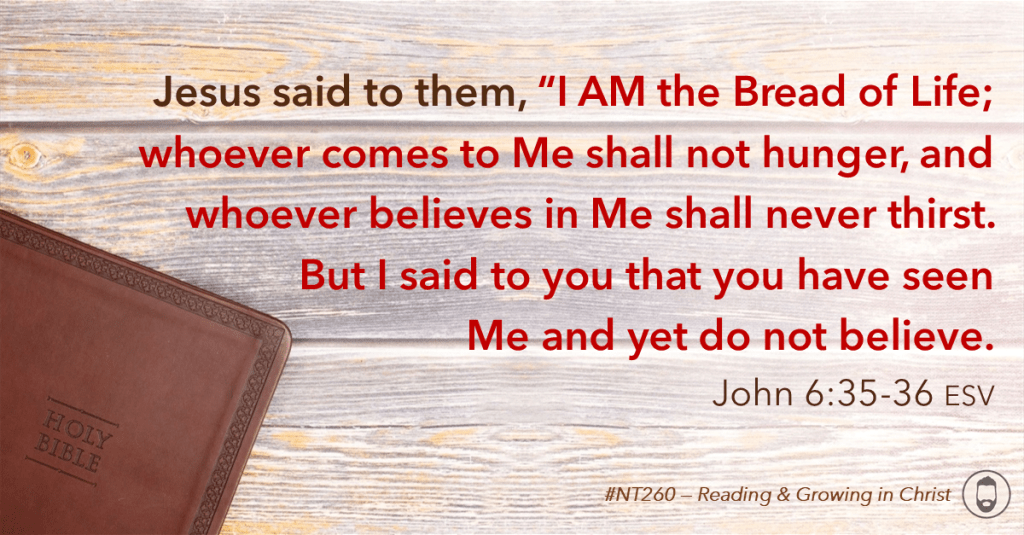
The next day the crowd searches for Jesus, but He exposes their motives. They are seeking Him not because they understood the sign, but because they wanted more bread (John 6:26). Jesus tells them not to work for food that perishes but for the food that leads to eternal life (John 6:27). When they ask what work God requires, Jesus gives a simple answer: believe in the One God has sent (John 6:28–29). Then He makes one of the great “I am” statements of this Gospel: “I am the bread of life” (John 6:35). Just as God gave manna in the wilderness, the Father now gives the true bread from heaven — Jesus Himself (John 6:32–33). Whoever comes to Him will never hunger spiritually, and whoever believes in Him will have eternal life and be raised on the last day (John 6:35, 40).
Many in the crowd grumble at these claims, especially when Jesus speaks of giving His flesh for the life of the world (John 6:41, 51). They misunderstand Him, but Jesus is pointing to His coming sacrifice. To “eat” His flesh and “drink” His blood is not literal cannibalism but a picture of believing in Him and trusting fully in His atoning death (John 6:53–56). As the discourse continues, the teaching becomes too difficult for many followers, and they turn away (John 6:60, 66). When Jesus asks the twelve if they will leave also, Peter answers with a confession that captures the heart of true faith: “Lord, to whom shall we go? You have the words of eternal life” (John 6:68). John 6 shows that Jesus is not merely a miracle-worker who fills empty stomachs. He is the living bread from heaven who gives eternal life to all who believe.
🌀 Reflection:
Many people are willing to follow Jesus as long as He meets their immediate needs, but true faith receives Him for who He truly is. John 6 reminds us that Jesus did not come primarily to improve our circumstances, but to give us eternal life through His sacrifice. The question is not whether Jesus is useful to us, but whether we truly believe in Him as the Bread of Life.
💬 Mission Challenge:
Ask someone today what they believe truly satisfies the human heart, then share how Jesus alone provides the eternal life and satisfaction we all need.
Continue reading in our NT260 plan in the rest of Phase 4 — That You May Believe.

 Just Keith Harris
1 Comment