
Click here for John 5 audio:
Read it. Pray it. Share it. Live it.
John 5 opens with Jesus going to Jerusalem for a feast and coming to the pool of Bethesda, where many suffering people were gathered (John 5:1–3). There He sees a man who had been disabled for thirty-eight years and, in sovereign mercy, chooses to heal him (John 5:5–6). The man does not display strong faith or even seem to know who Jesus is, yet Jesus speaks with authority: “Get up, take up your bed, and walk,” and immediately the man is healed (John 5:8–9). But instead of rejoicing, the Jewish leaders focus on the fact that the man is carrying his bed on the Sabbath (John 5:10). Their traditions had made them blind to the compassion and power of God standing in front of them. Later Jesus warns the healed man, “Sin no more, that nothing worse may happen to you,” reminding us that physical suffering is serious, but judgment is worse (John 5:14).
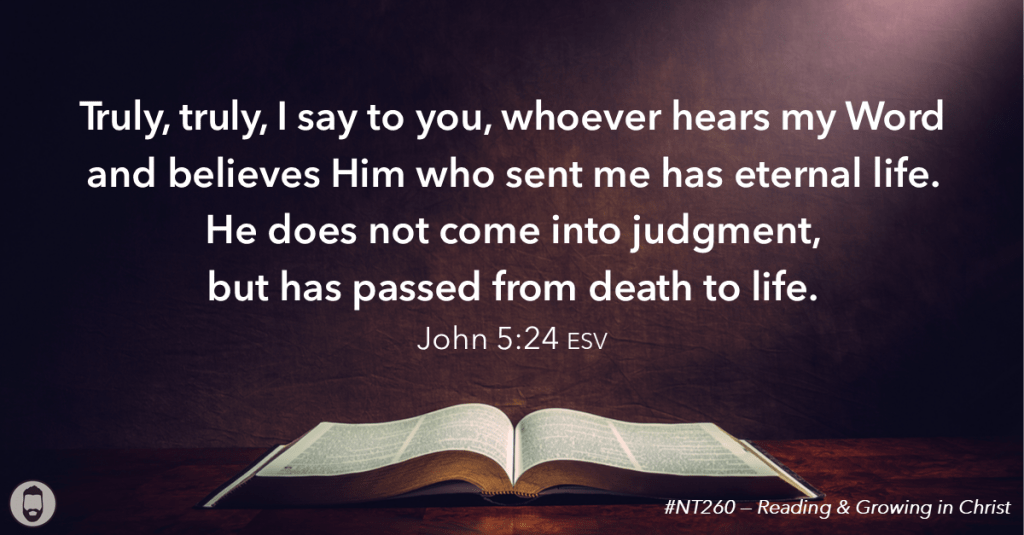
This healing becomes the setting for one of the clearest declarations of Jesus’ deity in the Gospel. When the Jewish leaders persecute Him for working on the Sabbath, Jesus answers, “My Father is working until now, and I am working” (John 5:16–17). They understand exactly what He means: He is calling God His own Father and making Himself equal with God (John 5:18). Jesus then explains that the Son does what the Father does, gives life as the Father gives life, and judges as the Father judges (John 5:19–22). The Father has given all judgment to the Son “that all may honor the Son, just as they honor the Father” (John 5:23). To refuse Jesus is not to honor God at all. But to hear His word and believe the Father who sent Him is to have eternal life already — to pass from death to life even now (John 5:24–25).
Jesus goes on to say that a day is coming when all who are in the tombs will hear His voice and rise, some to life and some to judgment (John 5:28–29). Then He lays out the witnesses that testify to who He is: John the Baptist, His works, the Father, and the Scriptures themselves (John 5:31–39). Yet the tragedy is that these leaders search the Scriptures while missing the One the Scriptures are about (John 5:39–40). They honor one another, but do not seek the glory that comes from God (John 5:44). Even Moses, in whom they trust, actually accuses them, because Moses wrote about Christ (John 5:45–46). John 5 shows that Jesus is not merely a healer or teacher. He is the divine Son who gives life, executes judgment, fulfills Scripture, and deserves the same honor as the Father.
🌀 Reflection:
It is possible to know a great deal about Scripture and still miss Jesus. That is one of the sobering truths of John 5. The goal of reading the Bible is not simply to gather information, but to come to Christ and find life in Him. He alone can heal what is broken, save us from judgment, and bring us from death to life.
💬 Mission Challenge:
Read one Old Testament passage today that points to Jesus, then share with someone how all of Scripture ultimately leads us to Him.
Continue reading in our NT260 plan in the rest of Phase 4 — That You May Believe.

 Just Keith Harris
1 Comment