
Click here for John 10 audio:
Read it. Pray it. Share it. Live it.
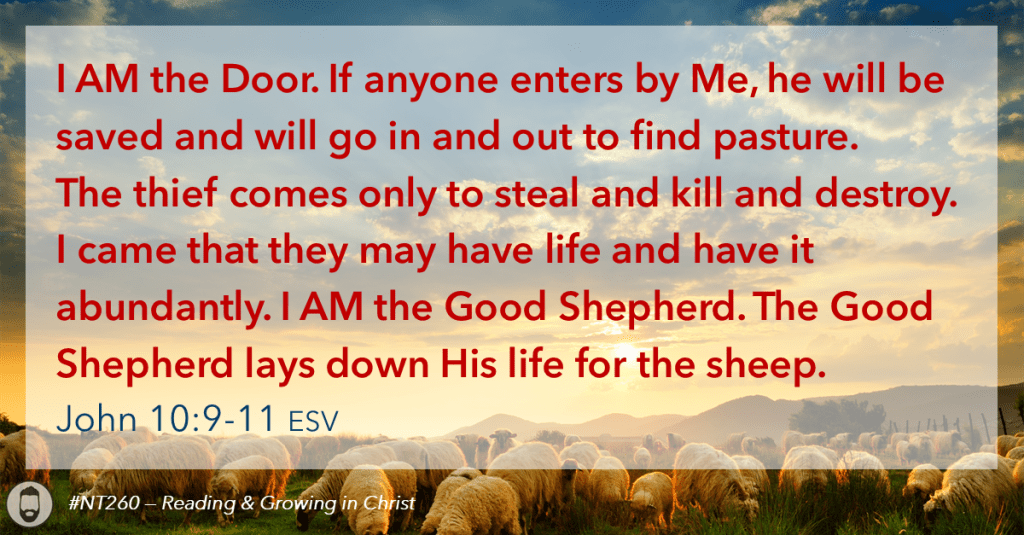
John 10 continues the tension from chapter 9, where the Pharisees proved themselves to be false shepherds who cared more about power and rules than about God’s sheep. Jesus now contrasts Himself with them by using the picture of a sheepfold. He says that the true shepherd enters by the door, calls his own sheep by name, and leads them out, while thieves and robbers come only to harm the flock (John 10:1–5). Then Jesus makes two great “I am” statements. First, He says, “I am the door,” meaning He is the only way into salvation, safety, and pasture (John 10:7–9). Then He says, “I am the good shepherd,” meaning He is the true shepherd promised in the Old Testament who does not abandon the sheep, but lays down His life for them (John 10:11; cf. Ps. 23:1; Ezek. 34:11–16). Unlike a hired hand who runs when danger comes, Jesus knows His sheep, cares for them, and gives Himself for them in love (John 10:12–15).
Jesus also says He has “other sheep” who are not of this fold, meaning His saving mission will reach beyond Israel to gather Gentiles too into one flock under one shepherd (John 10:16; cf. Isa. 56:8; Eph. 2:13–18). His death will not be an accident or defeat. He lays down His life willingly and has authority to take it up again (John 10:17–18). That is why His words continue to divide people. Some say He has a demon and is out of His mind, while others ask how someone empowered by a demon could open the eyes of the blind (John 10:19–21). Later, at the Feast of Dedication, the Jewish leaders demand that He tell them plainly whether He is the Christ, but Jesus answers that He already has — through both His words and His works (John 10:22–25).
The real issue is not that Jesus has been unclear, but that they do not believe because they are not His sheep (John 10:26). In contrast, His sheep hear His voice, follow Him, and are known by Him (John 10:27). Jesus then gives one of the strongest promises of security in all of Scripture: He gives His sheep eternal life, they will never perish, and no one can snatch them from His hand or from the Father’s hand (John 10:28–29). Then the chapter reaches its climax when Jesus says, “I and the Father are one” (John 10:30). The leaders understand that He is claiming equality with God, so they take up stones again for blasphemy (John 10:31–33). Yet Jesus points them again to His works as evidence that the Father is in Him and He is in the Father (John 10:37–38). When He leaves and goes back across the Jordan, many remember John the Baptist’s testimony and believe in Him there (John 10:40–42). John 10 shows us that Jesus is not merely a teacher among many. He is the only door, the good shepherd, and the Son who is one with the Father.
🌀 Reflection:
John 10 is deeply comforting because it reminds us that Jesus does not treat His people like a crowd, but like sheep He knows by name. He does not use us, neglect us, or abandon us. He protects us, leads us, and gave His life for us. In a world full of false voices, real safety is found in staying close to the Shepherd and listening for His voice.
💬 Mission Challenge:
Encourage someone today with John 10:27–28 by reminding them that Jesus knows His sheep, holds them securely, and will not let them be lost.
Continue reading in our NT260 plan in the rest of Phase 4 — That You May Believe.

 Just Keith Harris
1 Comment