
Click here for Ephesians 4 audio:
Read it. Pray it. Share it. Live it.
Paul turns from what God has done for us in Christ (chs. 1–3) to how we live because of it (v. 1). From prison, he urges believers to “walk in a manner worthy” of their calling—not by earning salvation, but by living in a way that fits the grace we’ve received (v. 1; cf. 2:8–10). The first “worthy” step is unity: humility, gentleness, patience, and a love that keeps bearing with each other (v. 2). The Spirit creates this unity; our job is to keep it, held together by peace (v. 3). Paul grounds that unity in seven “one” realities: one body, one Spirit, one hope, one Lord, one faith, one baptism, and one God and Father over all (vv. 4–6). Unity isn’t built on personality or preference—it’s built on the shared life of the Triune God.
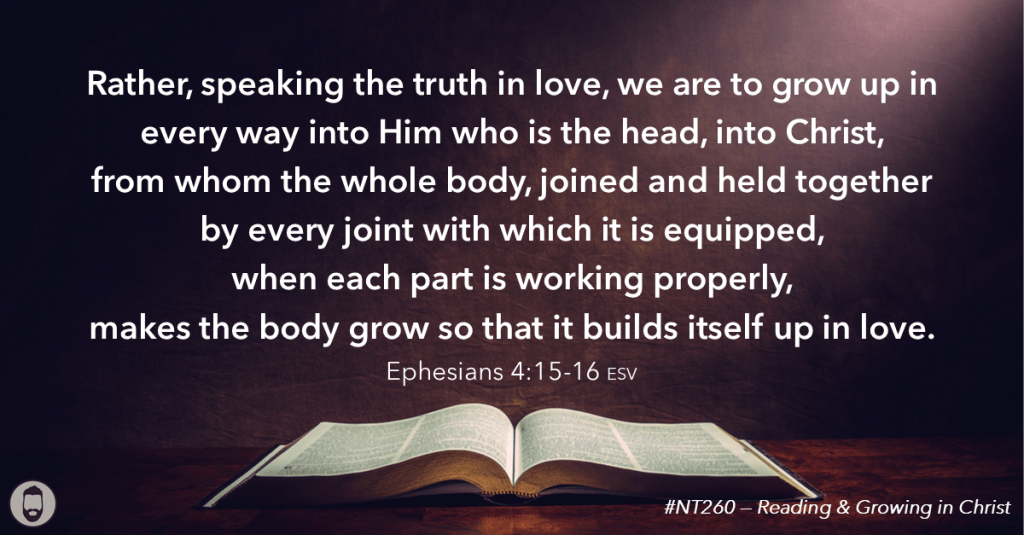
But unity doesn’t mean sameness. Christ gives grace-gifts to each believer, and He does it as the victorious, ascended King who has triumphed and now distributes gifts to His people (vv. 7–10; cf. Psalm 68:18). In particular, Christ gives gifted leaders—apostles, prophets, evangelists, and pastor-teachers—not to do all the ministry for everyone else, but to equip the saints so the whole church serves and the body is built up (vv. 11–12). The goal is a church that grows into maturity together: united in the faith and in the knowledge of the Son of God, steadily becoming more like Christ (v. 13). That kind of maturity protects believers from being tossed around by confusing teaching and spiritual scams (v. 14). Instead, the church grows by “speaking the truth in love,” holding tight to Christ the Head, as every member does their part and the body builds itself up in love (vv. 15–16).
Then Paul gets very practical: don’t go back to your old way of life. The old life is marked by empty thinking, spiritual darkness, hard hearts, and unchecked desires (vv. 17–19). But Christians have “learned Christ”—the truth that is in Jesus calls for a real break with the past (vv. 20–21). Put off the old self that’s being corrupted, be renewed in the spirit of your mind, and put on the new self—created after God’s likeness in righteousness and holiness (vv. 22–24). That new life shows up in everyday relationships: tell the truth (v. 25), deal with anger quickly (vv. 26–27), work honestly so you can share with those in need (v. 28), and speak words that build up and give grace (v. 29). Don’t grieve the Holy Spirit who sealed you for the day of redemption (v. 30). Put away bitterness and harsh speech, and instead be kind, tenderhearted, and forgiving—because God in Christ forgave you (vv. 31–32; cf. Matthew 6:12).
🌀 Reflection:
Which “new self” habit do you most need today—truthful words, quick reconciliation, honest work, or forgiving kindness (vv. 25–32)? What would it look like to practice it on purpose in one specific conversation?
💬 Mission Challenge:
Build up one person today with grace-filled speech. Send an encouraging text, write a note, or speak a timely word that strengthens them in Christ—truthful, kind, and fitted to the moment (v. 29; cf. Proverbs 25:11).
Click here to return to the contents page for Phase 2.4 — The Savior, His Church, and the Mission.

 Just Keith Harris
1 Comment