
Click here for Romans 11 audio:
Read it. Pray it. Share it. Live it.
Paul asks the question many would be afraid to ask: Has God rejected his people Israel? His answer is immediate and emphatic—“By no means!” (v. 1). Paul points to himself as living proof that God is still saving Jews (v. 1), and he reaches back to Elijah’s day, when it seemed like faithfulness had vanished—yet God had quietly preserved a remnant for Himself (vv. 3–4). In the same way, Paul says, there is “at the present time… a remnant, chosen by grace” (v. 5). And grace and works cannot be mixed: if salvation is by grace, it cannot be earned—otherwise grace would no longer be grace (v. 6; cf. 4:4–5). Many in Israel were hardened in unbelief, just as the Scriptures foretold (vv. 7–10), but that hardening is not the end of the story.
Paul then explains that Israel’s stumbling was not so that they would fall forever. God, in His wise providence, has used Israel’s trespass to bring salvation to the Gentiles—and even this is meant to stir Israel to jealousy, so that many will turn and be saved (vv. 11–14; cf. 10:19). Using the picture of an olive tree, Paul warns Gentile believers not to become proud: they were “grafted in” by faith, while some Jewish branches were broken off because of unbelief (vv. 17–20). The root supports them, not the other way around, so arrogance has no place in the church (v. 18). Paul calls them to a humble, persevering faith that remembers both the kindness and severity of God—kindness toward those who continue in faith, severity toward unbelief (v. 22). And the door of hope remains open: God is able to graft the natural branches back in again (vv. 23–24).
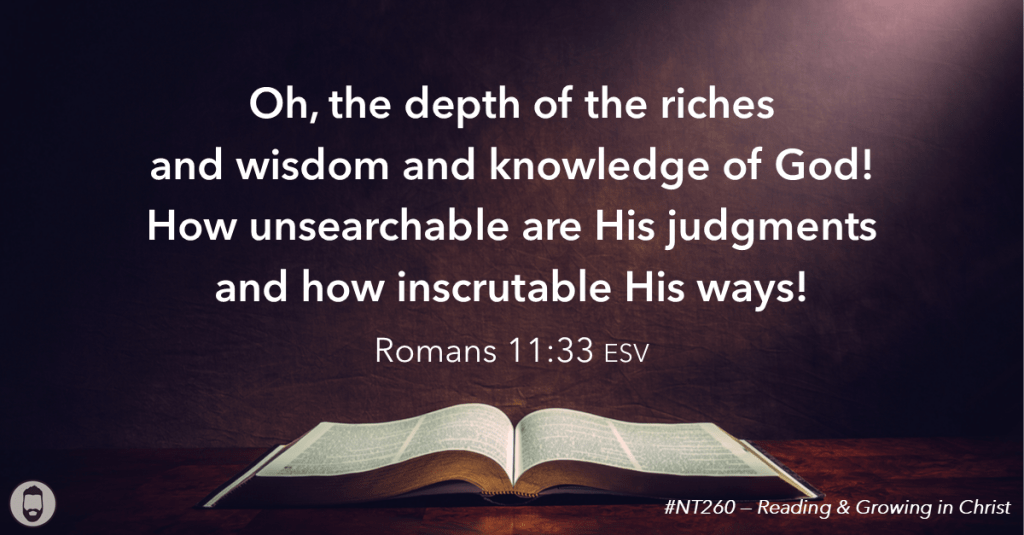
Finally, Paul reveals a “mystery”: Israel’s hardening is partial and temporary, lasting “until the fullness of the Gentiles has come in” (v. 25). In God’s saving plan, “all Israel will be saved” in the way He has ordained—through the Deliverer who takes away sins (vv. 26–27). Even now, Israel may stand as “enemies” regarding the gospel, yet they are still “beloved” regarding election, because God’s gifts and calling are irrevocable (vv. 28–29). God is weaving mercy through human disobedience—first mercy to Gentiles, and mercy also to Jews—so that no one can boast, and all salvation shines as mercy alone (vv. 30–32). Paul can only end one way: worship. “Oh, the depth of the riches and wisdom and knowledge of God!” (vv. 33–36).
🌀 Reflection:
Romans 11 humbles us. We didn’t get “grafted in” because we were better, smarter, or more deserving—we stand by faith, supported by grace (v. 20; cf. Eph. 2:8–9). And it gives us hope: God is never done, never surprised, and never unfaithful to His promises—even when His ways are deeper than we can trace.
💬 Mission Challenge:
Pray for someone you think is “too far gone,” and then reach out with a simple act of gospel kindness—an invitation, a conversation, or a Scripture shared—trusting that the God who grafts in outsiders can also bring the hardened to faith (v. 23).
Click here to return to the contents page for Phase 2.3 — The Savior, His Church, and the Mission.

 Just Keith Harris
1 Comment