
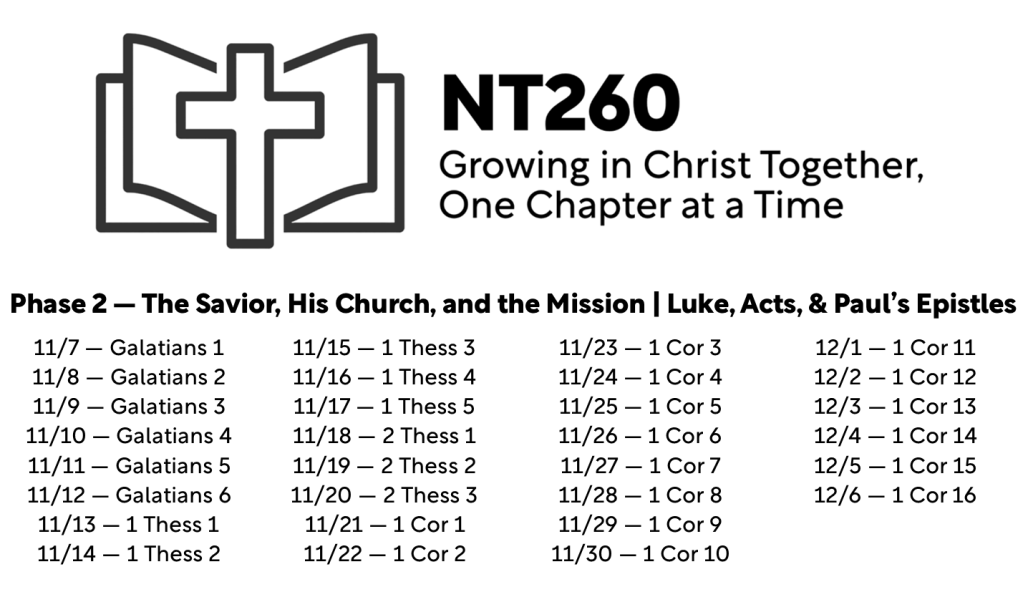
This phase will have us reading about Jesus’s life in the gospel of Luke, the formation of the Church in Acts, and walk through the theology found in Paul’s letters that the Church needs to know about and live out the eternal life given by grace through faith in Jesus.
Below, you’ll find brief synopses of each book in this phase to help you understand the scope of the book and most importantly, how it fits into the full Story of the Bible.
When you click on each day’s link, you will find a link to audio, a summary of the chapter, a key verse from the chapter, and opportunities for reflection and outreach.
We’re moving into Paul’s epistles, which we’ll go through chronologically rather than in the order they appear in our Bibles.
Galatians
The letter to the Galatians (check out this cool visual summary from the Bible Project) was written by Paul to churches in the Roman province of Galatia who were facing a spiritual crisis. After Paul preached the gospel of grace, other teachers arrived saying Gentile believers had to be circumcised and keep parts of the Mosaic law to belong to God’s people. Paul writes with urgency to defend the true gospel and his apostolic message, warning that any “different gospel” is no gospel at all (Galatians 1:6–9). His aim is pastoral and clear: believers are made right with God not by works of the law but by faith in Jesus Christ (Galatians 2:15–16).
Galatians shows how Christ’s cross brings a new era of freedom and life. Jesus bore the curse of the law so that blessing might come to the nations and the Spirit be given through faith (Galatians 3:13–14). Paul explains the law’s temporary role—it guarded and pointed to Christ—but now that Christ has come, we are God’s children by faith and clothed with Christ (Galatians 3:24–27). This freedom is not for selfishness but for love: “through love serve one another” (Galatians 5:13–14). The Christian life is life in the Spirit, where the desires of the flesh are put to death and the Spirit produces his good fruit—love, joy, peace, and more (Galatians 5:16–25). At the center stands the cross, which reshapes our identity and boasts (Galatians 2:20, 6:14).
In the story of salvation, Galatians declares that the promise to Abraham is fulfilled in Christ: Jew and Gentile are one family, justified by faith and adopted as sons through the Son (Genesis 12:3; Galatians 3:8, 3:26–29, 4:4–7). The gospel does not add law to Christ; it gives Christ alone by grace, and with him the Spirit who makes us new. Because Jesus has set us free, we stand firm in that freedom, walking by the Spirit and bearing one another’s burdens until the day of glory (Galatians 5:1, 5:16, 6:2).
- November 7 — Galatians 1
- November 8 — Galatians 2
- November 9 — Galatians 3
- November 10 — Galatians 4
- November 11 — Galatians 5
- November 12 — Galatians 6
1 Thessalonians
Paul writes 1 Thessalonians to a young church he planted in a strategic, bustling city and had to leave sooner than he wanted (Acts 17:1–10). After sending Timothy to check on them, Paul hears a mostly good report—but also real concerns: grief over believers who had died, questions about the day of the Lord, ongoing persecution, and a few idle members refusing to work (1 Thessalonians 3:1–6, 4:13, 5:1–11, 4:9–12). With a warm pastoral tone, he defends the integrity of the gospel workers (1 Thessalonians 2), thanks God for their evident faith, love, and hope (1 Thessalonians 1:2–3), and urges them to keep growing in holiness, especially in sexual purity and brotherly love (1 Thessalonians 4:1–8, 9–12).
A major theme is Christ’s return—the “coming” of Jesus appears in every chapter (1 Thessalonians 1:10, 2:19, 3:13, 4:13–18, 5:23). Paul comforts grieving believers: those who have died “in Christ” will rise first, and together with the living they will be caught up to meet the Lord—and “so we will always be with the Lord” (1 Thessalonians 4:14–17). He reassures them that the day of the Lord will not overtake them like a thief because they belong to the day, not the night (1 Thessalonians 5:1–5, 9–10). In light of this hope, he calls the church to a steady, everyday obedience—respecting leaders, helping the weak, rejecting idleness, praying constantly, and testing everything by God’s Word (1 Thessalonians 5:12–22).
In the story of salvation, 1 Thessalonians looks back to Jesus’ death and resurrection as the ground of our hope and forward to His coming as the goal of our hope (1 Thessalonians 4:14, 5:9–10). The God who chose and called them is faithful; He Himself will sanctify them completely and keep them blameless at the coming of the Lord Jesus (1 Thessalonians 1:4, 5:23–24). Until that day, the church waits with active faith, steadfast love, and durable hope—turning from idols to serve the living and true God and to wait for His Son from heaven (1 Thessalonians 1:3, 9–10).
- November 13 — 1 Thessalonians 1
- November 14 — 1 Thessalonians 2
- November 15 — 1 Thessalonians 3
- November 16 — 1 Thessalonians 4
- November 17 — 1 Thessalonians 5
2 Thessalonians
Paul’s second letter to the Thessalonians comes soon after the first and meets a church still under pressure. Persecution had not let up, and a false claim had spread that “the day of the Lord” had already come, leaving some shaken and afraid (2 Thessalonians 1:4, 2:1–2). Paul reassures them: when Jesus returns, He will bring justice—rest for His people and judgment on those who oppose the gospel (2 Thessalonians 1:5–10). He prays that God would make them worthy of their calling and glorify the name of Jesus in them, even as they suffer (2 Thessalonians 1:11–12).
Building on 1 Thessalonians, Paul clarifies what must happen before the Lord’s coming: a rebellion and the revealing of “the man of lawlessness,” whom Jesus will overthrow by the breath of His mouth at His appearing (2 Thessalonians 2:3–8; cf. 1 Thessalonians 4:13–18, 5:1–11). Until that day, the church must “stand firm and hold to the traditions” taught by the apostles, trusting the Lord to comfort and strengthen their hearts (2 Thessalonians 2:15–17). Paul also addresses a practical problem—idleness—commanding believers to work quietly and earn their own living, and instructing the church to correct those who refuse to obey (2 Thessalonians 3:6–12, 14–15). In the story of salvation, 2 Thessalonians keeps our eyes fixed on Christ’s certain return and calls us to steady, holy, hope-filled lives while we wait (2 Thessalonians 3:5, 13).
1 Corinthians
Paul writes 1 Corinthians to a gifted but divided church in a major port city shaped by status, rhetoric, and idolatry (Acts 18:1–11). After hearing troubling reports and receiving their questions, he calls them back to the gospel—to humble unity and holy living (1 Corinthians 1:10–13, 5:1–2, 7:1, 11:18). From the start, Paul centers everything on “Christ crucified,” God’s wisdom and power, not human show (1 Corinthians 1:18–25, 2:1–2). Because they belong to Jesus, they must stop boasting in leaders, flee sexual sin, and remember they are God’s temple where the Spirit dwells (1 Corinthians 3:16–17, 5:1–13, 6:18–20). Love—not pride or personal rights—must shape their life together (1 Corinthians 8:9–13, 13:1–7).
Paul also answers practical questions about marriage and singleness (1 Corinthians 7), food and idolatry (1 Corinthians 8–10), and gathered worship (1 Corinthians 11–14). He urges them to build up the church: take the Lord’s Supper in a worthy way, honor one another, and use spiritual gifts for the common good, not for display (1 Corinthians 11:23–26; 12:4–7; 14:12, 26). The famous “love chapter” shows that without love, even the greatest gifts amount to nothing (1 Corinthians 13:1–3). Above all, Paul insists on the bodily resurrection of Jesus and its hope for believers; because Christ is raised, our faith is not empty, our labor is not in vain, and we will be raised imperishable (1 Corinthians 15:3–4, 20–22, 51–58).
In the story of salvation, 1 Corinthians shows the gospel forming a holy people in a worldly place. The church is God’s family, Christ’s body, and the Spirit’s temple—set apart to reflect His character (1 Corinthians 1:2, 3:16, 12:12–27). So we lay down our rights for the weak (1 Corinthians 8:11), pursue love (1 Corinthians 14:1), and do all to the glory of God (1 Corinthians 10:31). Standing on the sure foundation—Jesus Christ our Lord—we work together for the advance of the gospel until He comes (1 Corinthians 3:11; 16:13–14, 22–24).
- November 21 — 1 Corinthians 1
- November 22 — 1 Corinthians 2
- November 23 — 1 Corinthians 3
- November 24 — 1 Corinthians 4
- November 25 — 1 Corinthians 5
- November 26 — 1 Corinthians 6
- November 27 — 1 Corinthians 7
- November 28 — 1 Corinthians 8
- November 29 — 1 Corinthians 9
- November 30 — 1 Corinthians 10
- December 1 — 1 Corinthians 11
- December 2 — 1 Corinthians 12
- December 3 — 1 Corinthians 13
- December 4 — 1 Corinthians 14
- December 5 — 1 Corinthians 15
- December 6 — 1 Corinthians 16
Continue reading in our NT260 plan with the third part of Phase 2 — The Savior, His Church, and the Mission.

 Just Keith Harris
37 Comments