Scripture Resource — Perseverance of the Saints

There are some who believe that a Christian can fall away into sin and lose their salvation; while others believe that, once God saves someone and adopts them into His family, that individual will always be saved. I believe that this is a primary gospel issue and vitally important to one’s view of Christ and His gospel. However, I do not seek to argue or wrangle over words.

I believe firmly in God’s Word and its ability to teach, reprove, correct, and train God’s people to walk with Him (2 Timothy 3:16). For that reason, I present to you the following passages of Scripture and let God’s Word speak for itself.

If you would like to talk about this further, feel free to contact me. I cannot promise that we will come to a consensus, but I can promise that I will respond as lovingly and graciously as I can and would love to talk to anyone, especially about the gospel and the Word!


John 6:35-40 —

35 Jesus said to them, “I am the bread of life; whoever comes to me shall not hunger, and whoever believes in me shall never thirst. 36 But I said to you that you have seen me and yet do not believe. 37 All that the Father gives me will come to me, and whoever comes to me I will never cast out. 38 For I have come down from heaven, not to do my own will but the will of him who sent me. 39 And this is the will of him who sent me, that I should lose nothing of all that he has given me, but raise it up on the last day. 40 For this is the will of my Father, that everyone who looks on the Son and believes in him should have eternal life, and I will raise him up on the last day.”[1]

John 10:25-30 —

25 Jesus answered them, “I told you, and you do not believe. The works that I do in my Father’s name bear witness about me, 26 but you do not believe because you are not among my sheep. 27 My sheep hear my voice, and I know them, and they follow me. 28 I give them eternal life, and they will never perish, and no one will snatch them out of my hand. 29 My Father, who has given them to me, is greater than all, and no one is able to snatch them out of the Father’s hand. 30 I and the Father are one.”[2]

Romans 8:31-39 —

31 What then shall we say to these things? If God is for us, who can be against us? 32 He who did not spare his own Son but gave him up for us all, how will he not also with him graciously give us all things? 33 Who shall bring any charge against God’s elect? It is God who justifies. 34 Who is to condemn? Christ Jesus is the one who died—more than that, who was raised—who is at the right hand of God, who indeed is interceding for us. 35 Who shall separate us from the love of Christ? Shall tribulation, or distress, or persecution, or famine, or nakedness, or danger, or sword? 36 As it is written,

       “For your sake we are being killed all the day long;
we are regarded as sheep to be slaughtered.”

37 No, in all these things we are more than conquerors through him who loved us. 38 For I am sure that neither death nor life, nor angels nor rulers, nor things present nor things to come, nor powers, 39 nor height nor depth, nor anything else in all creation, will be able to separate us from the love of God in Christ Jesus our Lord.[3]

John 3:16-17 —

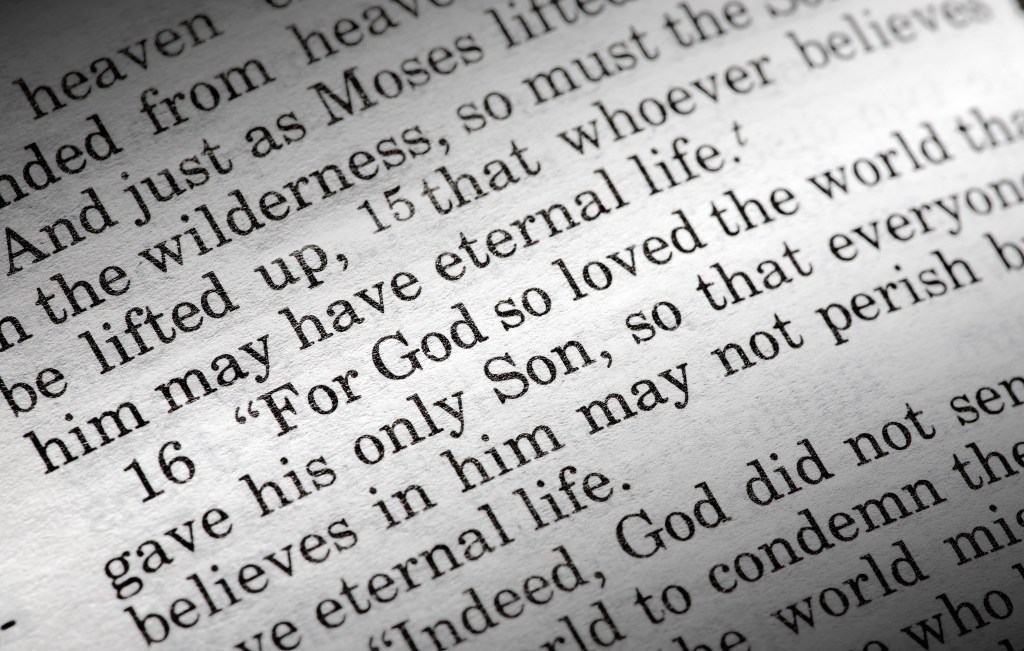
16 “For God so loved the world, that he gave his only Son, that whoever believes in him should not perish but have eternal life. 17 For God did not send his Son into the world to condemn the world, but in order that the world might be saved through him.[4]

John 3:36 —

Whoever believes in the Son has eternal life; whoever does not obey the Son shall not see life, but the wrath of God remains on him.[5]

Romans 8:1 —

There is therefore now no condemnation for those who are in Christ Jesus.[6]

Romans 8:28-30 —

28 And we know that for those who love God all things work together for good, for those who are called according to his purpose. 29 For those whom he foreknew he also predestined to be conformed to the image of his Son, in order that he might be the firstborn among many brothers. 30 And those whom he predestined he also called, and those whom he called he also justified, and those whom he justified he also glorified.[7]

Ephesians 1:13-14 —

13 In him you also, when you heard the word of truth, the gospel of your salvation, and believed in him, were sealed with the promised Holy Spirit, 14 who is the guarantee of our inheritance until we acquire possession of it, to the praise of his glory.[8]

1 Peter 1:3-5 —

Blessed be the God and Father of our Lord Jesus Christ! According to his great mercy, he has caused us to be born again to a living hope through the resurrection of Jesus Christ from the dead, to an inheritance that is imperishable, undefiled, and unfading, kept in heaven for you, who by God’s power are being guarded through faith for a salvation ready to be revealed in the last time.[9]

Philippians 1:6 —

And I am sure of this, that he who began a good work in you will bring it to completion at the day of Jesus Christ.[10]


[1] The Holy Bible: English Standard Version (Wheaton, IL: Crossway Bibles, 2016), Jn 6:35–40.

[2] Bible, Jn 10:25–30.

[3] Bible, Ro 8:31–39.

[4] Bible, Jn 3:16–17.

[5] Bible, Jn 3:36.

[6] Bible, Ro 8:1.

[7] Bible, Ro 8:28–30.

[8] Bible, Eph 1:13–14.

[9] Bible, 1 Pe 1:3–5.

[10] Bible, Php 1:6.

Refresh & Restore — January 28, 2021

Beloved, I am writing you no new commandment, but an old commandment that you had from the beginning. The old commandment is the word that you have heard. At the same time, it is a new commandment that I am writing to you, which is true in him and in you, because the darkness is passing away and the true light is already shining. Whoever says he is in the light and hates his brother is still in darkness. 10 Whoever loves his brother abides in the light, and in him there is no cause for stumbling. 11 But whoever hates his brother is in the darkness and walks in the darkness, and does not know where he is going, because the darkness has blinded his eyes.[1] 

1 John 2:7-11

Greetings, Sojourner – “Beloved”!

I am struck by the way that John writes to his original audience. He refers to them often as “little children” (2:1, 12, 18, 28; 3:7, 18); now, he calls them “beloved” (2:7; 3:2, 21; 4:1, 7, 11). He loves them, and it shows. But this word we see as “beloved” is more than a regular term for someone you care about. The love in it is the word agape – God’s never-ending, unfailing love. “Beloved” is a word that is unique to the Church. It is rooted in His love for us. It refers to those who love God and worship Him. And it is a greeting specific to the family of God – those united by their adoption through faith in Christ (John 1:12, Galatians 4:5-6).

I greet you the same today, beloved Sojourner, knowing that as we journey through this world that we are loved by God. That love is at the heart of John’s writing. It is one of the themes that we loop through over and over: life, light, and love, all of which we will see in today’s passage.

Before we get too far, I want to address the issue of following/keeping commandments. So far in 1 John, we have seen the importance of walking in the same way that Jesus walked (2:6) and how we should keep His commandments (2:3), His Word (2:4), and abide in Him through all of that (2:5). It is easy to get legalistic when we talk about being obedient and keeping commandments. So, I would like to revisit a statement from the end of last week’s devotion:

“We follow Him, learning from Him, and keep His commandments. We do not keep His commandments to earn our freedom but because of our freedom, in love and gratitude for what He has done for us.”

It is important that we do not fall back into trying to keep the Law (Galatians 5:1; Romans 6:14-18). Any reference to keeping commandments here speaks to following Christ and imitating Him (Ephesians 5:1) because He loves us and gave Himself up for us (Ephesians 5:2). We obey because we love Him (4:19) and trust that His Way is better than ours (John 14:6, Isaiah 55:9). To keep His commandments is not to earn salvation but to see that salvation has taken root in our hearts and lives (Colossians 2:6-7).

The commandment that John talks about here mirrors Jesus’ exact teaching:

“A new commandment I give to you, that you love one another: just as I have loved you, you also are to love one another. By this all people will know that you are my disciples, if you have love for one another.”

John 13:34-35

This was no doubt unforgettable for John as it was part of Jesus’ last supper with His disciples on the night before He was arrested, the day before He was crucified. That night would impact the rest of John’s life (1:1-3). It was that same “new commandment”, given straight from the mouth of God, that John references here: love others as Christ loved us.

You have no doubt heard this commandment before. It was Jesus’ upgraded version of the commandment found in Leviticus 19:18 – “You shall not take vengeance or bear grudge against the sons of your own people, but you shall love your neighbor as yourself” – which has been a feature of many Sunday School lessons and sermons. Yet Jesus’ command, especially the way it is referenced in 1 John, is not based out of loving like we love ourselves or treating others how we would like to be treated. No, this is no “golden rule”; this is a heart overflowing with the love we receive from Christ.

Jesus’ love for us in salvation should impact the way that we interact with other people. Having received grace, we should be gracious. Having received mercy, we should be merciful. Having experienced the love of God, we should love others. But, as simple as that sounds, it is extremely difficult.

Part of the reason that this is difficult is because it requires more than just lip-service. Here where I live in the American South, “I love you” and “love” are thrown about casually. The love that Jesus commands of us is anything but casual. His love is a “greater love” (John 15:13). He loved us “while we were yet sinners” (Romans 5:8). It is because God is “rich in mercy” and out of the “great love with which He loved us” that we have Life at all (Ephesians 2:4)! I speak from experience when I say that the true difficulty lies in acknowledging how difficult I am to love and how amazing the love of God is that He could ever love and save a “wretch like me”.

This is the reason that love becomes the defining characteristic of what it is to be a Christian. Just like Jesus told His original disciples that they would be known by their love for one another, the standard is the same for us. How we love God and share that love with others shows whether we are in darkness or light (2:7-8). In fact, hating our “brother” is an indicator that we live and stumble in the darkness (2:9-10).

Darkness is most definitely of Satan and not of God, but it also comes from our own sinful hearts. If we allow our hatred of someone – especially one close enough to be considered a brother in Christ (we will study more on this in the future) – to blind us, the darkness comes from that hatred; our own sinful hearts and desires have clouded our judgment and led us astray (Jeremiah 17:9).

If you are like me, this is where you start justifying your hatred. No, I do not know what they did to you. No, I have not experienced what you have. But God has (Hebrews 4:14-16)! He has experienced how I have sinned against Him (Psalm 51:4). His heart has been grieved time and again (Genesis 6:6, Ephesians 4:30).

And it is at the feet of the One who would be righteous to cast us out that we learn to love and forgive instead. Or, if our love for ourselves and hatred for others makes us unable (or unwilling) to forgive and let go of hate, we find that we truly abide in darkness and have not experienced the love of Christ at all (2:9, Matthew 6:14-15).

Rather than rationalizing your hatred, beloved, I urge you to repent – to not “abandon the love you had at first” (Revelation 2:4). The beauty of repentance is that it is always met with love. Always.

If you look at today’s passage and feel more than a little inadequate, you are not alone. I remind you that we are incapable of following Christ’s commandments perfectly. Remember, when we sin we have an Advocate (2:2) to meet us where we are and carry us through. I believe that John included this next section (2:12-14) to illustrate that, no matter where we are in our walk with Christ, none of us have arrived:

12  I am writing to you, little children,
because your sins are forgiven for his name’s sake.
13  I am writing to you, fathers,
because you know him who is from the beginning.
     I am writing to you, young men,
because you have overcome the evil one.
     I write to you, children,
because you know the Father.
14  I write to you, fathers,
because you know him who is from the beginning.
     I write to you, young men,
because you are strong,
and the word of God abides in you,
and you have overcome the evil one.[2]

John pauses here to give a special word to Christ-followers in every stage of walking with Him: “little children” who are just starting out with Him, “fathers” who have walked with Him for many years, and “young men” who are actively (and often through error and trials) seeking to serve the Lord.

To the children, he reminds them that they have been forgiven of their sins (2:12) and adopted by the Father into the family of God (2:13). When we sin and stumble, these things are easy to forget and necessary to remember to continue following Christ.

To the fathers (and mothers) in the faith, he reminds them that their relationship is grounded in “Him who is from the beginning” (2:13-14) – both the beginning of all things and the beginning of their walk when they were but children in their faith.

And to the young men (and women) who are in the midst of spiritual warfare and service of the Lord – not yet mature in their faith but actively walking with Christ, he reminds them that the evil one has already been overcome (2:13) and that the strength to win the battle comes from the Lord as found and taught from His Word (2:14).

Wherever you are on your journey – baby or an elder – Christ still has something for you. Rest assured, that His same new commandment still applies. Go out and find ways to “love one another” today.


[1] The Holy Bible: English Standard Version (Wheaton, IL: Crossway Bibles, 2016), 1 Jn 2:7–11.

[2] ESV, 1 Jn 2:12–14.

Songs for Sunday, January 24, 2021

There’s an old song that my daddy taught me when I was young. Any time I think of the words or hear someone sing it, I can hear daddy’s voice in my head. I can hear the specific way that his fingers hit the strings of his guitar when he plays it. This song comforts me more and more the older I get:

“Oh, Lord you know I have no friend like you. If Heaven’s not my home, then, Lord, what will I do….
“This world is not my home. I’m just a-passin’ through. My treasures are laid up somewhere beyond the blue. The angels beckon me to Heaven’s open door. And I can’t feel at home in this world anymore.”

Jim Reeves, “This World is Not My Home”

There’s some good theology and better advice in those words: this world was never meant to be home for us! It reminds me of Paul’s words in Philippians 3:20: “…our citizenship is in heaven, and from it we await a Savior, the Lord Jesus Christ”.

If you are struggling this week with earthly things – governments and people and things, be reminded that this world is not home. Be reminded that God is still on His throne and that He does not need anyone’s consent to stay there – it’s His forevermore.

And that’s what we are singing about this week: the hope that comes from our Savior, the Lord Jesus Christ, who is the Rescuer – the Great I AM – who has always reigned and will continue to reign forever because He is the King of kings and Lord of lords. We can trust in Him and not fear anything, even the grave, because He has already won!

Here are our songs:

  • Psalm 103:1-12

Bless the Lord, O my soul,
and all that is within me,
bless his holy name!
2 Bless the Lord, O my soul,
and forget not all his benefits,
 who forgives all your iniquity,
who heals all your diseases,
 who redeems your life from the pit,
who crowns you with steadfast love and mercy,
 who satisfies you with good
so that your youth is renewed like the eagle’s.

 The Lord works righteousness
and justice for all who are oppressed.
 He made known his ways to Moses,
his acts to the people of Israel.
 The Lord is merciful and gracious,
slow to anger and abounding in steadfast love.
 He will not always chide,
nor will he keep his anger forever.
10 He does not deal with us according to our sins,
nor repay us according to our iniquities.
11 For as high as the heavens are above the earth,
so great is his steadfast love toward those who fear him;
12 as far as the east is from the west, so far does he remove our transgressions from us.

  • Revelation 17:14

14 They will make war on the Lamb, and the Lamb will conquer them, for he is Lord of lords and King of kings, and those with him are called and chosen and faithful.”

  • Revelation 19:11-16

11 Then I saw heaven opened, and behold, a white horse! The one sitting on it is called Faithful and True, and in righteousness he judges and makes war. 12 His eyes are like a flame of fire, and on his head are many diadems, and he has a name written that no one knows but himself. 13 He is clothed in a robe dipped in blood, and the name by which he is called is The Word of God. 14 And the armies of heaven, arrayed in fine linen, white and pure, were following him on white horses. 15 From his mouth comes a sharp sword with which to strike down the nations, and he will rule them with a rod of iron. He will tread the winepress of the fury of the wrath of God the Almighty. 16 On his robe and on his thigh he has a name written, King of kings and Lord of lords.


I hope to see you with us, whether you gather in person, in the parking lot via speaker, or on Facebook or YouTube live!

If gathering in person, please remember that masks are recommended and that we need to remain vigilant in our social distancing measures. Continue to pray for those who are sick – not just our members but all those around the world.

Refresh & Restore — January 21, 2021

My little children, I am writing these things to you so that you may not sin. But if anyone does sin, we have an advocate with the Father, Jesus Christ the righteous. He is the propitiation for our sins, and not for ours only but also for the sins of the whole world. And by this we know that we have come to know him, if we keep his commandments. Whoever says “I know him” but does not keep his commandments is a liar, and the truth is not in him, but whoever keeps his word, in him truly the love of God is perfected. By this we may know that we are in him: whoever says he abides in him ought to walk in the same way in which he walked.[1]   

1 John 2:1-6

Greetings, Sojourner!

I absolutely love this week’s passage. It shows us so much of Christ’s heart for us and introduces us to some unique aspects of His character. It also shows us John’s heart for his original audience and, I hope, it shows a bit of mine for you.

Remember that the passage that we look at each week comes out of the larger whole of 1 John. So far, we have seen that what John writes in this letter flows out of his personal experience and testimony with Jesus (1:1-4). We have also seen that, to “walk in the light” (1:7), we must repent consistently of our sin and trust in Christ – that how we see and talk about our sin matters (1:5-10). And it is the seriousness of our sin that brings us into today’s verses.

John starts this paragraph with “my little children” (2:1). This shows that he cares about them. The fact that he calls them that in this paragraph shows that what he is talking to them about is serious. It reflects how parents talk to their children in times of extreme danger or importance. Speaking from experience, I find that when my children are terrified that I remind them to “listen to Daddy” and my tone is the same as it was when I spoke to them as infants cradled in my arms. John is talking to his spiritual children about sin.

In fact, he expands his purpose for writing to include “so [they/we] may not sin” (2:1). I want to clarify that this does not point to personal, human perfection. It is unattainable on earth. This is not a cop out; it is merely the truth. It is in our nature to sin and our sin nature continually wages war against the Spirit of God in us (Romans 6:23, 7:15-20; Galatians 5:16-17). But even though this is true, we have to be careful in how we talk about sin. Knowing that we will always struggle with sin does not give us an excuse to sin (Galatians 5:1). Sometimes, even knowing that there is forgiveness to be had can tempt us to sin more and more (Romans 6:1-2).

Just as John showed us in last week’s passage, we must have an appropriate view of sin. If we deny our sinfulness, we are liars who have no part in Christ (1:8). But, if we confess our sins to him in repentance and faith in Christ, “He is faithful and just to forgive us our sins and to cleanse us from all unrighteousness” (1:9). I do not know about you, but I struggle with the reality of my sin. I long for the day when I will see Jesus face-to-face and no longer struggle with sin. But I would be a fool to think that I had arrived at perfection before I kneel before perfection Himself in glory.

So, how does the reality of my continued sin fit with John’s purpose of writing “that [I] may not sin”? John acknowledges the reality of sin in verse 2: “But if anyone does sin”.

The picture that we see unfold in verse 2 is that of a courtroom. Our sin deserves death and hell (Romans 6:23, Revelation 21:8), and we are very clearly guilty (Romans 3:10, 23). As we saw last week, to plead innocent would be a lie and show that we are not in Christ (1:8). To plead guilty would be the truth. And, standing before the righteous Judge (Psalm 50:6, 75:7; 1 Corinthians 5:13; 2 Corinthians 5:10), we would be as aware of our sins as Isaiah was when he stood in the presence of God:

“Woe is me! For I am lost; for I am a man of unclean lips, and I dwell in the midst of a people of unclean lips; for my eyes have seen the King, the Lord of hosts!”

Isaiah 6:5

As in any criminal trial, there is a prosecutor – an accuser. His name is Satan (which literally translates as “the accuser”). Revelation 12:10 describes him as “the accuser of our brothers” and actively accusing them “day and night before our God”. He will have plenty of evidence against us – all we have said and done. And, if we are honest, we know we are guilty of everything he accuses us of and that we have sinned against God (Psalm 51:4). In fact, if we look in the Word, we know that God already knows everything (and so much more, including our thoughts, desires, and motivations) that Satan brings before the court (Hebrews 4:12-13).

Do you yet grasp the gravity of our situation? Surely you know how this works. We have seen enough courtroom dramas to know when a prosecutor has nailed the proverbial coffin shut with evidence. Yet this is exactly where John begins: “But if anyone does sin, we have an advocate with the Father, Jesus Christ the righteous” (2:1).

The word advocate is used only a handful of times in the New Testament, and most of those times it is translated as Helper or Comforter and refers to the Holy Spirit (John 14:16, 26; 16:17). It paints the picture of one who shows up on behalf of another. In the case of the Holy Spirit, it refers to Jesus leaving His Spirit with His people once He ascended back into heaven. In the case of our advocate, Jesus Himself appears on our behalf – defense attorney, key witness, evidence, and Divine plea bargain.

Let me be clear that this is the point where our earthly legal dramas fail to picture what is going on here. Much of what we see on television (and assume happens often in the real-world) centers around someone “getting off” instead of being found guilty. As I said earlier, we are most assuredly guilty. Again, I remind you that everything the accuser says about us is true – all the evidence is genuine. The sin is ours, and we willfully committed each sin.

Our advocate is “Jesus Christ the righteous”. Were He to try to get the charges merely thrown out, He would not be righteous. There is “a record of debt” and “legal demands” that come with our sin (Colossians 2:14). The Judge cannot allow the debt to remain unpaid. But every penny – every good deed – that we have ever been capable of is not a drop in the bucket compared to the sin debt we owe.

Our accuser no doubt delights in this. What prosecutor could keep from delighting in a sure win? Yet our advocate steps forward and enters Himself into evidence. He is not just advocate but also propitiation (2:2).

Please, do not let the size of these words intimidate you. They are not fancy, academic words. They are Bible words that are important to our understanding of what Christ has done for us. The word propitiation means a sacrifice that trades wrath for favor, anger for gladness, Christ’s sinlessness for the punishment our sin deserves (Isaiah 53:5).

As our propitiation, Jesus covers our sin and shame. He decides to fully bear our punishment and gives us the favor He has as the Son of God, so, now, when the Judge looks out, He does not see our sin but His Son. How does Jesus do this? He does it “by cancelling the record of debt that stood against us with its legal demands” by “set[ting] it aside, nailing it to the cross” (Colossians 2:14). He – the sinless Lamb of God (1 Peter 1:19) – took on our sin so that “we might become the righteousness of God” (2 Corinthians 5:21).

Rather than judgment, we find mercy. Instead of being condemned, we find grace. Since the Judge sees a son in the place of a sinner, we gain eternal life rather than the death sentence we deserve. And the accuser’s cries go unheard like those of a bug meeting the heel of a boot (Genesis 3:15). And we can rejoice that “if the Son sets you free, you will be free indeed” (John 8:36).

What do we do with this freedom?

We follow Him, learning from Him, and keep His commandments (2:3-4). We do not keep His commandments to earn our freedom but because of our freedom, in love and gratitude for what He has done for us (Matthew 11:29).

We see the love that He showed us through His death and resurrection (Romans 5:8) show up in our own lives (2:5). We love Him because He loves us (4:19). And we show that love to others for the same reason (4:11, Matthew 22:38-39).

We reflect His Light and Life (2:6) like the moon does the sun – a pale reflection but pointing to Him, nevertheless. And, hopefully, just as the moon pulls the tides toward it, people will be drawn to our Savior because they see Him in us.

I do not have to ask if you are struggling with sin. But I ask that when you do, you run to the advocate, Jesus Christ the righteous. “He is able to save to the uttermost those who draw near to God through Him, since He always lives to make intercession for them” (Hebrews 7:25). Now, that is good news!


[1] The Holy Bible: English Standard Version (Wheaton, IL: Crossway Bibles, 2016), 1 Jn 2:1–6.

Refresh & Restore — January 14, 2021

This is the message we have heard from him and proclaim to you, that God is light, and in him is no darkness at all. If we say we have fellowship with him while we walk in darkness, we lie and do not practice the truth. But if we walk in the light, as he is in the light, we have fellowship with one another, and the blood of Jesus his Son cleanses us from all sin. If we say we have no sin, we deceive ourselves, and the truth is not in us. If we confess our sins, he is faithful and just to forgive us our sins and to cleanse us from all unrighteousness. 10 If we say we have not sinned, we make him a liar, and his word is not in us.[1]

1 John 1:5-10

Greetings, Sojourner!

What a privilege it is to get to spend time together in the Word of God. When turmoil, confusion, and fear seem to be the norm, it is good to see the eternal perspective of God found in His Word. And, especially in the context of 1 John 1, we get to see the same hope that was promised in Christ long ago by the prophet Isaiah:

The people who walked in darkness
have seen a great light;
those who dwelt in a land of deep darkness,
on them has light shone.

Isaiah 9:2

This is part of what John wanted to show in his first letter. No matter how dark the darkness seems – whether in the world or in our own hearts – there is hope because “God is light, and in Him is no darkness at all” (v. 5). Let us dive into today’s passage, and may the Word of God shine into our lives today.

Since we are going through a book of the Bible together, it is important that we see how each week’s passage flows as part of the larger text – sentences into paragraphs into sections into chapters into the whole book. This week’s passage flows out of the introduction last week by John getting specific about the message that he “heard” and “proclaim[ed]” (vv. 1, 3) – a message directly from God and not man.

The message he writes here either sums up or elaborates on what he wrote previously in his gospel. This is cool because 1) he has already shared specifically what he “heard” directly from Jesus, and 2) the Word of God is the best commentary for itself (i.e., the verses that are cited in this devotion clear up the meaning of the word and bear more weight than any of the other words). Here are some of the verses from the gospel of John that are drawn on in today’s passage:

  • In Him was life, and the life was the light of men. The light shines in darkness, and the darkness has not overcome it. (1:4-5)
  • The true light, which gives light to everyone, was coming into the world. (1:9)
  • But whoever does what is true comes to the light, so that it may be clearly seen that his works have been carried out in God.” (3:21)
  • Again Jesus spoke to them, saying, “I Am the Light of the world. Whoever follows me will not walk in darkness, but will have the light of life.” (8:12)
  • So Jesus said to them, “The light is among you for a little while longer. Walk while you have the light, lest darkness overtake you. The one who walks in darkness does not know where he is going. While you have the light, believe in the light, that you may become sons of light.” (12:35-36)
  • I have come into the world as light, so that whoever believes in me may not remain in darkness. (12:46)

John wanted his original readers – and us – to look at the way that Christ – the Light– shines despite the darkness – that it is His shining that ultimately drives the darkness away because it cannot contend with Him. And, just like it is the nature of light to shine, Jesus revealed/manifested Himself to us (v. 2) and shines his “glory…full of grace and truth” (John 1:14). This is good news. It also carries with it some bad news.

The problem with light shining into darkness is that everything is revealed – good and bad. My wife and I were so excited to buy “daylight” bright light bulbs for our formerly dark bathroom. Now, we face the stark reality of each day that we age. The bags under my eyes are darker and deeper there. My pores seem magnified. Scars, wrinkles, and blemishes look like chasms in my face. And Candice remains beautiful.

The rest of today’s passage deals with what is found and exposed in the light – how we walk in either light or darkness exposes the state of our hearts and our fellowship (or lack of it) with Christ. It is important here that we note that all of the verses that we are looking at today have “we” as the subject. John is not pointing fingers but showing how everyone, everywhere, for all time who takes these positions (including himself) is included. He does this by making “if” statements that can help diagnose our relationship with Christ with each statement building on the others to help us understand what it means to “walk in the light, as He is in the light” (v. 7).

The first “if” statement is in verse 6: “If we say we have fellowship with Him while we walk in darkness”. Fellowship with God – that relationship that flows out of the grace of God in salvation – does not dwell in darkness. We saw in John 1:5 earlier that the darkness will never overcome the light, and, if we have fellowship with God, we live in the light. Let us check our own hearts. Do we claim to have fellowship with God? Are we walking (living/behaving/participating) in darkness? James 4:4 tells us the question we need to ask regarding our walk with Christ: “Do you not know that friendship with the world is enmity with God?”

The next “if” statement shifts to the brightness of the light and is given in a positive tone (emphasis added): “But if we walk in the light, as He is in the light”. Jesus – the Light – is always the contrast to darkness. Walking (again living/behaving/participating) with Him is the opposite of walking in darkness. If we walk with Him, we have fellowship with God (v. 6) and that fellowship extends to our brothers and sisters in Christ because of the shared experience of having been cleansed from sin by “the blood of Jesus” (v. 7). That fellowship will extend to heaven where it will be sung, “Worthy are you to take the scroll and to open its seals, for you were slain, and by your blood you ransomed people for God from every tribe and language and people and nation…” (Revelation 5:9). And, in heaven, all will “walk in the light” because it “has no need of sun or moon to shine on it, for the glory of God gives it light, and its lamp is the Lamb” (Revelation 21:23).

Verse 8’s “if” statement shifts back to the darkness: “if we say we have no sin”. The Bible is clear on this subject. Not one single person is righteous in their own works (Romans 3:10); in fact, “all have sinned” (Romans 3:23). Every, single human being from Adam to Kingdom come (except Christ) is a sinner. And, if we convince ourselves that we are not, we “deceive ourselves”. I like the way that Charles Spurgeon put it:

“He who cannot find water in the sea is not more foolish than the man who cannot perceive sin in his members. As the salt flavors every drop in the Atlantic, so does every sin affect every atom of our nature.”

The word “deceive” there means to “lead astray”. So, by saying that we have no sin, we are causing ourselves to stumble. And we are revealing that the Truth (Jesus Himself is the Truth – John 14:6) is “not in us”. Hear me, beloved Sojourner, how we react to our sin matters – whether we choose to conceal it or confess it matters. We might be able to convince ourselves that we are sinless and perfect. We may even be able to convince other people. But the Light recognizes the darkness, and nothing is hidden from Him (Hebrews 4:13).

The final positive “if” statement is where we need to be in our walk with Christ: “if we confess our sins” (v. 9). This is the appropriate attitude for a Christ-follower regarding sin. We should not deny it but admit it and receive the forgiveness that Christ promises (Proverbs 28:13, Psalm 32:5). When we confess our sin and “draw near to the throne of grace” where Christ is seated, “we may receive mercy and find grace to help in time of need” (Hebrews 4:16). You see, Christ does not just do away with sin. Verse 9 makes it clear that he is “faithful” and “just” in his forgiveness. He is faithful in His forgiveness because He does what He has said He would do for those who have confessed and believed in Him (Romans 10:9). He is just because He paid the penalty for our sin (Romans 5:8, 2 Corinthians 5:21). So, I ask again, are we walking in darkness or light? Do we deny and excuse our sin, or do we confess our need for the Savior? Our answers to these questions make all the difference in this world and the next.

John’s last “if” statement shows why all of these questions matter: “If we say we have not sinned, we make Him a liar, and His Word is not in us” (v. 10). We simply cannot have it both ways. No lie can be the Truth, nor can darkness be Light. And, since it is His voice that created this universe, His Word goes. And by the Word – Christ Himself – we are either saved or left to the death we earn ourselves through sin (Romans 6:23).

He does not ask for perfection from us. He provides that for us. He asks only that we repent and believe.

Do you?


[1] The Holy Bible: English Standard Version (Wheaton, IL: Crossway Bibles, 2016), 1 Jn 1:5–10.

Refresh & Restore — October 8, 2020

9 “I myself was convinced that I ought to do many things in opposing the name of Jesus of Nazareth. 10 And I did so in Jerusalem. I not only locked up many of the saints in prison after receiving authority from the chief priests, but when they were put to death I cast my vote against them. 11 And I punished them often in all the synagogues and tried to make them blaspheme, and in raging fury against them I persecuted them even to foreign cities.

12 “In this connection I journeyed to Damascus with the authority and commission of the chief priests. 13 At midday, O king, I saw on the way a light from heaven, brighter than the sun, that shone around me and those who journeyed with me. 14 And when we had all fallen to the ground, I heard a voice saying to me in the Hebrew language, ‘Saul, Saul, why are you persecuting me? It is hard for you to kick against the goads.’ 15 And I said, ‘Who are you, Lord?’ And the Lord said, ‘I am Jesus whom you are persecuting. 16 But rise and stand upon your feet, for I have appeared to you for this purpose, to appoint you as a servant and witness of the things in which you have seen me and to those in which I will appear to you, 17 delivering you from your people and from the Gentiles – to whom I am sending you 18 to open their eyes, so that they may turn from darkness to light and from the power of Satan to God, that they may receive forgiveness of sins and a place among those who are sanctified by faith in me.’

19 “Therefore, O King Agrippa, I was not disobedient to the heavenly vision, 20 but declared first to those in Damascus, then in Jerusalem and throughout the region of Judea, and also to the Gentiles, that they should repent and turn to God, performing deeds in keeping with their repentance.

Acts 26:9-20

Greetings Sojourners!

I hope that this finds you well and ready to dive into God’s Word together!

Last week, we started looking more closely at what it means to have been in the presence of Jesus. Our theme verses for this devotional are Acts 3:19-21, and, in them, we see that “times of refreshing…come from the presence of the Lord”. Those words came from a sermon that Peter preached, and we followed those events through to their end when the hearers of that sermon were “astonished” that “uneducated, common men” – working class fishermen –  could have spoken so eloquently (Acts 4:13). It was clear to all that the only way this could have happened was that they “recognized that they had been with Jesus”.

So, today, we are continuing our look at what happens to one’s life when they have been with Jesus – when He has saved them and “caused [them] to be born again to a living hope” (1 Peter 1:3). Peter and John were standing trial for practicing their faith, and it is the same for Paul in today’s passage.

Paul was standing before King Agrippa and was given the opportunity to “make a defense…for a reason for the hope” that was in him (1 Peter 3:15). I am sure that it had to be tempting to speak up for release. In fact, Paul had been imprisoned for a while by that point. Yet Paul saw this as an opportunity to share the gospel with his captive audience.

King Agrippa was really nothing more than a figurehead, but he had been summoned to hear Paul’s case by the Festus, an official representing the Roman government. Paul was originally put in jail for his own protection as some Jewish men had made a vow to kill him. He could have been released, but he had instead appealed to the emperor (Acts 25:25) since 1) it was his right as a Roman citizen, and 2) he felt compelled to take the gospel to the household of Caesar (Philippians 1:13, 4:22). You see, he had no desire to free himself from his worldly bonds because he was right where Jesus had already freed him to go – “…if the Son sets you free, you will be free indeed” (John 8:36).

I have often heard people say that they wished that they had a life like Paul’s, but, hearing his testimony, I do not think that people have really thought that through. Paul did not candy-coat his story or gloss over the rough bits. He was unashamedly sharing his sinful past because there was “now no condemnation” for those actions (Romans 8:1); he had already been forgiven!

He testified to the fact that he had been heavily involved in persecuting those who are now his brothers and sisters. He testified to the fact that he put them in prison (where he now finds himself) and that he sought to have them speak against Jesus. Why did he share these terrible bits? He cannot have been proud of them. Why would he tell these strangers about his sinful past? He wanted them to understand that they too could be forgiven – that they too could be saved!

He moves on from his sinful past to the moment that he encountered Jesus. For us, it is through His Word and the prompting of His Holy Spirit as it is read or preached. But, for Paul, it was an experience like no other. The very same Jesus he was persecuting – and trying to convince people that He was dead – showed up on the road to Damascus! Talk about a life-altering experience! The very Light that he was trying to extinguish shined so brightly on that road that he became literally blind. And the gospel truth of the resurrected Christ that he was blind to suddenly became clear!

Any time that a lost sinner, dead in his or her trespasses and sins, gets saved and finds new life in Christ, it is a miraculous thing. Men and women dead in their sins can come alive in Christ through faith and repentance in Him – even today! Think of the awesome opportunity that Paul had that day: he stood before the political leaders of his day and shared with them how to be saved. Let us look at the message he proclaimed to them.

He shared with them that – just as his blind eyes were opened – the gospel of Jesus Christ could “open their eyes” (v. 18a). Isaiah 42:7 tells us that God can “open eyes that are blind” and “bring out…prisoners from the dungeon”. This is especially cool since the prisoner (Paul) is seeking for Christ to free his jailers from the true prison – sin! He hoped that – as he would later write – their eyes would be opened to see “the light of the gospel of the glory of Christ, who is the image of God” (2 Corinthians 4:4).

He also shared with them how Christ can turn us from “darkness to light and from the power of Satan to God” (v. 18b). This reminds me of the imagery that we read about around Christmas time: “…the people dwelling in darkness have seen a great light, and for those dwelling in the region and shadow of death, on them a light has dawned” (Matthew 4:16). Paul introduced them to Jesus who was the “life and light of men” and who “shines in the darkness, and the darkness has not overcome” (John 1:4-5)! He wanted them to have the opportunity to turn away from their lives of sin to the light and light that only comes from Jesus Christ.

The last part of his message focused on forgiveness. How many of us could forgive those who had wrongfully imprisoned us? How many of us can forgive things much less than that? But this was not some great character trait of Paul; it is a trait that comes from being forgiven of much ourselves (Matthew 18:21-35)! You see, Paul’s sharing of his former wickedness and life change through Christ showed that he remembered what Christ had done for him. And he knows and wants others to have it, too.

He wanted King Agrippa, Festus, guards, and anyone else who would listen to “receive forgiveness of sins and a place among those who are sanctified by faith” (v. 18c). He wanted them to know that it is in Christ “in whom we have redemption, the forgiveness of sins” (Colossians 1:14) and that “to Him all the prophets bear witness that everyone who believes in Him receives forgiveness of sins through His name” (Acts 10:43).

I want you to know that the same thing is offered today. I hope that you have looked at the life of Paul today and noticed whether your life shows that you have been with Jesus. One day, we will all stand before Him, and we will either stand on the merit of our own works and the “wages of [our] sin” or on the merit of the work He did on our behalf and “the free gift of God…eternal life” (Romans 6:23).            

It is my hope and prayer that, if you are reading this, you have had your eyes opened by the gospel of Jesus Christ and moved from darkness to light, the power of Satan to God by repenting of your sins, believing in Him, and finding the forgiveness that only comes from Him. If you have, pray with me that God will make Himself evident in your life. If you have not received this eternal life, I would love to talk with you and introduce you to the One who gives it in abundance.

What the Grace of God Can Do for You

Titus 2:11-14

Introduction

Context is key when looking at the Bible. It is easy to take a verse out of its context and really mess it up.

Before we dive into our passage for tonight, let’s look a little bit at the context of Titus 2. Verse 1 helps a lot: But as for you, teach what accords with sound doctrine. Let me translate that verse a little simpler: But here’s what you need to be doing – teaching people (the Word) with correct, healthy instruction.

Paul goes on from there and tells Titus why this is important for various age groups in the church there in Crete where he pastored:

  • older men – (v. 2b) sound in faith, love, and in steadfastness
  • older and younger women – (v. 5b) that the Word of God may not be reviled (the literally word from which we get blasphemy)
  • younger men – (v. 8b) so that an opponent may be put to shame, having nothing evil to say about us
  • slaves – (v. 10b) so that in everything they may adorn the doctrine of God our Savior

So, when we look at our passage today, we get a piece of the doctrine – the instruction – about salvation that Paul was giving to Titus. Let’s check it out. We’re going to see how God’s grace redeems us, reforms us, and rewards us in salvation.

  1. Grace Redeems Us (vv. 11, 14a)
    1. v. 11 – For the grace of God has appeared, bringing salvation for all people….
      1. Titus 3:4-5a – But when the goodness and loving kindness of God our Savior appeared, He saved us….
      1. 1 Timothy 2:3-4 – This is good, and it is pleasing in the sight of God our Savior, who desires all people to be saved and to come to the knowledge of the truth.
      1. So, who can be saved? “all people”
        1. Colossians 3:11 – Here there is not Greek and Jew, circumcised and uncircumcised, barbarian, Scythian, slave, free; but Christ is all, and in all.
        1. Revelation 7:9-10 – After this I looked, and behold, a great multitude that no one could number, from every nation, from all tribes and peoples and languages, standing before the throne and before the Lamb, clothed in white robes, with palm branches in their hands, and crying out with a loud voice, “Salvation belongs to our God who sits on the throne, and to the Lamb!”
        1. Matthew 28:19-20 – Go therefore and make disciples of all nations, baptizing them in the name of the Father and of the Son and of the Holy Spirit, teaching them to observe all that I have commanded you. And behold, I am with you always, to the end of the age.”
        1. Romans 10:13 (quoting from Joel 2:32) – For “everyone who calls on the name of the Lord will be saved.”
          1. The Bible is clear: anyone can be saved. It is also clear on how one gets saved: by repenting and believing.
    1. v. 14a – …[Jesus Christ] who gave Himself up for us to redeem us from all lawlessness….
      1. Ezekiel 18:23 – Have I any pleasure in the death of the wicked, declares the Lord God, and not rather that he should turn from His way and live?
      1. Let’s look at a little more of Titus 3:4-5bBut when the goodness and loving kindness of God our Savior appeared, He saved, us, not because of works done by us in righteousness, but according to His own mercy…
        1. Jesus “redeem”s us by paying the penalty for our sin. And He does this simply because He loves us. Oh, what a love He has.
        1. A few weeks back, I noticed a church sign that caught my attention. It said, “Come as you are. Leave changed.”
          1. Jesus meets us in our sin (Romans 5:8) to save us, but He wants more for us afterward. Let’s look at how Grace Reforms Us
  • Grace Reforms Us (vv. 12, 14b)
    • v. 12 – …training us to renounce ungodliness and worldly passions, and to live self-controlled, upright, and godly lives in the present age.
      • Even though the world around us has not changed, our hearts are changed when Christ saves us.
        • 1 Peter 4:2 – …so as to live for the rest of the time in the flesh no longer for human passions but for the will of God.
      • So, what does all of this accomplish?
        • Philippians 2:15 – …that you may be blameless and innocent, children of God without blemish in the midst of a crooked and twisted generation, among whom you shine as lights in the world, holding fast to the word of truth….
        • The way we live our lives either shows God to be a powerful Savior or weak and not very effective.
    • v. 14b – …and to purify for himself a people for His own possession who are zealous for good works.
      • Ephesians 2:10 – For we are His workmanship, created in Christ Jesus for good works, which God prepared beforehand, that we should walk in them.
      • God has a plan for you. God has a mission for you.
      • But the best news of all, is the reward – but it’s not heaven and glory and mansions and crowns – we get to be with God! Let’s look at how Grace Rewards Us.
  • Grace Rewards Us (v. 13)
    • v. 13 – …waiting for our blessed hope, the appearing of the glory of our great God and Savior Jesus Christ.
      • I will never forget June 17, 2006…. When those doors opened at the back of the church….
      • Revelation 21:1-4 – Then I saw a new heaven and a new earth, for the first heaven and the first earth had passed away, and the sea was no more. And I saw the holy city, new Jerusalem, coming down out of heaven from God, prepared as a bride adorned for her husband. And I heard a loud voice from the throne saying, “Behold, the dwelling place of God is with man. He will dwell with them, and they will be His people, and God Himself will be with them as their God. He will wipe away every tear from their eyes, and death shall be no more, neither shall there be mourning, nor crying, nor pain anymore, for the former things have passed away.”
        • Amen, and hallelujah!
        • (Paul Washer) “Everyone wants to go to heaven. They just don’t want God to be there when they get there.”
        • He. Is. Our. Reward.

Conclusion/Application

I know I’ve given you a lot to chew on today, but I hope that you have listened to the Scripture that I shared and examined your life.

Salvation is available to everyone who calls on the Lord and repents/believes in Him. How about you: have you called on his name? Have you repented of your sin and confessed your faith to Him?

Coming into contact with the grace of God is life-changing. Has it changed your life?

Paul: A Man on a Mission (Outline)

Introduction:

Acts 9:13-16 – But Ananias answered, “Lord, I have heard from many about this man how much evil he has done to your saints at Jerusalem. And here he has the authority from the chief priests to bind all who call on your name.” But the Lord said to him, “Go, for he is a chosen instrument of mine to carry my name before the Gentiles and kings of the children of Israel. For I will show him how much he must suffer for the sake of my name.”

  1. The Setting (Acts 25:23-27)
    • Festus, the local Roman governor, needed to have specific charges to send with Paul to stand before Caesar in Rome, but he could not come up with any genuine charges other than the complaints of the Jews.
    • Agrippa (Antipater -> Herod the Great -> Herod Antipas I -> Herod Agrippa I -> Herod Agrippa II) was brought in to help him form the charges. He was a joke king – a figurehead and puppet.
  2. Paul’s Defense (Acts 26:1-23)
    • Agrippa invites Paul to make “his defense”. (v. 1) – So Agrippa said to Paul, “You have permission to speak for yourself.” Then Paul stretched out his hand and made his defense….”
      • 1 Peter 3:15 – …but in your hearts honor Christ the Lord as holy, always being prepared to make a defense to anyone who asks you for a reason for the hope that is in you; yet do it with gentleness and respect….
    • Paul begins his appeal to Agrippa – the same as was his custom in the synagogues. (vv. 2-3) – “I consider myself fortunate that it is before you, King Agrippa, I am going to make my defense today against all the accusations of the Jews, especially because you are familiar with all the customs and controversies of the Jews. Therefore I beg you to listen to me patiently.
    • Paul reminds Agrippa of the hope in God’s promises and introduces the gospel. (vv. 4-6) – “My manner of life from my youth, spent from the beginning among my own nation and in Jerusalem, is known by all the Jews. They have known for a long time, if they are willing to testify, that according to the strictest party of religion I have lived as a Pharisee. And now I stand here on trial because of my hope in the promise made by God to our fathers, to which our twelve tribes hope to attain, as they earnestly worship night and day. And for this hope I am accused by the Jews, O king! Why is it thought incredible by any of you that God raises the dead?
      • Genesis 3:15 – I will put enmity between you and the woman, and between your offspring and her offspring; he shall bruise your head, and you shall bruise his heel.”
      • Isaiah 7:14 – Therefore the Lord himself will give you a sign. Behold, the virgin shall conceive and bear a son, and shall call his name Immanuel.
      • Isaiah 9:6 – For to us a child is born, to us a son is given; and the government shall be upon his shoulder, and his name shall be called Wonderful Counselor, Mighty God, Everlasting Father, Prince of Peace.
      • Daniel 7:14 – And to him was given dominion and glory and a kingdom, that all peoples, nations, and languages should serve him; his dominion is an everlasting dominion, which shall not pass away, and his kingdom one that shall not be destroyed.
      • Micah 5:2 – But you, O Bethlehem Ephrathah, who are too little to be among the clans of Judah, from you shall come forth for me one who is to be ruler in Israel, whose coming forth is from old, from ancient days.
    • Paul testifies about his life as a lost person. (vv. 9-11) – “I myself was convinced that I ought to do many things in opposing the name of Jesus of Nazareth. And I did so in Jerusalem. I not only locked up many of the saints in prison after receiving authority from the chief priests, but when they were put to death I cast my vote against them. And I punished them often in all the synagogues and tried to make them blaspheme, and in raging fury against them I persecuted them even to foreign cities.
    • Paul shares how he was saved and presents the gospel. (vv. 12-18) – “I connection I journeyed to Damascus with the authority and commission of the chief priests. At midday, O king, I saw on the way a light from heaven, brighter than the sun, that shone around me and those who journeyed with me. And when we had all fallen to the ground, I heard a voice saying to me in the Hebrew language, ‘Saul, Saul, why are you persecuting me? It is hard for you to kick against the goads.’ And I said, ‘Who are you, Lord?’ And the Lord said, ‘I am Jesus whom you are persecuting. But rise and stand upon your feet, for I have appeared to you for this purpose, to appoint you as a servant and witness to the things in which you have seen me and to those in which I will appear to you, delivering you from your people and from the Gentiles – to whom I am sending you to open their eyes, so that they may turn from darkness to light and from the power of Satan to God, that they may receive forgiveness of sins and a place among those who are sanctified by faith in me.’
      • to open their eyes
        • 2 Corinthians 4:4 – In their case the god of this world has blinded the minds of the unbelievers, to keep them from seeing the light of the gospel of the glory of Christ, who is the image of God.
      • turn from darkness to light
        • Matthew 4:16 – …the people dwelling in darkness have seen a great light, and for those dwelling in the region of the shadow of death, on them a light has dawned.”
        • 1 Peter 2:9 – But you are a chosen race, a royal priesthood, a holy nation, a people for his own possession, that you may proclaim the excellencies of him who called you out of darkness into his marvelous light.
      • from the power of Satan to God
        • Ephesians 2:1-2 – And you were dead in the trespasses and sins in which you once walked, following the course of this world, following the prince of the power of the air, the spirit that is now at work in the sons of disobedience….
        • Ephesians 2:4 – But God, being rich in mercy, because of the great love with which he loved us….
      • forgiveness of sins
        • Matthew 1:21 – She will bear a son, and you shall call his name Jesus, for he will save his people from their sins.”
        • 1 Corinthians 15:3 – For I delivered to you as of first importance what I also received: that Christ died for our sins in accordance with the Scriptures….
    • Paul shows how his present actions are a response to Jesus’ call on his life and specifically/personally gives an opportunity to respond to the gospel. (vv. 19-23) – “Therefore, O King Agrippa, I was not disobedient to the heavenly vision, but declared first to those in Damascus, then in Jerusalem and throughout all the region of Judea, and also to the Gentiles, that they should repent and turn to God, performing deeds in keeping with their repentance. For this reason the Jews seized me in the temple and tried to kill me. To this day I have had the help that comes from God, and so I stand here testifying both to small and great, saying nothing but what the prophets and Moses said would come to pass: that the Christ must suffer and that, by being the first to rise from the dead, he would proclaim light both to our people and to the Gentiles.”
  3. Festus & Agrippa’s Response (Acts 26:24-29)
    • Festus: (v. 24) – And as he was saying these things in his defense, Festus said with a loud voice, “Paul you are out of your mind; your great learning is driving you out of your mind.
      • vv. 25-27 – But Paul said, “I am not out of my mind, most excellent Festus, but I am speaking true and rational words. For the king knows about these things, and to him I speak boldly. For I am persuaded that none of these things has escaped his notice, for this has not been done in a corner. King Agrippa, do you believe the prophets? I know that you believe.”
    • Agrippa: (v. 28) – And Agrippa said to Paul, “In a short time would you persuade me to be a Christian?”
      • v. 29 – And Paul said, “Whether short or long, I would to God that not only you but also all who hear me this day might become such as I am – except for these chains.”

CoclusionThe Mission Continues (Acts 26:30-32)

  • vv. 30-32 – Then the king rose, and the governor and Bernice and those who were sitting with them. And when they had withdrawn, they said to one another, “This man is doing nothing to deserve death or imprisonment.” And Agrippa said to Festus, “This man could have been set free if he had not appealed to Caesar.”
    • Philippians 1:12-14 – I want you to know, brothers, that what has happened to me has really served to advance the gospel, so that it has become known throughout the whole imperial guard and to all the rest that my imprisonment is for Christ. And most of the brothers, having become confident in the Lord by my imprisonment, are much more bold to speak the word without fear.
    • Philippians 4:21-22 – Greet every saint in Christ Jesus. The brothers who are with me greet you. All the saints greet you, especially those of Caesar’s household.