
“A Morning Cry to God” from Psalm 5 (#dailyPSALMSchallenge)

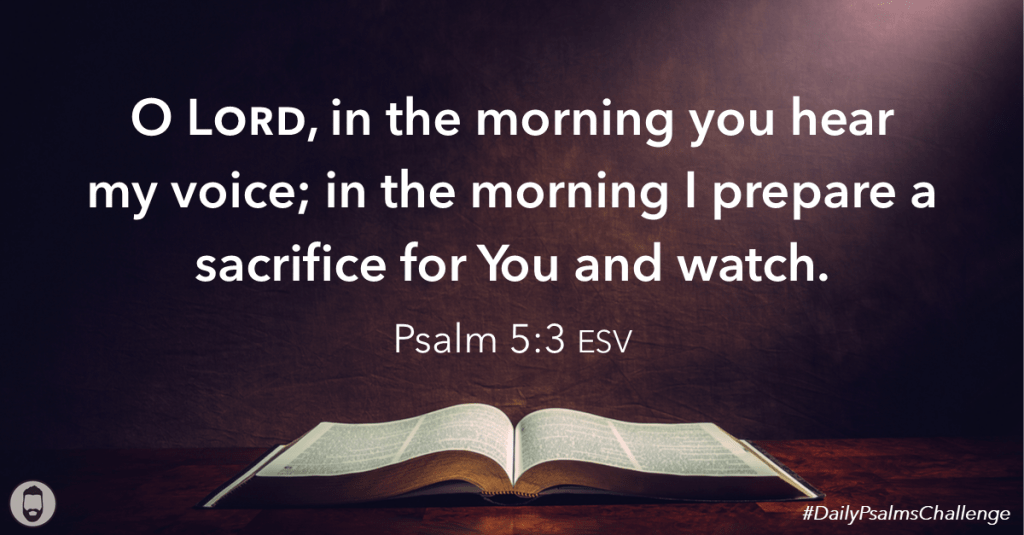
O Lord, in the morning You hear my voice; in the morning I prepare a sacrifice for You and watch.

Psalm 5:3

Psalm 5 is a morning prayer of David where he cries out urgently to the Lord, asking God to lead him in righteousness and bring justice to the wicked. This psalm contrasts the holiness of God and the ways of evildoers, showing both God’s hatred for sin and His steadfast love for those who take refuge in Him.

David’s confidence in God is rooted in God’s character. The Lord does not delight in wickedness, and evil cannot dwell in His presence (v. 4). David is confident he can enter God’s presence — not by his merit but God’s through the abundance of God’s steadfast love (v. 7).

This psalm also highlights the effects of sin. David illustrates the wicked as having no truth in their mouths and calls their throats open graves (v. 9), which is quoted by Paul in Romans 3:13 to show the depths of sin in all people. Left to ourselves and our own desires, we are no different. The difference is taking refuge and finding salvation in Jesus as Lord and Savior.

Seeing Jesus in Psalm 5

David’s prayer finds its ultimate fulfillment in Jesus. Jesus loved us so much that He took the wrath of God due our sin on Himself. Rather than standing before God in our wickedness, we can stand covered by Jesus’s righteousness.

Jesus also illustrated what it looks like to pray like David, rising early to talk to His Father (Mark 1:35). Let’s follow His example.

Reflection

As we meditate on Psalm 5, we are invited to pray like David. Each morning, we can cry out to God for guidance, trusting Him to lead us in righteousness and protect us from sin.

Just as David relied on God’s faithfulness, we can approach God today through Jesus, the perfect representation of God’s steadfast love. Jesus bore the penalty for our sins so that we can come boldly into God’s presence (Hebrews 10:19-22).
The #dailyPSALMSchallenge gives us the opportunity to start 2025 in God’s Word by digging into a psalm a day. Each day will identify a key passage for us to meditate on as well as seeking to help us see Jesus in the psalm and reflect on what we have read.

Won’t you take the challenge?
“Peace in the Night” from Psalm 4 (#dailyPSALMSchallenge)

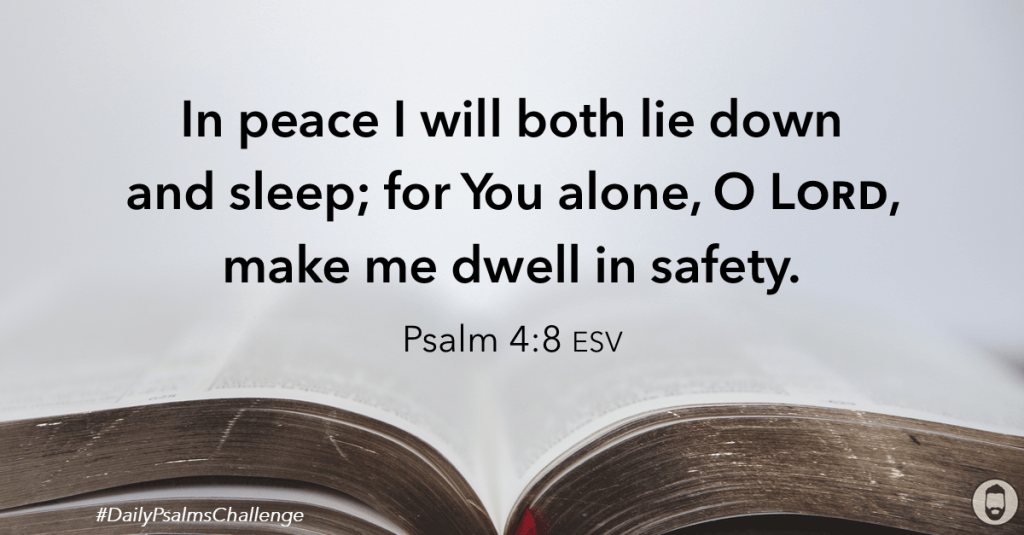
In peace I will both lie down and sleep; for You alone, O LORD, make me dwell in safety.

Psalm 4:8

Psalm 4 shows us more of David’s quiet trust in the Lord in the midst of trials and tribulations. This psalm teaches us how to respond to the anxiety that comes from trials with faith, leading to joy and peace despite circumstances.

A Cry for Help

David begins with an urgent plea to the Lord: “Answer me when I call, O God of my righteousness! You have given me relief when I was in distress. Be gracious to me and hear my prayer!” (v. 1) David can reflect on God’s faithfulness throughout his life and have faith to seek God in new trials. This is a good example for us: turn to the Lord when troubles weigh on us and know that He will be faithful in the present just has He has in the past.

Confidence in God’s Care

Don’t misunderstand and think that there was no trouble or turmoil. David’s opponents were terrible. God is just better and more powerful than they are. David had assurance that God “has set apart the godly for Himself” and hears him when he cries out (v. 3). God faithfully sustains His people, and His presence provides peace.

David’s words in v. 4 — “be angry, and do not sin” — show us the temptation to respond wrongly in times of trials, encouraging self-control and Holy Spirit reliance rather than retaliating or giving in to bitterness. Instead, David exhorts people to “ponder in [their] own hearts on [their] beds, and be silent” (v. 4). There is no need to speak on our own behalf; God has it handled.

Joy Surpasses Circumstance

David’s cry of “Lift up the light of Your face upon us, O Lord” (v. 6) shows the surpassing worth of God’s presence in our plight. Knowing God and having His presence in the midst of troubles brings “more joy…than they have when their grain and wine abound” (v. 7). Seeking God’s face echoes the blessing of Aaron in Numbers 6:24-26, affirming the promise of God’s provident presence.

David trusts God to provide security. That gives Him a peaceful assurance that even allows rest, recognizing that safety lies in the Lord and not in our circumstances.

Seeing Jesus in Psalm 4

Psalm 4 points to the peace that Jesus promised His disciples in John 14:27: “Peace I leave with you; my peace I give to you”. Jesus is the very same God who provided peace, security, joy, and rest to David and provides it still to His people today, no matter the circumstances.

Reflection

Meditate on God’s past faithfulness in your life and ask His Spirit to strengthen your faith in your present trials. His faithfulness and provident care is better than the momentary joy or happiness offered by material things.

May we, like David, learn to cry out to God, rest in His promises, and trust in His provision.

The #dailyPSALMSchallenge gives us the opportunity to start 2025 in God’s Word by digging into a psalm a day. Each day will identify a key passage for us to meditate on as well as seeking to help us see Jesus in the psalm and reflect on what we have read.

Won’t you take the challenge?
“Save Me, O God” from Psalm 3 (#dailyPSALMSchallenge)

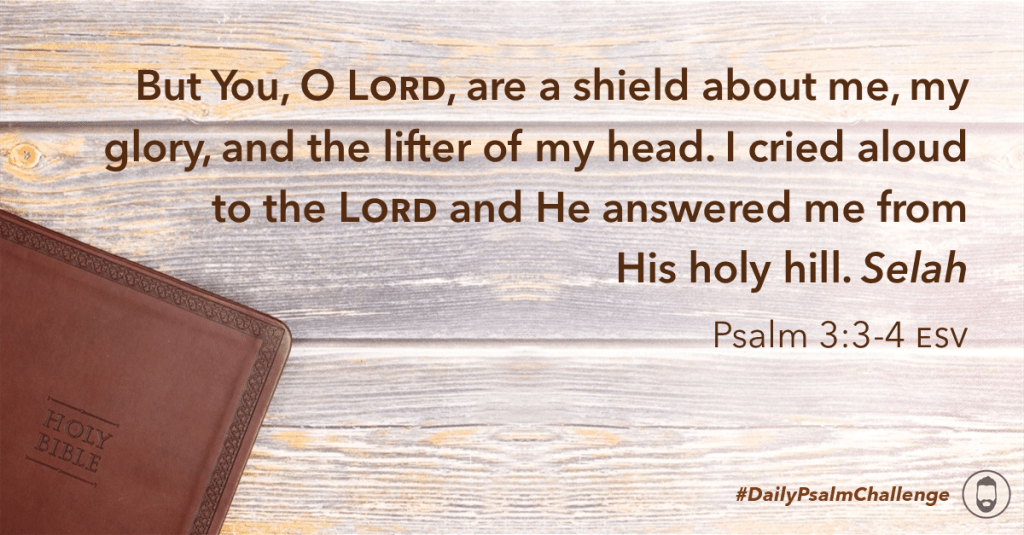
3But you, O LORD, are a shield about me, my glory, and the lifter of my head. 4I cried aloud to the LORD, and He answered me from His holy hill. Selah

Psalm 3:3-4

Psalm 3 is written after one of the most terrible moments of King David’s life — when he was on the run from his son Absalom, who was trying to remove him from power. This is a psalm of lament (letting out one’s feelings of grief or sadness) to be sure, but it is also a psalm of trust and hope in the Lord, offering us an example of turning to God in the midst of overwhelming circumstances.

The Crisis of Many

David begins by describing his specific circumstances: his enemies are many, their accusations are relentless, and their mockery sharp, saying that “There is no salvation for [David] in God” (v. 2). To say that David would not find salvation in his God strikes at David’s identity as God’s anointed king, but their mocking did not change the truth. David’s response to them reminds us that turning to the truth of God’s promises is the only place to go when doubt and despair set in.

The Confidence in God

David shifts his focus from his circumstances by declaring to the Lord that He is “a shield about [him], [his] glory, and the lifter of [his] head” (v. 3). His confidence is built on God’s steadfast character and strength rather than what is going on around him. He trusts that his Lord not only hears his cry but that He will answer him from His holy hill (v. 4).

The Calm in the Chaos

It would be understandable for David to be distraught, but we see God providing him with peace. How many of us find it difficult to sleep when we are in the midst of trials and tribulations? Because of his faith in God, David could say, “I lay down and slept; I woke again, for the Lord sustain me” (v. 5). This highlights his faith and teaches us that God watches over His people, especially in times of turmoil and insurmountable circumstances.

The Cry for Deliverance

We see David cry out to the Lord for help and relief: “Arise, O Lord! Save me, O my God!” (v. 7). This echoes the cries of God’s people past and future, asking God to intervene against a powerful foe. David trusts that God will deal justly with the wicked — even if that means Absalom, while affirming that “salvation belongs to the Lord” and asks that His blessing be on His people” (v. 8).

Seeing Jesus in Psalm 3

David’s experience crying out to the Lord in the midst of trial and finding help points forward to the ultimate son of David, Jesus. He faced all that David did and worse — rejection, betrayal, mockery, brutal torture, execution. Jesus bore the full weight of our sin and death on the cross and cried out to His Father. Though surrounded by enemies and taunts like we have never seen, Jesus rested in His Father’s will and the confident assurance in His prophesied resurrection. Jesus’s victory over sin and death ensures that all of us who trust in Him can truly echo David’s cry that “Salvation belongs to the Lord”.

Reflection

Psalm 3 teaches us to bring our fears and burdens to God, recognizing that He can shield us from trouble and sustain us through trials. Jesus is not a distant, detached King; He knows our struggles because He experienced them. He has already overcome them (John 16:33). Whatever troubles you face today, cry out to Him and rest in the assurance that salvation belongs to Him.

The #dailyPSALMSchallenge gives us the opportunity to start 2025 in God’s Word by digging into a psalm a day. Each day will identify a key passage for us to meditate on as well as seeking to help us see Jesus in the psalm and reflect on what we have read.

Won’t you take the challenge?

“Let Earth Receive Her King” from Psalm 2 (#dailyPSALMSchallenge)

6“As for me, I have set my King on Zion, my holy hill.”

7I will tell of the decree: The LORD said to me, “You are my Son; today I have begotten you.

Psalm 2:6-7

Psalm 2 reminds me of the line in the hymn “Joy to the World”: “Let Earth receive her king”. This psalm proclaims the reign of God’s anointed King, Jesus, who is set over all creation. Though the nations rebel, Psalm 2 reveals that true peace and joy come only by receiving and submitting to this King. His authority is certain, and His rule is good.

The Rebellion of the Nations

Psalm 2 begins with the nations raging and plotting in vain against God and His Anointed (vv. 1-3). In their pride, they reject God’s authority by choosing to skewing it as oppressive and restrictive, yet their rebellion reflects the condition of sinful humanity — desiring to rule ourselves rather than submitting to our Creator and King.

God’s Response

God does not respond in fear or by some kneejerk reaction but with laughter (v. 4). He clearly declares His plan: “I have set my King on Zion, my holy hill” (v. 6). This King, the Son of God, has been appointed to rule all nations. How? Well, as God created everything and appoints the rise and fall of nations, it is His divine prerogative! The New Testament affirms that this King is Jesus, the Messiah — the Christ — who was divinely declared to be this Son at His baptism and resurrection (Matthew 3:17, Acts 13:33).

God’s plan is unshakable. The King of kings is enthroned. His reign is certain.

The Universal Reign of the King

God promises His Anointed authority over all nations, to the ends of the earth (v. 8). He will bring justice and restore order, breaking down opposition like shattering pottery (v. 9). His rule is both powerful and righteous, ensuring that evil will not (and cannot) prevail.

A Call to Submission and Joy

The call for earth is clear: receive your rightful King and rejoice in His rule. This is seen in the way Psalm 2 closes with a warning and an invitation: “Serve the LORD with fear, and rejoice with trembling. Kiss the Son” (vv. 11-12). To “kiss the Son” is to honor Him, recognizing His authority and submitting to His reign. Though His wrath and power are real, His invitation is filled with grace and “blessed are all who take refuge in Him” (v. 12). True joy is not found in rebellion but in embracing Jesus as King — as Lord (Romans 10:9).

Seeing Jesus in Psalm 2

Psalm 2 make this pretty clear and explicit. Jesus is the King.

Reflection

Psalm 2 calls us to reflect on whether we will receive or resist Jesus. The nations rage, but we are invited to rejoice under His rule. To receive Him is to put our faith, hope, and trust in Him, finding refuge and joy.

Let earth — and each of us — receive the King.

The #dailyPSALMSchallenge gives us the opportunity to start 2025 in God’s Word by digging into a psalm a day. Each day will identify a key passage for us to meditate on as well as seeking to help us see Jesus in the psalm and reflect on what we have read.

Won’t you take the challenge?

“The Way of the Righteous and the Wicked” from Psalm 1 (#dailyPSALMSchallenge)

1Blessed is the man who walks not in the counsel of the wicked, nor stands in the way of sinners, nor sits in the seat of scoffers; 2but his delight is in the law of the LORD, and on His law he meditates day and night. 3He is like a tree planted by streams of water that yields its fruit in its season, and its leaf does not wither.

Psalm 1:1-3

Psalm 1 opens the Psalter with a clear choice. There are two ways to live, and both have a drastically different outcome — the way of righteousness that leads to life, those who love God and His Word, and the way of the wicked, those who reject God. Today, we will consider where we’re rooted and what way we are walking in.

The Blessed Life

The psalmist describes the “blessed” man as one who refuses to follow sinful influences. He avoids walking with the wicked, standing with sinners, or sitting with scoffers (v. 1). This isn’t just about avoiding outward sin but about not letting anything other than God shape our lives.

Instead, the “blessed” delights in God’s law and meditates on it day and night (v. 2). “Delight” here suggests joy and deep satisfaction. God’s Word isn’t a burden for the “blessed” but a treasure. When we spend time in Scripture and meditate on it — focusing on the God of the Word, it shapes our hearts and brings us closer to Him.

This life is compared to a tree planted by streams of water (v. 3), well-watered and thriving, bearing fruit and standing firm even in harsh conditions. This “blessed” life is nourished by God’s Word, producing fruit and remaining steadfast through difficulties and trials.

The Peril of the Wicked

In contrast to the tree, the “wicked” are described as chaff — weightless and useless, blown away by wind (v. 4). Their lives lack purpose and stability. They won’t be able to stand in the judgment or belong in the assembly of the righteous (v. 5). The path of the wicked ultimately leads to destruction.

Seeing Jesus in Psalm 1

Ultimately, Jesus is the only One who is truly righteous and perfectly matches the “blessed” man described in Psalm 1. He lived a sinless life, delighted fully in the Word, and bore eternal fruit through His life, death, and resurrection. The only way for us to be counted as righteous is through faith in Him (2 Corinthians 5:21). The only way for us to live the “blessed” life described here is to be filled and empowered by His Spirit.

Reflection

Psalm 1 challenges us to examine where we are headed and in what we find our delight. Ask yourself: are you rooted in God’s Word, drawing life and sustenance from Him and His Word, or is your delight in the futile, fleeting things of the world?

We are called in Psalm 1 to meditate on Scripture, finding nourishment in Christ, the perfect and righteous One. May we find ourselves rooted in His living water, equipped to flourish and bear fruit.

The #dailyPSALMSchallenge gives us the opportunity to start 2025 in God’s Word by digging into a psalm a day. Each day will identify a key passage for us to meditate on as well as seeking to help us see Jesus in the psalm and reflect on what we have read.

Won’t you take the challenge?