13 And suddenly there was with the angel a multitude of the heavenly army, praising God and saying,
14 “Glory to God in the highest, and on earth peace among people with whom He is pleased!”
Luke 2:13-14
8 And when he took the scroll, the four living creatures and the twenty-four elders fell down before the Lamb, each one of whom had a harp and golden bowls full of incense, which are the prayers of the saints. 9 And they were singing a new song, saying,
“You are worthy to take the scroll and to open its seals, because You were slaughtered, and bought people for God by Your blood from every tribe and language and people and nation, 10 and made them a kingdom and priests to our God, and they will reign on the earth.”
The angels sang because the everlasting Father had come to extend arms of redeeming grace to all who would give their hearts to him.
It is a wonderful, mysterious, hard-to-grasp, and beyond-the-scope-of-our-normal-reasoning story. But when you get it, when you come to fully understand the purpose and implications of this story, you will sing too. This story’s amazing plot wasn’t written when Mary got pregnant or when prophets began foretelling it or when God announced it after the disastrous rebellion of Adam and Eve. This story is so miraculous in every way that it could have only come out of the mind of God in eternity before the foundations of the earth were laid down by his mighty hand. It points to the divine imagination and screams the power of the divine hand. No man could write this plot and if he did, no man could expedite what he had written. This story is itself an argument for the existence of God and is a portrait of his holy character.
The beautiful world that God had created was now broken and groaning—the direct result of the rebellion of the ones God had made in his own image and had placed his guiding and providing love upon. The evidence of its brokenness was everywhere, from the inner recesses of the hearts of people, to violence and corruption of government, to the existence of plagues and diseases. Sure, there was beauty still to be seen, but the whole world groaned under the weight of its brokenness. It would have been just for God to stay his distance, to let the world quake and groan. It would have been a just response to the arrogant rebellion that brought this brokenness on the world. But in one of the gorgeous mysteries of God’s sovereign grace, he looked on his broken, rebellious world with eyes of mercy.
Yes, God would act decisively, and his actions would be what he had planned in the beginning, but they would be a stunning surprise to every mere mortal. His response would not be condemnation and judgment. His response would not be a meting out of justice. Rather, his response would be intervention and rescue. He would do in grace what the law could never do. He would do in grace what we could never do for ourselves. He would do what philosophers could never conceive, what leaders could never strategize, and what poets could never imagine. He would offer the only thing that would ever address the need and solve the problem. He, himself, would become the greatest, most costly, most transformational gift ever.
God would take on human flesh and invade his sin-broken world with his wisdom, power, glory, and grace. But he wouldn’t descend to a palace. Instead, the Lord Almighty, the Creator, the sovereign King over all things would humble himself and take on the form of servant; he would live on our behalf the life we could have never lived, he would willingly die the death that you and I deserve to die, and he would rise from his tomb as the conqueror of sin and death. He would suffer every single day of his life so that he could, with his life, give grace to rebels, extend love to those who would deny his existence, impart wisdom to those who think they know better, and extend forgiveness to everyone who seeks him. His coming stands as an affirmation that he will not relent, he will not be satisfied until sin and suffering are no more and we are like him, dwelling with him in unity, peace, and harmony forever and ever. It is true that you just can’t write this stuff! The majesty of the patient and forgiving love of this story defies words. The implications of this birth are not only transformational to the cosmos, but also eternal in their extent. This is the story of Jesus, born in a barn in Bethlehem. The Messiah the earth cried for now cries to be held by Mary and will soon cry in torment of the cross of salvation. He came to suffer because he came to save. The angels sang because finally hope had come. Don’t you want to join them?
[1] Paul David Tripp, Come, Let Us Adore Him: A Daily Advent Devotional (Wheaton, IL: Crossway, 2017).
The word advent refers to the arrival of someone or something important.
The season of Advent (basically the month prior to the celebration of Christmas) brings Titus 2:11-14 to mind:
For the grace of God has appeared, bringing salvation for all people, training us to renounce ungodliness and worldly passions, and to live self-controlled, upright, and godly lives in the present age, waiting for our blessed hope, the appearing of the glory of our great God and Savior Jesus Christ, who gave Himself for us to redeem us from all lawlessness and to purify for Himself a people for His own possession who are zealous for good works.
That phrase “waiting for our blessed hope” reminds me of those who had long-awaited Jesus’ first coming. It also reminds me of how we should be as we await His return!
We want to give you the opportunity to use this time – when people are trying to focus on and remember hope, peace, joy, and love – to focus on “our great God and Savior Jesus Christ”. Starting on December 1 and going up to Christmas day, we have a Bible passage to read and have curated devotions to help focus our hearts and minds on Jesus.
Or you can use the links or podcast player below to listen to the Bible reading and devotion.
If you would like to sign-up to receive weekly devotions and other content, enter your email address in the box below and click the “subscribe” button.
11 On the way to Jerusalem he was passing along between Samaria and Galilee. 12 And as he entered a village, he was met by ten lepers, who stood at a distance 13 and lifted up their voices, saying, “Jesus, Master, have mercy on us.” 14 When he saw them he said to them, “Go and show yourselves to the priests.” And as they went they were cleansed. 15 Then one of them, when he saw that he was healed, turned back, praising God with a loud voice; 16 and he fell on his face at Jesus’ feet, giving him thanks. Now he was a Samaritan. 17 Then Jesus answered, “Were not ten cleansed? Where are the nine? 18 Was no one found to return and give praise to God except this foreigner?” 19 And he said to him, “Rise and go your way; your faith has made you well.”[1]
Luke 17:11-19
Greetings Sojourners!
It’s been too long! But I’m glad to be back studying God’s Word with you!
I’ve been writing – just a different sort of writing. As I have said before, I am blessed to be a part of the Masters of Christian Theology program at William Carey University. It has not been easy, but it has been a blessing to me. As bad as I hate to admit it, I have lost a step or two since I was last in school (as a student), but it has been good to grow in my understanding of the Word of God and in theology; it’s even been good to grow as a writer through the (many) research papers.
While I have, unfortunately, been a little more hit-or-miss in the writings here, that is something that I hope will be remedied between now and when I graduate – and definitely beyond if the Lord allows. I have enjoyed our time spent studying Colossians, but we are going to pause that study for the time being. In the meantime, I will shift the writings between now and graduation to dive into passages that fit into and overlap with passages I am diving into either in personal devotional time or in my studies for Christ Community or at Carey.
Even as I look at how to better maximize my time and strategize to use it more effectively, I am thankful to get to be a part of all I get to do. I get to be a follower of Christ. I get to be a husband. I get to be a father. I get to teach and write and serve. I am even thankful for the time I must schedule all these aspects of my life.
This week is a time set aside in America for one to be thankful. The fourth Thursday in November is supposed to be a holiday devoted to celebrating all we have to be thankful for. Since the invention of social media, some challenge themselves to find and commemorate something they are thankful for every day in the month of November. Part of me thinks that it is sad that we need to be reminded to be thankful, but the rest of me knows just how selfish I am and that, left to my own, I will neglect to be grateful. Maybe you don’t need reminding, but I find that I do.
Today, I would like to look with you to God’s Word at a passage that reminded me to be thankful and convicted me of my own lack of thankfulness.
Meeting the Master and Finding Mercy (vv. 11-14)
Any time I study a passage in the latter half of Luke, I cannot help but think of Luke 9:51: When the days drew near for Him to be taken up, He set His face to go to Jerusalem. That phrase “set His face” could also be translated “he steadfastly set his face to go”[2]. This describes Jesus’ attitude and mindset when the end of His life was drawing near, knowing full well that the cross is why He was headed to Jerusalem. You see, He was not caught off-guard by His crucifixion. Luke’s gospel records this as the moment of Jesus “turned to Jerusalem to complete his work through the predicted betrayal, death, and resurrection.”[3]
This is important because it highlights that His sacrifice was willing. The fact that “He set His face” illustrates that He was resolutely focused on getting there. It brings to mind the sort of focus that an Olympic athlete has when preparing to compete. They focus only on things that are necessary to carry out that goal. Jesus, however, did not stop doing what He came to do – seeking and saving the lost (Luke 19:10), which is what He was going to the cross to do! So, the encounters He had with those who needed saving were not random encounters or detours, they were part of His mission.
Jesus and His disciples were, as we saw in Luke 9:51, still “on the way to Jerusalem” (v. 11) when they encountered ten lepers. Leprosy meant that these men would have had to declare that they had leprosy when approaching other people by crying out “Unclean, unclean!” (Leviticus 13:45-46) so that 1) people would not come into contact with the infected person[4] and 2) those concerned with being clean according to the Law would be made aware so they would not become unclean.
Leprosy was a catch-all term in the New Testament that referenced any skin disease from the period, but it is safe to say, regardless of the level of severity, that these men had been ostracized and at a distance from society for some time. They would have been unable to work or socialize with others, even family. They would feel isolated and alone. More than that, they were isolated and alone. When these men saw Jesus, they respectfully kept their distance, but they ceased their cries of “unclean” to cry out to Jesus: “Jesus, Master, have mercy on us” (vv. 12-13).
Time and again, those who are outcast and downcast found their way to Jesus seeking help from Him. These particular outcasts asked Him for mercy. The word translated “mercy” here meant “to have compassion or mercy on a person in unhappy circumstances” or “to be gracious toward [or] bestow kindness”.[5] This request for mercy would have been the same whether they were asking for charity or alms or to be healed, so it is difficult to tell exactly what they were seeking. They found more charity than they could have ever hoped to receive.
No matter what they were seeking, they were likely confused by Jesus’ response. He did not toss them a coin or lay hands on them for healing. He didn’t even make mud and rub it on them (John 9:6) or tell them to bathe in the Jordan (2 Kings 5). He simply told them, “Go and show yourselves to the priests.” If they had been familiar with the Law, they would have recognized that this was what those who were cleansed of leprosy were told to do in Leviticus 14:1-32 – to go and show themselves to the priest so that he could confirm they were clean and make an offering for their guilt and atonement for their sin. When the text says, “as they went” (v. 14), it shows that the men – all ten of them – departed to go to the priest. They had faith. Or at the very least belief or held to 1st century Judaism.
Nothing miraculous had happened to spark their journey, merely the command of Him from whom they sought mercy. But after they headed out on their journey, the miracle happened. They were cleansed. The sores on their skin were healed, yes, but something more happened. They were cleansed. Those who had just moments before needed to cry out “unclean” when they approached others were made clean by Jesus. They did not need lengthy washings or offerings by a priest because they had been cleansed by the God those priests served. Those ten men’s lives were changed in a moment. But the heart of one was touched more than the other nine.
Gratitude and Grace (vv. 15-19)
I cannot imagine what those men must have felt in their hearts – and in their bodies! It is important for us to look at the distinctions between the one and the nine in this narrative. Before we judge the nine too harshly, it is important to note as we did in v. 14 that they likely were heading exactly where Jesus had told them to go – to the priest. They were being obedient to Jesus and to the Law. The one who turned back would have had a hard time fulfilling that command, though, because he was a Samaritan.
All my life, I have heard the issue with Samaritans oversimplified to say that there was simply a sort of racial tension between Jewish people and those from Samaria. They have a long history of division. The Samaritans are largely the descendants of people brought in to colonize the region when the Assyrians conquered the land.[6] Those inhabitants were later educated in the Law after God had sent lions into the land to attack them (2 Kings 17:25-26) and some intermarrying occurred with the northern tribes of Ephraim and Manasseh.[7] They claimed the same or at least similar beliefs as their Jewish relatives, but they had different holy places and places of worship. So, the tensions over ethnicity are accompanied and highlighted by the religious differences. The Samaritans were not accepted by Jewish people.
A leper would have been ostracized, but a Samaritan leper would have been a total outcast. So, for the Master (v. 13) to show such grace apparently made quite an impact. Ten lepers were cleansed. Nine Jewish former-lepers went to show themselves to the priest like Jesus commanded them. But only one stopped to thank Jesus. In fact, saying that he stopped to thank Jesus is an understatement. Look at what the text says. He saw that he was healed, turned back to where Jesus was, praised God, fell on his face at Jesus’ feet, and thanked Him (vv. 15-16).
Imagine what led this man to have such a reaction – a potentially incurable and infectious skin disease, seeking charity in a foreign land that is hostile to you and your people. Then, he encountered the One from whom mercy could be found. Imagine the feeling when looking down at your hands, expecting them to be covered in sores and boils but seeing clear skin. You would still have to go to present yourself to the priest, but Jesus was still standing there. Being cleared by the priest would mean you could go back to your life, but the One who healed you is right there.
What we see as a display of thankfulness was an act of worship for this man. What does that say for our thankfulness for what God has done for us?
Jesus asked the man some important questions: “Were not ten cleansed? Where are the nine? Was no one found to return and give praise to God except this foreigner?” What can he ask of us?
Jesus knew the man’s heart. He knew what he meant when he asked for mercy. And He knew what drove the man to his face at His feet in praise and thanksgiving. Rather than showing himself before a priest, this man laid himself down at the feet of the Great High Priest. Jesus told the man, “Rise and go your way; your faith has made you well.”
Amen.
Wrapping Up
I asked you to imagine what the man must have been feeling, but, if you are in Christ, you know. If you are in Christ, you were formerly outcast (Ephesians 2:12). You were formerly not His people (1 Peter 2:10). You were His enemy (Romans 5:10). And you were dead in your sin (Ephesians 2:1-2, Colossians 2:13). Any of those are hopeless, but all of them leaves one desperate and despondent. Or it leaves one callous and defiant (Ephesians 4:17-19).
If that is true of you, does it move you to worship? Does it move you to gratitude? When is the last time that you cast yourself on your face before God and thanked Him for His love and grace and mercy?
Religion does not produce such a reaction.
When John the Baptist sent His disciples to Jesus to make sure He was the Messiah, Jesus answered them by paraphrasing Isaiah 29:18-19 and 35:5-10: “the blind receive their sight and the lame walk, lepers are cleansed and the deaf hear, and the dead are raised up, and the poor have the good news preached to them.” This answer satisfied John, and it points us to who Jesus is and what He does. He is the God who saves! One thing is for sure, dear Sojourner, the ones who can now see or walk who couldn’t before, the ones who were cleansed from their leprosy or given the ability to hear, those who were dead and are now alive – they are grateful! What does it say for me if I am not?
I needed this reminder. It is so easy to forget sometimes what it was to be lost, what it was to be dead in my sins. But there is a Savior who has earned my gratitude. He is worthy of better worship than I can offer.
I urge you to examine your heart – not because tomorrow is the fourth Thursday in November but because encountering Jesus produces a response. Encountering Him either drives us to repent of our sins and put our trust in Him or to vehemently deny Him. There is no middle ground. The good news is that if you find that you are not saved, He is still the God who saves! And I would love to help you encounter Him today.
9 Do not lie to one another, seeing that you have put off the old self with its practices 10 and have put on the new self, which is being renewed in knowledge after the image of its creator. 11 Here there is not Greek and Jew, circumcised and uncircumcised, barbarian, Scythian, slave, free; but Christ is all, and in all.[1]
Colossians 3:9-11
Greetings Sojourners!
When we first started in these devotions a few years ago, all we had was an opportunity to help people dive more deeply into God’s Word and a desire to make that possible. We have, for the most part, been able to keep that going on a weekly basis, but for the next little while that will not be possible. Our desire has not changed. We still want to give opportunity to help people study God’s Word. The study that makes it possible sometimes requires a bit more time than life offers.
Part of that study will be completed in May. As I have mentioned before, I am getting to be part of a Master of Theology program at William Carey University. I began this past February and am thankful for all I have learned, am learning, and will learn before it is over (as well as continue to learn as these skills are applicable for the rest of my life). But that level of study, especially as a husband, father, teacher, pastor, and aspiring writer, takes time – time that takes me away from writing Bible studies like these, but time that also better equips me to write them.
Please, do not take this as complaining. I am thankful to get to do everything God allows! However, I am definitely learning my own limitations as He grows me more into who He is making me to be.
Having said all that, I am glad to be back in our study of Colossians, especially as we transition out of what we once were in our trespasses and sins (dead) and into looking at what new life in Christ is meant to look like.
When a person comes to Christ, more happens than simply joining a church or walking an aisle. Everyone who is not in Christ is dead in their sin (Colossians 2:13, Ephesians 2:1-2) no matter their religious affliliation. So for us to say that we have new life in Christ recognizes 1) that the old has gone/died and 2) there should be a marked difference in the new because that which was dead now lives through Christ (Ephesians 2:4-5)! When Paul transitions in our passage today from taking off the sins of the old life to putting on Christ, he is doing more than talking about behaviors; he is showing the Colossians what the new life in Christ is supposed to be like (and what it is not).
Seeing That You Have Put Off the Old Self with Its Practices (vv. 9-10)
The last of the sins Paul told the Colossian believers to “put…away” in verse 8 was to put away “obscene talk from [their mouths]”. In verse 9, he tells them not to “lie to one another, seeing that [they] have put off the old self with its practices” (emphasis added). You can see here that this is more than morality and the monitoring and modifying of behavior – it is about the “new self” (v. 10).
Too often, Christians and church-folks[2]put either too much or a wrong emphasis on behavior, so, for us to understand what Paul is talking to them about, it may be helpful for us to first clarify what we are not talking about.
Church-folks worry a lot about the way behaviors look. They hurry up and stop arguing as they pull in the church parking lot. They have expectations about the way that people carry themselves while at church, too. They think no cussing should occur in the church building; no obscene talk in there. If a lost person comes into the building, they want them to learn how to act and behave because the image of being sanctified or reverent or holy is more important than being sanctified, reverent, or holy. They are a caricature of Jesus said the Pharisees were like: “whitewashed tombs, which outwardly appear beautiful, but within are full of dead people’s bones and all uncleanness” (Matthew 23:27). Basically, they want to look like they have been changed by Jesus – look like they have new life – when they are actually still dead in their trespasses and sins (Ephesians 2:1-2, Colossians 2:13).
If they were to repent of their sins and seek Jesus, everyone would know that they are not perfect. Everyone would know they are sinners. If this describes you, I hate to tell you, but people already know. Church-folks ain’t fooling anyone.
What Paul is telling the Colossians when he says “you have put off the old self with its practices” (v. 9) is a reminder that they have encountered Jesus. It is a reminder that they do not have to live like dead men and women because Jesus has made them alive! That would be like Jesus coming back to Bethany to visit Lazarus after he had been raised (John 11, 12:1) and finding him hanging out back at the tomb. That would be foolish, right? No, after Lazarus had been called out of death and hopped out of the tomb, Jesus found him in the house reclining at the dinner table (John 12:2). He was eating and hanging out. He was alive and no longer dead because Jesus made him alive (John 11:43-44, Ephesians 2:4-5)!
What about you?
Has Jesus made you alive, or are you still dead in your sins? Are you trying to convince others that you are not a sinner or yourself?
Paul wanted the Colossians to be reminded that they have “put on the new self” – that who they are after coming to Christ is “being renewed in knowledge after the image of its creator” (v. 10). Everything that sin has done, is doing, and will do since the Fall (Genesis 3) has effectively marred how man bears God’s image (Genesis 1:26-27). When Jesus saves us – when He brings us from death to eternal life in Him, He begins correcting that image. We go from looking like the world, little-by-little and day-by-day, to looking like Him again. The longer we walk with Him the more significant the change!
That’s good news!
Here There is Not…. (v. 11)
Think about all of the categories and labels that Paul lists in verse 11 and how that compares to the image of God: Greek, Jew, circumcised, uncircumcised, barbarian, Scythian, slave, free. Each of those words was a worldly description of somebody in the church at Colossae. Some of those categories were even Biblical or are part of the unique and beautiful way that God created that person. Others came from the way that other men had labeled them to either belittle or marginalize them. But none of them compare to what it is to be in Christ!
Those who are in Christ are His (1 Corinthians 6:19-20, Titus 2:14). They have been adopted into His family (Romans 8:15, Galatians 4:5). The labels and categories that are so emphasized here on earth just cannot compare to belonging to Him – to being alive in Him. That is why Paul tells them that their ethnicity, their religious affiliation and practices, their nationality, or even whether they are free or owned by another person pales in comparison to “Christ [being] all, and in all” (v. 11).
There will not be a gate for entrance into heaven for American Christians, Evangelical Christians, Catholics, or Protestants. Their will not be gates per ethnicity or culture. Those are qualifications sinful people make up to either lift themselves up, tear others down, or some mixture thereof. No, in heaven there will be none of that foolishness! I love the beautiful picture from John’s vision of heaven in Revelation 7:
“After this I looked, and behold, a great multitude that no one could number, from every nation, from all tribes and peoples and languages, standing before the throne and before the Lamb, clothed in white robes, with palm branches in their hands, and crying out with a loud voice, ‘Salvation belongs to our God who sits on the throne, and to the Lamb!’”
Everyone will be together. All those who are in Christ will stand before His throne. He will be the focus. Amen!
He is either “all, and in all” – or He ain’t. To paraphrase Ricky Bobby: if Jesus ain’t first, He’s last.
Wrapping Up
Since today’s verses are transitioning from our last passage to what comes next, I am afraid that this might have come across a bit disjointed, so I want to clear things up a bit. To do so, there are two statements my pastor John Goldwater has made at Christ Community Church recently that stand out in my mind as I write this. Let me paraphrase them for you:
There was a Sunday a while back where we had a noticeably large group of visitors. During the announcements, he told them that if they had come to Christ Community looking to see their social status raised by attending or are looking for some sort of worldly benefit they had come to the wrong place. He told them all we had to offer was Jesus and His gospel and that those looking for social capital would never find it with us.
He is preaching through Matthew and was going through the passage where the Pharisees were angry at Jesus for healing a man on the Sabbath day (Matthew 12:1-14). As he talked about how the morally-elite and religiously-superior Pharisees were lecturing God Himself on what He should and should not have done, he reminded us that we do not have time to teach people how to act in church because that is all they will learn (acting). No, he reminded us that if we point them to Jesus – if we share His gospel with them, they can learn Christ, be saved, and Jesus will change their lives. All acting will do is teach lost, dead sinners how to hide how dead they are.
What Paul was doing for the Colossian church, and for believers today, is helping them to see that there is supposed to be a difference between those who have been saved – those who are in Christ – those who have been made alive by grace through faith in Christ alone – and those who are still dead. I hope you can see, beloved Sojourner, that there should not even be a comparison here much less confusion. We should be able to easily tell the difference between death and life. We should not be satisfied going back to the cemetery when Jesus is preparing a room for us in the Father’s house (John 14:1-6)!
But, sadly, we allow ourselves to be. “But that is not the way you learned Christ!” (Ephesians 4:20)
If someone taught you to act like a Christian but you have not been born again (John 3), you are dead in your trespasses. No amount of service or behavior or the Academy Award quality acting that even has your grandmama fooled will get you through the gate. Those who are not in Christ will not hear, “Well done my good and faithful servant” (Matthew 25:21) because they are not His servant. They will cry out that they had preached in the name of Jesus, done mighty works in the name of Jesus, and had even cast out demons in the name of Jesus (Matthew 7:22), but they had never believed in Jesus (Acts 4:12, Romans 10:9-10) – they had never called upon His name to save them (Romans 10:13). No, all acting will get is this declaration from Him: “I never knew you; depart from me, you workers of lawlessness” (Matthew 7:23).
On the other hand, there are those who have called upon Him and have been saved. They have been convicted in their hearts of their sins (Psalm 73:21), repented (Psalm 51), and confessed Jesus as Lord (Romans 10:9). They were dead, but Jesus made them alive.
They may not always act right, but Jesus is still working on and in them. They need to be reminded like their Colossian brothers and sisters of old to stop doing the sins of the old self and put on Christ and His new life. They need to be reminded to get out of the cemetery and come to the table. They need to be reminded that Jesus has more for them than this world. He has given life and His Spirit to help them live it.
Which describes you?
John was right. No amount of social capital can compare with an encounter with Jesus. And no amount of acting will earn heaven when the credits roll.
I am reminded of my son Xander when he got saved about a month ago. He had asked questions for months and months. He understood that everyone is a sinner and that those who die without believing in Christ go to hell. He knew lots of information and details. The more he asked, the worse he acted. There were times where he was so worried over acting this way or that – over trying to seem like he did not sin at all – that his behavior was worse than it had ever been before. He seesawed between trying to earn salvation and acting like hell until he finally changed his question. Mid-sermon one Sunday morning, he turned around and, instead of asking how to be saved, he asked, “How do you know God will save you?” He was shocked at how simple the answer was: “You do what the Bible says to do to be saved, and you trust God will do what He promised for them.”
He was relieved. None of it depended on him. It all depended on Jesus. I imagine the Colossian church was relieved, too. They did not need to be circumcised because they had been saved. They did not need to act this way or that, or celebrate this religious festival or another, because they had been saved. All they needed was Jesus. And, dear Sojourner, that is all you need as well. If you do not know Him, I would be glad to talk to you or help you find a pastor or believer where you live to sit down with you. If you are part of a church that gives acting lessons over the gospel, I would love to help you find one where the Word of God is open and His gospel offered freely. As always, know that I am praying for you and thankful that the Spirit works through His Word!
[2] When I say church-folks, I mean religious people who go to church who use the name Christian without actually having been saved. The area of the southeastern United States where I live is inundated with church-folks. Even within my denomination, Southern Baptist, which prides itself on regenerate church membership (fancy seminary term for you must be saved to join the church), there are people who are allowed to join the church for what they bring to the table – for their gifts, talents, or, sadly, the size of their bank account – instead of having been made alive in Christ. This is important to clarify because, despite how it looks to the outside world, a church building full of dead people is not a church. It can’t be because the church is a people not a building or organization. Christ’s church is made up of those He has made alive. Church-folks are something else entirely.
1 Oh sing to the Lord a new song; sing to the Lord, all the earth! 2 Sing to the Lord, bless his name; tell of his salvation from day to day. 3 Declare his glory among the nations, his marvelous works among all the peoples! 4 For great is the Lord, and greatly to be praised; he is to be feared above all gods. 5 For all the gods of the peoples are worthless idols, but the Lord made the heavens. 6 Splendor and majesty are before him; strength and beauty are in his sanctuary.
7 Ascribe to the Lord, O families of the peoples, ascribe to the Lord glory and strength! 8 Ascribe to the Lord the glory due his name; bring an offering, and come into his courts! 9 Worship the Lord in the splendor of holiness; tremble before him, all the earth!
10 Say among the nations, “The Lord reigns! Yes, the world is established; it shall never be moved; he will judge the peoples with equity.”
11 Let the heavens be glad, and let the earth rejoice; let the sea roar, and all that fills it; 12 let the field exult, and everything in it! Then shall all the trees of the forest sing for joy 13 before the Lord, for he comes, for he comes to judge the earth. He will judge the world in righteousness, and the peoples in his faithfulness.
8 And the four living creatures, each of them with six wings, are full of eyes all around and within, and day and night they never cease to say,
“Holy, holy, holy, is the Lord God Almighty, who was and is and is to come!”
9 And whenever the living creatures give glory and honor and thanks to him who is seated on the throne, who lives forever and ever, 10 the twenty-four elders fall down before him who is seated on the throne and worship him who lives forever and ever. They cast their crowns before the throne, saying,
11 “Worthy are you, our Lord and God, to receive glory and honor and power, for you created all things, and by your will they existed and were created.”
5 And one of the elders said to me, “Weep no more; behold, the Lion of the tribe of Judah, the Root of David, has conquered, so that he can open the scroll and its seven seals.”
6 And between the throne and the four living creatures and among the elders I saw a Lamb standing, as though it had been slain, with seven horns and with seven eyes, which are the seven spirits of God sent out into all the earth. 7 And he went and took the scroll from the right hand of him who was seated on the throne. 8 And when he had taken the scroll, the four living creatures and the twenty-four elders fell down before the Lamb, each holding a harp, and golden bowls full of incense, which are the prayers of the saints. 9 And they sang a new song, saying,
“Worthy are you to take the scroll and to open its seals, for you were slain, and by your blood you ransomed people for God from every tribe and language and people and nation, 10 and you have made them a kingdom and priests to our God, and they shall reign on the earth.”
11 Then I looked, and I heard around the throne and the living creatures and the elders the voice of many angels, numbering myriads of myriads and thousands of thousands, 12 saying with a loud voice,
“Worthy is the Lamb who was slain, to receive power and wealth and wisdom and might and honor and glory and blessing!”
13 And I heard every creature in heaven and on earth and under the earth and in the sea, and all that is in them, saying,
“To him who sits on the throne and to the Lamb be blessing and honor and glory and might forever and ever!”
14 And the four living creatures said, “Amen!” and the elders fell down and worshiped.
If you have not been gathering, consider gathering with your church family again. We have a 10:00 Bible study where Jamie Harrison is walking us through the book of Revelation. If you are at-risk, this Bible study would be perfect for you so you can spread out (and even dip out the side door before the 11:00 worship gathering begins).
5 Put to death therefore what is earthly in you: sexual immorality, impurity, passion, evil desire, and covetousness, which is idolatry. 6 On account of these the wrath of God is coming. 7 In these you too once walked, when you were living in them. 8 But now you must put them all away: anger, wrath, malice, slander, and obscene talk from your mouth. 9 Do not lie to one another, seeing that you have put off the old self with its practices 10 and have put on the new self, which is being renewed in knowledge after the image of its creator. 11 Here there is not Greek and Jew, circumcised and uncircumcised, barbarian, Scythian, slave, free; but Christ is all, and in all.[1]
Colossians 3:5-11
Greetings Sojourners!
What a whirlwind year this has been. I guess it has really been whirlwind season for the past two years! So much has changed – but so much remains the same. Some things have gotten worse, others better, and a whole lot of things have gone from worse to better and back! One thing is certain, the Fall (Genesis 3) is still falling, and those who belong to Christ (Nahum 1:7, Galatians 4:4-5) are feeling the pains and crying out that this world is not our home (Philippians 3:20) and “Come, Lord Jesus” (Revelation 22:20)!
For all that changes in our lives, unfortunately sin still lingers. For the past two Bible studies in our Jesus Over All study (July 21 and July 28), we have been dealing with the subject of sin and how the Bible teaches that we are to put it to death and take it off. I know that this is not a popular subject, but, if we profess to believe that what the Bible says is true, we need to know what it says and especially know what we do not want to hear from it. Stick with me as we move from today looking at what we need to take off (negative) to walk with Christ to next week when we look at what we need to put on (positive) to be the Church!
We had our introduction to this in the last study, so we will just dive on in today.
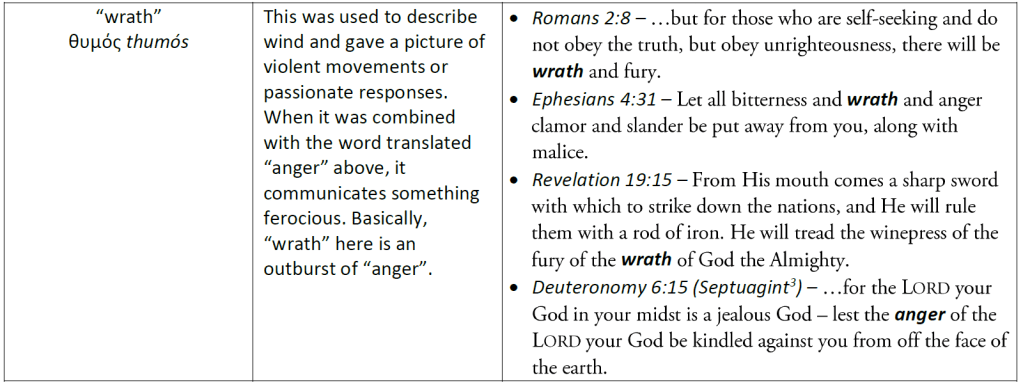
As with verses 5-7, we are going to rely on a single lexicon/dictionary (Spiros Zodhiates’ The Complete Word Study Dictionary: New Testament[2]) and lay out the definition and verses that contain the same word so that we get the full picture and context.
Now You Must Put Them All Away (v.8)
In verses 5-7, there are specific sins listed that were plaguing the church at Colossae (and likely its sister church Laodicea), but the sin in verse 8 seems to be more of a heart-set and mind-set than specific actions. Each of these things can lead to sins like those listed in vv. 5-7 but evidence more of what is going on within a person rather than what is visible in their lives. Also, these are the sins Paul says are sins in which we “too once walked” and lived in but have no place in the new life in Jesus Christ. This is because those who are in Christ have been brought from being dead in their trespasses and sins – again “in which [we] once walked” (Ephesians 2:1-2) – to being “made alive…in Christ Jesus” (Ephesians 2:4-5).
Those who believe in Christ and confess Him as their Lord and Savior (Romans 10:9-10) are saved from their sin and the wrath that accompanies it. But it is not a new or a New Testament phenomenon; it goes all the way back to how God showed it would work back in the Old Testament prophecies (Ezekiel 36:26-27):
And I will give you a new heart, and a new spirit I will put within you. And I will remove the heart of stone from your flesh and give you a heart of flesh. And I will put my Spirit within you and cause you to walk in my statutes and be careful to obey my rules.
It was made abundantly clear – and continues to be made clear through God’s Word – that one’s life matches one’s spiritual standing. Those who are dead in their trespasses and sins live that out. Jesus Himself clarified in Matthew 15:18 that “what comes out of the mouth proceeds from the heart, and this defiles a person”. What is inside will come out! It will come out because the life that comes from believing and learning Jesus (Ephesians 4:20-21) is not a learned set of skills and cannot be faked. Like Ezekiel said above, God puts His Spirit in His people. His Spirit causes His people to walk in His ways. Even the desire to do good comes from Him.
So often the world says, “Fake it ‘till you make it.” Well, dear Sojourner, that just will not cut it with the Christian life because what God does is the genuine article. Just as sure as turkey does not make tasty bacon and tofu will never satisfy like a ribeye, only the divine power of God by grace through faith in the finished work of Jesus Christ will produce the genuine article. And we need to be sure that if we are not taking off these things that Paul talks about here and are content to live in them, we are more likely to make a convincing turkey than being a child of God.
Here are those things that the Holy Spirit (through Paul) is telling us does not belong in our lives.
The last in this list is “obscene talk” which essentially goes back to what Jesus said in Matthew 15:18 – what comes out of our mouths evidences what is really in our hearts. And, ultimately, it is the heart that matters. Works do prove faith (James 2:17), but there are those who appear to do good works that fall away.
Wrapping Up
There was a man named Demas who Paul mentions at the end of Colossians. In Colossians 4:14, he tells the church at Colossae that Demas “greets” them just like Luke did. In Philemon (which was mailed with the letter to the Colossians), Paul calls him one of his “fellow workers” (Philemon 24). Yet in 2 Timothy 4:10 when Paul was in his final years and a prisoner in Rome, he reported that Demas, “in love with this present world”, deserted him and went to Thessalonica.
There is a saying in contemporary America that is used to justify whatever a person wants to do, especially things that someone might call sinful: “The heart wants what the heart wants.” It is the verbal equivalent to shrugged shoulders and communicates that people cannot help what they want to do. This is right and wrong. For those who do not know Christ, it is right. They want what they want and can do what they want. One cannot get more lost. Those who are dead in their sin are dead and cannot get dead-er. But the Bible does not leave room for those who profess Christ to take that path.
Demas was able to act like a Christian convincingly. He even convinced Paul and Luke! But he could not hide his heart – eventually he did not want to hide it. 1 John 2:19 tells us that the enduring mark of faith in Christ is whether we continue in the faith – that those who “went out from us” were not “of us” because those who are in Christ continue in the faith until the end. Pretend does not endure. Acting does not endure. But what Jesus does on the inside is long lasting.
So, Sojourner, we have some soul-searching to do.
Jamie Harrison has been teaching through the book of Revelation at Christ Community, and right now we are in the letters from Jesus to the seven churches. One thing that Jamie has done consistently through this section is remind us that Jesus is speaking to us and our churches by His Spirit through the reading and hearing of His Word. And He points to where the Bible gives us application. That is fitting here because we may be tempted to work our way out of any of these sins that are present in our lives. That will not work. We need to fix our eyes on Jesus and repent, trusting in His Spirit to give us what He promised back in Ezekiel 36.
Let Psalm 139:23-24 be our prayer as we look at our own lives and seek to take off these sins – as we desire to love and follow Jesus and not allow our love for our sins draw us away like Demas:
23 Search me, O God, and know my heart! Try me and know my thoughts! 24 And see if there be any grievous way in me, and lead me in the way everlasting!
I am praying for you as always and want you to know that you are not alone in the struggle against sin. Sometimes it seems harder to take certain sins off than others but know this: Jesus has paid the penalty for our sin and made a way – the only Way (John 14:6) out of death and into His eternal life. Will you trust Him or continue in sins? Do you love Jesus, or are you in love with this present world? I pray He helps you see which and draws you to Himself.
[3] The Septuagint is a Greek translation of the Old Testament in the 3rd-2nd centuries BC by Jewish scholars who understood Hebrew (and Greek) better than anyone who has lived in the last 1,800 years.
***Announcement: We will be having a baptism service @ 1pm following our morning worship service at the Grenada Lake’s north-end abutment!
Here are our Scriptures & songs:
Scripture | Isaiah 55:1-9 —
1 Come, everyone who thirsts, come to the waters; and he who has no money, come, buy and eat! Come, buy wine and milk without money and without price. 2 Why do you spend your money for that which is not bread, and your labor for that which does not satisfy? Listen diligently to me, and eat what is good, and delight yourselves in rich food. 3 Incline your ear, and come to me; hear, that your soul may live; and I will make with you an everlasting covenant, my steadfast, sure love for David. 4 Behold, I made him a witness to the peoples, a leader and commander for the peoples. 5 Behold, you shall call a nation that you do not know, and a nation that did not know you shall run to you, because of the Lord your God, and of the Holy One of Israel, for he has glorified you.
6 “Seek the Lord while he may be found; call upon him while he is near; 7 let the wicked forsake his way, and the unrighteous man his thoughts; let him return to the Lord, that he may have compassion on him, and to our God, for he will abundantly pardon. 8 For my thoughts are not your thoughts, neither are your ways my ways, declares the Lord. 9 For as the heavens are higher than the earth, so are my ways higher than your ways and my thoughts than your thoughts.
Song | Come Ye Sinners — Scripture References / Inspiration for the Song:
Scripture | Lamentations 3:19-24 —
19 Remember my affliction and my wanderings, the wormwood and the gall! 20 My soul continually remembers it and is bowed down within me. 21 But this I call to mind, and therefore I have hope:
22 The steadfast love of the LORD never ceases; his mercies never come to an end; 23 they are new every morning; great is your faithfulness. 24 “The LORD is my portion,” says my soul, “therefore I will hope in Him.”
Song | His Mercy is More — Scripture References / Inspiration for the Song:
7 But if we walk in the light, as he is in the light, we have fellowship with one another, and the blood of Jesus his Son cleanses us from all sin. 8 If we say we have no sin, we deceive ourselves, and the truth is not in us. 9 If we confess our sins, he is faithful and just to forgive us our sins and to cleanse us from all unrighteousness.
If you have not been gathering, consider gathering with your church family again. We have a 10:00 Bible study where Jamie Harrison is walking us through the book of Revelation. If you are at-risk, this Bible study would be perfect for you so you can spread out (and even dip out the side door before the 11:00 worship gathering begins).
27 Make me understand the way of your precepts, and I will meditate on your wondrous works. 28 My soul melts away for sorrow; strengthen me according to your word![1]
Psalm 119:27-28
Greetings Sojourners!
I have written in the past regarding struggles that I have, so I will not revisit that here today. In fact, it is my plan to be brief.
It is not often when I am found at a loss for words, but there are a few things that are on my mind as I write this that I want to say – and I hope that it is helpful to someone.
First, it is okay to struggle. It is. The idea that any one of us can be self-sufficient and manage to never have anything overwhelming happen is on one side a pipe-dream and on the other utter foolishness.
I spent too many years in my twenties trying to give the impression that I had it (whatever it is) together. And, in all of that time putting up a façade of strength and resolve, I became more and more prideful, grew to try to rely more on my own strength (which was lacking in the first place), and forgot that complete and total surrender and reliance upon God is the bedrock of faith. We trust in Him because He is God. When we are weak, He is strong. When we are drowning in whatever this fallen world throws on us, He sets our feet on the rock (Psalm 40:2) – He is even the Rock!
Second, there are many people who are struggling. Sometimes, I pride myself in getting to be the guy God uses to help struggling people. I am not so foolish to think that I can fix people’s troubles, but I enjoy getting to point people to the Christ who is my hope – to the God who saves (eternally and in present times of trouble). Over the past few weeks, a sister and some brothers in Christ reminded me that it is good to be helped and not just try to help others. In the midst of some angst, exhaustion, and despair, they helped me like I have helped others. They pointed me to Jesus. They prayed for me. I rejoice that God is not only my Savior but that He has not left me alone. His Spirit never leaves me. And He moved in the hearts of these helpers to help me.
Lastly, there are varieties of struggles that I could not begin to enumerate. But the existence of those struggles does not mean that God is not there. He is. It does not negate the hope that is in Christ for us to struggle. The trials and tribulations of this life is why we “take heart” in the One who “has overcome the world” (John 16:33)!
I know have a dear sister in Christ who has gone through many sorrows and trials over the past few years than many will ever go through in their lifetimes. She has consistently reached out for people to pray and lift her up to the Lord. He hears those prayers. He loves her.
He loves me and you, too.
The verses above appeared in my quiet time yesterday, specifically verse 28, and reminded me of what I do when I find myself overwhelmed. I meditate on God’s Word – not ohmmmmmm with legs crossed, but listening to or reading chunks of God’s Word and let my mind dwell on Him rather than whatever has me bogged down in the moment. As I say this, I feel it necessary to say that this is not a magic cure. His Word is not a series of incantations that force my struggles into submission. This ain’t that. But fixing my mind upon Him, like we have been looking at in Colossians, means that my struggles are in perspective correctly with eternity.
Yesterday when I read verse 28 – “My soul melts away for sorrow; strengthen me according to Your Word” – I was reminded why I do what I do, both in personal pursuit and relationship with God and in getting to write these devotions. I seek to be strengthen by God through His Word. And I want to help you, dear Sojourner, to receive the very same thing – to point you to Him through His Word and receive the help and salvation you need.
I told you I wanted to be short and will live up to that. My feeble words are over, but I want to give you something so much better. I want to share with you some passages from the Word that help me when I am struggling. There is no better place to turn when our souls are melting away with sorrow that the Word of the King of kings and Lord of lords.
Passages for Meditation
7 The Lord is good, a stronghold in the day of trouble; He knows those who take refuge in Him.
Nahum 1:7
6 [Humble yourselves], therefore, under the mighty hand of God so that at the proper time He may exalt you, 7 casting all your anxieties on Him, because He cares for you.
1 Peter 5:6-7
19 Remember my affliction and my wanderings, the wormwood and the gall! 20 My soul continually remembers it and is bowed down within me. 21 But this I call to mind, and therefore I have hope:
22 The steadfast love of the Lord never ceases; His mercies never come to an end; 23 they are new every morning; great is your faithfulness. 24 “The Lord is my portion,” says my soul, “therefore I will hope in Him.”
25 The Lord is good to those who wait for Him, to the soul who seeks Him. 26 It is good that one should wait quietly for the salvation of the Lord.
Lamentations 3:19-26
8 Three times I pleaded with the Lord about this, that it should leave me. 9 But he said to me, “My grace is sufficient for you, for my power is made perfect in weakness.” Therefore I will boast all the more gladly of my weaknesses, so that the power of Christ may rest upon me. 10 For the sake of Christ, then, I am content with weaknesses, insults, hardships, persecutions, and calamities. For when I am weak, then I am strong.
2 Corinthians 12:8-10
21 Do you not know? Do you not hear? Has it not been told you from the beginning? Have you not understood from the foundations of the earth? 22 It is he who sits above the circle of the earth, and its inhabitants are like grasshoppers; who stretches out the heavens like a curtain, and spreads them like a tent to dwell in; 23 who brings princes to nothing, and makes the rulers of the earth as emptiness.
24 Scarcely are they planted, scarcely sown, scarcely has their stem taken root in the earth, when he blows on them, and they wither, and the tempest carries them off like stubble.
25 To whom then will you compare me, that I should be like him? says the Holy One. 26 Lift up your eyes on high and see: who created these? He who brings out their host by number, calling them all by name; by the greatness of his might and because he is strong in power, not one is missing.
27 Why do you say, O Jacob, and speak, O Israel, “My way is hidden from the Lord, and my right is disregarded by my God”? 28 Have you not known? Have you not heard? The Lord is the everlasting God, the Creator of the ends of the earth. He does not faint or grow weary; his understanding is unsearchable. 29 He gives power to the faint, and to him who has no might he increases strength. 30 Even youths shall faint and be weary, and young men shall fall exhausted; 31 but they who wait for the Lord shall renew their strength; they shall mount up with wings like eagles; they shall run and not be weary; they shall walk and not faint.
Isaiah 40:21-31
4 Rejoice in the Lord always; again I will say, rejoice. 5 Let your reasonableness be known to everyone. The Lord is at hand; 6 do not be anxious about anything, but in everything by prayer and supplication with thanksgiving let your requests be made known to God. 7 And the peace of God, which surpasses all understanding, will guard your hearts and your minds in Christ Jesus.
8 Finally, brothers, whatever is true, whatever is honorable, whatever is just, whatever is pure, whatever is lovely, whatever is commendable, if there is any excellence, if there is anything worthy of praise, think about these things. 9 What you have learned and received and heard and seen in me—practice these things, and the God of peace will be with you.
Philippians 4:4-9
28 Come to me, all who labor and are heavy laden, and I will give you rest. 29 Take my yoke upon you, and learn from me, for I am gentle and lowly in heart, and you will find rest for your souls. 30 For my yoke is easy, and my burden is light.”
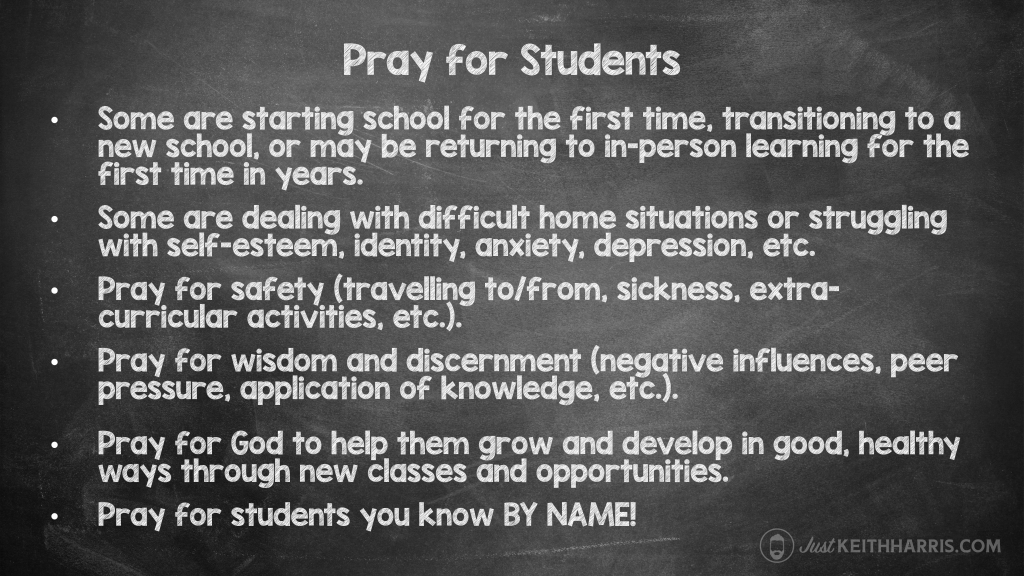
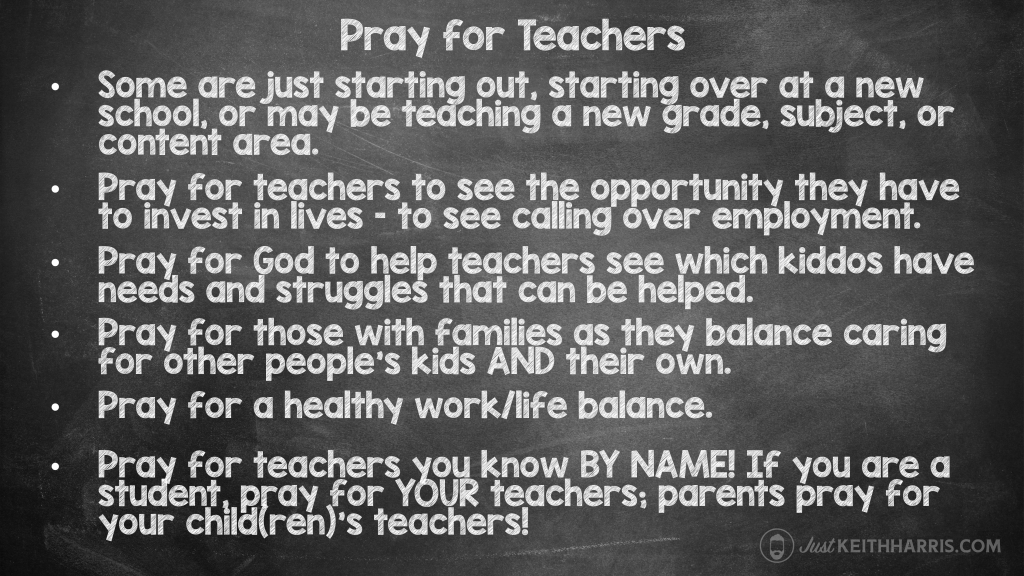
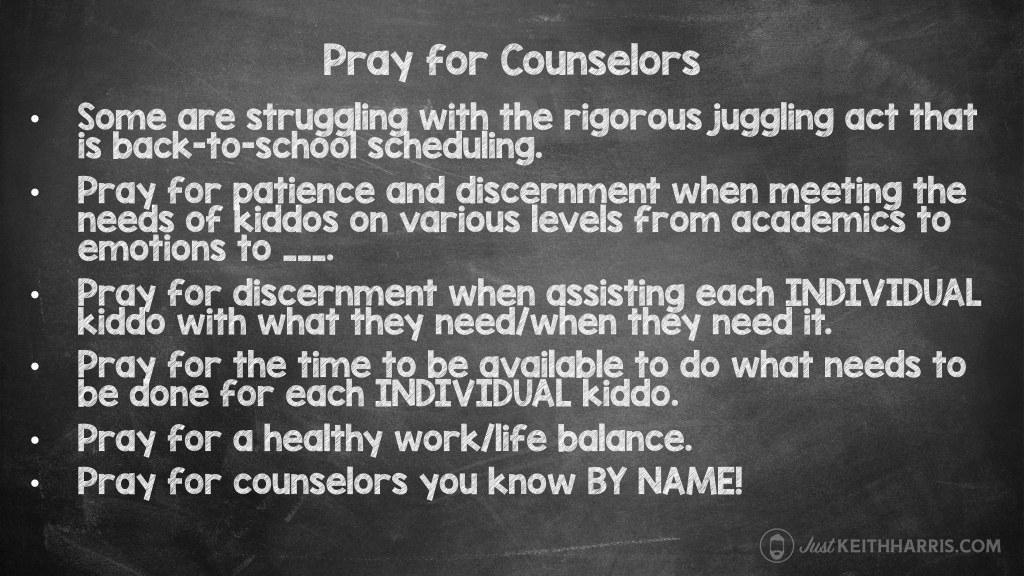
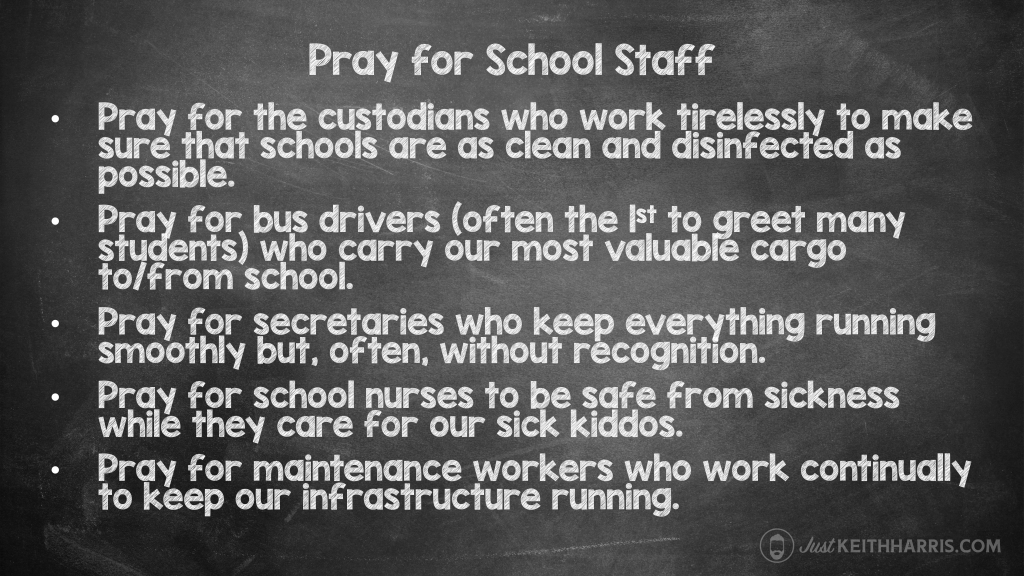
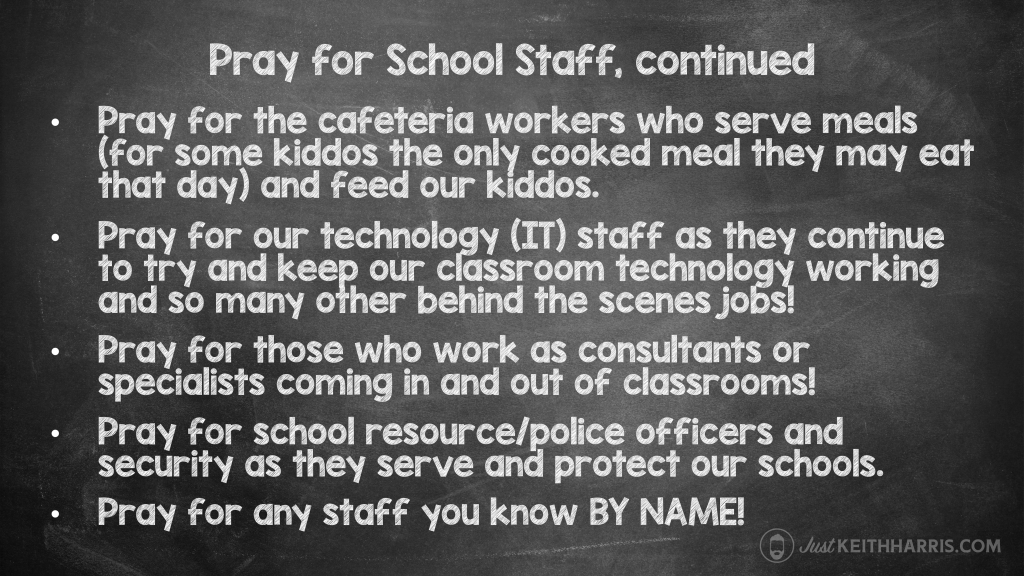
This is meant to be a resource to help you pray for the upcoming school year – local schools, students, parents, teachers, administration, and school staff.
Praying is the most we can do – handing our concerns and cares over to the sovereign, almighty God of the universe. The requests and guide below are just suggestions; feel free to pray for whatever comes to mind!
There are two passages of Scripture that drive our desire to do this and show us the goal, scope, and hope of turning things over to the Lord in prayer:
“The Lord is at hand; do not be anxious about anything, but in everything by prayer and supplication with thanksgiving let your requests be made known to God. And the peace of God that surpasses all understanding, will guard your hearts and your minds in Christ Jesus.” (Philippians 4:5b-7)
“May the God of hope fill you with all joy and peace in believing, so that by the power of the Holy Spirit you may abound in hope.” (Romans 15:13)
1 I will extol you, O LORD, for you have drawn me up and have not let my foes rejoice over me. 2 O LORD my God, I cried to you for help, and you have healed me. 3 O LORD, you have brought up my soul from Sheol; you restored me to life from among those who go down to the pit.
4 Sing praises to the LORD, O you his saints, and give thanks to his holy name. 5 For his anger is but for a moment, and his favor is for a lifetime. Weeping may tarry for the night, but joy comes with the morning.
6 As for me, I said in my prosperity, “I shall never be moved.” 7 By your favor, O LORD, you made my mountain stand strong; you hid your face; I was dismayed.
8 To you, O LORD, I cry, and to the Lord I plead for mercy: 9 “What profit is there in my death, if I go down to the pit? Will the dust praise you? Will it tell of your faithfulness? 10 Hear, O LORD, and be merciful to me! O LORD, be my helper!”
11 You have turned for me my mourning into dancing; you have loosed my sackcloth and clothed me with gladness, 12 that my glory may sing your praise and not be silent. O LORD my God, I will give thanks to you forever!
9 The true light, which gives light to everyone, was coming into the world. 10 He was in the world, and the world was made through him, yet the world did not know him. 11 He came to his own, and his own people did not receive him. 12 But to all who did receive him, who believed in his name, he gave the right to become children of God, 13 who were born, not of blood nor of the will of the flesh nor of the will of man, but of God.
14 And the Word became flesh and dwelt among us, and we have seen his glory, glory as of the only Son from the Father, full of grace and truth.
Invitation/Preparation for Lord’s Supper | Behold the Lamb (Communion Hymn) — Scripture References / Inspiration for the Song: 1 Corinthians 11:23-26, John 1:29, 1 Peter 1:19, 1 Peter 2:24, Revelation 13:8, Isaiah 53:5-7, 1 John 1:9, Ephesians 2:4-9, Ephesians 4:1, 1 Corinthians 6:19-20, Colossians 3:14, 1 John 1:7, Psalm 51:1-2, 1 Thessalonians 5:15-18, Luke 9:23-27, 1 Corinthians 12:12-13, Philippians 3:10
If you have not been gathering, consider gathering with your church family again. We have a 10:00 Bible study where Jamie Harrison is walking us through the book of Revelation. If you are at-risk, this Bible study would be perfect for you so you can spread out (and even dip out the side door before the 11:00 worship gathering begins).













 Just Keith Harris