“The Excellency of Christ” from Hebrews 1:1-4 — a Refresh & Restore Bible Study w/David Miller

Long ago, at many times and in many ways, God spoke to our fathers by the prophets, but in these last days He has spoken to us by His Son, whom He appointed the heir of all things, through whom also He created the world. He is the radiance of the glory of God and the exact imprint of His nature, and He upholds the universe by the word of His power. After making purification for sins, He sat down at the right hand of the Majesty on high, having become as much superior to angels as the name He has inherited is more excellent than theirs.[1]


"Strengthen What Remains: Jesus's Letter to the Church at Sardis" (The KING is Coming) Refresh & Restore | A JustKeithHarris.com Podcast

📖 Revelation 3:1–6In this episode of The King is Coming, Keith Harris and Jamie Harrison open up Jesus’s sobering message to the church in Sardis—a church with a good reputation but a dying reality. Jesus doesn’t offer praise; instead, He calls them to wake up and strengthen what remains before it’s too late.Together, Keith and Jamie discuss:✔️ The difference between a spiritual reputation and spiritual reality✔️ What it means to be alive in Christ rather than just looking the part✔️ Jesus’s call to remember, keep, and repent✔️ Why true repentance is more than words—it’s a whole-life surrender✔️ The promise of walking with Jesus in white garments and never being blotted out of the Book of LifeThis letter pulls no punches. But it also holds out real hope—because Jesus is in the business of making the dead come alive.“He who has an ear, let him hear what the Spirit says to the churches.” (Revelation 3:6)🔗 If you would like to see a written version of this podcast, complete with footnotes and cross-references, you can find it here.
  1. "Strengthen What Remains: Jesus's Letter to the Church at Sardis" (The KING is Coming)
  2. "Hold Fast Until Jesus Comes: Jesus’s Letter to the Church at Thyatira" (The KING is Coming)
  3. "Hope in Jesus Does Not Put Us to Shame" from Romans 5:1-5 (Refresh & Restore)
  4. "Church at a Crossroads: Jesus's Letter to the Church at Pergamum" (The KING is Coming)

Greetings Sojourners!

It is my pleasure today to introduce you to David Miller. He went to be with the Lord last week, but thanks to recordings and videos, his sermons still proclaim the gospel after his death.

Bro. David called himself a “Country Preacher at Large” because, at his core, he felt that no matter how far God allowed him to travel to preach that a humble country preacher was what he was made to be. To those who knew him and were blessed to be discipled by him, well, we knew he was much more. I could go on and on about him – from the role he played in the Conservative Resurgence or in the shift of Southern Seminary to orthodoxy or the over 1,500 pastors like myself who were able to be taught by him, but I will leave that for now.

His ministry was called Line Upon Line, based off of Isaiah 28:10 – “For it is precept upon precept…, line upon line…”, which was a testament to how he preached, taking texts of Scripture and preaching them line by line and breaking down the precepts so that they can be understood. Because of his disability, peroneal muscular atrophy, he was in a wheelchair for decades even by the time I met him sixteen years ago. By that point, he could no longer hold a Bible or write out sermon notes – hadn’t been able to for a long time. What I called a disability, God used to strengthen his mind by giving Bro. David a gift for memorizing long passages of Scripture and sermon notes and a singular gifting to preach with clarity like no other I have ever met. And it is that preaching that I want to share with you.

What follows is a sermon Bro. David preached at the G3 conference several years back[2] on Hebrews 1:1-4 on “The Excellency of Christ”. Just as he would not want himself proclaimed as excellent but to have people pointed to Christ, my effort here is to allow others to benefit from the preaching that has been so beneficial to my spirit.

So, with no further ado, let us be in awe of the excellent Christ, King Jesus, and dive deep into His Word today.

—————————————————————————

Turn please to the New Testament Book of Hebrews chapter one. Hebrews chapter one, beginning at verse one.

The title for my sermon now is “The Excellency of Christ”. The writer in the book of Hebrews has for his theme the excellency – the superiority – of Jesus Christ. In this book, he tells us that Jesus is better than the Old Testament prophets, better than the Old Testament priests. He’s greater than the angels. And the new covenant in His blood is far superior to the Old Testament covenant.

He will argue his theme along two lines: 1) He will argue on the basis of Christ’s person – who He is, and 2) he will argue on the basis of Christ’s performance – the things that He has done. And the bottom line in the Book of Hebrews is this: there is no other one like Jesus and no other one has ever done the things that Christ has done. And these two items, the person, and the performances of Christ, will form the two items in my outline.

Have you found our text? Let’s begin at verse one.

God, who at sundry times and in divers manners spake in time past unto the fathers by the prophets, Hath in these last days spoken unto us by His Son, whom He hath appointed heir of all things, by whom also He made the worlds; Who being the brightness of His glory, and the express image of His person, and upholding all things by the word of His power, when He had by Himself purged our sins, sat down on the right hand of the Majesty on high; Being made so much better than the angels, as He hath by inheritance obtained a more excellent name than they.[3]

The Person of Christ

I call your attention to verse three first. Here, we have two statements regarding the person of Christ. He begins by telling us that Christ is the brightness of God’s glory. That is, He is the effulgence. He is the radiant splendor. He is the shining forth of the glory of God. Jesus is to God what the rays and the beams are to the sun; the rays and the beams are that by which the sun is seen and known. Its warmth, its beauty, its brightness are experienced through the rays and the beams. Now, in a far greater way, Jesus is the one in whom and through whom the glory of God is seen and known. He’s the brightness of God’s glory.

But not only that, He is the “express image” of the person of God. This phrase “express image” has in mind an engraver’s too, upon which there is an insignia and when placed down upon the wood and the wax it leaves there an exact duplication, a precise reproduction of the insignia. We get our English word character from this idea. Do you see what he’s telling us about Jesus? In His essential nature, Jesus Christ possesses the exact same character as deity. Here is a biblical affirmation of the deity of Christ.

What do you folks think about when you think about God? Do you think about the eternal, pre-existent one?

Well, I would remind you that before the sun had ever shone upon the face of the sea, before there was any gold in California, before there were any bulldogs in Georgia {congregation laughs}, before there were any razorbacks in Arkansas, before there was any coal in Kentucky, or any all in the Middle East, Jesus Christ was already living in eternity past dwelling in unapproachable light enjoying the fellowship of His Father.

What do you think about when you think about God?

Whatever characterizes the nature of God also characterizes the nature of Jesus. He is the express image of the person of God. Now put that aside. That’s the first half of my sermon.

What do you think? I expected resounding “Amen” to that question if for no other reason it was brief. However, if you thought that was half of the sermon chronologically, you have greatly erred in your judgment {congregation laughs}. That’s the first half of the sermon outline. Here’s the second half.

The Performance of Christ

I want you to see the excellence in His performances. There are four of these.

One, I want you to see the excellency of Christ as the inerrant revelator.

Now in verse one and the first half of verse two, we have four distinct ideas regarding God’s revelation of Himself to man.

  1. He begins by speaking of the fragmentation of the Old Testament revelation. It, the Old Testament revelation, was at “sundry times.” It didn’t come all at once. It came in stages. It came in parts. And it was in “diverse manners.” God didn’t use the same method. He didn’t employ the same means every time He made Himself known in the Old Testament.

    You will recall that on one occasion He spoke to Moses in a burning Bush on the backside of the desert (Exodus 3:1-6). Unless of course, you had read Dr. Roy Honeycutt’s commentary in the old Broadman commentary series on the Book of Exodus. There in Chapter 3, Dr. Honeycutt says there are three possible interpretations of this text. Number one, it could have been a burning bush. Imagine that. {congregation laughs} Number two, it could have been the sun reflecting upon the orange foliage, giving the appearance of burning. Or number three, it could have been an inner experience that only Moses had, and if you and I had been there, we would not have seen any burning Bush nor heard any audible voice. And then he adds, “For the present writer, the latter seems more probable.” Well, for the present country preacher, the former seems more probable. God spoke to Moses in the burning bush.

    On another occasion, He spoke audibly to Moses on Mount Sinai as the mountain trembled and smoked (Exodus 19:18-19). Later, with His finger, God wrote the Ten Commandments on tables of stone (Exodus 31:18)….

    He spoke through a donkey (Numbers 22:28-30). Do you remember that occasion? He spoke to Isaiah in a vision (Isaiah 6:1-4) – to Daniel in a dream (Daniel 7:1-2). The Old Testament scriptures did not come all at once, nor did they come in the same way (v. 1). It was a fragmented, incomplete revelation.
  2. Now, I want you to see the fullness of the New Testament revelation in Christ. God hath spoken unto us by His son. I am addressing a highly privileged class of people this morning. You and I, who live on the post- side of the incarnation of Jesus, have a full revelation from God. We know more about faith than Abraham. We know more about the Law than Moses. We know more about salvation than Isaiah. We know more about the end time than Daniel. We know more about how and why to worship God than David We have a full revelation from God in Christ.
  3. Number three, I want you to see the finality of the New Testament revelation in Christ. Listen to it: God hath in these last days, in these last days of revelation, God hath spoken fully and finally in His son Jesus Christ.

Now I don’t know about you folks, but it makes me nervous to be around these saints who seem to have a fresh word from God. They make me nervous. I sat in a midweek Bible study and prayer time in a Baptist Church in my hometown several years ago – make a note of this, it was more than three years ago. The pastor and some of the laymen were having a share time relating what all they had learned from a seminar on prophecy at the local charismatic church on Monday and Tuesday evening of that week. It seems that the leader of the seminar had received a vision from God. And in his vision, God had told him that there was going to be a nuclear explosion south of Heber Springs, about fifty miles, within the next three years. And our area up through Heber Springs was going to be a refugee camp for those who escaped the explosion. Now, immediately upon hearing such news, my attention piqued. I live there.

And one of the layman spoke up and said, “This corroborates what I’ve been telling the body,” and he reminded them how that a few weeks earlier he had had a dream and in his dream God had told him there was going to be a nuclear explosion south of Heber Springs in the near future. “But,” said he, “what I did not know until this week was that our area would be a refugee camp for those who escaped the explosion.”

“But,” said he, “that’s the way God speaks today. To one member of the body he gives a dream, to another member of the body a vision, to another, a word of knowledge, and the body of Christ comes together and each member shares what he or she has received from God  and the church synthesizes – puts all of that together. And there you have God’s word to man today.”

What do you think?

Well, I sat there for an inordinately long period of time, being long-suffering and forbearing. But after a while, I said, “Brethren, since this is the share time, I’ve got something I’d like to share with you. I’d like to share with you that it makes me nervous to be around folks who have a fresh word from God that the rest of us don’t have, because we’re limited to just the Old and New Testaments.” That makes me nervous. And I, like the apostle Paul, I’m a premillennialist…. {congregation laughs} I’m keenly interested in the second coming of the Lord. I think it’s profitable for the Saints to get together and contemplate all of those complex and intricate details of the second coming of the Lord. However. I want to caution you. You must make a difference between the exposition of Holy Scripture on the one hand, and the supposition of some dude’s mind on the other hand. Those two things are not the same.

Hereby shall you know a prophet if what he says comes to pass (Deuteronomy 18:21-22). That’s good, strong evidence that he’s spoken for God. However, that – even that – if what he says comes to pass, that is not proof-positive that he’s spoken for God. You want proof-positive? If what he says does not come to pass; that’s proof positive (Deuteronomy 18:22). Now, that’s been much longer than three years ago. And I know that I’m the last one to find out, but I believe if there had been a nuclear explosion south of Heber Springs – 50 miles or 500 miles – I would have heard about it by now. What does that tell us about the leader of the seminar? Beloved, that tells me that he must have heard a jackass braying and thought he had been called to preach. He was as bogus as a $3 bill. And the Baptist who went to the seminar and gave money deserved to lose every dime.

Beware, when a person says God told me. Oral Roberts once said, “God told me to raise $8 million, or he’s going to kill me.” I wondered why God didn’t kill him for saying that. {congregation laughs}

God hath spoken fully, and finally, in His son Jesus Christ.

Now, I want to show you a fourth thing. I want you to see the father of both revelations. Now this is audience participation time. Straighten yourself up. Now get your shoulders back, your chin up. Some of you are a little more comfortable than you ought to be in church. {congregation laughs} Here’s the question who was it? Who spoke in time, passed unto the fathers by the prophets? Who did that? {God did.} Now, who was it who had spoken unto us in these last days by His son? {God.}

This is an above average congregation. Now, sophisticated academic credentials are not required at this point. It doesn’t matter if you’re reading in the Old Testament, something the prophet said, or if you’re reading in the New Testament, something Jesus said, you are reading the Word of God. He is the Father of both revelations. No man ever spoke like Jesus, He is the inerrant revelator.

Now here’s the second item: I want you to see the excellency of His performance as the infallible regulator.

Now look at verse 2, the last statement: “by whom also He made the worlds”. Now look at verse three, the third statement: “and upholding all things by the word of His power.” Here we are told that Jesus Christ was the agent in creation. And He is currently involved in maintaining the order, the unity, and the balance in the created order. He governs it by the word of His power.

I appreciated the recitation from Colossians [1:15-20] earlier this morning. Didn’t you?

He is the image of the invisible God, the first born of every creature, for by Him were all things made that are in heaven and that are in earth, visible and invisible, whether they be thrones or dominions or principalities or powers, all things were created by Him and for Him, and He is before all things and by Him all things consist – they cohere – they are held together.

Do you have any idea how big the created order is? Let me illustrate it for you. If at the dawn of creation, you could have caught a light beam and put a saddle on it, mounted up and commenced to ride from one end of the Milky Way galaxy toward the opposite end. And you had been riding at the speed of light, 182-186,000 miles per second – that’s zipping right along – and you had been riding non-stop from the dawn of creation as we know it, this morning, you would only be about one-tenth of the way across the Milky Way galaxy. And yet the scientists tell us there are other galaxies, many of these larger than the Milky Way. I don’t know about you, but in my country-boy way of thinking, that is big time stuff. That’s Major League. And here the Bible affirms not only did Christ create the universe, He maintains the order and balance and unity of the universe by the word of His omnipotence.

Hallelujah!

I don’t think I’m out of line this morning if I tell you that you can bring the broken pieces of your life and lay them at the feet of Jesus in humble submission to His lordship, and have every confidence that He is able to put them together and make something beautiful out of your life. He’s the infallible regulator.

Do you want some peace? Do you want some tranquility? Do you want some order? Do you want some balance in your own existence? Come to Jesus, bend the knee, and bow the heart. He’s the great, infallible regulator.

Number three, I want you to see His performance as the incomparable redeemer.

When He had by Himself purged our sin, notice three things:

  1. One, the sovereignty of the redeemer. He purged our sins (v. 3). Now to hear some of the brethren preach, you’d think the Lord had been morally obligated, bound by some solemn moral responsibility to leave heaven’s glory, condescend to Earth’s shame, and die a substitutionary, vicarious death on behalf of sinners. But let me ask you this: did God owe us anything? Why did He come? He came because in His heart there is grace and mercy (Ephesians 2:4-5). He came because he wanted to, not because He was obligated (John 10:18).
  2. Notice the sufficiency of the redemption. He purged our sin (v. 3). Grammatically, it is a fact accomplished in the past, but having perfect and continuing result throughout the future (Hebrews 10:14). “’Tis done! ‘Tis done! The great transaction is done!” (John 19:30) There’s never going to be any more work done regarding our redemption (Hebrews 9:12).
  3. Notice the singularity of the Redeemer when He had, by Himself, purged our sin. “Jesus paid it all. All to Him. I owe Sin had left a crimson stain. He washed it white as snow.”

Now, item number four: I want you to see His performance as the indisputed ruler.

Look at verse three. Look at that last statement. Have you ever seen one verse that had more good stuff in it? When “He had by Himself purged our sin, He sat down at the right hand of the Majesty on high; being made so much better than the angels, as He hath by inheritance obtained a more excellent name than they.”

You hear some of the brethren preach, you would think the Lord and the Devil were locked in the death throes of a spiritual battle out in space, and the outcome had not yet been determined. But listen: Jesus is not going to be Lord; He is Lord already! He’s not Lord because He’s risen from the dead; He was Lord before He ever died. He’s King Jesus!

There’s a line that’s been drawn through the ages, on that line stands an old rugged cross. On that cross, a battle is raging for the gain of man’s soul or its loss. On one side march the forces of evil – all the demons and the devils of Hell. On the other, the angels of glory, and they meet on Golgotha’s hill. The earth shakes with the force of that conflict, and the sun refuses to shine. For there hangs God’s son in the balance.

But then from the darkness He cries:

It is finished – the battle is over.
It is finished – there will be no more war.
It is finished – the end of the conflict.
It is finished, and Jesus is Lord! Hallelujah!


[1] The Holy Bible: English Standard Version (Wheaton, IL: Crossway Bibles, 2016), Heb 1:1–4.

[2] He preached on “The Excellency of Christ” twice at G3 Conferences over the years. The one I have transcribed is from 2014. Here is the more recent version of the sermon from 2021.

[3] The Holy Bible: King James Version, Electronic Edition of the 1900 Authorized Version. (Bellingham, WA: Logos Research Systems, Inc., 2009), Heb 1.

Sermon: “Greetings, Sojourners & Exiles” from 1 Peter 1:1-2


Peter, an apostle of Jesus Christ,
To those who are elect exiles of the Dispersion in Pontus, Galatia, Cappadocia, Asia, and Bithynia, according to the foreknowledge of God the Father, in the sanctification of the Spirit, for obedience to Jesus Christ and for sprinkling with his blood:
May grace and peace be multiplied to you.

Introduction

  • Tony Merida calls those 1 Peter was writing to “grieved saints gladdened by the gospel”.
  • Martin Luther believed 1 Peter contained all a believer needed to know to be a faithful follower of Christ.

Author (v. 1a)

  • v. 1a — Peter, an apostle of Jesus Christ….
    • Peter is an example of great faithFULness.
    • Peter is an example of great faithLESSness.
      • He took his eyes off and nearly drowned after standing on liquid water (Matthew 14:30).
      • He tried to rebuke and correct Jesus after a prophecy by Jesus regarding His soon-to-come death, burial, and resurrection (Matthew 16:22-23).
      • And, of course, Peter denied Jesus three times while He was being beaten, mocked, and tortured.
    • Peter’s life is a beautiful example of redemption and repentance.
      • Jesus restored Peter three times after His resurrection (John 21:15-19).
      • Peter repented after being confronted regarding sin by the apostle Paul (Galatians 2:11-14).
      • 1 Peter, at least in part, is an answer to what Jesus prayed about for Peter’s life, faith, and ministry (Luke 22:31-32).

Audience (v. 1b)

  • v. 1b — To those who are elect exiles of the Dispersion in Pontus, Galatia, Cappadocia, Asia, and Bithynia….
    • “elect exiles”
      • This is almost an oxymoron. To be an exile means to have been rejected, but to be elect means to have been selected.
      • This phrase could be understood as resident aliens and is reminiscent of Philippians 3:20 — our citizenship is in heaven and from it we await a Savior!
    • “of the Dispersion”
      • Some Jews were already dispersed throughout the Greco-Roman world (John 7:35).
      • During the reign of Emperor Claudius (41-54AD), Christians were expelled from Rome and the areas that these elect exiles lived were where some of those outcasts settled.
      • Jerusalem Christians were dispersed after the stoning of Stephen (Acts 8:1-4).

According to… (v. 2)

Conclusion

May grace and peace be multiplied to you.

The Holy Bible: English Standard Version (Wheaton, IL: Crossway Bibles, 2016), 1 Pe 1:1–2.

Sermon: “A Life of Repentance” from Psalm 51


Introduction

Reinforcing the Necessary Pre-suppositions:

  1. The Bible is what it claims to be (2 Timothy 3:16-17). It is God’s Word. It is true. It contains everything that can be known about God and is sufficient to bring us to Him.
  2. There is a difference in the lives of those who know Christ – are saved/born again – and those who are not – lost/dead in their sin (Ephesians 2:1-10, 4:20-24).
  3. God has authority over His creation. What He intended to be right is right, and what He calls sin is sin (Isaiah 5:20). He is the supreme authority of such (John 1:1-5).
  4. Salvation is by grace through faith in Jesus Christ alone (Ephesians 2:8), “not a result of works, so that no one may boast” (Ephesians 2:9).
  5. If one is in Christ, His surpassing worthiness changes one’s life to the point that the things of this world pale in comparison to knowing Him (Philippians 3:7-11) and God’s Spirit produces change – or fruit (Galatians 5:16-26) – that is evident in real life.

Repentance is, per Wayne Grudem, “a heartfelt sorrow for sin, a renouncing of it, and a sincere commitment to forsake it and walk in obedience to Christ”.[1]


Breakdown of Psalm 51:

Repentance Means Seeking God’s Grace and Mercy (vv. 1-2)

  • God’s forgiveness is fueled by His “steadfast love” and “abundant mercy” (v. 1).
  • God’s forgiveness cleanses us from our sin and covers it by the blood of Christ (vv. 1b-2).

Repentance Requires Us to Own Up to Our Sin (vv. 3-6)

  • If we are in Christ and are filled with His Spirit, we know what we have done and are convicted of its wrongness (v. 3).

  • If we are in Christ, we understand that He is holy and worthy and that sin is against and opposed to Him – and that His righteous judgment is fair/final and His grace is good (v. 4).

  • If we are in Christ, we recognize that sin is part of our nature and causes consistent struggles (v. 5).

  • If we are in Christ, we are loved by God despite our failings and can trust that God delights in hearts changed by Him through salvation (v. 6).

      Repentance Desires Restoration and Renewal (vv. 7-12)

      • Sin damages and dirties, requiring us to need purging, cleansing, and restoration (v. 7).

      • The process of repentance can be painful, but even the scars produce worship in the end (v. 8).

      • Repentance is a beautiful picture of a restored relationship with God – from death to life, lost to saved, being distant from the Father to drawn into His embrace (vv. 9-10).

      • Repentance means turning from sin and seeking God even if the consequences of sin never allow things to return to what they once were (v. 11).

      • By God’s grace and mercy, joy returns and, by the power of His Spirit, He upholds us and carries us through (v. 12).

      Repentance Produces Worship and Worshipful Service (vv. 13-17)

      • Sin stops service to God. Repentance begins the restart. (v. 13)

      • Worship is the only fitting response to being delivered from sin and is a result of repentance, which is worship (vv. 14-15).

      • Repentance is not religion. It is a response to God’s Spirit who gives us “a broken and contrite heart” refining our lives to be holy and acceptable to Him. (vv. 16-17).

      Repentance Strengthens the Body of Christ (vv. 18-19)

      • Individual repentance produces lives that impact the part of the world where God has us, meaning the Spirit of God is active in those who follow Christ and produces fruit in the real world (vv. 18-19).

      Application – Bear Fruit in Keeping with Repentance

      1. How does your life fit with a lifestyle of repentance?
      2. Is your repentance bearing fruit?
      3. Where is your hope?


      [1] Wayne A. Grudem, Systematic Theology: An Introduction to Biblical Doctrine (Leicester, England; Grand Rapids, MI: Inter-Varsity Press; Zondervan Pub. House, 2004), 713.


      Sermon: “An Autopsy of Sin” from James 1:13-15 & 2 Samuel 11-12


      Introduction

      Three necessary pre-suppositions:

      1. The Bible is what it claims to be (2 Timothy 3:16-17). It is God’s Word. It is true. It contains everything that can be known about God and is sufficient to bring us to Him.
      2. There is a difference in the lives of those who know Christ – are saved/born again – and those who are not – lost/dead in their sin (Ephesians 2:1-10, 4:20-24).
      3. God has authority over creation, which He Himself created. What He intended to be right is right, and what He calls sin is sin. He is the supreme Authority of such.

      Breakdown of the Text

      Sin is not of God (v. 13)

      • v. 13 – Let no one say when he is tempted, “I am being tempted by God,” for God cannot be tempted with evil, and He Himself tempts on one.
        • God is holy and sinless – since before the beginning and forever and ever,
          • Leviticus 19:2 – Speak to the congregation of the people of Israel and say to them, You shall be holy for I the Lord your God am holy.
          • 2 Corinthians 5:21 – For our sake He made Him to be sin who knew no sin, so that in Him we might become the righteousness of God.
        • To illustrate how sin works from a wholly biblical perspective, our illustrations today are going to come from the life of King David – “a man after [God’s] own heart” (1 Samuel 13:14).
          • So, for us to understand how sin works, and specifically in this first example how temptation occurs, we are going to look at 2 Samuel 11:1-2: “In the spring of the year, the time when kings go out to battle, David sent Joab, and his servants with him, and all Israel. And they ravaged the Ammonites and besieged Rabbah. But David remained at Jerusalem. It happened, late one afternoon….
          • David was not where he was supposed to be.Because of that, he put himself in a position he should have never been.
          • Then, IT happened. What happened? Temptation – then, sin – then…death.

      Our temptation is rooted in our own desire (v. 14)

      • v. 14 – But each person is tempted when he is lured and enticed by his own desire.
        • “lured” – used to describe wild game being baited into a trap meant to capture for the kill
        • “enticed” – used to describe the moment of being captured (or hooked) by the bait
        • “by his own desire” – used to describe the reality that our sin is rooted in what we want (that we know is wrong)
        • The life of King David:
          • The Bible clearly illustrates David had issues with this sort of sin, illustrated by his pursuit of multiple wives:
            • Michal (1 Samuel 18:27) – daughter of King Saul; at one point was taken away from him by King Saul and given to another (1 Samuel 25:44), but David never stopped viewing her as his wife (2 Samuel 3:13-14) despite his marrying other women (pl)
            • Abigail – wife of Nabal and described as “discerning and beautiful” (1 Samuel 25:3); helped keep David from making mistakes due to her husband’s treachery; David’s encounter with her happened to coincide with Saul giving Michal to another, so David married her.
            • Before we let David off the hook – see what I did there? – he married a woman named Ahinoam at the same time he did Abigail (1 Samuel 25:43).
            • NOTE: These are descriptive passages, not prescriptive. God’s design for marriage has always been what we see in Genesis 2:24-25 – one man and one woman for life.
            • If you think that this is putting David in a false context, I want you to also consider that Nathan the prophet reminds David in 2 Samuel 12:8 that he had taken King Saul’s harem of concubines for himself, too….
          •  So, to illustrate James 1:14, David was not where he was supposed to be (2 Samuel 11:1), saw what he should not have seen (2 Samuel 11:2), asked his servants about the woman he should not have been looking at or asking about (2 Samuel 11:3), had this woman brought to him to consummate his desires into reality (2 Samuel 11:4), sent her home after his desire was satiated, thinking he had gotten away with it all scot-free (2 Samuel 11:4), and ultimately found out “desire when it has conceived gives birth” (James 1:13, 2 Samuel 11:5).

      The Wages of Sin is Non-Negotiably Death (v. 15).

      • v. 15 – Then desire when it has conceived gives birth to sin, and sin when it is fully grown brings forth death.
        • God has been clear regarding sin and death since the beginning.
          • Genesis 2:17 – …but of the tree of the knowledge of good and evil you shall not eat, for in the day that you eat of it you shall surely die.”
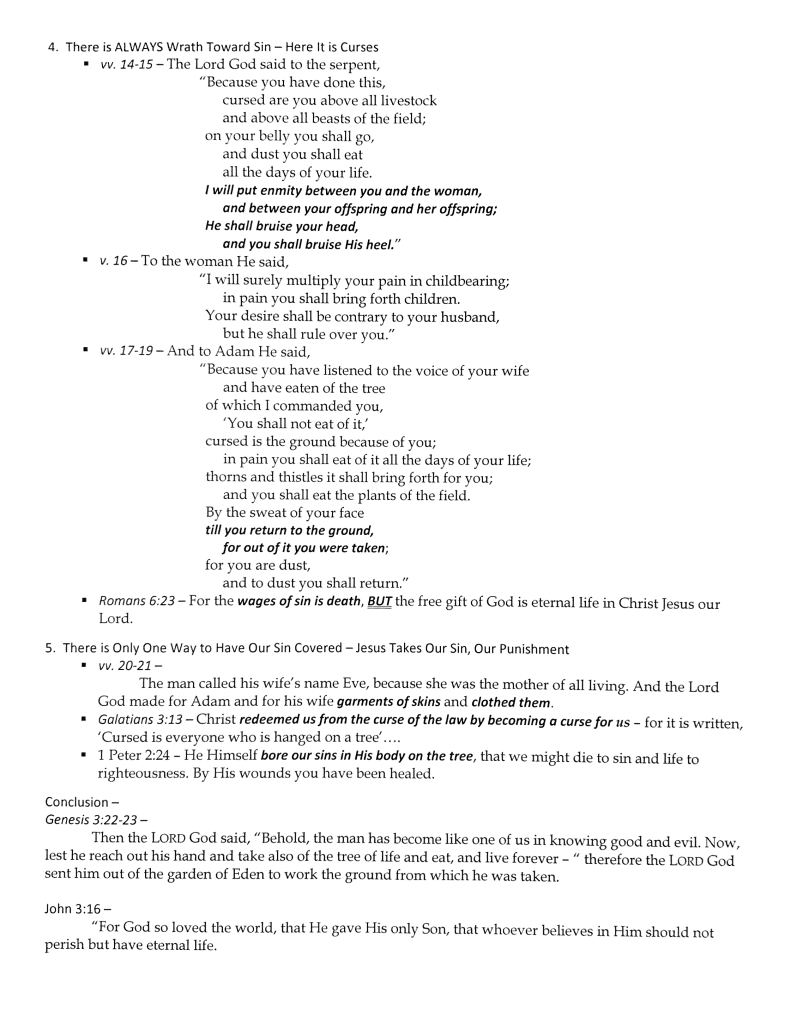
          • Genesis 3:22-23 – Then the Lord God said, “Behold, the man has become like one of us in knowing good and evil. Now, lest he reach out his hand and take also of the tree of life and eat, and live forever—” therefore the Lord God sent Him from the garden of Eden to work the ground from which he was taken.
          • Genesis 5:5 – Thus all the days that Adam lived were 930 years, and he died.
          • Romans 5:12 – Therefore, just as sin came into the world through one man, and death through sin, and so death spread to all men because all sinned….
          • Romans 6:23 – For the wages of sin is death, but the free gift of God is eternal life in Christ Jesus our Lord.
        • The life of King David:
          • Rather than admit his sin, confess it to God, and repent, David set out to cover up his sin (2 Samuel 11:6-13) and ultimately had Bathsheba’s husband Uriah killed (2 Samuel 11:14-25).
          • David, after the 7-day mourning period was over, took “the wife of Uriah” to be his wife, thinking once the child was born no one would be the wiser (2 Samuel 11:25-27), but God….
          • God sent the prophet Nathan to tell David a parable to illustrate the heinous and wicked nature of his sin with “the wife of Uriah” (2 Samuel 12:1-4).
          • David’s response to the parable was right and ended up prophetically responding to his own sin:
        • 2 Samuel 12:5-7 – Then David’s anger was greatly kindled against the man, and he said to Nathan, “As the Lord lives, the man who has done this deserves to die, and he shall restore the lamb fourfold, because he did this thing, and because he had no pity.”
          • David’s response to the terrible results of his sin (2 Samuel 12:7-12)??? “I have sinned against the Lord.” (2 Samuel 12:13)
          • The Lord’s response: “The Lord has put away your sin; you shall not die. Nevertheless….

      Conclusion/Application

      • 1 Peter 2:22-24 – He committed no sin, neither was deceit found in His mouth. When He was reviled, He did not revile in return; when He suffered, He did not threaten, but continued entrusting Himself to Him who judges justly. He Himself bore our sins in His body on the tree, that we might die to sin and live to righteousness. By His wounds we have been healed.
      • 1 John 2:1-2 – My little children, I am writing these things to you so that you may not sin. But if anyone does sin, we have an advocate with the Father, Jesus Christ the righteous. He is the propitiation for our sins, and not for ours only but for the sins of the whole world.
      • Romans 10:9-13 – …because, if you confess with your mouth that Jesus is Lord and believe in your heart that Jesus is Lord and believe in your heart that God raised Him from the dead, you will be saved. For with the heart one believes and is justified, and with the mouth one confesses and is saved. For the Scripture says, “Everyone who believes in Him will not be put to shame.” For there is no distinction between Jew and Greek; for the same Lord is Lord of all, bestowing riches on all who call on Him. For “everyone who calls upon the name of the Lord will be saved.”

      Scripture Resource — Perseverance of the Saints

      There are some who believe that a Christian can fall away into sin and lose their salvation; while others believe that, once God saves someone and adopts them into His family, that individual will always be saved. I believe that this is a primary gospel issue and vitally important to one’s view of Christ and His gospel. However, I do not seek to argue or wrangle over words.

      I believe firmly in God’s Word and its ability to teach, reprove, correct, and train God’s people to walk with Him (2 Timothy 3:16). For that reason, I present to you the following passages of Scripture and let God’s Word speak for itself.

      If you would like to talk about this further, feel free to contact me. I cannot promise that we will come to a consensus, but I can promise that I will respond as lovingly and graciously as I can and would love to talk to anyone, especially about the gospel and the Word!


      John 6:35-40 —

      35 Jesus said to them, “I am the bread of life; whoever comes to me shall not hunger, and whoever believes in me shall never thirst. 36 But I said to you that you have seen me and yet do not believe. 37 All that the Father gives me will come to me, and whoever comes to me I will never cast out. 38 For I have come down from heaven, not to do my own will but the will of him who sent me. 39 And this is the will of him who sent me, that I should lose nothing of all that he has given me, but raise it up on the last day. 40 For this is the will of my Father, that everyone who looks on the Son and believes in him should have eternal life, and I will raise him up on the last day.”[1]

      John 10:25-30 —

      25 Jesus answered them, “I told you, and you do not believe. The works that I do in my Father’s name bear witness about me, 26 but you do not believe because you are not among my sheep. 27 My sheep hear my voice, and I know them, and they follow me. 28 I give them eternal life, and they will never perish, and no one will snatch them out of my hand. 29 My Father, who has given them to me, is greater than all, and no one is able to snatch them out of the Father’s hand. 30 I and the Father are one.”[2]

      Romans 8:31-39 —

      31 What then shall we say to these things? If God is for us, who can be against us? 32 He who did not spare his own Son but gave him up for us all, how will he not also with him graciously give us all things? 33 Who shall bring any charge against God’s elect? It is God who justifies. 34 Who is to condemn? Christ Jesus is the one who died—more than that, who was raised—who is at the right hand of God, who indeed is interceding for us. 35 Who shall separate us from the love of Christ? Shall tribulation, or distress, or persecution, or famine, or nakedness, or danger, or sword? 36 As it is written,

             “For your sake we are being killed all the day long;
      we are regarded as sheep to be slaughtered.”

      37 No, in all these things we are more than conquerors through him who loved us. 38 For I am sure that neither death nor life, nor angels nor rulers, nor things present nor things to come, nor powers, 39 nor height nor depth, nor anything else in all creation, will be able to separate us from the love of God in Christ Jesus our Lord.[3]

      John 3:16-17 —

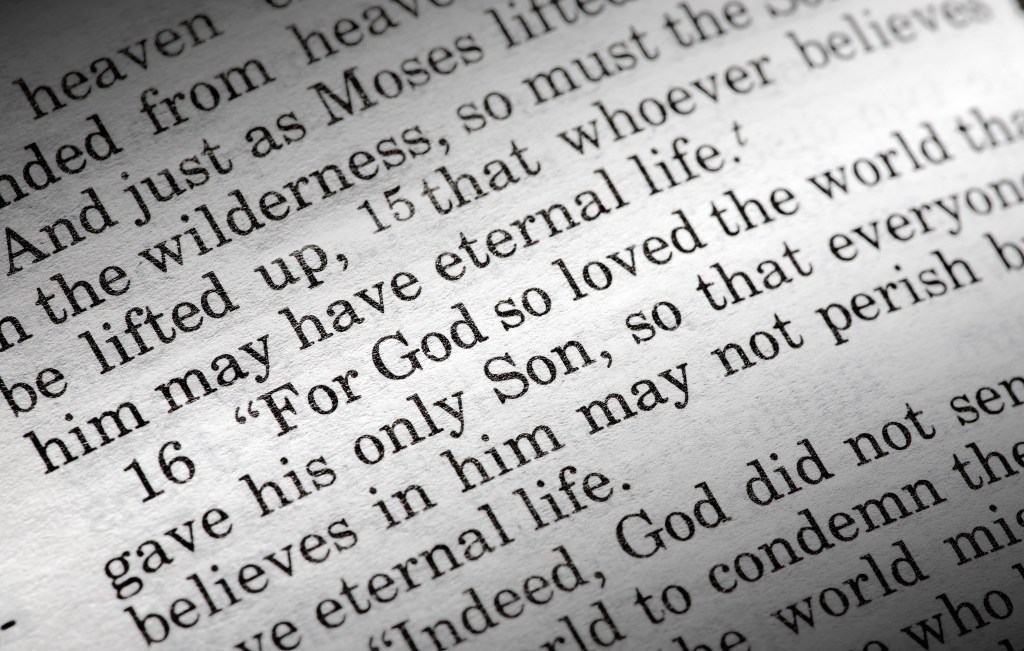
      16 “For God so loved the world, that he gave his only Son, that whoever believes in him should not perish but have eternal life. 17 For God did not send his Son into the world to condemn the world, but in order that the world might be saved through him.[4]

      John 3:36 —

      Whoever believes in the Son has eternal life; whoever does not obey the Son shall not see life, but the wrath of God remains on him.[5]

      Romans 8:1 —

      There is therefore now no condemnation for those who are in Christ Jesus.[6]

      Romans 8:28-30 —

      28 And we know that for those who love God all things work together for good, for those who are called according to his purpose. 29 For those whom he foreknew he also predestined to be conformed to the image of his Son, in order that he might be the firstborn among many brothers. 30 And those whom he predestined he also called, and those whom he called he also justified, and those whom he justified he also glorified.[7]

      Ephesians 1:13-14 —

      13 In him you also, when you heard the word of truth, the gospel of your salvation, and believed in him, were sealed with the promised Holy Spirit, 14 who is the guarantee of our inheritance until we acquire possession of it, to the praise of his glory.[8]

      1 Peter 1:3-5 —

      Blessed be the God and Father of our Lord Jesus Christ! According to his great mercy, he has caused us to be born again to a living hope through the resurrection of Jesus Christ from the dead, to an inheritance that is imperishable, undefiled, and unfading, kept in heaven for you, who by God’s power are being guarded through faith for a salvation ready to be revealed in the last time.[9]

      Philippians 1:6 —

      And I am sure of this, that he who began a good work in you will bring it to completion at the day of Jesus Christ.[10]


      [1] The Holy Bible: English Standard Version (Wheaton, IL: Crossway Bibles, 2016), Jn 6:35–40.

      [2] Bible, Jn 10:25–30.

      [3] Bible, Ro 8:31–39.

      [4] Bible, Jn 3:16–17.

      [5] Bible, Jn 3:36.

      [6] Bible, Ro 8:1.

      [7] Bible, Ro 8:28–30.

      [8] Bible, Eph 1:13–14.

      [9] Bible, 1 Pe 1:3–5.

      [10] Bible, Php 1:6.

      Come, Ye Sinners Poor and Needy

      “Let us strive therefore to enter that rest, so that no one may fall by the same sort of disobedience. For the Word of God is living and active, sharper than any two-edged sword, piercing to the division of soul and of spirit, of joints and of marrow, and discerning the thoughts and intentions of the heart. And no creature is hidden from His sight, but all are naked and exposed to the eyes of Him to whom we must give account.

      “Since then we have a great high priest who has passed through the heavens, Jesus, the Son of God, let us hold fast our confession. For we do not have a high priest who is unable to sympathize with our weaknesses, but one who in every respect has been tempted as we are, yet without sin. Let us then with confidence draw near to the throne of grace, that we may receive mercy and find grace to help in time of need.

      Hebrews 4:11-16

      Introduction

      “Come, ye sinners, poor and needy / Weak and wounded, sick and sore / Jesus ready, stands to save you / Full of pity, love, and power // Come, ye weary, heavy-laden / Lost and ruined by the Fall / If you tarry ‘till you’re better / You will never come at all // I will arise and go to Jesus / He will embrace me in His arms / In the arms of my dear Savior / Oh, there are ten thousand charms” [1]

      • We Need Rest (v. 11)
        • v. 11 – Let us therefore strive to enter that rest, so that no one may fall by the same sort of disobedience.
          • The idea of rest in the OT was the Sabbath. On the seventh day, God rested from the work of Creation. His people were commanded to do the same. That rest was to come into fruition in the Promised Land, but their rebellion against God messed all of that up.
          • For us today, our rest only comes from trusting in Christ. Those who have put their faith in Him as Savior and Lord do not have to work or try to save themselves through their own strength and effort. They/we rest in what Jesus has already accomplished and finished. But that is nothing new; it was the plan of God for His people all along.
            • Psalm 116:7 – Return, O my soul, to your rest; for the Lord has dealt bountifully with you.
            • Isaiah 28:12 – …to whom He has said, “This is rest; give rest to the weary; and this is repose”; yet they would not hear.
          • The good news here is that Jesus’ “works were finished from the foundation of the world” (Hebrews 4:3) – essentially “It is finished” (John 19:30) before “In the beginning” (Genesis 1:1).
          • And Jesus offers that same rest today – and we desperately need it.(Why? “…so that no one may fall into the same sort of disobedience”)
            • Matthew 11:28-30 – Come to me, all who labor and are heavy laden, and I will give you rest. Take my yoke upon you, and learn from Me, for I am gentle and lowly in heart, and you will find rest for your souls. For my yoke is easy, and my burden is light.”
      • We Need the Word (vv. 12-13)
        • v. 12 – For the Word of God is living and active, sharper than any two-edged sword, piercing to the division of soul and spirit, of joints and of marrow, and discerning the thoughts and intentions of the heart.
          • The Word of God refers to the written Scriptures – the Bible – and to our God and Savior Jesus Christ. Some want to argue over which these verses refer to, but I would like to settle that debate: yes.
            • Jesus, the Word of God, has always been.
              • John 1:1 – In the beginning was the Word, and the Word was with God, and the Word was God.
            • The power of His Word(s) has, too.
              • Genesis 1:1-3a – In the beginning, God created the heavens and the earth. The earth was without form and void, and darkness was over the face of the deep. And the Spirit of God was hovering over the face of the waters. And God said….
            • Thinking especially of Christmas (two days ago), we would have nothing without the intervention of the Word in our lives.
              • John 1:14 – And the Word became flesh and dwelt among us, and we have seen His glory, glory as of the only Son from the Father, full of grace and truth.
            • Everything in Creation literally hangs on His Word.
              • Hebrews 1:3a – He is the radiance of the glory of God and the exact imprint of His nature, and He upholds the universe by the word of His power.
            • We do, too.
          • the Word of God is living
            • Jesus is alive – and so is His Word!
            • The Words of Christ captivate us, and it is by them we are saved (Romans 10:17).
            • His Word is more than a book. It can capture the conscience of sinners, simultaneously cutting them to the depths of their hearts and giving comfort and binding wounds of the soul.
            • (Matthew Henry) “Saints die, and sinners die; but the Word of God lives.
          • the Word of God is…active
            • Active is translated from the Greek word energēs. It means “effective; able to bring about”.
            • Everything that is written about Him is true. Everything it says He promised He will do. He is capable of everything it says He can do.
            • Through the Word, strongholds are torn down (2 Corinthians 10:4), the dead are raised, the deaf can hear, the blind can see, lame will leap, and the dumb will speak “the praises of the Lamb” (“Mary, Did You Know?)
            • It can – and will – absolutely obliterate the kingdom of this world and Satan, but the same Word builds up the Kingdom of God.
            • (Martin Luther, “A Mighty Fortress is Our God”) “And though this world with devils filled / Should threaten to undo us / We will not fear for God has willed / His truth to triumph through us / The prince of darkness grim / We tremble not for Him / His rage we can endure / For lo! His doom is sure! / One little word can fell him” [2]
          • the Word of God is…sharper than any two-edged sword
            • It cuts both ways….
            • …piercing to the division of soul and spirit, of joints and of marrow, and discerning the thoughts and intentions of the heart.
              • The Word sees through the lies of the world – through our lies. We cannot deceive Him. The written word lays our sin bare. We are fully exposed with nowhere to hide….
        • v. 13 – And no creature is hidden from his sight, but all are naked and exposed to the eyes of Him to whom we must give an account.
          • Job 34:21 – “For His eyes are on the ways of a man, and He sees all His steps.
          • Psalm 33:13-15 – The Lord looks down from heaven; He sees all the children of man; from where He sits enthroned He looks out on all the inhabitants of the earth, He who fashions the hearts of them all and observes all their deeds.
          • This is utterly terrifying to me. He knows me – knows me. When facing the word, we find ourselves “naked” (not hidden; easily known) and “exposed” (laid bare; easily known).
            • vv. 12-13, Message paraphrase – God means what He says. What He says goes. His powerful Word is as sharp as a surgeon’s scalpel, cutting through everything , whether doubt or defense, laying us open to listen and obey. Nothing and no one is impervious to God’s Word. We can’t get away from it – no matter what.
      • We Need Sympathy (vv. 14-15)
        • v. 14 – Since then we have a great high priest who has passed through the heavens, Jesus, the Son of God, let us hold fast our confession.
          • who has passed through the heavens
            • This is the heart of the Christmas Story. If we are left with verse 13, all we have is bad news. We will not get the promised rest because our sin is fully displayed before the holy, righteous, all-powerful God of the universe.
            • (Paul David Tripp) “The beautiful news of the Christmas season is that God wasn’t willing to leave us in this tragic state. At Christmas we celebrate a God who is glorious in His abundant love and patient mercy. The glory of the birth of Jesus becomes even more glorious when it is seen through the humbling lens of the desperate condition that was the reason for His coming.”
              • John 1:14 – And the Word became flesh and dwelt among us, and we have seen His glory, glory as of the only Son from the Father, full of grace and truth.
              • Romans 5:8 – …but God shows His love for us in that while we were still sinners, Christ died for us.
          • let us hold fast our confession
            • Because of all He has done and all He has promised, we need never deny Him or be ashamed of Him. He washes us clean from our sin. He covers our shame.
            • This phrase shows up multiple times in the book of Hebrews, but all those times wrap up in v. 10:23:
              • Let us hold fast the confession of our hope without wavering, for He who promised is faithful.
            • We hold fast our confession because He is all we have got. But know this: if He is all you have, you have everything.
        • v. 15 – For we do not have a high priest who is unable to sympathize with our weaknesses, but one who in every respect has been tempted as we are, yet without sin.
          • The “Word became flesh and dwelt among us”, went through all the same junk that we go through, faced all the temptations and difficulties that we go through, was rejected and ostracized and mocked and beaten and hated. He gets us. He understands.
          • The internet has grabbed hold of a Rick Astley song and uses it to point out the foolishness and unfaithfulness found in human relationships: “Never gonna give you up / Never gonna let you down / Never gonna run around and desert you / Never gonna make you cry / Never gonna say goodbye / Never gonna tell a lie and hurt you”
            • We can “Rick Roll” all we want to. We can look to others and the internet and society and the government for sympathy, but they offer nothing. There is no world leader who is going to leave their ivory tower to walk in our poverty. No queen or king of England will ever leave Buckingham palace to walk the streets as a peasant. No president – sitting or former – will ever need a stimulus check or have to worry whether their rent will be paid or if can keep the heat on.
            • But the King of kings and Lord of lords “passed through the heavens” (v. 14) and became a baby. He traded the throne of Heaven for an animal’s feeding trough. He was the only begotten Son of God but looked at as a bastard by people He created.
            • He was not some “Undercover Boss” who came for a week or two and tried to walk in our shoes – He lived for decades alongside those who needed saving. And then He allowed Himself to be killed for the sake of those who shouted “Crucify”.
            • This seems like the saddest story ever, but His funeral was wasted because He broke death – He is “the Way, the Truth, and the Life” (John 14:6) after all! He ascended back to the throne of Heaven – which belonged to Him the whole time – and He still loves us, still understands us, still has sympathy for us.
            • Nothing changed – or ever changes with Him. He has always been and always been there for us should we reach out to Him. Maybe it’s us who need to change.
      • We Need Grace and Mercy of the King (v. 16)
        • v. 16 – Let us then with confidence draw near to the throne of grace, that we may receive mercy and find grace to help in time of need.
          • draw near to the throne of grace
            • The word translated “draw near” means to approach or devote oneself to something or someone.
            • Hebrews 7:25 – Consequently, He is able to save to the uttermost those who draw near to God through [Christ], since He always lives to make intercession for them.
            • James 4:7-10 – Submit yourselves therefore to God. Resist the devil, and he will flee from you. Draw near to God, and He will draw near to you. Cleanse your hands, you sinners, and purify your hearts, you double-minded. Be wretched and mourn and weep. Let your laughter be turned to mourning and your joy to gloom. Humble yourselves before the Lord, and He will exalt you.
            • (Matthew Henry) “A throne speaks of authority and bespeaks awe and reverence. A throne of grace speaks great encouragement even to the chief of sinners. There grace reigns, and acts with sovereign freedom, power, and bounty.”
          • receive mercy and find grace to help in time of need
            • King Jesus sits on the throne of grace. We can approach Him at any time.
            • We do not have to approached Him like beggars. We approach Him as His sons and daughters.
            • He loves us and cares for us. He wants us to come to Him. If we humble ourselves, repent of our sin, and draw near to His throne we are sure to find mercy. If we come to Him in our “time of need”, we are sure to find grace. We are sure to find these things because, when we approach His throne, we find Him.
            • And He is all we truly need.

      Conclusion/Application

      We do need rest, but we will only find it by trusting in Jesus Christ – the Word of God. We need sympathy more than ever, but we will only find it at the throne of the King.

      We looked at Psalm 33:13-15 earlier to see how God sees the hearts of men; let finish out that chapter to find hope and good news for the future (vv. 16-22):

      “The king is not saved by his great army; a warrior is not delivered by his great strength. The war horse is a false hope for salvation, and by its great might it cannot rescue.
      “Behold, the eye of the Lord is on those who fear Him, on those who hope in His steadfast love, that He may deliver their soul from death and keep them alive in famine.
      “Our soul waits for the Lord; He is our help and our shield. For our heart is glad in Him, because we trust in His holy name. Let your steadfast love, O Lord, be upon us, even as we hope in you.”


      [1]Come, Ye Sinners Poor and Needy”, Bob Kauflin © Sovereign Grace Praise (Admin. by Capitol CMG Publishing (Integrity Music, David C Cook))

      [2]A Mighty Fortress is Our God”, Frederick Henry Hedge | Martin Luther © Words: Public Domain | Music: Public Domain


      What the Grace of God Can Do for You

      Titus 2:11-14

      Introduction

      Context is key when looking at the Bible. It is easy to take a verse out of its context and really mess it up.

      Before we dive into our passage for tonight, let’s look a little bit at the context of Titus 2. Verse 1 helps a lot: But as for you, teach what accords with sound doctrine. Let me translate that verse a little simpler: But here’s what you need to be doing – teaching people (the Word) with correct, healthy instruction.

      Paul goes on from there and tells Titus why this is important for various age groups in the church there in Crete where he pastored:

      • older men – (v. 2b) sound in faith, love, and in steadfastness
      • older and younger women – (v. 5b) that the Word of God may not be reviled (the literally word from which we get blasphemy)
      • younger men – (v. 8b) so that an opponent may be put to shame, having nothing evil to say about us
      • slaves – (v. 10b) so that in everything they may adorn the doctrine of God our Savior

      So, when we look at our passage today, we get a piece of the doctrine – the instruction – about salvation that Paul was giving to Titus. Let’s check it out. We’re going to see how God’s grace redeems us, reforms us, and rewards us in salvation.

      1. Grace Redeems Us (vv. 11, 14a)
        1. v. 11 – For the grace of God has appeared, bringing salvation for all people….
          1. Titus 3:4-5a – But when the goodness and loving kindness of God our Savior appeared, He saved us….
          1. 1 Timothy 2:3-4 – This is good, and it is pleasing in the sight of God our Savior, who desires all people to be saved and to come to the knowledge of the truth.
          1. So, who can be saved? “all people”
            1. Colossians 3:11 – Here there is not Greek and Jew, circumcised and uncircumcised, barbarian, Scythian, slave, free; but Christ is all, and in all.
            1. Revelation 7:9-10 – After this I looked, and behold, a great multitude that no one could number, from every nation, from all tribes and peoples and languages, standing before the throne and before the Lamb, clothed in white robes, with palm branches in their hands, and crying out with a loud voice, “Salvation belongs to our God who sits on the throne, and to the Lamb!”
            1. Matthew 28:19-20 – Go therefore and make disciples of all nations, baptizing them in the name of the Father and of the Son and of the Holy Spirit, teaching them to observe all that I have commanded you. And behold, I am with you always, to the end of the age.”
            1. Romans 10:13 (quoting from Joel 2:32) – For “everyone who calls on the name of the Lord will be saved.”
              1. The Bible is clear: anyone can be saved. It is also clear on how one gets saved: by repenting and believing.
        1. v. 14a – …[Jesus Christ] who gave Himself up for us to redeem us from all lawlessness….
          1. Ezekiel 18:23 – Have I any pleasure in the death of the wicked, declares the Lord God, and not rather that he should turn from His way and live?
          1. Let’s look at a little more of Titus 3:4-5bBut when the goodness and loving kindness of God our Savior appeared, He saved, us, not because of works done by us in righteousness, but according to His own mercy…
            1. Jesus “redeem”s us by paying the penalty for our sin. And He does this simply because He loves us. Oh, what a love He has.
            1. A few weeks back, I noticed a church sign that caught my attention. It said, “Come as you are. Leave changed.”
              1. Jesus meets us in our sin (Romans 5:8) to save us, but He wants more for us afterward. Let’s look at how Grace Reforms Us
      • Grace Reforms Us (vv. 12, 14b)
        • v. 12 – …training us to renounce ungodliness and worldly passions, and to live self-controlled, upright, and godly lives in the present age.
          • Even though the world around us has not changed, our hearts are changed when Christ saves us.
            • 1 Peter 4:2 – …so as to live for the rest of the time in the flesh no longer for human passions but for the will of God.
          • So, what does all of this accomplish?
            • Philippians 2:15 – …that you may be blameless and innocent, children of God without blemish in the midst of a crooked and twisted generation, among whom you shine as lights in the world, holding fast to the word of truth….
            • The way we live our lives either shows God to be a powerful Savior or weak and not very effective.
        • v. 14b – …and to purify for himself a people for His own possession who are zealous for good works.
          • Ephesians 2:10 – For we are His workmanship, created in Christ Jesus for good works, which God prepared beforehand, that we should walk in them.
          • God has a plan for you. God has a mission for you.
          • But the best news of all, is the reward – but it’s not heaven and glory and mansions and crowns – we get to be with God! Let’s look at how Grace Rewards Us.
      • Grace Rewards Us (v. 13)
        • v. 13 – …waiting for our blessed hope, the appearing of the glory of our great God and Savior Jesus Christ.
          • I will never forget June 17, 2006…. When those doors opened at the back of the church….
          • Revelation 21:1-4 – Then I saw a new heaven and a new earth, for the first heaven and the first earth had passed away, and the sea was no more. And I saw the holy city, new Jerusalem, coming down out of heaven from God, prepared as a bride adorned for her husband. And I heard a loud voice from the throne saying, “Behold, the dwelling place of God is with man. He will dwell with them, and they will be His people, and God Himself will be with them as their God. He will wipe away every tear from their eyes, and death shall be no more, neither shall there be mourning, nor crying, nor pain anymore, for the former things have passed away.”
            • Amen, and hallelujah!
            • (Paul Washer) “Everyone wants to go to heaven. They just don’t want God to be there when they get there.”
            • He. Is. Our. Reward.

      Conclusion/Application

      I know I’ve given you a lot to chew on today, but I hope that you have listened to the Scripture that I shared and examined your life.

      Salvation is available to everyone who calls on the Lord and repents/believes in Him. How about you: have you called on his name? Have you repented of your sin and confessed your faith to Him?

      Coming into contact with the grace of God is life-changing. Has it changed your life?

      Paul: A Man on a Mission (Outline)

      Introduction:

      Acts 9:13-16 – But Ananias answered, “Lord, I have heard from many about this man how much evil he has done to your saints at Jerusalem. And here he has the authority from the chief priests to bind all who call on your name.” But the Lord said to him, “Go, for he is a chosen instrument of mine to carry my name before the Gentiles and kings of the children of Israel. For I will show him how much he must suffer for the sake of my name.”

      1. The Setting (Acts 25:23-27)
        • Festus, the local Roman governor, needed to have specific charges to send with Paul to stand before Caesar in Rome, but he could not come up with any genuine charges other than the complaints of the Jews.
        • Agrippa (Antipater -> Herod the Great -> Herod Antipas I -> Herod Agrippa I -> Herod Agrippa II) was brought in to help him form the charges. He was a joke king – a figurehead and puppet.
      2. Paul’s Defense (Acts 26:1-23)
        • Agrippa invites Paul to make “his defense”. (v. 1) – So Agrippa said to Paul, “You have permission to speak for yourself.” Then Paul stretched out his hand and made his defense….”
          • 1 Peter 3:15 – …but in your hearts honor Christ the Lord as holy, always being prepared to make a defense to anyone who asks you for a reason for the hope that is in you; yet do it with gentleness and respect….
        • Paul begins his appeal to Agrippa – the same as was his custom in the synagogues. (vv. 2-3) – “I consider myself fortunate that it is before you, King Agrippa, I am going to make my defense today against all the accusations of the Jews, especially because you are familiar with all the customs and controversies of the Jews. Therefore I beg you to listen to me patiently.
        • Paul reminds Agrippa of the hope in God’s promises and introduces the gospel. (vv. 4-6) – “My manner of life from my youth, spent from the beginning among my own nation and in Jerusalem, is known by all the Jews. They have known for a long time, if they are willing to testify, that according to the strictest party of religion I have lived as a Pharisee. And now I stand here on trial because of my hope in the promise made by God to our fathers, to which our twelve tribes hope to attain, as they earnestly worship night and day. And for this hope I am accused by the Jews, O king! Why is it thought incredible by any of you that God raises the dead?
          • Genesis 3:15 – I will put enmity between you and the woman, and between your offspring and her offspring; he shall bruise your head, and you shall bruise his heel.”
          • Isaiah 7:14 – Therefore the Lord himself will give you a sign. Behold, the virgin shall conceive and bear a son, and shall call his name Immanuel.
          • Isaiah 9:6 – For to us a child is born, to us a son is given; and the government shall be upon his shoulder, and his name shall be called Wonderful Counselor, Mighty God, Everlasting Father, Prince of Peace.
          • Daniel 7:14 – And to him was given dominion and glory and a kingdom, that all peoples, nations, and languages should serve him; his dominion is an everlasting dominion, which shall not pass away, and his kingdom one that shall not be destroyed.
          • Micah 5:2 – But you, O Bethlehem Ephrathah, who are too little to be among the clans of Judah, from you shall come forth for me one who is to be ruler in Israel, whose coming forth is from old, from ancient days.
        • Paul testifies about his life as a lost person. (vv. 9-11) – “I myself was convinced that I ought to do many things in opposing the name of Jesus of Nazareth. And I did so in Jerusalem. I not only locked up many of the saints in prison after receiving authority from the chief priests, but when they were put to death I cast my vote against them. And I punished them often in all the synagogues and tried to make them blaspheme, and in raging fury against them I persecuted them even to foreign cities.
        • Paul shares how he was saved and presents the gospel. (vv. 12-18) – “I connection I journeyed to Damascus with the authority and commission of the chief priests. At midday, O king, I saw on the way a light from heaven, brighter than the sun, that shone around me and those who journeyed with me. And when we had all fallen to the ground, I heard a voice saying to me in the Hebrew language, ‘Saul, Saul, why are you persecuting me? It is hard for you to kick against the goads.’ And I said, ‘Who are you, Lord?’ And the Lord said, ‘I am Jesus whom you are persecuting. But rise and stand upon your feet, for I have appeared to you for this purpose, to appoint you as a servant and witness to the things in which you have seen me and to those in which I will appear to you, delivering you from your people and from the Gentiles – to whom I am sending you to open their eyes, so that they may turn from darkness to light and from the power of Satan to God, that they may receive forgiveness of sins and a place among those who are sanctified by faith in me.’
          • to open their eyes
            • 2 Corinthians 4:4 – In their case the god of this world has blinded the minds of the unbelievers, to keep them from seeing the light of the gospel of the glory of Christ, who is the image of God.
          • turn from darkness to light
            • Matthew 4:16 – …the people dwelling in darkness have seen a great light, and for those dwelling in the region of the shadow of death, on them a light has dawned.”
            • 1 Peter 2:9 – But you are a chosen race, a royal priesthood, a holy nation, a people for his own possession, that you may proclaim the excellencies of him who called you out of darkness into his marvelous light.
          • from the power of Satan to God
            • Ephesians 2:1-2 – And you were dead in the trespasses and sins in which you once walked, following the course of this world, following the prince of the power of the air, the spirit that is now at work in the sons of disobedience….
            • Ephesians 2:4 – But God, being rich in mercy, because of the great love with which he loved us….
          • forgiveness of sins
            • Matthew 1:21 – She will bear a son, and you shall call his name Jesus, for he will save his people from their sins.”
            • 1 Corinthians 15:3 – For I delivered to you as of first importance what I also received: that Christ died for our sins in accordance with the Scriptures….
        • Paul shows how his present actions are a response to Jesus’ call on his life and specifically/personally gives an opportunity to respond to the gospel. (vv. 19-23) – “Therefore, O King Agrippa, I was not disobedient to the heavenly vision, but declared first to those in Damascus, then in Jerusalem and throughout all the region of Judea, and also to the Gentiles, that they should repent and turn to God, performing deeds in keeping with their repentance. For this reason the Jews seized me in the temple and tried to kill me. To this day I have had the help that comes from God, and so I stand here testifying both to small and great, saying nothing but what the prophets and Moses said would come to pass: that the Christ must suffer and that, by being the first to rise from the dead, he would proclaim light both to our people and to the Gentiles.”
      3. Festus & Agrippa’s Response (Acts 26:24-29)
        • Festus: (v. 24) – And as he was saying these things in his defense, Festus said with a loud voice, “Paul you are out of your mind; your great learning is driving you out of your mind.
          • vv. 25-27 – But Paul said, “I am not out of my mind, most excellent Festus, but I am speaking true and rational words. For the king knows about these things, and to him I speak boldly. For I am persuaded that none of these things has escaped his notice, for this has not been done in a corner. King Agrippa, do you believe the prophets? I know that you believe.”
        • Agrippa: (v. 28) – And Agrippa said to Paul, “In a short time would you persuade me to be a Christian?”
          • v. 29 – And Paul said, “Whether short or long, I would to God that not only you but also all who hear me this day might become such as I am – except for these chains.”

      CoclusionThe Mission Continues (Acts 26:30-32)

      • vv. 30-32 – Then the king rose, and the governor and Bernice and those who were sitting with them. And when they had withdrawn, they said to one another, “This man is doing nothing to deserve death or imprisonment.” And Agrippa said to Festus, “This man could have been set free if he had not appealed to Caesar.”
        • Philippians 1:12-14 – I want you to know, brothers, that what has happened to me has really served to advance the gospel, so that it has become known throughout the whole imperial guard and to all the rest that my imprisonment is for Christ. And most of the brothers, having become confident in the Lord by my imprisonment, are much more bold to speak the word without fear.
        • Philippians 4:21-22 – Greet every saint in Christ Jesus. The brothers who are with me greet you. All the saints greet you, especially those of Caesar’s household.