
“God’s Word as a Refuge” from Psalm 12 (#dailyPSALMSchallenge)

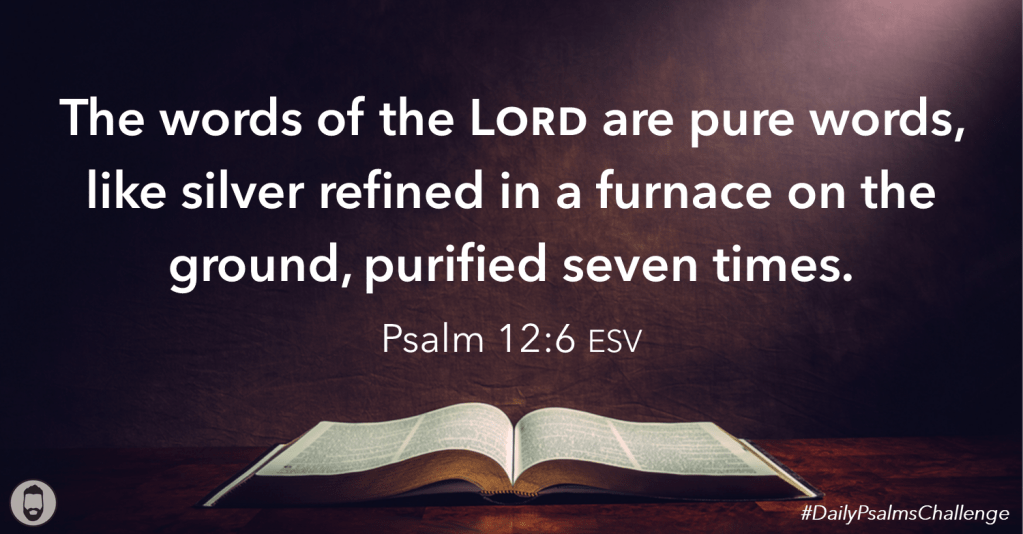
The words of the LORD are pure words, like silver refined in a furnace on the ground, purified seven times.

Psalm 12:6

Psalm 12 presents a striking picture of what society looks like when overrun with deceit and dishonesty. David begins with a desperate plea: “Save, O LORD, for the godly one is gone; for the faithful have vanished from among the children of man” (v. 1). David finds himself surrounded by lies, flattery, and arrogant pride; He finds himself feeling isolated and alone, as if all of the godly have gone from the earth.

He identifies that the root of the problem is in people’s speech (which definitely reflects the godly wisdom of Proverbs). He says that everyone “lies to his neighbor” and that their “flattering lips” reflects their “double heart” (v. 2). These words tear apart trust and relationships, leaving the vulnerable – the poor and needy – oppen to oppression (v. 5). Yet amid the chaos, David anchors his hope in the purity and power of God’s Word (v. 6). Unlike the empty promises and wicked speech of humanity, God’s Word is flawless, reliable, and live-giving.

God’s response to this broken world is a promise of protection. He assures David, 

“Because the poor are plundered, because the needy groan, I will now arise…. I will place him in the safety for which he longs.” (v. 5)

This promise underscores the LORD’s active role in defending His people and upholding righteousness, even when wickedness seems to dominate.

Though David ends with the somber observation that “the wicked prowl” and “vileness is exalted” (v. 8), his confidence in God’s faithfulness remains unshaken. For David, the pure, tested Word of God is a firm foundation that no human deceit can overcome.

Seeing Jesus in Psalm 12

Jesus, the Word made flesh (John 1:1, 14), perfectly embodies the purity and truth described in Psalm 12. He is not like the deceitful and boastful (1 Peter 2:22). He lived a life of perfect faithfulness and truth, ultimately bearing the penalty for our sinful words and actions in His body on the cross. 

In Jesus, God’s promise to “arise” for the poor and needy finds its ultimate fulfillment. Jesus’s time on earth was marked by His compassion toward those who needed help – whether it be needs, sickness, or ostracized because of sin or uncleanliness (Luke 4:18). Through His death and resurrection, He secured eternal safety and deliverance for all who trust Him.

Reflection

What role to your words play in your relationships and witness?

Are they marked by truth, humility, and love, or do they reflect the deceit and flattery of the world?

Psalm 12 challenges us to examine our speech and align it with God’s Word and consider how we can lean on the promises of GOd when deceit and wickedness seem overwhelming. Rest in assurance that God sees, hears, and acts on behalf of His people. His Word is a reliable refuge, offering hope and strength as we navigate a broken world.
The #dailyPSALMSchallenge gives us the opportunity to start 2025 in God’s Word by digging into a psalm a day. Each day will identify a key passage for us to meditate on as well as seeking to help us see Jesus in the psalm and reflect on what we have read.

Won’t you take the challenge?
“Foundations of Faith” from Psalm 11 (#dailyPSALMSchallenge)

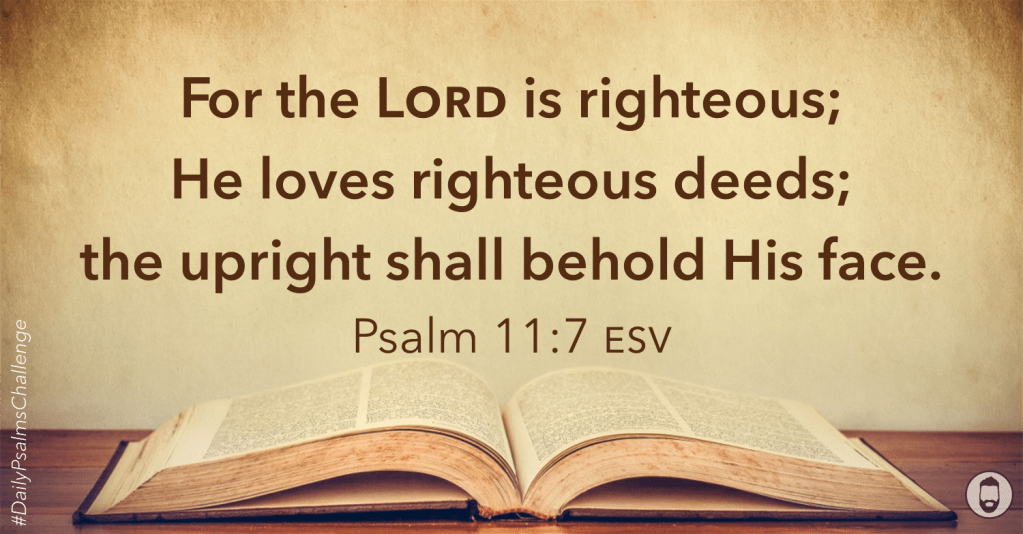
For the LORD is righteous; He loves righteous deeds; the upright shall behold His face.

Psalm 11:7

Psalm 11 speaks directly to a moment of crisis, when fear and doubt creep in while everything around David seems to be going wrong because of wicked enemies. David starts off with a declaration of his trust in the LORD: “In the LORD I take refuge” (v. 1). This is David’s response to being told to “flee like a bird” (v. 1) in the face of danger. He refused to flee anywhere other than to the LORD. Why? Because his hope is not found in his circumstances but in the sovereignty and power of God.

People looked at David and saw chaos – wicked men lurking in the shadows, preparing to strike out at the righteous (v. 2). They questioned what the righteous could do once “the foundations are destroyed” (v. 3), yet David’s confidence was not shaken. His response was to turn his gaze upward, away from the troubles and wicked enemies, declaring, “The LORD is in His holy temple; the LORD’s throne is in heaven” (v. 4). His foundations are too high and too deep to be in danger of crumbling or shaking! From His throne, He sees all, tests all men’s hearts, and brings judgment on the wicked while vindicating the righteous.

Psalm 11 culminates in a beautiful promise: “The upright shall behold His face” (v. 7). For those whose trust is in the LORD, there is not only refuge now but the ultimate reward of seeing God face-to-face. This hope is unshakable because it rests on the unchanging character of the LORD, who is righteous and loves justice (v. 7).

Seeing Jesus in Psalm 11

Jesus fulfills the promise of Psalm 11. In His life, He endured the attacks of the wicked, standing firm in the face of betrayal, violence, and the cross. He is the ultimate example of trusting the Father as a refuge. On the cross, He bore the judgment we deserve, drinking the cup of wrath described in v. 6 so that those who believe in Him can experience the joy of seeing God’s face (1 John 3:2).

Jesus triumphed over sin and death through His resurrection, ensuring that the righteous will one day be vindicated, and His return will bring ultimate justice, proving that no wickedness escapes His notice.

Reflection

In times of crisis, where do you turn for refuge? Psalm 11 challenges us to put our trust in the LORD not human solutions or fleeing.

Let the hope of seeing Jesus face-to-face sustain you as you navigate the challenges of life.

The #dailyPSALMSchallenge gives us the opportunity to start 2025 in God’s Word by digging into a psalm a day. Each day will identify a key passage for us to meditate on as well as seeking to help us see Jesus in the psalm and reflect on what we have read.

Won’t you take the challenge?
“Finding Hope in God’s Justice” from Psalm 10 (#dailyPSALMSchallenge

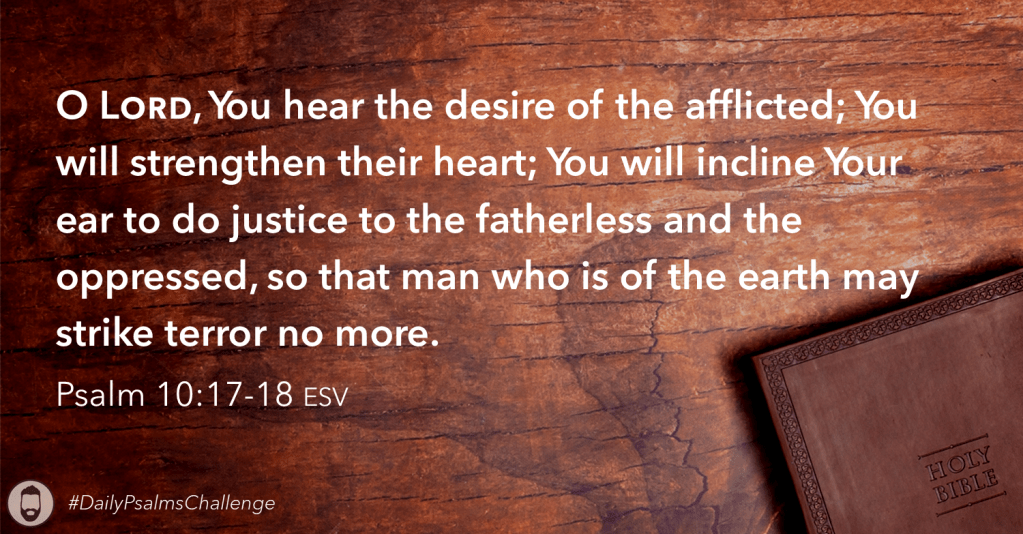
O LORD, You hear the desire of the afflicted; You will strengthen their heart; You will incline Your ear to do justice to the fatherless and the oppressed, so that man who is of the earth may strike terror no more.

Psalm 10:17-18

Psalm 10 opens with a heartfelt cry, “Why, O LORD, do you stand far away/ Why do You hide Yourself in times of trouble?” (v. 1). This lament resonates deeply with anyone who has ever tried to reconcile what may look like God being silent toward the rampant injustice in the world.

The psalmist (no one is specifically named as the writer of Psalm 10) paints a vivid picture of the wicked — arrogant, oppressive, and violent — preying upon the helpless with no fear of accountability (vv. 2-11). Their hearts are full of pride, and they make the bold proclamation that “There is no God” (v. 4).

The wicked seem to prosper — seem. Their prosperity is only temporary because their ways are deceptive and cruel. They lurk in ambush like predators, exploiting the vulnerable like their prey and doing so with what seems to be no punishment or repercussions. The psalmist pleads with GOd to respond — to rise up, defend the afflicted, and bring the wicked to account (vv. 12-15). These cries are not expressions of doubt but of trust that God is just and able to intervene.

Psalm 10 concludes with renewed confidence (rather than disappointment) in the Lord, who is “King forever and ever” (v. 16). The wicked may seem to prevail, but the power is fleeting. God hears the cries of the afflicted, strengthens their hearts, and ensures justice for the fatherless and the oppressed (vv. 17-18). This is the assurance that while human justice is rampant, divine justice will ultimately prevail.

Seeing Jesus in Psalm 10

Jesus embodies the heart of Psalm 10. He demonstrated God’s care for the afflicted and oppressed during His earthly ministry — healing the sick, comforting the grieving, and extending grace to the outcasts. On the cross, Jesus bore the ultimate injustice — dying for sins He did not commit — so that justice and mercy could be perfectly reconciled in Him.

When Jesus returns to establish His eternal Kingdom of justice and peace, He will fulfill the psalmist’s cry that “man who is of the earth may strike terror no more” (v. 18).

Reflect

Psalm 10 reminds us that even when God seems distant, He is neither unaware nor indifferent to injustice.

Are you wrestling with situations where the wicked appear to prosper? Bring your concerns — and even your laments — to the Lord, trusting that He sees, hears, and will act.

Consider ways you might be able to defend the weak, care for the vulnerable, and trust in His ultimate plan to right every wrong. May Psalm 10 strength your faith as you learn to wait on the Lord.

The #dailyPSALMSchallenge gives us the opportunity to start 2025 in God’s Word by digging into a psalm a day. Each day will identify a key passage for us to meditate on as well as seeking to help us see Jesus in the psalm and reflect on what we have read.

Won’t you take the challenge?

“The LORD is a Stronghold” from Psalm 9 (#dailyPSALMSchallenge)

The LORD is a stronghold for the oppressed, a stronghold in times of trouble.

Psalm 9:9

Psalm 9 is a celebration of God’s justice, faithfulness, and salvation. David opens with a powerful declaration of praise to God: “I will give thanks to the LORD with my whole heart; I will recount all of Your wonderful deeds” (v. 1). Throughout Psalm 9, he does just that: recounting God’s past acts of deliverance and expressing praise through trusting in His eternal reign.

David reflects on God’s role as judge. God is able to both rebuke the nations and destroy the wicked, blotting out their names forever (vv. 5-6). This righteous judgment reminds us that God’s justice is not limited by time; He is enthroned forever, ruling with fairness and protecting the oppressed (vv. 7-9). For those who trust in Him — in His name, God offers refuge and security as a mighty stronghold, never forsaking His people (v. 10).

Psalm 9 also highlights God’s concern and care for the weak and afflicted. He remembers their cries and avenges their suffering (v. 12). David pleads for deliverance himself, trusting that God is able and will lift him from the “gates of death” so he can praise God in the “gates of the daughters of Zion” (vv. 13-14). The reversal from near-death to rejoicing is a powerful testimony to God’s power and grace.

God’s justice is clear in Psalm 9. The wicked often fall into the traps that they have set for others (v. 15), yet ultimate justice belongs to the Lord, who will one day judge the world completely in His righteousness. Until then, the needy and poor can take comfort in the knowledge that He has not forgotten them — and that hope in Him will not perish (v. 18)!

Seeing Jesus in Psalm 9

Psalm 9 anticipates Jesus’s reign as the righteous Judge of all nations. As Paul declared in Acts 17:31, God has “fixed a day on which He will judge the world in righteousness by a man whom He has appointed” — Jesus is the appointed Judge as well as our assurance because of His resurrection.

In His first coming, Jesus brought hope to the oppressed and salvation to the lost. When He returns, He will bring final justice and an end to all evil.

David’s plea for deliverance also foreshadows Jesus and His gospel. Just as David was able to rejoice in God saving him from the “gates of death”, we can rejoice that Jesus conquered death itself through His resurrection. Through Him, believers are delivered from sin and eternal death and transferred into His Kingdom to rejoice in Him forevermore (Colossians 1:13-14)!

Reflection

Psalm 9 gives an example of David worshiping the Lord out of a grateful heart. Take time today to thank God for His faithfulness in your own life. Consider His acts of justice and salvation — both in the world around you and through Jesus. Follow David’s example and recount His wonderful deeds and sing His praises so that those around you can hear about Jesus.

The #dailyPSALMSchallenge gives us the opportunity to start 2025 in God’s Word by digging into a psalm a day. Each day will identify a key passage for us to meditate on as well as seeking to help us see Jesus in the psalm and reflect on what we have read.

Won’t you take the challenge?

“The Majesty of God’s Name” from Psalm 8 (#dailyPSALMSchallenge)

O LORD, our Lord, how majestic is Your name in all the earth! You have set Your glory above the heavens.

Psalm 8:1

Psalm 8 is a beautiful hymn of praise, celebrating the glory of God as seen in creation and the high calling He has given to humanity. David begins and ends with the same refrain: “O LORD, our Lord, how majestic is Your name in all the earth!” (vv. 1, 9) This bookends Psalm 8 with awe and reverence for the true God, Yahweh, the Creator and Sustainer of all that there is.

As David contemplates the vastness of the heavens — the moon and stars set in place by God’s fingers — he marvels at the smallness of humanity in contrast and asks “What is man that You are mindful of Him, and the son of man that You care for him?” (v. 4) Yet, despite our frailty, God has given us the honor of being entrusted with dominion over His creation (vv. 5-6) which reflects our unique position as His image-bearers (Genesis 1:26-28).

Psalm 8 also highlights how God uses the weak to display His strength: “Out of the mouth of babies and infants, You have established strength because of Your foes” (v. 2). This theme is echoed in Jesus’s ministry when He cited this verse in Matthew 21:16 to defend children’s praises in the temple. God’s majesty shines brightly when His power is displayed in (and despite) human weakness.

Seeing Jesus in Psalm 8

Psalm 8 points us to Jesus, the perfect fulfillment of humanity’s calling. The writer of Hebrews quotes this psalm, showing that Jesus was “made a little lower than the angels” and crowned with glory and honor through His suffering and resurrection (Hebrews 2:6-9). As the second Adam, Jesus restores what was broken by sin, exercising dominion over all things in heaven and earth (1 Corinthians 15:27, Ephesians 1:22).

Jesus’s victory over sin and death through His death and resurrection ensures that one day creation will be restored and that His followers will share in His reign (2 Timothy 2:12).

Reflection

Take time today to marvel at the majesty of God in His creation. Look at the stars or consider the intricate design of nature around you, and reflect on how small we are compared to God’s greatness. Yet, despite all of His majesty and everything He has made, He is mindful of you, cares for you, and has given you a purpose in His creation.

The #dailyPSALMSchallenge gives us the opportunity to start 2025 in God’s Word by digging into a psalm a day. Each day will identify a key passage for us to meditate on as well as seeking to help us see Jesus in the psalm and reflect on what we have read.

Won’t you take the challenge?
“A Righteous Refuge” from Psalm 7 (#dailyPSALMSchallenge)

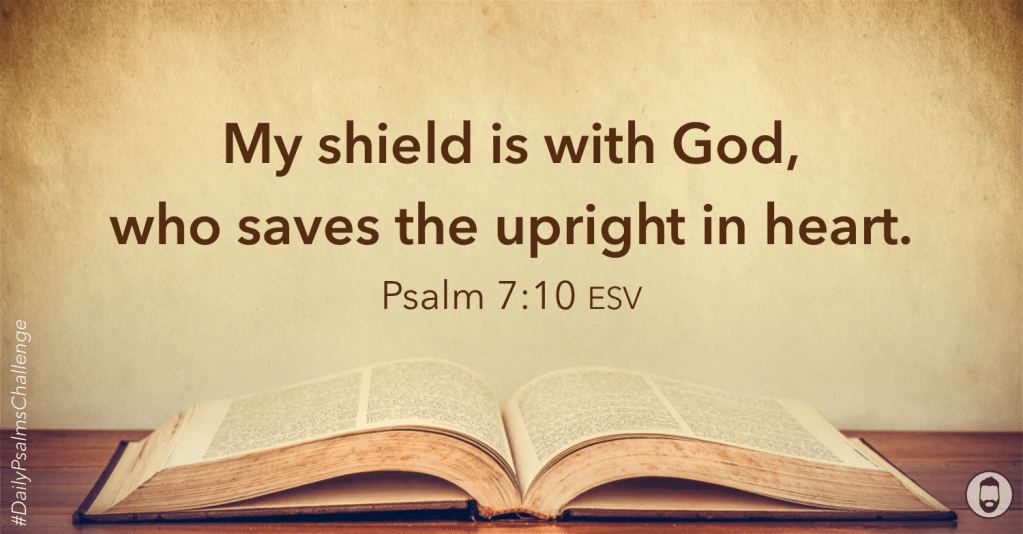
My shield is with God, who saves the upright in heart.

Psalm 7:10

Psalm 7 offers a vivid picture of David’s reliance on God in the midst of slander and false accusations. Faced with an attack from Cush, a Benjamite likely allied with Saul, David turns to God as his refuge (v. 1). He describes his pursuers as lions ready to tear him apart (v. 2), yet, instead of seeking personal revenge or justifying himself to others, David brings his case before the ultimate Judge.

David’s prayer begins with self-examination. In vv. 3-5, he acknowledges the possibility of wrongdoing (because he knows he is a sinner) and invites God to judge him if he is guilty. This humble request reveals David’s heart toward God, seeking to be the man God called him to be rather than be vindicated. His appeal for justice (v. 8) is grounded in his trust that God is a righteous judge who sees all hearts and minds (v. 9).

When he talks about the pit and hole in vv. 14-16, he paints a striking illustration of how sin traps people. This sort of poetic justice reminds us that God’s judgment is perfect, but it is also active. Despite his situation, David concludes Psalm 7 with confident praise in his God: “I will give to the LORD the thanks due to His righteousness” (v. 17).

Seeing Jesus in Psalm 7

David’s plea for justice and his willingness to entrust himself to God foreshadows Jesus who endured what David did and more. Jesus was reviled and slandered but “continued trusting Himself to Him who judges justly” (1 Peter 2:23) — to the Father. Unlike David, though, Jesus was (and is) sinless leaving no doubt to His righteousness.

When David talks about God’s bow being “bend and readied” toward those who don’t repent in v. 12, we are reminded of the reality of what our sin deserves. We need to be reminded that God hung His bow in the clouds a long time ago, reminded that for those who trust in God for salvation His bow is pointed toward heaven — toward His Son Jesus — instead.

Reflection

Psalm 7 invites us to bring our hurts and accusations to God and let Him sort them out rather than seeking personal revenge.

Are you carrying such a burden today?

Lay it before the righteous Judge who knows every heart. His justice may not be immediate, but it is certain.

Let this psalm inspire you to trust in God as your refuge, examine your own heart, and rest in the assurance that God’s justice — and, thankfully, His mercy — will prevail.

The #dailyPSALMSchallenge gives us the opportunity to start 2025 in God’s Word by digging into a psalm a day. Each day will identify a key passage for us to meditate on as well as seeking to help us see Jesus in the psalm and reflect on what we have read.

Won’t you take the challenge?
“Trusting God’s Steadfast Love in Sorrow” from Psalm 6 (#dailyPSALMSchallenge)

Turn, O LORD, deliver my life; save me for the sake of Your steadfast love.

Psalm 6:4

Psalm 6 is a cry of deep lament (which we defined in Psalm 3 as letting out one’s feelings of grief or sadness) as David is overwhelmed by distress and the apparent silence of God. This is the first of the penitential psalms (meaning Psalms of confession and repentance — including Psalms 32, 38, 51, 130, and 143). Here, rather than confessing specific sins, David cries out to God about his experiences with God’s discipline and his enemies’ torment.

David starts off with an urgent plea: “O Lord, rebuke me not in Your anger, nor discipline me in Your wrath” (v. 1). He feels the weight of God’s discipline but asks for God’s mercy instead of wrath. If God’s grace is giving His undeserved favor, His mercy is withholding punishment or wrath that we DO deserve. David’s plea for mercy is because his distress is affecting him physically and longs to know from the Lord how long the discipline will last (vv. 2-3).

The turning point in Psalm 6 comes when David appeals to God’s steadfast love (Hebrew: chesed) and sees that love as the basis for his hope. He has experienced God’s steadfast love in the past and trusts that God will not be angry with him forever and will move to rescue and save him (v. 4). David understands that God is just and does not dispute whether the discipline is warranted; knowing God loves him, though, he pleads for mercy.

What began as lament turns to worship with David pouring out his soul before the Lord. While he initially remarked that he felt God was being silent toward him, He had faith that God had heard his prayer (v. 9). This assurance fuels his boldness to call out his enemies, knowing that God is not done with him and will vindicate him.

Seeing Jesus in Psalm 6

This psalm points forward to Jesus, the Man of sorrows (Isaiah 53:3). Like David, Jesus experienced deep anguish as He prayed in the garden of Gethsemane (Luke 22:44). On the cross, He bore the full weight of God’s wrath and punishment for our sin — not His, but ours — so that we might be delivered and experience His steadfast love.

Jesus also fulfills David’s confidence that God hears the cries of the afflicted. In Him, have assurance that our prayers are heard and that our salvation is sure. More than that, Jesus’s resurrection turns our weeping to joy, proving that not even death can separate us from God’s love.

Reflection

Psalm 6 invites us to bring our deepest sorrows and fears to God, trusting in His steadfast love even when we are being disciplined (and our troubles stem from our own sin). When God seems silent, David’s faith and words in Psalm 6 can help us see that God’s mercy is greater than His discipline and that His salvation is certain for those who trust in Him.

The #dailyPSALMSchallenge gives us the opportunity to start 2025 in God’s Word by digging into a psalm a day. Each day will identify a key passage for us to meditate on as well as seeking to help us see Jesus in the psalm and reflect on what we have read.

Won’t you take the challenge?
“A Morning Cry to God” from Psalm 5 (#dailyPSALMSchallenge)

O Lord, in the morning You hear my voice; in the morning I prepare a sacrifice for You and watch.

Psalm 5:3

Psalm 5 is a morning prayer of David where he cries out urgently to the Lord, asking God to lead him in righteousness and bring justice to the wicked. This psalm contrasts the holiness of God and the ways of evildoers, showing both God’s hatred for sin and His steadfast love for those who take refuge in Him.

David’s confidence in God is rooted in God’s character. The Lord does not delight in wickedness, and evil cannot dwell in His presence (v. 4). David is confident he can enter God’s presence — not by his merit but God’s through the abundance of God’s steadfast love (v. 7).

This psalm also highlights the effects of sin. David illustrates the wicked as having no truth in their mouths and calls their throats open graves (v. 9), which is quoted by Paul in Romans 3:13 to show the depths of sin in all people. Left to ourselves and our own desires, we are no different. The difference is taking refuge and finding salvation in Jesus as Lord and Savior.

Seeing Jesus in Psalm 5

David’s prayer finds its ultimate fulfillment in Jesus. Jesus loved us so much that He took the wrath of God due our sin on Himself. Rather than standing before God in our wickedness, we can stand covered by Jesus’s righteousness.

Jesus also illustrated what it looks like to pray like David, rising early to talk to His Father (Mark 1:35). Let’s follow His example.

Reflection

As we meditate on Psalm 5, we are invited to pray like David. Each morning, we can cry out to God for guidance, trusting Him to lead us in righteousness and protect us from sin.

Just as David relied on God’s faithfulness, we can approach God today through Jesus, the perfect representation of God’s steadfast love. Jesus bore the penalty for our sins so that we can come boldly into God’s presence (Hebrews 10:19-22).

The #dailyPSALMSchallenge gives us the opportunity to start 2025 in God’s Word by digging into a psalm a day. Each day will identify a key passage for us to meditate on as well as seeking to help us see Jesus in the psalm and reflect on what we have read.

Won’t you take the challenge?
“Peace in the Night” from Psalm 4 (#dailyPSALMSchallenge)

In peace I will both lie down and sleep; for You alone, O LORD, make me dwell in safety.

Psalm 4:8

Psalm 4 shows us more of David’s quiet trust in the Lord in the midst of trials and tribulations. This psalm teaches us how to respond to the anxiety that comes from trials with faith, leading to joy and peace despite circumstances.

A Cry for Help

David begins with an urgent plea to the Lord: “Answer me when I call, O God of my righteousness! You have given me relief when I was in distress. Be gracious to me and hear my prayer!” (v. 1) David can reflect on God’s faithfulness throughout his life and have faith to seek God in new trials. This is a good example for us: turn to the Lord when troubles weigh on us and know that He will be faithful in the present just has He has in the past.

Confidence in God’s Care

Don’t misunderstand and think that there was no trouble or turmoil. David’s opponents were terrible. God is just better and more powerful than they are. David had assurance that God “has set apart the godly for Himself” and hears him when he cries out (v. 3). God faithfully sustains His people, and His presence provides peace.

David’s words in v. 4 — “be angry, and do not sin” — show us the temptation to respond wrongly in times of trials, encouraging self-control and Holy Spirit reliance rather than retaliating or giving in to bitterness. Instead, David exhorts people to “ponder in [their] own hearts on [their] beds, and be silent” (v. 4). There is no need to speak on our own behalf; God has it handled.

Joy Surpasses Circumstance

David’s cry of “Lift up the light of Your face upon us, O Lord” (v. 6) shows the surpassing worth of God’s presence in our plight. Knowing God and having His presence in the midst of troubles brings “more joy…than they have when their grain and wine abound” (v. 7). Seeking God’s face echoes the blessing of Aaron in Numbers 6:24-26, affirming the promise of God’s provident presence.

David trusts God to provide security. That gives Him a peaceful assurance that even allows rest, recognizing that safety lies in the Lord and not in our circumstances.

Seeing Jesus in Psalm 4

Psalm 4 points to the peace that Jesus promised His disciples in John 14:27: “Peace I leave with you; my peace I give to you”. Jesus is the very same God who provided peace, security, joy, and rest to David and provides it still to His people today, no matter the circumstances.

Reflection

Meditate on God’s past faithfulness in your life and ask His Spirit to strengthen your faith in your present trials. His faithfulness and provident care is better than the momentary joy or happiness offered by material things.

May we, like David, learn to cry out to God, rest in His promises, and trust in His provision.

The #dailyPSALMSchallenge gives us the opportunity to start 2025 in God’s Word by digging into a psalm a day. Each day will identify a key passage for us to meditate on as well as seeking to help us see Jesus in the psalm and reflect on what we have read.

Won’t you take the challenge?
“Save Me, O God” from Psalm 3 (#dailyPSALMSchallenge)

3But you, O LORD, are a shield about me, my glory, and the lifter of my head. 4I cried aloud to the LORD, and He answered me from His holy hill. Selah

Psalm 3:3-4

Psalm 3 is written after one of the most terrible moments of King David’s life — when he was on the run from his son Absalom, who was trying to remove him from power. This is a psalm of lament (letting out one’s feelings of grief or sadness) to be sure, but it is also a psalm of trust and hope in the Lord, offering us an example of turning to God in the midst of overwhelming circumstances.

The Crisis of Many

David begins by describing his specific circumstances: his enemies are many, their accusations are relentless, and their mockery sharp, saying that “There is no salvation for [David] in God” (v. 2). To say that David would not find salvation in his God strikes at David’s identity as God’s anointed king, but their mocking did not change the truth. David’s response to them reminds us that turning to the truth of God’s promises is the only place to go when doubt and despair set in.

The Confidence in God

David shifts his focus from his circumstances by declaring to the Lord that He is “a shield about [him], [his] glory, and the lifter of [his] head” (v. 3). His confidence is built on God’s steadfast character and strength rather than what is going on around him. He trusts that his Lord not only hears his cry but that He will answer him from His holy hill (v. 4).

The Calm in the Chaos

It would be understandable for David to be distraught, but we see God providing him with peace. How many of us find it difficult to sleep when we are in the midst of trials and tribulations? Because of his faith in God, David could say, “I lay down and slept; I woke again, for the Lord sustain me” (v. 5). This highlights his faith and teaches us that God watches over His people, especially in times of turmoil and insurmountable circumstances.

The Cry for Deliverance

We see David cry out to the Lord for help and relief: “Arise, O Lord! Save me, O my God!” (v. 7). This echoes the cries of God’s people past and future, asking God to intervene against a powerful foe. David trusts that God will deal justly with the wicked — even if that means Absalom, while affirming that “salvation belongs to the Lord” and asks that His blessing be on His people” (v. 8).

Seeing Jesus in Psalm 3

David’s experience crying out to the Lord in the midst of trial and finding help points forward to the ultimate son of David, Jesus. He faced all that David did and worse — rejection, betrayal, mockery, brutal torture, execution. Jesus bore the full weight of our sin and death on the cross and cried out to His Father. Though surrounded by enemies and taunts like we have never seen, Jesus rested in His Father’s will and the confident assurance in His prophesied resurrection. Jesus’s victory over sin and death ensures that all of us who trust in Him can truly echo David’s cry that “Salvation belongs to the Lord”.

Reflection

Psalm 3 teaches us to bring our fears and burdens to God, recognizing that He can shield us from trouble and sustain us through trials. Jesus is not a distant, detached King; He knows our struggles because He experienced them. He has already overcome them (John 16:33). Whatever troubles you face today, cry out to Him and rest in the assurance that salvation belongs to Him.

The #dailyPSALMSchallenge gives us the opportunity to start 2025 in God’s Word by digging into a psalm a day. Each day will identify a key passage for us to meditate on as well as seeking to help us see Jesus in the psalm and reflect on what we have read.

Won’t you take the challenge?