
These verses are a beautiful picture of God’s forgiveness and are good reminders for those who are saved to see what the “free gift of eternal life” is in light of the “wages of [our] sin” (Romans 6:23). We are going to briefly unpack these verses, and Lord willing, you will be moved to be thankful as well.
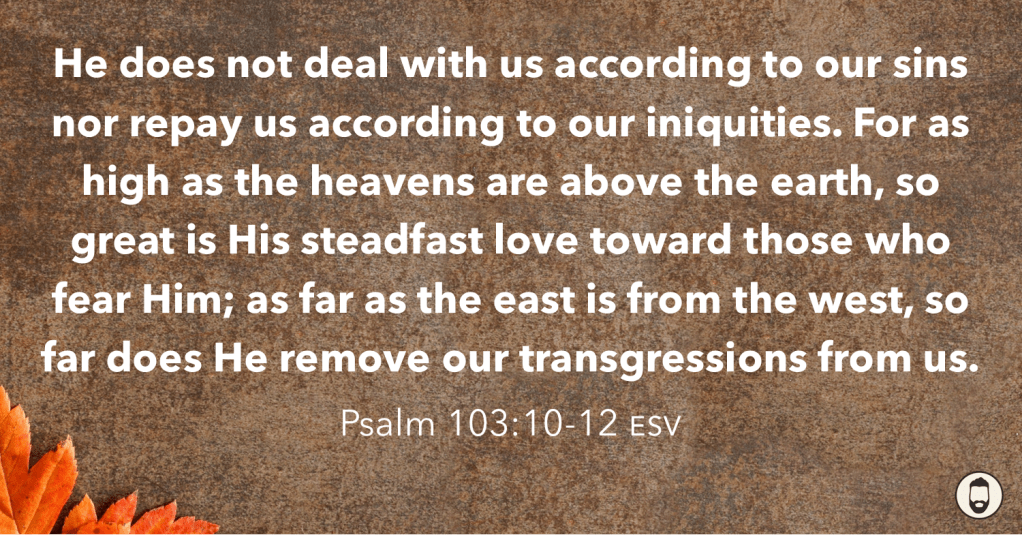
“He does not deal with us according to our sins nor repay us according to our iniquities.” This is a beautiful example of the otherness of God. I know that term sounds weird, but when we talk about God, it is important to remember that He is not like us. This otherness is really linked to His holiness, meaning that He is entirely set apart and above us in His worth, splender, and perfection. God is God, and we are not.
Human beings deal with each other according to their sin and iniquity. If someone has wronged us or someone close to us, it is likely that we will forever treat them differently because of it. Even if we forgive, we are quick to let folks know we won’t forget. If we catch someone in a lie, they will forever be defined as a liar (even though we have been guilty of the same). The sin is a defining point for us because we don’t want to fall victim of it again. Yet God does not deal with US that way.
That “us” is very important here because it is a distinction from how others are dealt with. This is not the us v. them where we make ourselves to be righteous (Romans 3:10-12). No, this is referencing the difference between those who have believed and put their faith in God and have been saved by grace through faith in Jesus (Ephesians 2:8-9) and those who have not (John 3:18). He does not deal with “us” according to our sin because Jesus has paid for our sin (1 Peter 2:24). Our sin does not define us because He defines us based on our relationship with Jesus (2 Corinthians 5:17, 21; Romans 8:1).
“For as high as the heavens are above the earth, so great is His steadfast love toward those who fear Him….” Here we see the otherness of God again. This is literally the 6,000 mile view, one that God sees easily from His vantage point that we might struggle with from ours. 6,214 miles above our vantage point is when the earth stops being the earth; that’s literally how high the heavens are above the earth. God’s steadfast love – His never-stopping, never-failing, never-giving-up, everlasting love – is astronomically greater than our human hearts can fathom or feature (Isaiah 55:8-9).
This qualifies the “us” from the last section because the “us” is made up of those who fear the Lord – those who follow and worship Him, those who have been saved by Him (Psalm 25:12-14). It also builds on the last section specifically because it shows that God not only has decided not to “deal with us according to our sins or repay us according to our iniquities” because He has paid the penalty for them (2 Corinthians 5:21) but did this because He loves us (John 3:16, Ephesians 2:4-5). This love is foreign to us because in our sinfulness we want to repay evil with evil, sin with sin (Matthew 5:44-45, 1 Peter 3:9). God is different. He loved us and saved us from our sin when we were still in it – when we still deserved death and hell; that “demonstrates” how much higher His love is than ours (Romans 5:8).
“…[A]s far as the east is from the west, so far does He remove our transgressions from us.” I love the contrast of imagery between the atmospheric levels of love in the last section and the global stretch of His forgiveness in this one. It is really cool to see how God specifically created the earth in such a way that it illustrates this, too. If His love requires a 6,000 foot view, His forgiveness requires understanding of what infinity is. You see, if you set out westward here on earth, you will go infinitely west. West will never start being east, and vice versa. God infinitely removes our sin from us. It is gone. Period. Finito. Over with. It is finished.
When Jesus forgives, He can allow Himself to forget because when He saves us He will not lose us. The eternal life He gives is, well, eternal. The change He produces in people’s lives is continual because it stems from His love and faithfulness, not ours. So, He doesn’t have to deal with us “according to our sins” because they have been infinitely removed. They have been paid for and we cannot repossess them. He has the receipt and is not taking returns.
This is good news. It is nearly incomprehensible for us because we know the weight and evil nature of our sin (Psalm 51:3-5, Jeremiah 17:9). Yet He loved us and became the propitiation (wrath bearing sacrifice that trades the punishment due our sin for the favor due His Son) for our sin (Romans 3:23-25; 1 John 2:1-2, 4:10).
What about you? Have you experienced the forgiveness of God? Will you stand before Him and have Him see Jesus’s blood and righteousness or stand before Him in your sin?
Thank You, Lord, for offering forgiveness and salvation through Your Son Jesus.
Thank You, Lord, for Your astronomical love and the way you help us to see what You have done for us.
All through the month of November, our Christ Community Church family is focusing on what we are thankful for and expressing our thanks to our “great God and Savior Jesus Christ, who gave Himself for us to redeem us” (Titus 2:13-14).
This, like the #DailyWisdomChallenge we went through in October, is a challenge from our pastor John Goldwater — the #GRATITUDEandHOPEchallenge — where we have the opportunity to post Bible passages that move us to thanksgiving or in which we find hope. May this lead you to be grateful and find your hope in Jesus!

 Just Keith Harris