“Jesus & His Church: Context for the Letters to the Churches” — a Refresh & Restore Bible Study

We’re continuing in our study of Revelation called The KING is Coming. Today, we will be diving into the context of Jesus’s letters to the seven churches (and to us). Once again, I am thankful for Jamie Harrison and the opportunity to do this study together. This weeks passage is Revelation 1:9-20:

I, John, your brother and partner in the tribulation and the kingdom and the patient endurance that are in Jesus, was on the island called Patmos on account of the word of God and the testimony of Jesus. 10 I was in the Spirit on the Lord’s day, and I heard behind me a loud voice like a trumpet 11 saying, “Write what you see in a book and send it to the seven churches, to Ephesus and to Smyrna and to Pergamum and to Thyatira and to Sardis and to Philadelphia and to Laodicea.”
12 Then I turned to see the voice that was speaking to me, and on turning I saw seven golden lampstands, 13 and in the midst of the lampstands one like a son of man, clothed with a long robe and with a golden sash around his chest. 14 The hairs of his head were white, like white wool, like snow. His eyes were like a flame of fire, 15 his feet were like burnished bronze, refined in a furnace, and his voice was like the roar of many waters. 16 In his right hand he held seven stars, from his mouth came a sharp two-edged sword, and his face was like the sun shining in full strength.
17 When I saw him, I fell at his feet as though dead. But he laid his right hand on me, saying, “Fear not, I am the first and the last, 18 and the living one. I died, and behold I am alive forevermore, and I have the keys of Death and Hades. 19 Write therefore the things that you have seen, those that are and those that are to take place after this. 20 As for the mystery of the seven stars that you saw in my right hand, and the seven golden lampstands, the seven stars are the angels of the seven churches, and the seven lampstands are the seven churches.[1]


Keith Harris:      
Greetings, Sojourners,
We’re about to dive into the meat of the book of Revelation, looking here at the background. The cool thing about this, Jamie, that I like is there are places in Revelation that you have wonder Does this symbolize something? or Is this ___?, but if you look at this in a Bible with red letters for the words of Jesus, you notice that in this section Jesus Himself explains what elements like the lamp stands and stars are – He tells us here what they symbolize so we don’t have to wonder.

That’s good news for us because Jesus gave these letters to specific churches – and they even may apply to us today.

Jamie, take it away!

Jamie Harrison:
Alright. Last week, I did say at one point that we were about to pray, and I never did. So I apologize for that and want to start with prayer before we jump in:

Lord, thank You. Thank You for being our Father. Thank You for loving us. We just give You praise. We give You honor. And, Lord, we pray that You would open Your Word to us as we read today and discuss. We pray that it would be only truth that comes out, not conjecture. God, I pray that if anybody is listening and they don’t know You that through Your Word and Your Word only they would come to know You. Lord, we just thank You and give You praise. In Jesus’s name, Amen.     

So, let’s start in v. 9. We won’t really discuss v. 9 too terribly much; I just think it’s interesting that v. 9 is one of several verses in the Bible that show that the prosperity gospel[2] is incorrect. It says,[3] “I, John, your brother and partner in the affliction, Kingdom, and endurance that are in Jesus…” and then goes on to explain where he (John) is because of the “testimony” of Christ. That he’s on an island, and he’s doing backbreaking work everyday.

Keith:                   
…exiled, imprisoned….  

Jamie:                  
…completely. And an island meaning it’s surrounded by water so there’s nowhere to go except death. He’s there because of this testimony.

I just want to point out, y’all, that if you’re listening to people preach or whatever, and they’re telling you that if you’re not doing this and you’re not doing that you must not be right with God [regarding your health or your financial status or how prosperous you are on earth]…know that’s dumb.     

Keith:
Right. This is John, the gospel writer, the disciple whom Jesus loved. You would think that if there is a prosperity track, he’d be on it. But considering how this is so different, like you said, from the prosperity gospel, how he is in this place that no one would sanely want to be in and he received this treasure, these visions. It’s such a cool thing.      

Jamie:
That’s how it starts there. And then it goes into (v. 10) “I was in the Spirit on the Lord’s day, and I heard a loud voice behind me like a trumpet….” And I do think that’s cool. Again, I won’t spend a whole lot of time [on trumpets right now], we will moving forward…, but trumpets were used back in the Old Testament for like a warning, a call to war, and things like that, right?

Keith:                   
And heralds.      

Jamie:                  
So, this is like a voice saying, hey, you better listen up.    

Keith:                   
It obviously got his attention.

Jamie:                  
Right. So, here, Jesus gets his attention telling him to write down what he sees and send it to the seven churches, specifically naming them. The seven churches, you know, people try to make some kind of symbolic thing about them being seven of them and this and that, but this really is a logistical thing. These cities were not too terribly far apart. They were all along kind of the main routes where people would travel.

The churches at that time, I guess you could say that they were really the center point of the dissemination of information. Information kind of went from these hubs out to the rest of the world.                

Keith:                   
And you know Laodicea was a sister church of Colossae, and so on.          

Jamie:                  
Right, right. Notice when it says when John looks (in v. 12). This is one of those things – “Then I turned to see whose voice it was that spoke to me” – that reminds us that the timeline of Revelation is what John saw next. He hears the voice, turns, and sees (vv. 12-13) “seven golden lampstands, and among the lampstands was one like the Son of Man”. Then he goes on to give a description.

At first you look at it and think, well, there’s seven lampstands; what in the world are those seven lampstands? Again, it’s like Keith said earlier, it’s really cool because the Bible always is going to confirm what the Bible says. It’s going to give us the answer if we’re meant to know the answer. 

Keith:                   
If we are meant to know.             

Jamie:                  
That’s correct. And right there in v. 20 of Revelation 1, the second half there, it says, “The seven stars are the angels of the seven churches, and the seven lampstands are the seven churches.” So, literally, when he turned, what he was the seven churches – the seven golden lampstands. And then he sees Jesus. He’s dressed in a robe with a golden sash….

Keith:                   
That’s the part that really hits me. In this, as Jesus is walking in the midst of them…. We know that Adam and Eve had a very special thing that was squandered there in the garden where God came and walked in the garden with them in the cool of the day, but when Jesus before His ascension says, “and, lo, I am with you always” (Matthew 28:20), He is in the midst of His churches – in the midst of the presence of His bride here on earth.

                               
It kind of makes me think He’s disseminating information, like you say, but He had something specific to say to these churches. It’s to us all generically, but to Ephesus, to Smyrna, to all those specifically, He had a word that He wanted those churches, those local congregations to hear.

Jamie:                  
That’s right. And that being said, I think it begs the question: is Jesus walking through our churches today? I think that’s something to think about. If he’s not the center of the body, then we’ve stepped wrong somewhere.        

Keith:                   
Well, that question kind of builds into: is your church His – or yours?       

Jamie:                  
Yeah, that’s tough.

I saw a clip of a guy preaching the other day, and he said [to his congregation] that he had asked them for a watch a year ago and that they hadn’t bought him that watch yet. He asked why they were still broke and poor and busted – busted, that’s his word, what he said. That’s false gospel and has nothing to do with the Bible. That has nothing to do with anything. It’s supposed to all be about Jesus, and He isn’t at the center, then we really got to do something different.               

Keith:                   
That’s got me thinking about the way that some of these foolish false preachers – the way they talk to their church. That’s not how Jesus talks to His Bride. We’re going to get into these letters and see some tough stuff that He says to them – and thereby us – but, man, it’s for a purpose.

The guy you spoke of called them broke, busted, ignorant, all these things. Jesus – He says to the church at Laodicea (in Revelation 3:17) that they thought they were rich, that they thought they were prospering. He tells them they aren’t looking for Him and that they’re really wretched, pitiable, poor, blind, and naked. Jesus isn’t trying to bust them down and get a namebrand watch – not trying to get rich off them. The church is rich because of Christ. Or it’s poor and bankrupt without Him.             

Jamie:                  
Amen.

So, let’s jump into the description of Christ here. It says He’s dressed in a robe with a golden sash around His chest – that’s kind of like a high priest, or someone with authority. Jesus is the high priest. So, that’s the idea there.

And then, his hair (v. 14) – the hair of his head was as white as wool, white as snow. His eyes like a fiery flame. That’s a little scary, almost. I mean we know the white represents purity, holiness, wisdom, all these things. But that flame of fire, you know, His eyes like a fiery flame, that one should kind of set us down a little bit – the omniscience of God, He’s all knowing, all seeing. Hebrews 4:13 would be a good verse to look at.

But think about it like this when it talks about these eyes like a fiery flame. What we’re seeing is…. Picture this person that you’ve come into contact with in life that just has the look. You know the parent look, the coach look that has….   

Keith:                   
…gravitas….       

Jamie:
That’s it. They just have this look, and it seems to literally reach into the depths of your soul and you feel like you’ve got to look away. You can’t look at them. Jesus’s look here is like that on steroids.                

Keith:                   
I read where a preach said that’s why you should wear a suit and tie. It gives gravitas. Jesus didn’t get His gravitas in this scene because of the sash around His chest or His hair. It’s who He is. It’s His presence.           

Jamie:                  
That’s it. And it is not only gazing into the depths of our soul, but think about it bigger picture: it’s this penetrating gaze into the depths of His church, which is us as individuals but joined together. I think it’s important to bring that out that He is looking at His bride. He is looking at His church like we were discussing earlier. And He’s looking and going, well, they’re doing really great in these areas…look at that endurance…and look at these people what they’re doing for Me…. Then, (as in the case of the letter to Ephesus) He’s like but you’ve lost your first love.

This gaze is extremely uncomfortable and should make us step back and rethink things and lead us to repentance.      

Keith:                   
That’s the thing: lead us to repentance. He’s not tearing them down. He’s not tearing them up. He’s building them up because His people will recant. His people will change and follow Him. If not, then you get the other things He promises….

Jamie:                  
Right, right – which is nothing good.

So, in v. 15: “His feet were like fine bronze as it is fired in a furnace, and His voice like the sound of cascading waters.” Just kind of think about that for a second – that fine bronze. The alter of burnt offering (in the tabernacle and temple in the Old Testament) are covered with bronze, and it’s this divine judgment idea. This divine judgment on the church.

And His voice like the sound of “cascading waters” – think about that for a second. Everybody knows what that sounds like. Like you’re at a waterfall or something and hear that water. Think about it from John’s perspective. He’s on an island. These waves are crashing into the rocks of the island. That’s kind of his background noise all day long. That’s the idea here. This is what it sounds like.

It says in v. 16 that “He had seven stars in His right hand; a sharp double-edged sword came from His mouth, and His face was shining like the sun at full strength.” Which…let me back up and not get too far ahead of myself. So, we’re going to find out in just a minute that the “seven stars in His right hand” – He tells us in v. 20 – those are the angels of the seven churches, those are the pastors. The right hand of course is considered the hand of might, power, and strength.     

Keith:                   
The word “angel” there (in v. 20) means messenger (and can refer to people as well as heavenly beings – context helping you see the difference). So it’s not saying that these people who have been adopted into the family of God and charged by Him to care for a local congregation have been demoted to angelic beings. He’s saying that they are His messengers.

That’s something to consider, again, when asking whether Jesus is walking in the midst of your church. Is your pastor giving the information from the Word of God that Jesus – the Word of God – has give for His church, or is he giving some other message? That’s a tough question. 

Jamie:                  
It is. To hit on that for a minute, I know when I started preaching I thought I had to have all the right words and say all the right things to get people to come to know Christ – and almost like a play on emotions type of thing, you know? Set the mood just right. All that stuff, right? What I’ve learned as I’ve grown in Christ is, first off, I need to ask forgiveness from some people for some people for some of the stuff I said and did as a “young” preacher, but the fact is that the Word saves (Romans 10:17), you know? If we’re preaching and people aren’t hearing more from the Word than from us, we’ve got it backwards. The Word speaks for itself. The Word builds up.

Keith:                   
Which is the purpose of having pastors if you look at Ephesians 4.             

Jamie:                  
So, I just challenge you guys as you’re listening: surround yourself with people who are in the Word. Make sure you are in a Bible-believing, Bible-preaching church. Not a manipulative thing.              

Keith:                   
And if you listen to this and you’re a pastor. I think that the way our lead pastor at Christ Community (John Goldwater) put it when we were talking a couple weeks ago is that if you win someone with an argument, you’ve got to keep them with an argument. You win somebody with emotion, you’ve got to keep them with emotion. But if you see someone won to Christ, then He will keep them.

So, when we see here that He’s got these stars, these pastors, who He’s got.

Jamie:                  
That’s it. So, after it tells us about the pastors (stars) being in His right hand, it says that this “double-edged sword” came from His mouth, which we will actually get to later in Revelation when we discuss the final battle. We have a few cross-references for it Ephesians 6:17 and Revelation 19:15. Check those out. But that sword is the Word of God in His judgement, and it’s going to be the Word of God…

Keith:                   
…Hebrews 4:12-13….

Jamie:                  
…and that is how He is going to pronounce His final judgment with that double-edged sword – with the Word – coming from His mouth. Again, we don’t want to get ahead of ourselves. We’ll get there.

It says His face is shining like the sun at full strength. Now, we can’t even fathom this and imagine this because we can’t look into the sun for too long because we’ll go blind.  

Keith:                   
Let us clarify. Disclaimer: don’t look into the sun.              

Jamie:                  
That is correct. Please don’t try it. I tried when I was younger. That’s probably why I squint when I look at things now. Or it just could be that I’m getting old – not as old as Keith, but I am getting old. He is definitely older than I am.

So, looking into His face there, shining like the sun at full strength. Think about this magnificent glory of God – this magnificent brilliance and radiance that’s so glorious it can’t be concealed. It’s shining like nothing you’ve ever seen before. Think Matthew 17:1-13 at [Jesus’s] Transfiguration and what they saw, but this is that on…I don’t even know, right?   

Keith:                   
In person. In it’s fullness.             

Jamie:                  
I always go back to Moses in Exodus 34:29-35 where, you know, he sees the glory of God. But he only sees Him from His back. After seeing Him, though, [Moses’s] face is so bright the Israelites make him put a veil over his face because they can’t handle [the brightness of Moses’s face after his even glimpsing God]. We can’t look on the glory of God. It would kill us. It would legitimately kill us. We can’t handle that.            

Keith:                   
And so to this extent, the Moses example is the moon. Jesus here in Revelation 1 shows the real source of the light on his face. Jesus is light.

Jamie:                  
And we say all that to say this: when you’re looking at somebody like this – which again we can’t fathom – the One who is about to speak has 100% authority. We know that it’s Jesus who is about to speak. When John sees Him, his immediate reaction is to fall at His feet like a dead man.

Keith:                   
This is different when you see people in the Bible encounter angels. They cower in fear, but John just fell as if dead. His entire living faculties fail him.

Jamie:                  
I think it’s the expression. When we look at, you know, our wife or I’m going to specify here: if you’re a husband looking at your wife or a wife looking at your husband. When you say, oh, they took my breath away. [Seeing Jesus like this] took his breath.       

Keith:                   
All of it. Here’s the deal, too, though. John knows Him, right? So, the husband/wife analogy is so much clearer because this isn’t John seeing some amazing creature and being afraid. He’s looking face-to-face at Him who died and said “behold, I am alive forevermore” (v. 18). This is a huge deal, especially for John late in his life, outliving most, if not all, the apostles, and now he sees his friend. He sees his Lord. That’s huge.           

Jamie:                  
That’s exactly it. Jesus looks at John and is like, hey, don’t be afraid; I’m the first and the last, the living One.

Check out Isaiah 41:4, 44:6, 48:12, but again, some of these things it’s hard to even talk about. The first, the last, the living One. The last time a lot of people that were around and saw Jesus, He was dying on a cross. Not everybody saw Him after He was resurrected.   

Keith:                   
Many did, but not all.    

Jamie:                  
So, He’s declaring Himself [as] the living One. I was dead, but look, I’m alive forever and ever. I hold the keys to death and Hades. You could have a whole conversation on [these keys]; if anyone ever tells you they have [these keys or any like them], they’re a liar. Jesus has the keys to death and Hades. Jesus has the keys to the house of David (which we’re going to see later on in Revelation).            

Keith:                   
If anyone claims to have something that belongs to Jesus only they are not one of the stars (pastors) of the church. They’re definitely false teachers. They’re wolves who are in sheep’s clothing, trying to look like a pastor but leading to the devil whose goal it is to steal and kill and destroy. So, in the context of this conversation [and looking at the description of who Jesus is and the power He alone claims], any who claim what Jesus alone has is dangerous. They are of their father, the devil, and are a liar like him. They are not to be trusted. They are to be avoided at all costs.

That’s a tough statement to make because when you have conversations like this, people want to say, well, you can’t judge. Well, you judge not lest you be judged. Jesus Himself said they are ravenous wolves in sheep’s clothing. The devil is prowling like a roaring lion, seeking whom he can devour, who he can destroy…. You want to avoid what Jesus says avoid, what the Bible says avoid.      

Jamie:                  
You’re supposed to test the spirit by the Spirit. I think that’s where a lot of people – like the video I mentioned a little while ago, the pastor was saying y’all want to buy me a watch. The really disturbing thing about this video – and the dude points it out – there’re people in the background going, “Amen”, “Come on”, “Preach it”, like…get out. If you’re saying “Amen” to that, the spirit that is within you is not the spirit of God, it’s the spirit of man. And that’s what Keith’s saying: we are supposed to test the spirit by the Spirit; we are supposed to look at the fruit that’s coming off the tree.

Look, if somebody’s supposed to be your spiritual leader…. So many are supposedly spiritual leaders who are beating their spouse and doing crazy stuff – like, how can you lead me if you’re not following Christ yourself? The Bible specifically tells us that’s how it’s supposed to be.

I know we were going to go through (and it was actually my idea to try to get through) the letter to Ephesus, but we’re probably at a good place to stop in just a second.

Keith:                   
I think we are at a good place to stop. And not because we don’t want to get to the letter to Ephesus, but because there’s a reason this part of Revelation 1 is here. It’s not just exposition to help you understand the rest of it. It’s part of the revelation – part of understanding whose the churches are, whose the pastors are – or whose they aren’t.   

Jamie:                  
A good place to end this today is going to be those last three verses [in Revelation 1]. Where we’re starting at the end of v. 17 where Jesus says,

“Don’t be afraid. I am the First and the Last, and the Living One. I was dead, but look – I am alive forever and ever, and I hold the keys of death and Hades. Therefore write what you have seen, what is, and what will take place after this. The mystery of the seven stars you saw in my right hand and of the seven golden lampstands is this: The seven stars are the angels of the seven churches, and the seven lampstands are the seven churches.”

We’ve discussed that already, but I want to go back to the way Jesus describes Himself: “I am the First and the Last, and the Living One. I was dead, but look – I am alive forever and ever, and I hold the keys of death and Hades.” Philippians 2:9-11 say:

“For this reason God highly exalted him and gave him the name that is above every name, so that at the name of Jesus every knee will bow—in heaven and on earth and under the earth—and every tongue will confess that Jesus Christ is Lord, to the glory of God the Father.”   

I really want to press this home. This whole revelation is about Jesus Christ. This whole revelation is supposed to make us look towards Jesus Christ, and if it makes you look anywhere else, then we’ve got to start over from the beginning. Jesus’s name is the name that is above every name. It is the name. And at His name every knee will bow, every tongue will confess that Jesus is Lord.

Watch this, now, this is important; we’re going to go to Romans 10:9-13. This is our favorite verse at Christ Community. We make sure we say it every time that we’re gathered together. People often ask and say that they’d like to have a relationship with Christ – how does that happen? Romans 10:9-13 tells us how:

“If you confess with your mouth, ‘Jesus is Lord,’ and believe in your heart that God raised him from the dead, you will be saved. One believes with the heart, resulting in righteousness, and one confesses with the mouth, resulting in salvation. For the Scripture says, Everyone who believes on him will not be put to shame,, since there is no distinction between Jew and Greek, because the same Lord of all richly blesses all who call on him. For everyone who calls on the name of the Lord will be saved.”

Now, let’s put all this together from what we just read in Revelation where Jesus says He’s the first and the last, the living One. In other words, He’s saying I was dead but I’ve come back to life now. That’s the key to salvation. If you confess with your mouth “Jesus is Lord” and believe in your heart God raised Him from the dead – without this there is no Christianity. Without the resurrection it’s pointless – a waste of our time.

Here’s what I want to point out to everybody listening, ok? Whether you want to or not, at some point in your life, you are going to confess that Jesus is Lord. You are going to confess that He was raised from the dead and He’s alive forevermore.

Keith:                   
…because you are going to be faced with Him – irrefutable face-to-face evidence              

Jamie:                  
That’s exactly right. And that’s what Philippians 2 tells us. It doesn’t say every believer will confess. It says everyone. Everyone.

Keith:                   
…on the earth and under it….

Jamie:                  
And that’s everybody who is, who was, and who ever will be. So, I challenge you to look at these verses, Confess with your mouth that Jesus is Lord – which means giving everything over to Him, trusting in Him completely to lead, guide, and direct you in the right way. To say that you’re going to trust Him with every little thing that’s going on in your life. And that you believe in your heart that God raised Him from the dead. That’s how to be saved.

Keith:                   
That’s the faith we talked about – that trust.

Jamie:                  
That’s it. And, honestly, it’s one of two choices. You can say it because you want to or….

Keith:                   
…because you have to and it’s out of subjection that the King has come.

Jamie:                  
And He is coming.

Keith:                   
I think that’s a good place to stop. I urge you to check out…the Scripture references for yourself, and as we prepare to look at these letters to the churches over the next few weeks, be prepared to examine your own heart – not to be critical but to be biblical.

And we’ll catch you with the letter to the church at Ephesus next week! Thank you and God bless!


[1] The Holy Bible: English Standard Version (Wheaton, IL: Crossway Bibles, 2016), Re 1:9–20.

[2] A religious belief that financial blessing and physical well-being are always the will of God for faithful Christians

[3] Jamie – unless he states otherwise – uses the Christian Standard Bible (copyright © 2018 by Holman Bible Publishers).

“Preparing for the Coming King” — a Refresh & Restore Bible Study

Greetings, Sojourners, and welcome to this week’s Refresh & Restore Bible study!

We’re kicking off a new study today through the book of Revelation, but it’s not going to be a typical study of the book of Revelation. I’ll be going through it conversationally with Jamie Harrison, and we’re calling it The KING is Coming.

Today, we’ll be opening with Revelation 1:1-8 to introduce and open the study:

1The revelation of Jesus Christ, which God gave him to show to his servants the things that must soon take place. He made it known by sending his angel to his servant John, 2who bore witness to the word of God and to the testimony of Jesus Christ, even to all that he saw. 3Blessed is the one who reads aloud the words of this prophecy, and blessed are those who hear, and who keep what is written in it, for the time is near.

4John to the seven churches that are in Asia:

Grace to you and peace from him who is and who was and who is to come, and from the seven spirits who are before his throne, 5and from Jesus Christ the faithful witness, the firstborn of the dead, and the ruler of kings on earth.

To him who loves us and has freed us from our sins by his blood 6and made us a kingdom, priests to his God and Father, to him be glory and dominion forever and ever. Amen. 7Behold, he is coming with the clouds, and every eye will see him, even those who pierced him, and all tribes of the earth will wail on account of him. Even so. Amen.

8“I am the Alpha and the Omega,” says the Lord God, “who is and who was and who is to come, the Almighty.”[1]


Keith Harris:
Jamie Harrison is with us, and he’s going to talk to us about the book of Revelation. We will be doing this, as I said earlier, conversationally. I am as curious as any to see how this is going to go.

Jamie Harrison:
Same here.       

Keith:
So, Revelation – The KING is Coming….   

Jamie:
Revelation. I love the fact that you say Revelation and not RevelationS. That’s a common misconception with the book of RevelatioN. If you look, and I’m pretty sure any translation of the Bible, it’ll say Revelation is singular.

I love the way John MacArthur puts it in his Revelation Bible study. He says,

“Revelation depicts Jesus as the risen, glorified Son of God, ministering among the churches as the faithful witness, the firstborn from the dead, and the ruler over the kings of Earth as the Alpha and the Omega, the beginning and the end, as the first and the last, as the Son of Man, as the one who was dead but now is alive forevermore, as the Son of God, as the One who is holy and true, as the Amen, the faithful and true witness, the beginning of the creation of God, as the Lion of the tribe of Judah, as the Lamb in heaven with authority to open the title deed to the earth, as the Lamb on the throne, as the Messiah who will reign forever, as the Word of God, as the majestic King of kings and Lord of lords, returning in glorious splendor to conquer His foes, and as the root and the offspring of David, the bright and morning star.”[2]

What does all that mean? That the Revelation is Jesus.

I think it’s important to start off with the fact that the book of Revelation is oftentimes misunderstood as a book of something we’re supposed to guess about and put together conjecture….     

Keith:
…a code to break….        

Jamie:
That’s right. And draw pictures of what this might be and what that might be.

The book of Revelation is about Jesus. The whole Bible builds up to this book, right?

Keith:
Which is why it’s last in the canon[3] – because it’s supposed to be.            

Jamie:
That’s correct!

A couple of things before we get started, just so everyone knows what we’re not doing in this study. We’re not speculating about whether Jesus might come back on this day or on that day. We’re not debating on which theory is right or wrong. We’re not getting into the whole pre-, mid-, post-trib thing – anything like that; we’re going to present those as common approaches as to when Jesus is going to come.

Keith:
Acknowledge them, but if I remember when we first talked about this, the goal was a verse-by-verse study of the book of Revelation, like one studies the other sixty-five books of the Bible.

Jamie:
That’s correct. I think that’s it.

I think the best approach to the book of Revelation, because so many people that listen to this and so many of the conversations I’ve had with people over the years we’ve been doing this study at our church – if you have pre-conceived notions of anything in the book of Revelation, I genuinely pray that you approach it with the Holy Spirit as our teacher (John 14:26). We must have total dependence on Him. Total. Dependence. On Him.            

Keith:
I think this is a good time to reference that as we do these Bible studies, as we seek to be refreshed and restored – not just in the Revelation study but in all of them, this is not self-help; it’s not a magic pill or some sort of sorcery or incantation. The Holy Spirit is your teacher if you have faith in Jesus Christ. Salvation comes by grace through faith in Him alone. If He has saved you, He is your teacher.

If not, we invite you to confess Him as Lord, to believe in your heart that He died on the cross for our sins and rose again on the third day, and that by putting your faith in Him by asking – calling out – to Him, trusting that He will save you (Romans 10:9-13, 1 Corinthians 15:3-4).

If that’s the case, the book of Revelation will be good news. If it’s not the case, there will be several places in this study that will not be good news.              

Jamie:
That’s correct. One of the things that has kept coming up in our Bible study at church is that, man, it seems Revelation is full of bad news all the way through, but then, all of a sudden, you know, if you really pay attention every time something “bad” is given, it is followed up by something that’s awesome!          

Keith:
The King IS coming! That’s what all the “bad” is going to culminate in – the most awesome.

Jamie:
And He’s coming whether you want Him to or not.

The last thing before we get into it is to talk about the timeline of Revelation real quick, just because a lot of times when you read Revelation, you automatically think: OK, well, we’re reading this in order – you know this happens, then this happens. But the fact is, the timeline of Revelation is what John saw next.

A couple of examples of that is in ch. 1:12 (CSB)[4], it says,

“Then I turned to see whose voice it was that spoke to me. When I turned I saw seven golden lampstands….”

So that’s what he saw when he turned. It doesn’t mean it was in order (chronologically) of what he just said. Chapter 4:1, another good example:

“After this I looked….”

So, after what he had just talked about – after he had received the letters to the churches, he looked and there in heaven was an open door. It doesn’t mean that he received the letters and, then, that’s what happened next. This is what he saw next.

Keith:
A timeline for us to plan this all out isn’t part of the goal.

Going back to what you said earlier, the goal is for us to see Jesus Christ revealed – as He revealed this to John.  

Jamie:
That’s it. That’s correct. Just don’t get caught up trying to figure out when Jesus is coming. The fact is…we don’t know. And if anyone tells you different, they’re a liar – a false prophet.             

Keith:
Because Jesus says it cannot be known (Matthew 24:36).              

Jamie:
That’s right. The only inclination we’re given is in 1 Thessalonians 5:1-11 where we’re told that believers will be able to tell that the tribulation is happening. They will understand it by things that are going on because they’ve read the Bible and they’re filled with the Holy Spirit. It doesn’t mean they’ll know when Jesus is coming. That just means they’ll understand the times that are going on.               

Keith:
When you look at a lot of the people who are trying to narrow it down to a date – that’s often for their own glory. You think of Harold Camping who had one date, then other date, and then kind of just goes into relative obscurity because he didn’t get (it right) or the glory he was looking for. It’s about the coming of Jesus, not the one who can pinpoint the date. It’s about Him, not setting up some fruitful and enriching – monetary or otherwise – eschatology[5] ministry for people who are afraid to kind of twist them or turn them whichever way (2 Timothy 3:6-7, Romans 16:17-18, 2 Peter 2:1-3, Jude 4, Ephesians 4:14).         

Jamie:
That’s right.

Now, with all of that being said, let’s jump into it.            

Keith:
Sounds good.    

Jamie:
So, we started in v. 1. And this is to just reiterate how we started, it says:

“The revelation of Jesus Christ that God gave Him to show His servants what must soon take place.”

According to v. 1 – let me see how to phrase this – the Bible gives all the answers, right? If you can’t find the answers in the Bible, then the answer is “I don’t know”. 

Keith:
Right, and that’s a very good answer because it’s always better – and especially if people ask you, dear Sojourners, something that you don’t know, it’s better to tell them that you don’t know and that you’re willing to seek it out in Scripture than to make something up. (Making up answers) has never served Christ well or built up His Church. So, Jamie and I are fans of “I don’t know”.     

Jamie:
Yes, big fan. Those are three of my favorite words actually.

So, v. 1 gives us the answer to this revelation is an unveiling of. Revelation is an unveiling, a revealing, of all these things we are about to read about. There was what these people looked like and these animals look like and all these things – what in the world is that? None of that, in the end, matters. What matters is the unveiling – the revealing – of the revelation of Jesus Christ. We’re given that answer right here at the beginning.

The next thing we find here is the chain of communication. We’re told how it was made known to the rest of us. There in v. 1 it says He made it known by sending His angel to His servant John. Who sent it to the angel? God did. So, God sent the revelation to the angel, the angel gave the revelation to John, and John gave the revelation to us.             

Keith:
To the seven churches and then to the rest of us through John.

Jamie:
That is also an important thing to look at because people will say that this was just a man writing this book. Who is he? Why should we believe what he says? We’re told right from the beginning that this revelation comes from the mouth of God, as does all Scripture (2 Timothy 3:16-17, 2 Peter 1:20-21).              

Keith:
That’s the argument that people commonly want to make. Oh, a man wrote this. Part of the Holy Spirit being our teacher if we are saved is believing that the Bible doesn’t contain God’s Words, it is God’s Word that He breathed out through these people who wrote it down, and He is faithful.               

Jamie:
Amen.

Off of that, who is this revelation for? This is written to seven specific churches. Is it for them, us – who is it for? Again, the Bible gives us the answer. Look at v. 3:

“Blessed is the one who reads aloud the words of this prophecy, and blessed are those who hear the words of this prophecy and keep what is written in it, because the time is near.”

Again, the Bible gives us the answer. Who is this for? It is for those who read it aloud, those who hear the words of the prophecy and those who keep what is written in it.

That’s who it’s for: everybody. If you read it – if you keep it, it’s for you.

Keith:
And, I do think it’s important to clarify since there are so many – you can almost throw a rock in some towns and hit a church that’s “preaching” through Revelation – but so much of it is about their theories and conjectures. It needs to be important that, even and especially with our words, our commentary, our discussion of this, that it’s the words from the Bible that hold the power, that hold the weight.

And you don’t hear that in some of these eschatology, end-time studies. They are promoting their view.  

Jamie:
That’s such a big word you used there. What does eschatology mean?    

Keith:
Eschatology is the study of the end times – of what is to come.   

Jamie: [joking]
That’s for us simple-minded people.       

Keith:
I’ve seen over the last few weeks on social media – ads of various big-name, popular preachers – where you can get their fold-out guide to the apocalypse or you can get their timeline where they lay it out and say “This is the only way….” It’s free, but you click on the link and you’re selling a lot of stuff. Jesus’s revelation was freely given – good news and bad news – for the churches, for us to take heed of.      

Jamie:
So, we’re not selling this Bible study?     

Keith:
No, this is not a money-making venture. That has not been my experience.              

Jamie:
Apologies, I thought we were going to get rich quick.      

Keith:
No. In fact, I was hoping some money would fall out of your pocket while we were recording – that was my only chance.         

Jamie:
Coincidentally, I left my wallet in the truck.         

Keith:
So, we digress…back to the revelation.   

Jamie:
Here in vv. 4-6 we get to a description of the Trinity. It says,

“John: To the seven churches in Asia. Grace and peace to you from the One who is, Who was, and Who is to come, from the seven spirits before His throne, and from Jesus Christ, the faithful witness, the firstborn from the dead and the ruler of the kings of the earth. To Him who loves us and has set us free from our sins by His blood, and made us a kingdom, priests to His God and Father – to Him be glory and dominion forever and ever. Amen.”

So, you get this really awesome description of the Trinity here, the One who is, was, and is to come. Obviously referring to God the Father from the seven spirits before His throne, referring to the Holy Spirit. That seven number there, Keith, I don’t know I you want to hit on it or just for our purposes say seven means (represents) fullness?

Keith:
Right. Completion.          

Jamie:
That’s right. That’s the idea there. And then, finally, from Jesus Christ, the faithful witness. I do think that’s important to talk about real quick. Faithful witness, meaning that if he says it you can take it to the bank. Everything Jesus has ever said – when He was here on earth or things that He’s revealed through His Spirit – has been accurate, has been true. And not only that, He’s a faithful witness because He was there from the beginning.    

Keith:
I think that’s very important to say because, a lot of the time we see the word “witness” in the New Testament, it’s the Greek word from which we get our word “martyr”. He was faithful with His life from before the foundation of the world all the way to His incarnation, death, resurrection, ascension, and always will be because he’s an eternally faithful witness because He was and is and is to come.   

Jamie:
That’s right. John 1 speaks to that. It says in John 1:14:

“The Word became flesh and dwelt among us. We observed His glory, the glory as of the One and only Son from the Father, full of grace and truth.”

So, the Word became flesh. Ok, now watch this. John 1:1:

“In the beginning was the Word, and the Word was with God, and the Word was God.”

He was with God in the beginning, so John 1:14 tells us the Word became flesh – obviously referring to Jesus – He was there from the beginning. When creation happened, Jesus was there. And don’t get that confused. He wasn’t somebody randomly created along the way.

Keith:
He is God because He wasn’t created.

And don’t expect a explanation of the Trinity here because, well, let’s be honest. If someone could fully explain all of who God is then somebody made Him up. I think it’s C.S. Lewis – what’s that book we read? Mere Christianity. He said the way the Bible presents things is just odd enough that man couldn’t have made it up.[6] It’s so different – and in some places unexplainable that dome dude didn’t think of it. That’s good news!          

Jamie:
It is. Amen.

The other part here, of vv. 5-6, that I want to point out is you get this spontaneity of praise that happens. It’s just this seemingly random, you know, we’re getting a description here when all of a sudden he goes into this praise moment where he’s like “the faithful witness, the first born of the dead, the ruler of the kings of the earth”. Think about that for a second. “To Him who loves us and has set us free from our sins by His blood”. This moment of praise for salvation for being made into a kingdom and priests to God – “glory and dominion forever and ever”. Amen. What I want to point out about this is when we’re going through our everyday life – when we’re going to work, when you’re dealing with whatever, all the issues, all the problems, whatever, we should have moments every day where we stop and for whatever reason it just hits us and we stop and say thank you to Him. Now, I’m not saying you’re in the middle of Walmart and you all of a sudden start shouting and running the aisles and doing all that. That would be glorifying yourself not the Lord.          

Keith:
Attention to you rather than Him.           

Jamie:
That’s right. What I’m talking about is a moment where you just sit back and you go, “Thank you, Lord, for saving me. Thank you for choosing me. Out of all the people in the world, you chose me.”         

Keith:
And those won’t be moments where you’ve done something great. I know when they come in my life that it’s done that is boneheadedly stupid – sin that I know better than to commit, or that I willingly committed knowing full well it was sin, and then it hitting me, the impact that He has freed us from our sins by His blood that…. Was it Romans 5:8?

“…but God shows His love for us in that while we were still sinners, Christ died for us.”

It’s that realization that I can’t believe He would want to love me. It’s just such a…. It’s that He is praiseworthy. Not because of what He’s done for us, but because He and His character would do something like that for people like us.

Jamie:
That verse always reminds me of that movie about emotions. [Inside Out] In the movie joy and anger and all those things, they’re trying to get back to the headquarters because Riley, the main character is going through puberty or whatever and has moved. She’s about to, you know, her emotions are going crazy – much like my middle school students I work with every day. Anyway, that verse reminds me of that because it says [in Romans 5:8-11]:

“God proved His own love for us, and that while we were sinners, Christ died for us. How much more then, since we have now been [declared righteous] by His blood, will we be saved by Him from wrath. For if, while we were enemies, we were reconciled to God through the death of His Son, then how much more, having been reconciled, will we be saved by His life. And not only that, but we also boast in God through our Lord Jesus Christ, through whom we have now received this reconciliation.”

It reminds me of [Inside Out] because there’s all these fake people in their head – it’s an imagination thing – where these characters in her head would like die for Riley…. My point is the Bible [in Romans 5:7] asks how often someone would really be willing to die – even for a just person. Maybe for a good person somebody might die….       

Keith:
Somebody who you dearly love and has significance to you personally.   

Jamie:
But not some random person on the street who’s done you wrong. That’s the enemy – the language it uses in Romans 5:10-11. We’re talking about the person who hates you – strong word, but hates you and you know they do. Maybe they’ve messed you out of a job or whatever. You know they did something to you. Christ died for them.

Keith:
I mean, that’s the context back in Revelation 1:7 – some of those He is “coming with the clouds” to get will include “even those who pierced Him”. There’s some bad news that there are “tribes of earth” that will wail on account of Him, but just like the Centurion standing at the foot of the cross who was one of the ones presiding over His execution (Matthew 27:54, Mark 14:39, Luke 23:47) said, “Surely this was the Son of God!”

Jesus saves sinners. Prior to coming to Christ, enemies – everyone is affiliated. There’s no unaffiliated random innocent person out in some jungle. All “have sinned and fallen short of the glory of God” (Romans 3:23). There’s enmity between us and God because of our sin, and He, willingly, because of His great love and mercy, died for even me.  

Jamie:
And that’s the second half of v. 5: “To Him who loves us and has set us free from our sins by His blood”.

A couple of cross-references for you real quick – I’d be remiss to not give these. Verse 7:

“Look, he is coming with the clouds,
and every eye will see him,
even those who pierced him.
And all the tribes of the earth,
will mourn over him.
So it is to be. Amen.”

Some cross-references for that are Isaiah 19:1, Zechariah 12:10, John 19:34-37, Genesis 12:3, Genesis 28:14, Zechariah 14:17. I just encourage you to go through those and read those because the Bible confirms the Bible. There’s nothing in the Bible that’s not going to be confirmed by something else in the Bible. And, if you’re reading something in the Bible and you think it means something that cannot be confirmed through other Scriptures, you might want to rethink that.

Keith:
And you can look in the footnotes as well as in the parenthetical (in parenthesis) references and check what we say. You don’t need to take our word for this.

I’m not saying we’re not trustworthy. I’m saying we are fallible. We can misspeak and misunderstand from time to time. But God’s Word that is infallible.

Jamie:
Before we finish up, here are some other verses from the spontaneity of praise in vv. 5-6. Y’all check out Revelation 4:9-11, 5:13, 7:11-12; Ephesians 3:20-21; 1 Timothy 1:17; Jude 24-25. There’s a whole lot more; that’s just some. But as you’re reading the Word every day, there should be this moment where you just stop and praise the Lord. Like, [reading His Word] overwhelms you and His being Almighty.

I think one of the big questions from vv. 1-8 should be whether reading the Word leads to a moment of praise. And if it doesn’t, then we need to rethink and maybe rework why we’re reading the Word (and the way we’re reading the Word). You know, I like to turn my Bible plan on and hit play and listen to it while I’m getting ready in the mornings, but if that’s not leading me to a moment of praise then I need to rethink how I’m doing it because it’s not getting through, I’m just playing it to play it.

Keith:
You’re getting through the Bible, not getting the Bible through you.

Jamie:
That’s it.

Then, finally, the last two verses – what we just read in v. 7 and then in v. 8. I love this v. 8. In it, Jesus says,

“I am the Alpha and the Omega…the one who is, who was, and who is to come, the Almighty.”

This is a cool moment. The Lord introduces Himself as the Alpha and the Omega – which means the beginning and the end, the first and last letters (of the Greek alphabet – essentially the A-Z), the one who is, who was, and who is to come. The Almighty.

Now, in Revelation 22:13, Jesus says,

“I am the Alpha and the Omega, the first and the last, the beginning and the end.”

So, the way Revelation starts is the way Revelation ends, letting us know that Jesus is the Alpha and Omega.

Keith:
Letting us know He is the God who has always been. He is the God who is speaking, and as we’ve said throughout, He is the King who is coming! That gives me chill bumps!

Jamie:
Yeah, and it’s not cold in here.[7] That’s a Holy Spirit bump, I would say.

Keith:
Don’t miss this as we wrap this study. This is the first of however many it takes for us to get through this.

Jamie:
Hopefully not as long as it’s been [in the church study].

Keith:
As I’ve said, Jamie, it takes what it takes, but the idea here is to keep our focus on Jesus returning, Jesus coming back, because He has promised that He is.

Jamie:
Hey, let’s talk about that for a second – just for a second. In vv. 7-8, talking about He’s coming back and we know He’s coming. We’re told at the end of v. 3 “because the time is near”, and I know everybody looks and they freak out because this was way back then the time isnear. All that means is God’s time frame is near because God’s time frame and our time frame are two different things, ok? You know, just keep that in the back of your mind.

I want you to understand that from the beginning of the Bible in Genesis to the end of the Bible in Revelation, it all leads up to this moment: He is coming, coming as the conquering King. He is coming as the King of kings and the Lord of lords, and every knee shall bow, every tongue confess that Jesus Christ is Lord (Philippians 2:10-11).

And, I’m sorry – I’m going off on a little thing here, but y’all just really think about this for a minute when it says every, single one, I want you to think about all the people around the world. Right? People – we always go to political leaders and stuff, and I was trying not to name drop anybody because, I just don’t like doing that, but I guess I’m about to anyway. But just think of people like Vladimir Putin – who is an atheist, right? Totally against God, and, man, when Jesus comes back, his knees are going to bow, his tongue is going to confess.

I think of – what was the real famous atheist that just died? The science guy in the chair? Stephen Hawking. He was totally against God – and clarified that he was going into nothingness. His knees are going to bow. His tongue is going to confess.

And, again, this has been from Genesis all the way to the end of Revelation. So, here are some verses to check out: Genesis 3:15, Matthew 24:37, Luke 19:13, John 14:1-3, 1 Corinthians 15:51-52, Philippians 3:20-21, Hebrews 9:28, and Jude 14 – again, there are more, but that’s just an idea how from the very beginning in Genesis to the very end in Revelation, the entire Bible leads up to this moment when the King is Coming.

Keith:
And I think that’s a good spot for us to get to today, not timewise but just thoughtwise. Sojourners, while we are recording this podcast, my nine-year-old (at the time) son is sitting in our living room is waiting on someone to pick him up – a friend who has asked him to hang out. And he’s been up there – it’s currently 10:15 in the morning, and he’s been up since before 7:00a in expectation – because it’s something he’s looking forward to. He is not anxious. He’s not disappointed in the wait. There’s an expectation, though.

And so we talk about every knee bowing, what you have to ask yourself is what heart-position is going to accompany your bowed knee. When it says that we know Jesus is coming as the conquering King, are you kneeling in subjection, in recognition that you have been conquered because the King of kings and Lord of lords has won the day? Or are you doing it in worship of the King who you have longed for His return – that He who is on the throne is coming, and there will be a Day when you get to stand before Him? When He pulls you from your knees. When He exalts you as it says in 1 Peter 5:6 by the mighty Hand of God and get pulled into an embrace. That’s the expectation. Or if that’s not it, then we definitely have some soul searching we need to do.


[1] The Holy Bible: English Standard Version (Wheaton, IL: Crossway Bibles, 2016), Re 1:1–8.

[2] NEED THE EXACT QUOTE/REFERENCE FOR JOHN MACARTHUR HERE.

[3] Footnote on the canon?

[4] Jamie – unless he states otherwise – uses the Christian Standard Bible (copyright © 2018 by Holman Bible Publishers).

[5] Eschatology will be defined later on.

[6] Mere Christianity publication info and actual quote?

[7] Fun story: it really was not cold the morning we recorded this first Bible study for Revelation. In fact, we didn’t know it but my air conditioner when out while we were recording!

Songs for Sunday, February 16, 2025 @ Christ Community Church

Sunday’s coming, and that’s good news!

Lord willing, we will gather together Sunday morning as a faith family and worship Him. We will lift our voices in song. We will submit our hearts to His Word preached. We will give Him our focus and praise. 

It’s good practice and preparation for when we stand around His throne and worship Him together one day.

It’s a beautiful shadow of the substance that is coming when we see our King face-to-face and pour out our hearts in grateful praise for who He is and all He has done. 

Sunday is good news for the believer because it points us back to that first resurrection Sunday when Jesus walked out of His borrowed tomb, risen just as He had promised. 

Sunday is good news because it points forward to the day (not necessarily a Sunday on the calendar) when He will return and gather His bride – His Church – to Him. 

Sunday gatherings are good news in the present because they represent His grace and mercy toward people who still have the opportunity to turn from their sin to Christ, confessing Him as their Lord and King. But there is coming a day when the opportunity to call on Him will be over. This is why the Scriptures urge us to be mindful of the time and call with urgency for people to repent and turn to Him. Look at how the prophet Isaiah put it:

“Seek the LORD while He may be found; call upon Him while He is near; let the wicked forsake his way, and the unrighteous man his thoughts; let him return to the LORD, that He may have compassion on him, and to our God, for He will abundantly pardon.” (Isaiah 55:6-7)

Similarly, Paul said,

“Working together with Him, then, we appeal to you not to receive the grace of God in vain. For He says, ‘In a favorable time I listened to you, and in a day of salvation I have helped you.’ Behold, now is the favorable time; behold, now is the day of salvation.” (2 Corinthians 6:1-2)

God will not wait around in His “divine forbearance”, passing over “former sins” (Romans 3:25) forever. He is coming. That’s what He said at the end of Revelation, isn’t it? “And behold, I am coming soon.” (Revelation 22:7). But look at the way He said it the final time in Revelation 22:12-13:

“Behold, I am coming soon, bringing my recompense with me, to repay each one for what he has done. I am the Alpha and the Omega, the first and the last, the beginning and the end.”

He’s coming and doing what? Could “bringing…recompense” mean what it says? Simply put: yes. 

So, the urgency of seeking the Lord while He may be found is underscored – underlined – highlighted and bolded for emphasis. Those who call upon the name of the Lord, those who confess faith in Him and submit to Him as Lord and Savior do not receive the just recompense for their sin because Jesus took that wrath and punishment on their behalf. But for those who have not, the full weight of the wrath of God awaits. It’s a startling prospect. I would definitely categorize that as not-good news.

It does not have to be though. There is grace enough for all who come to Him. 

Jesus doesn’t end His revelation with the bad news. He also offers an invitation. “Come” say the Spirit and the Bride. “Come” says those who have heard the Word of God and responded to Jesus in faith. Those who are thirsty can come and receive from Jesus the “water of life without price” (Revelation 22:17).

So, I echo that invitation to you, beloved: “Come”. Or as Philipp told Nathaniel, “Come and see” (John 1:46). Come, and meet with Jesus. Come, and lay your burdens down. Come, and call upon Him while He is near. Simply, come. 

This is not about coming to church but coming to Jesus. This is not about religion but extending an invitation for relationship. This is about the God of the universe, the King of kings and Lord of lords, extending an invitation for those who are weary and heavy laden to come to Him (Matthew 11:28). 

As I said earlier, Sunday is coming and there is an opportunity to gather and worship Jesus. Won’t you come and join us? Won’t you lift your voice with ours? There’s no time like the present.

Just know that YOU are invited. YOU are wanted. YOU are welcomed. 

Come on.


Here are our Scriptures and songs:

11Then I saw heaven opened, and behold, a white horse! The one sitting on it is called Faithful and True, and in righteousness he judges and makes war. 12His eyes are like a flame of fire, and on his head are many diadems, and he has a name written that no one knows but himself. 13He is clothed in a robe dipped in blood, and the name by which he is called is The Word of God. 14And the armies of heaven, arrayed in fine linen, white and pure, were following him on white horses. 15From his mouth comes a sharp sword with which to strike down the nations, and he will rule them with a rod of iron. He will tread the winepress of the fury of the wrath of God the Almighty. 16On his robe and on his thigh he has a name written, King of kings and Lord of lords.


8And the four living creatures, each of them with six wings, are full of eyes all around and within, and day and night they never cease to say,

“Holy, holy, holy, is the Lord God Almighty, who was and is and is to come!”

9And whenever the living creatures give glory and honor and thanks to him who is seated on the throne, who lives forever and ever, 10the twenty-four elders fall down before him who is seated on the throne and worship him who lives forever and ever. They cast their crowns before the throne, saying,

11“Worthy are you, our Lord and God, to receive glory and honor and power, for you created all things, and by your will they existed and were created.”


8And when he had taken the scroll, the four living creatures and the twenty-four elders fell down before the Lamb, each holding a harp, and golden bowls full of incense, which are the prayers of the saints. 9And they sang a new song, saying,

“Worthy are you to take the scroll and to open its seals, for you were slain, and by your blood you ransomed people for God from every tribe and language and people and nation, 10and you have made them a kingdom and priests to our God, and they shall reign on the earth.”

11Then I looked, and I heard around the throne and the living creatures and the elders the voice of many angels, numbering myriads of myriads and thousands of thousands, 12saying with a loud voice,

“Worthy is the Lamb who was slain, to receive power and wealth and wisdom and might and honor and glory and blessing!”

13And I heard every creature in heaven and on earth and under the earth and in the sea, and all that is in them, saying,

“To him who sits on the throne and to the Lamb be blessing and honor and glory and might forever and ever!”

14And the four living creatures said, “Amen!” and the elders fell down and worshiped.


“The Thundering Power of God’s Voice” from Psalm 29 (#dailyPSALMSchallenge)

The LORD sits enthroned over the flood; the LORD sits enthroned as King forever.

Psalm 29:10

Psalm 29 is a majestic hymn that calls us to worship God for His unrivaled power and glory. Using the imagery of a powerful thunderstorm, David declares the might of the Lord’s voice, His sovereign rule over creation, and His eternal kingship.

David opens with a call to worship for the “heavenly beings” to “ascribe to the LORD glory and strength” (v. 1). Whether this is a reference to angels or to false gods, David is compelling them to acknowledge the Lord’s supremacy and preeminence. The repeated call to “ascribe to the Lord” emphasizes God’s inherent glory, strength, and holiness. As worshipers, we are invited to recognize His matchless greatness and bow in reverence before Him (vv. 1-2).

The middle portion of the psalm (vv. 3-9) describes the “voice of the Lord” as it moves across creation, bring both destruction and awe. From the “mighty waters” of the sea (v. 3) to the forests of Lebanon and the wilderness of Kadesh (vv. 5-8), God’s voice shakes the earth and demonstrates His unrivaled power. Even the majestic cedars of Lebanon, symbols of strength and stability, are shattered at His command (v. 5). This vivid imagery reminds us that no force – indeed nothing in creation – is beyond God’s reach or control. 

Psalm 29 culminates with a declaration of God’s eternal rule: “The LORD sits enthroned as King forever” (v. 10). The reverence to the “flood” in v. 10 recalls the great flood in Noah’s time, a powerful reminder of God’s sovereignty over creation as well as His might in judgment. Yet, alongside this display of power is the promise of peace for God’s people (v. 11).

Psalm 29 is the revelation of the dual reality of God’s greatness and goodness – His fearsome power contrasted with His blessing and protective care for His people.

Seeing Jesus in Psalm 29

Psalm 29 points to Jesus as the ultimate Word of God (John 1:1-3), describing the voice of the Lord as powerful and majestic. As God incarnate, Jesus spoke with authority over creation, calming storms with a word (Mark 4:39) and demonstrating His sovereignty as King of kings (Revelation 19:11-16).

The imagery of a storm also reminds us of the judgment and salvation accomplished through Jesus. At the cross, the earth trembled (Matthew 27:51) as Jesus bore God’s wrath against sin. Through His resurrection, He conquered death and now reigns eternally as King. Psalm 29 concludes with a prayer for strength and peace, which are both fully realized in Jesus, who offers peace with God through His sacrifice (Romans 5:1).

Reflection

Psalm 29 invites us to worship the Lord for His power, holiness, and eternal reign. Consider these following questions to help you reflect. 

When you see displays of God’s power in nature, are you reminded of God’s power and majesty? How can those moments move you to praise?

In what areas of your life do you need to remember God’s sovereignty and trust in His control?


Take time today to marvel at God’s power and glory, expressed both in creation and in the person of Jesus. Let your heart respond with the same cry as the worshipers in the temple: Glory! (v. 9)

The #dailyPSALMSchallenge gives us the opportunity to start 2025 in God’s Word by digging into a psalm a day. Each day will identify a key passage for us to meditate on as well as seeking to help us see Jesus in the psalm and reflect on what we have read.

Won’t you take the challenge?

“His Name is Jesus” from Psalm 24 (#dailyPSALMSchallenge)

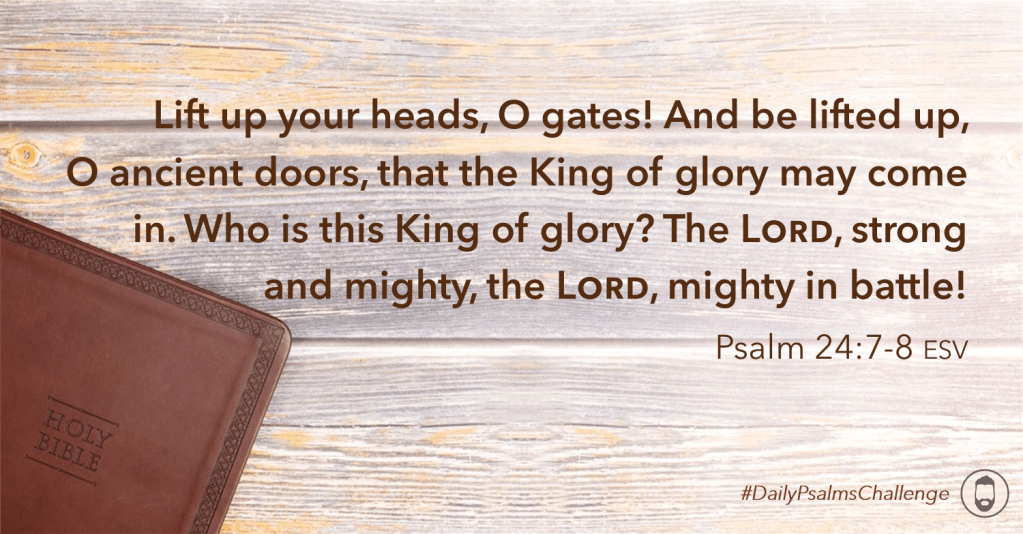
Lift up your heads, O gates! And be lifted up, O ancient doors, that the King of glory may come in. Who is this King of glory? The LORD, strong and mighty, the LORD, mighty in battle!

Psalm 24:7-8

Psalm 24 is a majestic declaration of God’s greatness, His rightful place as ruler over all creation, and the glory of His presence. Traditionally, this psalm is connected to the Ark of the Covenant arriving in Jerusalem in 2 Samuel 6. The Ark of the Covenant symbolized God’s presence among His people (especially the Mercy Seat on its top), but this psalm transcends the Ark and Israel because we know the answer to Psalm 24’s question of “Who is this King of Glory?” – His name is Jesus!

David begins Psalm 24 by asserting that the earth and everything in it belongs to the Lord because He founded and established it (vv. 1-2). He is the Creator and therefore the rightful owner of everything that is, including every person. This foundational truth reminds us that our lives are not our own; we belong to God who made us for His purposes.

In vv. 3-6, David asks an important question: “Who shall ascend the hill of the LORD? And who shall stand in His holy presence?” (v. 3). Then, David promptly answers by saying that only those with “clean hands” and a “pure heart” may enter into God’s holy presence (v. 4). These qualifications reveal two things: 1)God is immensely holy, pure, and perfect, and 2)humanity is immensely, well, not. It is impossible for sinful humanity to stand before God on our own merit. Clean hands refers to righteous actions and deeds, and a pure heart references cleanliness in our motives and minds. Religion cannot produce this; only a life fully devoted to God in truth and righteousness.

Psalm 24 then crescendos in vv. 7-10 with a triumphant call to open the gates for the King of Glory. The repetition of the question referenced above – “Who is this King of Glory?” – underscores His unmatched majesty. He is “the LORD, strong and mighty, the LORD, mighty in battle” (v. 8). This imagery celebrates God as the victorious Warrior-King who reigns supreme over all creation. Ultimately, this points to Jesus, the King of Glory.

Seeing Jesus in Psalm 24

As stated multiple times above, this psalm very clearly points to Jesus. He is the Creator through whom all things were made (John 1:1-3). He is the sinless Son of God who alone has clean hands and a pure heart. He not only can ascend the hill of the Lord but descended down to where we are, making Himself like us so that He can carry us up the hill – which is essential for us to understand because He is the only Way we will make it (John 1:14, 14:6)!

Potentially the most important connection in Psalm 24 is its ties to the Ark of the Covenant entering the city. The Ark was never meant to be more than a representation of God’s presence going before them and being among them. Jesus is the better Ark. After His victory over sin, Jesus entered the heavenly sanctuary – ascended the holy hill – as the victorious King (Hebrews 9:24). More than that, Jesus Himself IS the mercy seat!

The mercy seat was where the priest sprinkled the blood on Yom Kippur, the day of atonement. The word the author of Hebrews used in Hebrews 9:5 for mercy seat is the exact same word Paul used in Romans 3:25 for propitiation – atoning sacrifice. Jesus is the better Ark because He is not a shadow or symbol but the substance; His sacrifice was once for all (Hebrews 7:27, 10:10). He is the King of Glory! He is the atoning sacrifice for our sins! He is God! And He is good!

The gates of heaven open wide for Him, and He now reigns as the exalted Lord. Revelation 19:11-16 vividly portrays Jesus as the rider on the white horse, leading the armies of heaven in final victory. When He returns, the King of Glory will bring the fullness of His kingdom to earth, and every knee will bow before Him!

Reflection

Psalm 24 challenges us to examine our hearts and lives. Are our hands clean and our hearts pure before God? On our own, we fall short of His holy standard. But the gospel assures us that through Jesus, we can be washed clean and made new.

As you reflect on this psalm, consider these question. Are you living as though your life belongs to God? Are you seeking His presence daily with a heart devoted to Him?

Take time to marvel at Jesus’s majesty, the King of Glory who reigns in power and grace. Lift up your heart in worship, for He is worthy. Let the gates of your life be opened wide to welcome Him in.

The King of Glory has come, and He is coming again. Are you ready to meet Him?


Here’s a good song to help you meditate on Jesus, the “King of Glory”: