Meditation Monday, July 29,2024

The Bible teaches us that it is good to meditate on God’s Word so that, as the Lord told Joshua, we “may be careful to do everything written in it” (Joshua 1:8). To meditate on it means that we are doing more than reading or comprehending it because we are dwelling on it, allowing it to stay on our minds and hearts throughout the day. This is a practice the Bible attributes to those who “delight” or “love” God’s Word and want the words of their mouths and meditation of their hearts to be pleasing in the sight of God (Psalm 1:2, 19:14, 119:97).

Meditation Monday is an opportunity for us to take a short passage of Scripture — no more than a few verses, consider what it means, and store it in our minds so that we think on it throughout the day and it make its way into our hearts and lives.

Here is today’s passage:
Psalm 119 is all about God’s Word. It is 176 verses long and has 22 sections (one for each letter of the Hebrew alphabet). It is a very long poem of adoration and worship to God for giving His Word and providing His people with it. There are eight words the psalmist uses to talk about the Word of God: law, testimonies, ways, precepts, statutes, commandments, rules, and, of course, word. We are going to be spending a while on Mondays looking at some highlights from Psalm 119 to help train our minds and hearts to meditate on God’s Word.

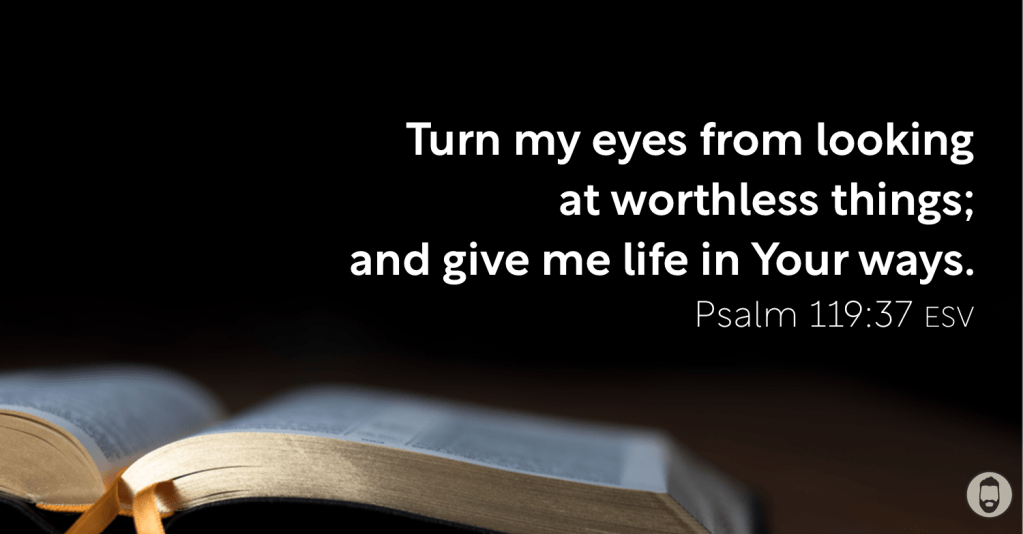
Today’s passage helps us understand how viewing life in light of eternal life can help keep us from focusing on “worthless things”.

If we are not careful, we can get caught up in all of the evil and darkness of this world and begin to feel like all that is light, good, or godly is being extinguished. Hopelessness takes root easily because we cannot see a way forward and it seems like the forces for good are few and weak in the face of overwhelming evil. But that is not the case. How can I say that with assurance? To use the words of the beloved children’s song: “The Bible tells me so”:

There are many Bible passages that I could give, but two from John’s gospel are very clear and comforting:

  • John 1:1-5 — “In the beginning was the Word, and the Word was with God, and the Word was God. He was in the beginning with God. All things were made through him, and without him was not any thing made that was made. In him was life, and the life was the light of men. The light shines in the darkness, and the darkness has not overcome it.”
  • ‭‭John‬ ‭16:29-33 — “His disciples said, ‘Ah, now you are speaking plainly and not using figurative speech! Now we know that you know all things and do not need anyone to question you; this is why we believe that you came from God.’ Jesus answered them, ‘Do you now believe? Behold, the hour is coming, indeed it has come, when you will be scattered, each to his own home, and will leave me alone. Yet I am not alone, for the Father is with me. I have said these things to you, that in me you may have peace. In the world you will have tribulation. But take heart; I have overcome the world.’”

In these verses we get needed perspective and an illustration of our need for God, through His Word and His Spirit within us, to turn our eyes from the “worthless things” of this world toward the “life” that comes from His “ways”. The darkness is not powerful enough to extinguish the light because Jesus is the Light of the world (John 8:12)! He is God and has already “overcome the world”!

If our eyes are fixed on our social media feeds and news outlets, we will be in constant fear, but if our eyes are fixed on Jesus, there is no need to fear. You might be tempted argue against this, but it is the Bible that defines what is worthless and what is worth focusing on. The things above where Jesus is are where our eyes and focus should be fixed (Colossians 3:1-3). The “worthless things” are here below.

So, meditate on God’s Word today and find life in His ways.

The Bible tells us so!
Meditation Monday, July 8, 2024

The Bible teaches us that it is good to meditate on God’s Word so that, as the Lord told Joshua, we “may be careful to do everything written in it” (Joshua 1:8). To meditate on it means that we are doing more than reading or comprehending it because we are dwelling on it, allowing it to stay on our minds and hearts throughout the day. This is a practice the Bible attributes to those who “delight” or “love” God’s Word and want the words of their mouths and meditation of their hearts to be pleasing in the sight of God (Psalm 1:2, 19:14, 119:97).

Meditation Monday is an opportunity for us to take a short passage of Scripture — no more than a few verses, consider what it means, and store it in our minds so that we think on it throughout the day and it make its way into our hearts and lives.

Here is today’s passage:

Psalm 119 is all about God’s Word. It is 176 verses long and has 22 sections (one for each letter of the Hebrew alphabet). It is a very long poem of adoration and worship to God for giving His Word and providing His people with it. There are eight words the psalmist uses to talk about the Word of God: law, testimonies, ways, precepts, statutes, commandments, rules, and, of course, word. We are going to be spending a while on Mondays looking at some highlights from Psalm 119 to help train our minds and hearts to meditate on God’s Word.

Today’s passage helps us understand the way studying God’s Word — meditating on it, storing it in our minds and hearts (memorizing it), and listening to or obeying it — helps us to follow Christ.

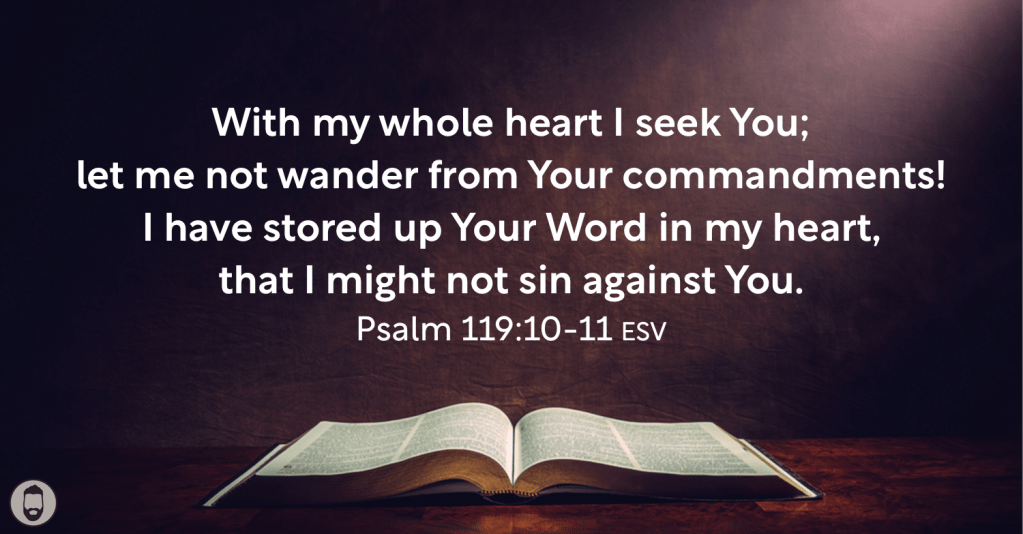
Psalm 119:10 gives us the picture of how we need God’s Word, specifically His commandments, to keep our “whole heart” seeking after the Lord. His ways are best. God knows what we need and how we should live. This is not a popular viewpoint today; well, it never has been a popular viewpoint. But v. 10 clearly shows us the value in trusting in God’s authority as Creator and Lord to tell us how we should live our lives, to command us with sovereign authority to live as He calls us and to recognize how His Word conveys His authority to us.

This carries over into Psalm 119:11 and the value of storing God’s Word in our hearts, namely preventing sin. The idea of storing up God’s Word is clearly speaking of memorizing Scripture, but it also extends to meditating or pondering on God’s Word. This sort of memorization or meditation is not for knowing information but for knowing the Lord. The idea of storing up God’s Word is clearly speaking of memorizing Scripture, but it also extends to meditating or pondering on God’s Word (Psalm 1:2). This sort of memorization or meditation is not for knowing information but for knowing the Lord (John 17:3). The idea is that God is able to keep us from sin — that knowing Him and desiring a deeper relationship with Him is better than any fleeting pleasure sin can offer (Hebrews 11:25).

Look at the way v. 10 and v. 11 fit together. Seeking after God with one’s whole heart means that you do not want to sin against Him. Read that again: sin against Him. Having God’s Word in our minds and hearts — stored up like bales of hay to sustain life and livelihood through the winter — keeps our focus on Him and not our desires (Psalm 37:31). To continue the analogy of storing hay ahead of winter, memorizing and meditating on God’s Word is like cultivating and tilling the ground, planting grass seeds, fertilizing, cutting, and baling, all with winter in mind. Storing up God’s Word in our hearts means cultivating our relationship with Him by having His Word teach us correct doctrine and holy living (2 Timothy 3:16), watering the implanted Word and having His Spirit grow us to bear fruit in keeping with repentance and walking with Him (Matthew 3:8, James 1:21-22, Galatians 5:22-23).

May we meditate on these verses today with eternity in mind rather than the futile fleeting pleasures of sin. May we store up His Word and seek Him with our whole hearts today.

Meditation Monday, July 1, 2024

The Bible teaches us that it is good to meditate on God’s Word so that, as the Lord told Joshua, we “may be careful to do everything written in it” (Joshua 1:8). To meditate on it means that we are doing more than reading or comprehending it because we are dwelling on it, allowing it to stay on our minds and hearts throughout the day. This is a practice the Bible attributes to those who “delight” or “love” God’s Word and want the words of their mouths and meditation of their hearts to be pleasing in the sight of God (Psalm 1:2, 19:14, 119:97).

Meditation Monday is an opportunity for us to take a short passage of Scripture — no more than a few verses, consider what it means, and store it in our minds so that we think on it throughout the day and it make its way into our hearts and lives.

Here is today’s passage:

Meditation Monday began as a means to both redeem a hashtag fairly common in some social media circles (#meditationMonday) and take the opportunity to help people meditate on God’s Word. This is not the hmmmm meditation of Eastern religion but a specific spiritual discipline laid out in Scripture where we put God’s Word in focus and dwell on it — and it in us.

When it comes to meditating on the Word, Psalm 119 is a great place to go. It is 176 verses long and has 22 sections (one for each letter of the Hebrew alphabet). It is a very long poem of adoration and worship to God for giving His Word and providing His people with it. There are eight words the psalmist uses to talk about the Word of God: law, testimonies, ways, precepts, statutes, commandments, rules, and, of course, word. We are going to be spending a while on Mondays looking at some highlights from Psalm 119 to help train our minds and hearts to meditate on God’s Word.

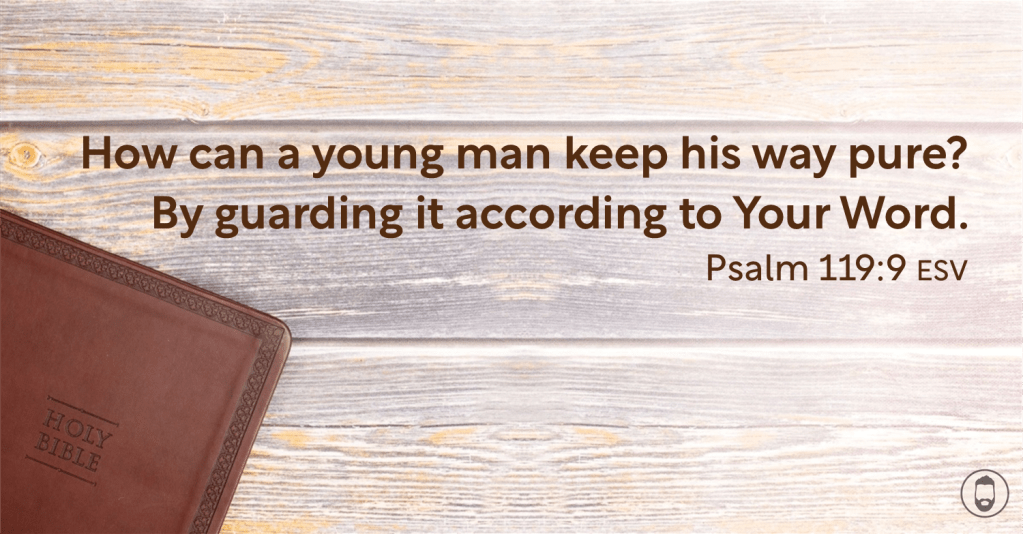
Today’s verse is simple, involving a question and an answer. I find that simple, bite-sized chunks help me keep the passage on my mind. It sticks in my memory better, which is part of why we meditate on the Word. The question is very practical, how can a young person (not limited to men via the context) keep their way pure — or what can they do to live holy lives? The Psalmists answer is simple and is something worth remembering: guarding it according to the Word.

Sometimes people see God’s commandments or guidelines as oppressing them or keeping them from doing what they want or feel, but this verse gives us a better perspective. Just as the mother of a toddler is going to vigilantly keep objects out of their child’s mouth and deal with tantrums and tears because the baby cannot get their way, God’s Word shows us how the Creator — the inventor of human beings — designed life to work best. To carry on with the toddler metaphor, it means that God’s Word protects us from choking hazards and burns and falls and breaks — it keeps us from sin. It is a guardian guidebook to help us follow Christ.


"Kept Through the Trial: Jesus's Letter to the Church at Philadelphia" (The KING is Coming) Refresh & Restore | A JustKeithHarris.com Podcast

📖 Revelation 3:7–13We’re back!After a few months off, The King is Coming returns in 2026 with one of the most encouraging letters in Revelation — Jesus’s message to the faithful church in Philadelphia. In a world filled with opposition and weakness, Jesus opens a door no one can shut.In this episode, Keith Harris and Jamie Harrison explore:✔️ Jesus’s identity as the Holy One, the True One — God Himself✔️ What the “key of David” means and how Jesus alone opens and shuts✔️ The debated phrase “I will keep you from the hour of trial” — and how to read it biblically✔️ Why “little power” doesn’t disqualify faithfulness✔️ How being kept through the trial glorifies Christ’s strength in us✔️ What it means to be a pillar in God’s presence foreverThis church had no rebuke — only encouragement. And Jesus’s call still stands today: “Hold fast what you have, so that no one may seize your crown.” (Revelation 3:11, ESV)🔗 Missed earlier episodes in the series? You can click here to catch up and listen from the beginning.✍️ If you’d like to see a written version of this podcast, complete with footnotes and cross-references, you can find it here.
  1. "Kept Through the Trial: Jesus's Letter to the Church at Philadelphia" (The KING is Coming)
  2. Christ Has Come: The Promised King & His Gift of Love" (Advent 2025)
  3. Christ Has Come: The Promised King & His Gift of Peace (Advent 2025)
  4. Christ Has Come: The Promised King & His Gift of PEACE (Advent 2025)
  5. Christ Has Come: The Promised King & His Gift of HOPE (Advent 2025)

Meditation Monday, June 24, 2024

The Bible teaches us that it is good to meditate on God’s Word so that, as the Lord told Joshua, we “may be careful to do everything written in it” (Joshua 1:8). To meditate on it means that we are doing more than reading or comprehending it because we are dwelling on it, allowing it to stay on our minds and hearts throughout the day. This is a practice the Bible attributes to those who “delight” or “love” God’s Word and want the words of their mouths and meditation of their hearts to be pleasing in the sight of God (Psalm 1:2, 19:14, 119:97).

Meditation Monday is an opportunity for us to take a short passage of Scripture — no more than a few verses, consider what it means, and store it in our minds so that we think on it throughout the day and it make its way into our hearts and lives.

Here is today’s passage:

It’s Meditation Monday and a good opportunity for us to consider what trusting in God looks like.

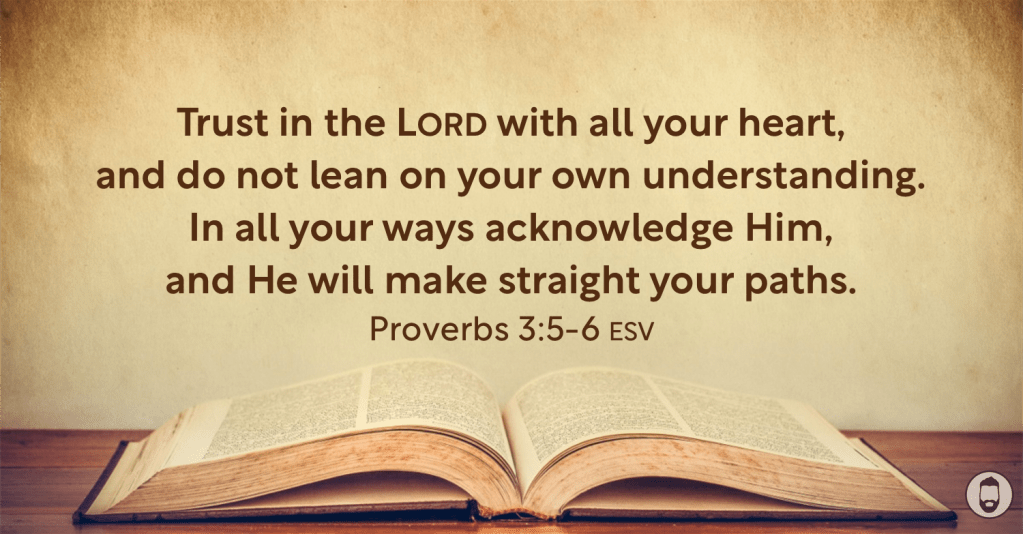
The Proverbs are about wisdom and give us good insight into what living out one’s faith is supposed to look like (and often what it is not supposed to look like). Proverbs 3:5-6 gives us some sound advice and counsel that will help us in following Christ.

Trusting the Lord with all one’s heart means that they cannot trust their own hearts for guidance. Our hearts are not trustworthy because they tell us what we want to hear, permit us to do what we want, and lead us toward what we want (even if we do not intellectually know we want it). Trusting in the Lord is first recognizing that He is Lord and as such directs our paths, but it is also trusting in Him to steer our lives because we know we are blind to certain things.

To think that we can “lean” on our own understanding shows foolishness because we too often blind to how our desires or biases affect our decision making. We need help. This is why we see here that we are to “acknowledge” the Lord in “all [our] ways”: we need to submit to Him and put our life in His hands. This is a scary prospect because we like to be in control, but this is what faith is all about, “the assurance of things hoped for, the conviction of things not seen” (Hebrews 11:1). Faith (or trust as we see in today’s passage) is trusting the God we cannot see to be able to steer us around or over or through whatever obstacles we are blind to. What looks like a detour to us is really Him making our paths straight and headed toward Him!


Feel free to check out our latest posts:


"Kept Through the Trial: Jesus's Letter to the Church at Philadelphia" (The KING is Coming) Refresh & Restore | A JustKeithHarris.com Podcast

📖 Revelation 3:7–13We’re back!After a few months off, The King is Coming returns in 2026 with one of the most encouraging letters in Revelation — Jesus’s message to the faithful church in Philadelphia. In a world filled with opposition and weakness, Jesus opens a door no one can shut.In this episode, Keith Harris and Jamie Harrison explore:✔️ Jesus’s identity as the Holy One, the True One — God Himself✔️ What the “key of David” means and how Jesus alone opens and shuts✔️ The debated phrase “I will keep you from the hour of trial” — and how to read it biblically✔️ Why “little power” doesn’t disqualify faithfulness✔️ How being kept through the trial glorifies Christ’s strength in us✔️ What it means to be a pillar in God’s presence foreverThis church had no rebuke — only encouragement. And Jesus’s call still stands today: “Hold fast what you have, so that no one may seize your crown.” (Revelation 3:11, ESV)🔗 Missed earlier episodes in the series? You can click here to catch up and listen from the beginning.✍️ If you’d like to see a written version of this podcast, complete with footnotes and cross-references, you can find it here.
  1. "Kept Through the Trial: Jesus's Letter to the Church at Philadelphia" (The KING is Coming)
  2. Christ Has Come: The Promised King & His Gift of Love" (Advent 2025)
  3. Christ Has Come: The Promised King & His Gift of Peace (Advent 2025)
  4. Christ Has Come: The Promised King & His Gift of PEACE (Advent 2025)
  5. Christ Has Come: The Promised King & His Gift of HOPE (Advent 2025)