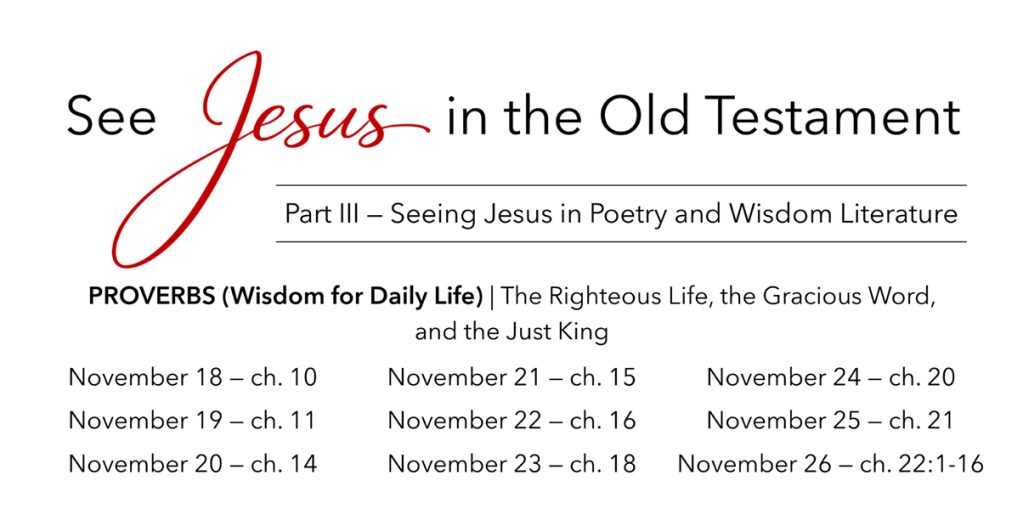
See JESUS in the Old Testament — Proverbs (Wisdom for Daily Life)

The Righteous Life, the Gracious Word, and
the Just King


See the Wisdom’s Invitation overview for an introduction to Proverbs and how to read it in light of Christ.


This section of Proverbs (10:1–22:16) moves from the extended invitations of the opening chapters into Solomon’s shorter sayings, showing what wisdom looks like in everyday life. The fear of the LORD remains the foundation as we consider honesty, diligence, generosity, humility, and our willingness to receive correction. These sayings often contrast the righteous with the wicked and the wise with the foolish, helping us recognize the character and consequences of each way of life. Proverbs 11 condemns dishonest dealings, while Proverbs 14 connects our treatment of the poor with our regard for their Maker. Proverbs 22 reminds us that rich and poor alike owe their lives to the LORD. Together, these readings teach us that walking wisely involves how we work, handle money, and treat our neighbors. We must also read them alongside the rest of Scripture: they describe God’s wise ordering of life without promising that righteousness will always bring immediate relief or prosperity. Our trust rests in Him as we learn to follow His ways.

Our words receive particular attention throughout these readings. Proverbs 10 exposes the harm of careless speech, Proverbs 15 commends the gentle answer that quiets anger, and Proverbs 18 warns that speaking before listening brings shame. Proverbs 16 describes gracious words as bringing sweetness and healing. These sayings call us to consider both what we say and the heart from which we say it. The scarlet thread leads us toward Jesus, whose words reveal His wisdom, grace, and truth. Those who heard Him marveled at the gracious words He spoke (Luke 4:22), and His teaching carried an authority unlike that of their scribes (Matthew 7:28–29). He also taught that our mouths speak from the abundance of our hearts (Luke 6:45). We need more than greater care in choosing our words; we need Him to change the hearts behind them. As His people, we are called to speak truthfully and use our words to build others up and give grace to those who hear (Ephesians 4:25, 29).

These chapters also bring wisdom into the exercise of authority. Proverbs 16 describes righteousness as essential to a king’s throne, while Proverbs 20 pictures a wise king discerning and confronting evil. Yet even a king remains under God’s rule: Proverbs 21 reminds us that the LORD directs the king’s heart and that victory belongs to Him. These descriptions help us recognize both what righteous leadership should be and how far earthly rulers fall short. They prepare us to see Jesus, the greater Son of David, who rules with perfect justice and whose throne endures forever (Hebrews 1:8–9). He is also the righteous Savior who makes sinners right with God and teaches them to live as His people (1 Corinthians 1:30; Titus 2:11–14). As we read, ask the Spirit to help us receive His correction, practice honesty and mercy, and speak words that reflect His grace. The wisdom of Proverbs reaches into the ordinary moments of our days, calling us to live under the authority of Jesus — the righteous Savior, gracious Teacher, and just King.


Let’s dive in together and see JESUS in these readings from Proverbs!

  • November 18 — Proverbs 10
    Solomon contrasts righteousness and wickedness in work, wealth, speech, and relationships, showing wisdom gives life but sin leads to death.
  • November 19 — Proverbs 11
    The LORD delights in honesty, humility, trustworthy speech, and generosity, showing that righteousness blesses a community while sin leads to ruin.
  • November 20 — Proverbs 14
    Those who fear the LORD consider their ways, avoid evil, care for the poor, and find secure refuge in God, while folly destroys homes and nations.
  • November 21 — Proverbs 15
    The LORD sees every heart, delights in the prayer of the upright, and teaches that gentle words, correction, and humility belong to wisdom’s path.
  • November 22 — Proverbs 16
    The LORD weighs motives, establishes plans, and rules all outcomes; His wisdom produces righteousness and the life-giving justice of a king.
  • November 23 — Proverbs 18
    Words carry life or death, but the righteous find true security in the LORD, listening before answering, resisting gossip/pride, and valuing friendship.
  • November 24 — Proverbs 20
    No one can claim a pure heart, so wisdom receives correction, waits for the LORD’s justice, and looks to the faithful King for redemption.
  • November 25 — Proverbs 21
    The LORD directs kings and weighs hearts, desiring righteousness over empty worship; no human wisdom can prevail against His purpose.
  • November 26 — Proverbs 22:1-16
    Because the LORD made rich and poor alike, wisdom prizes character over wealth, trains children in life’s right path, and gives generously.


Continue in the See JESUS in the Old Testament readings with Book III of the Psalms!
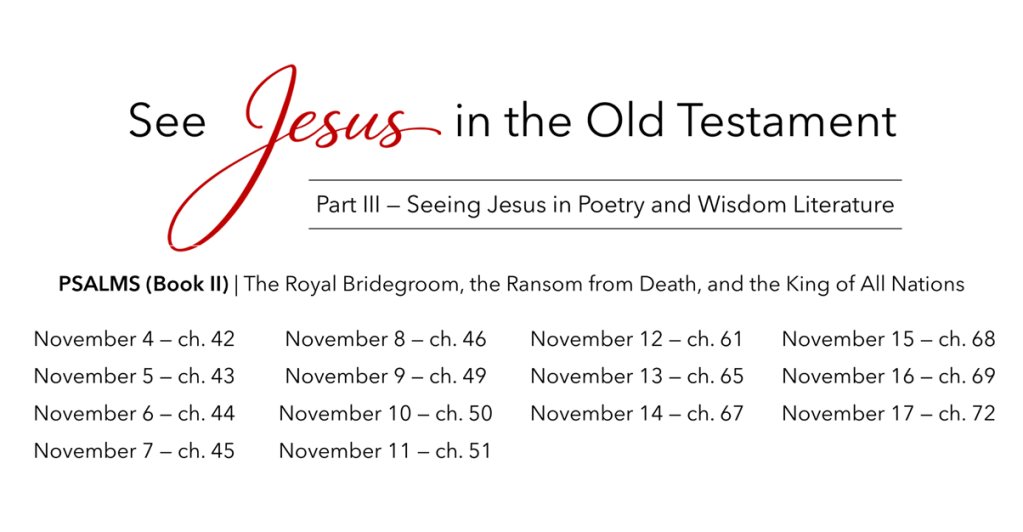


See JESUS in the Old Testament — Book II of the Psalms

The Royal Bridegroom, the Ransom from Death, and
the King of All Nations


See the Book I overview for an introduction to the Psalms and how to read them in light of Christ.


Book II of the Psalms (Psalms 42–72) continues the prayers of God’s people as they bring their troubles before Him and wait for His help. Alongside David’s prayers, we hear from the sons of Korah and Asaph, with the final psalm attributed to Solomon. These voices draw us into both personal struggles and the suffering of God’s people together. Psalms 42–43 express a deep longing for God’s presence, while Psalm 44 asks why His people suffer even as they seek to remain faithful. Other readings remind us that God is our refuge, that He deserves sincere worship, and that sinners need the cleansing only He can provide. Through sorrow, repentance, and thanksgiving, these psalms teach us to place our hope in Him. They also keep before us the connection between God’s people and His appointed king — a connection that leads us toward Jesus, whose victory secures the salvation of His people.

The scarlet thread comes into particular focus in Psalms 45 and 49. Psalm 45 celebrates a royal wedding, describing the king’s greatness, righteous rule, and enduring throne. Its praise reaches beyond what any earthly descendant of David could fully fulfill. Hebrews 1:8–9 applies its words to Jesus, the Son whose throne lasts forever. This royal wedding also helps prepare us to understand Him as the Bridegroom who loves His church and gave Himself for her (Ephesians 5:25–27). Psalm 49 turns our attention to a need no earthly king or fortune can meet: no human being can pay enough to escape death. Yet the psalmist trusts that God will redeem him and receive him. That hope finds its fulfillment in Jesus, who gave His life as a ransom for many (Mark 10:45). What we could never purchase, He provides through His death and resurrection.

Book II also widens our view to the nations. Psalm 67 asks God to bless His people so that His saving power will be known throughout the earth. Psalm 69 anticipates the rejection and suffering Jesus endured (John 2:17; 15:25), reminding us of the cost of that salvation. Finally, Psalm 72 prays for a king who rules with justice, rescues the needy, and brings blessing to all nations — carrying forward God’s promise to Abraham (Genesis 22:18). Its vision reaches beyond Solomon to Jesus, the greater Son of David, whose reign will never end. As we read, ask the Spirit to help us trust Him in our troubles, seek His mercy for our sins, and rejoice that His salvation reaches people from every nation. He is the Royal Bridegroom, the Ransom from Death, and the King of All Nations.


Let’s dive in together and see JESUS in Book II of the Psalms!

  • November 4 — Psalm 42
    Overwhelmed by sorrow, the psalmist thirsts for God, remembers His steadfast love, and repeatedly calls his downcast soul to hope in Him.
  • November 5 — Psalm 43
    The psalmist asks God to vindicate him and sent His light and truth to lead him home, where he will worship God, his exceeding joy.
  • November 6 — Psalm 44
    Remembering God’s past victories, His people lament present defeat and plead for help, yet in Christ no suffering can separate from God’s love.
  • November 7 — Psalm 45
    A royal wedding celebrates the anointed king and his bride, looking beyond David’s sons to Jesus, the eternal Bridegroom who endures forever.
  • November 8 — Psalm 46
    Though creation trembles and nations rage, God remains His people’s refuge and fortress, dwelling among them and exalted throughout the earth.
  • November 9 — Psalm 49
    No wealth can ransom life from death, but God redeems His people to Himself, pointing to Jesus, who gave His life as our sufficient ransom.
  • November 10 — Psalm 50
    God summons His people to judgment, rejecting empty sacrifice and calling them to worship, obedience, and dependence upon Him in trouble.
  • November 11 — Psalm 51
    Confronted with his sin, David casts himself on God’s mercy, seeking forgiveness and cleansing and a new heart only God can create.
  • November 12 — Psalm 61
    From the ends of the earth, David asks God to lead him to the higher Rock and preserve the King’s throne forever, fulfilled in the reign of King Jesus.
  • November 13 — Psalm 65
    God hears prayer, atones for sin, and blesses the earth with abundance, drawing all peoples to praise Him as the hope of the whole world.
  • November 14 — Psalm 67
    God’s people ask Him to shine His blessing among them so His saving ways will be known and praised with joy by every nation.
  • November 15 — Psalm 68
    David celebrates God’s triumphant march from Sinai to Zion and calls every kingdom to praise Him, anticipating the risen Christ’s ascension.
  • November 16 — Psalm 69
    David’s unjust suffering, zeal for God’s house, and bitter drink point to Jesus, who endured rejection and the cross before gathering His own.
  • November 17 — Psalm 72
    Solomon prays for a righteous King who defends the needy, rules to the ends of the earth, and brings blessing to every nation — King Jesus.


Continue in the See JESUS in the Old Testament readings with Proverbs (Wisdom for Daily Life)!


1 Proverbs poetically personifies wisdom as a woman calling people to fear the Lord and live according to God’s order. Proverbs 8 does not teach that God’s wisdom — or Jesus — is a created being, nor should every detail be treated as a direct description of Christ. The New Testament nevertheless reveals Jesus as “the wisdom of God” and the eternal One through whom all things were made (John 1:1–3, 1 Corinthians 1:24, Colossians 1:15–17).


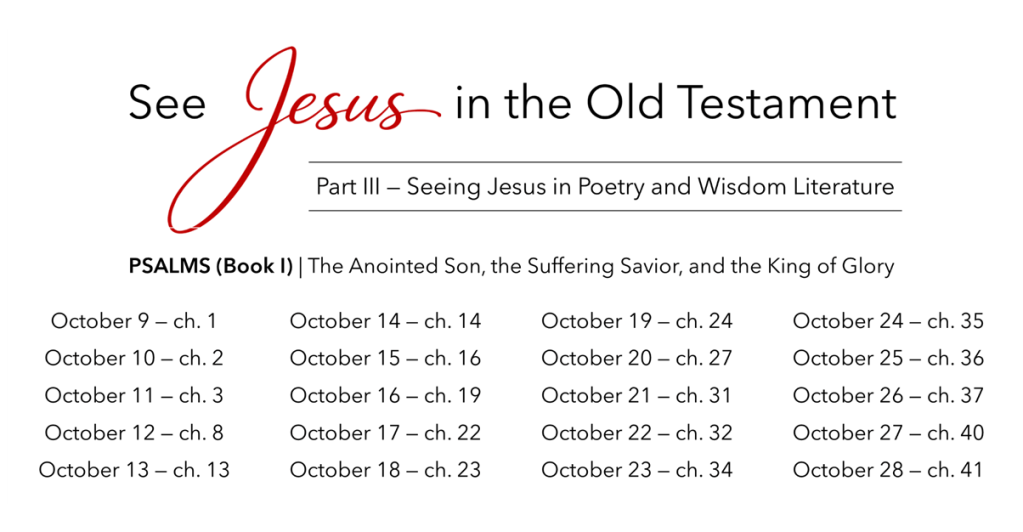
See JESUS in the Old Testament — Book I of the Psalms

The Anointed Son, the Suffering Savior, and
the King of Glory


The book of Psalms gives us words to bring before God in every season of life. There are songs of joy and thanksgiving, laments and cries for help, confessions of sin, and prayers offered when God seems far away. Written by David and other authors across generations of Israel’s history, these 150 Spirit-breathed and inspired songs teach God’s people to pray and worship together. They also carry the Story forward that we have been following: the God who creates, makes promises, delivers His people, and remains faithful even when they are not. In the Psalms, we hear God’s people responding to who He is and what He has done. Their words to God are also His Word to us, teaching us to know Him, trust Him, and bring our hearts before Him in worship.

Because the Psalms are poetry, we need to pay attention to how they communicate. Their writers use figurative language, pictures, comparisons, and lines that repeat or develop a thought to help us understand and feel what they are saying. When David calls God his rock or his shepherd, that imagery helps us see something of God’s strength and care. When a psalmist asks how long suffering will continue, we hear the prayer of someone learning to trust God in the middle of it. The Psalms give us room to grieve, confess, rejoice, and wait. They also shape those responses through the truth of who God is. Even their prayers for judgment teach us to entrust justice to Him rather than take revenge ourselves.

The Psalter — another name for the book of Psalms — is divided into five books: Book I (Psalms 1-41), Book II (42-72), Book III (73-89), Book IV (90-106), and Book V (107-150). We will read selections from each, beginning with Book I.


Book I Overview

Psalms 1 and 2 introduce the whole collection by placing before us the way of the righteous and the reign of God’s anointed King. Together, they call us to delight in God’s Word and take refuge in His Son. Most of the remaining psalms in Book I are attributed to David. Through his prayers and songs, we hear the struggles of God’s appointed king and the faith of a man who needs God’s help. Enemies threaten him, sorrows weigh on him, and his own sin requires forgiveness. Again and again, he turns to the LORD as his refuge.

Here the scarlet thread leads us to JESUS, the greater Son of David. JESUS Himself taught that the Psalms spoke of Him and must be fulfilled (Luke 24:44). He is the truly righteous One whose obedience never failed and the Anointed Son whose Kingdom cannot be overthrown. Our selected readings bring these connections into view: Psalm 2 anticipates His kingship, Psalm 16 points to His resurrection (Acts 2:25-32), and Psalm 22 gives words to the suffering He endured on the cross (Matthew 27:46). Psalm 23’s picture of the LORD caring for His sheep helps us understand JESUS as the Good Shepherd (John 10:11). Psalm 24 celebrates the King of Glory, directing our worship toward the LORD whose greatness no earthly king can match.

As we read Book I, we will encounter both our need and God’s faithfulness: the foolishness of sin, the blessing of forgiveness, the pain of waiting, and the security of belonging to Him. These psalms invite us to trust the Savior who suffered for His people and rose victorious. Ask the Spirit to help you see JESUS in these songs and prayers — and, through His Word, to grow in the knowledge of Him.

The One we are seeking is the Anointed Son, the Suffering Savior, and the King of Glory.


Let’s dive in together and see JESUS in Book I of the Psalms!

  • October 9 — Psalm 1
    JESUS perfectly embodies the blessed man who delights in God’s Word and flourishes like a watered tree, wholly unlike the wicked.
  • October 10 — Psalm 2
    The nations rebel in vain against the LORD and His Anointed Son, JESUS, whose Kingdom reaches the ends of the earth and offers refuge.
  • October 11 — Psalm 3
    Surrounded by enemies, David trusts the LORD as his shield and deliverer, confident that salvation belongs to God and asking His blessing.
  • October 12 — Psalm 8
    David praises the majesty of God, who crowns humanity with honor and dominion — fulfilled perfectly in the Son of Man who rules over all.
  • October 13 — Psalm 13
    David moves from cries of “How long?” to confident praise, trusting God’s steadfast love and faithfulness while deliverance still seems distant.
  • October 14 — Psalm 14
    David laments humanity’s corruption and the oppression of God’s people yet hopes for salvation, fulfilled in JESUS, who restores His people.
  • October 15 — Psalm 16
    David delights in the LORD as his portion and refuge, looking beyond death to the resurrection of JESUS and everlasting joy in God’s presence.
  • October 16 — Psalm 19
    Creation declares God’s glory, His perfect Word revives and guides, and David asks the LORD, his Rock and Redeemer, to cleanse and guard from sin.
  • October 17 — Psalm 22
    David’s cry of suffering points to Jesus’s crucifixion, while his answered prayer anticipates the risen King’s praise among all people.
  • October 18 — Psalm 23
    David trusts the LORD as his Shepherd, pointing to JESUS, the Good Shepherd whose presence leads His people safely home forever.
  • October 19 — Psalm 24
    The earth belongs to the LORD, and only one with cleans hands may ascend His holy hill — fulfilled by JESUS, the victorious King of Glory.
  • October 20 — Psalm 27
    David seeks the LORD as his light and salvation, desiring His presence above all and waiting to see His goodness despite surrounding enemies.
  • October 21 — Psalm 31
    In deep distress, David entrusts his life and times to the LORD — words JESUS fulfills as He commits His spirit to the Father on the cross.
  • October 22 — Psalm 32
    David celebrates the blessing of forgiven sin, showing that honest confession brings release from guilt and pointing to justification by faith in Christ.
  • October 23 — Psalm 34
    David invites the afflicted to taste the LORD’s goodness and seek refuge in Him, while the righteous sufferer’s unbroken bones point forward to JESUS.
  • October 24 — Psalm 351
    Falsely accused and hated without cause, David asks the LORD to vindicate Him, foreshadowing JESUS, the righteous Sufferer opposed to the world.
  • October 25 — Psalm 36
    David contrasts the godless way of the wicked with the LORD’s immeasurable steadfast love, under whose wings His people find refuge and life.
  • October 26 — Psalm 37
    David calls the righteous to trust, delight in, and wait for the LORD rather than envy evildoers; JESUS promises the meek will inherit the earth.
  • October 27 — Psalm 40
    David praises God for lifting him from the pit, while his obedience points to JESUS, who came to do God’s will as the perfect sacrifice.
  • October 28 — Psalm 41
    Sick, sinful, and betrayed by a close friend, David seeks God’s mercy and restoration, foreshadowing the betrayal Jesus would endure.


Continue in the See JESUS in the Old Testament readings with Part 1 of Proverbs (Wisdom’s Invitation)!


1 Imprecatory psalms ask God to judge evil and defend His people. They do not authorize personal vengeance but place justice in God’s hands (Deuteronomy 32:35, Romans 12:19). Christians may pray for evil to end, for enemies to repent, and for Christ’s righteous Kingdom to come, remembering that we escape judgment only through His mercy.