
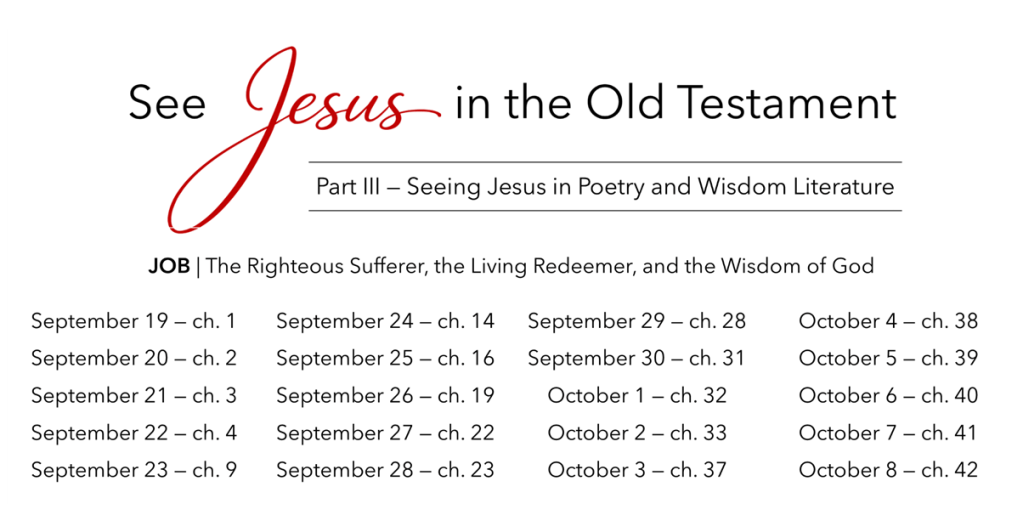
The Righteous Sufferer, the Living Redeemer, and
the Wisdom of God
The book of Job wrestles with one of the hardest questions of life: how should we understand suffering when we cannot see what God is doing?
Job is introduced as a righteous and faithful man, yet he suffers devastating loss without knowing the heavenly events behind it. His friends insist that suffering must be the direct result of personal sin, but the book shows how inadequate that explanation can be. Job’s anguish is real, his questions are honest, and his suffering is not neatly explained. Instead, we are taught that our view is limited while God’s wisdom is perfect, calling us to trust Him even when we cannot understand His purposes.
Job’s longing also points forward to Jesus. In his suffering, Job cries out for someone who could stand between himself and God (Job 9:33), speaks of a witness in heaven (Job 16:19), and finally declares, “I know that my Redeemer lives” (Job 19:25). Job didn’t yet possess the full revelation of Christ, but his hope for an advocate, vindicator, and living Redeemer finds its fulfillment in Him nonetheless. Jesus is truly the righteous sufferer, the One who suffered not for His own sin but for ours, and His resurrection gives firm foundation to Job’s hope that death would not have the final word. In Jesus, we see that God’s wisdom and saving purposes reach far beyond what human eyes can see.
While not every chapter of Job is included, these readings have been carefully chosen to highlight the Righteous Sufferer, the Living Redeemer, and the Wisdom of God. You’ll see Job’s faith tested (chs. 1-2), his grief and debates with his friends (chs. 3-4, 9, 14, 16, 22-23), his confession of a living Redeemer (ch. 19), his search for true wisdom (ch. 28), and his final defense (ch. 31). Elihu’s speeches then begin to redirect attention toward God’s greatness (chs. 32-33, 37) before the LORD Himself answers from the whirlwind (chs. 38-41). Job receives no simple explanation for all that happened; instead, he encounters the wisdom, power, and sovereignty of God and responds in humility and trust (ch. 42). The book leaves us not with every question answered — nor does it set out to do that, but we end with a clearer view of the God who is worthy of faith even in suffering and with hope in the Redeemer who lives.
Let’s dive in together and see JESUS in Job!
- September 19 — Job 1
God permits Satan to test Job, who loses his children, servants, and possessi9ons yet worships the LORD, trusting Him amid overwhelming grief. - September 20 — Job 2
Job holds fast his integrity through bodily affliction, receiving both good and adversity from GOD as his friends come to mourn with him. - September 21 — Job 3
Job gives voice to the darkness of deep suffering, lamenting the day of his birth and longing for the rest he cannot find in life. - September 22 — Job 4
Eliphaz assumes Job’s suffering must prove hidden sin, a mistaken judgment that earthly circumstance always reveals a person’s spiritual standing. - September 23 — Job 9
Unable to contend with the Almighty, Job longs for an arbitrator to plead his case, anticipating Jesus, the one Mediator between GOD and man. - September 24 — Job 14
Job laments the brevity of human life and longs for renewal beyond death, anticipating the resurrection secured by Jesus for all who belong to Him. - September 25 — Job 16
Abandoned and falsely accused, Job looks beyond his miserable comforters to a witness in heaven, anticipating Jesus who intercedes for sufferers. - September 26 — Job 19
Rejected by those closest to him, Job declares that his living Redeemer will vindicate him and that even after death he will see GOD. - September 27 — Job 22
Eliphaz falsely accuses Job of wickedness and urges him to repent, unaware that he himself will need Job’s intercession and GOD’s mercy. - September 28 — Job 23
Unable to find GOD or understand His purposes, Job trusts that He knows his way and will bring him through suffering like refined gold. - September 29 — Job 28
Though people uncover earth’s treasures, true wisdom belongs to GOD, is found ultimately in Jesus, and teaches us to fear Him and turn from evil. - September 30 — Job 31
Job concludes his defense by recounting a life of integrity before GOD and asks Him to hear the charges against him and answer. - October 1 — Job 31
After Job’s friends fall silent, young Elihu speaks in anger, insisting that understanding comes from the Almighty rather than age. - October 2 — Job 33
Though he misrepresents Job, Elihu says GOD may use suffering to warn sinners and describes a mediator, anticipating Jesus’s saving work. - October 3 — Job 37
Elihu points to the storm as a display of GOD’s awesome majesty, calling Job to consider His perfect knowledge, power, justice, and care. - October 4 — Job 38
The LORD answers Job from the whirlwind and questions him about creation, revealing that His sovereign rule is beyond human understanding. - October 5 — Job 39
GOD displays His wisdom and power through the wild creatures He governs and sustains, showing Job that all creation remains under His care. - October 6 — Job 40
Job humbly pledges silence, but the LORD continues, challenging his understanding of justice and displaying His power through Behemoth. - October 7 — Job 41
GOD describes the untamable Leviathan, showing that no creature stands beyond His rule and pointing toward Jesus’s final victory over Satan. - October 8 — Job 42
Job repents before GOD, is vindicated before his friends, intercedes for them, and receives restoration, pointing to the mercy of Jesus.
Continue in the See JESUS in the Old Testament readings with Book I of the Psalms!

