
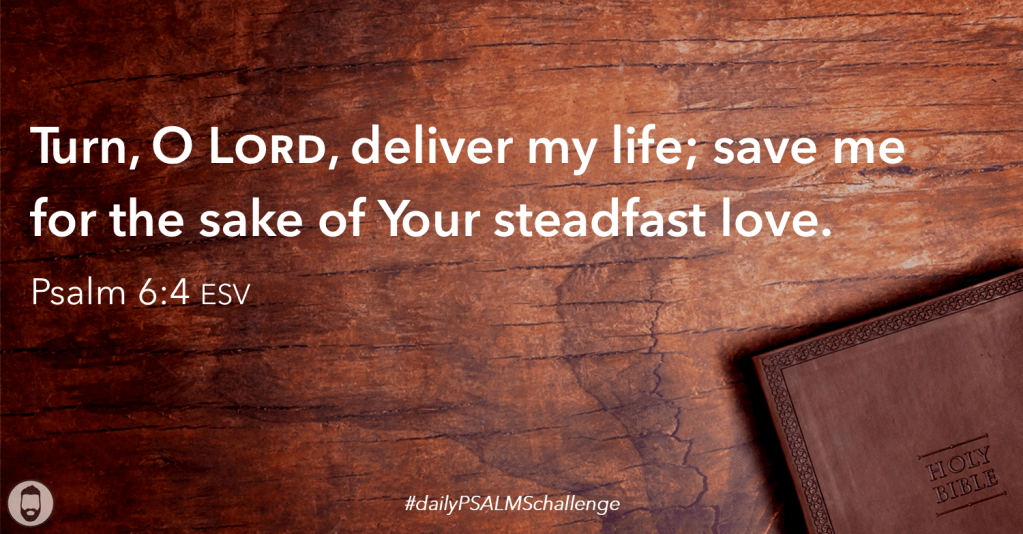
Turn, O LORD, deliver my life; save me for the sake of Your steadfast love.
Psalm 6:4
Psalm 6 is a cry of deep lament (which we defined in Psalm 3 as letting out one’s feelings of grief or sadness) as David is overwhelmed by distress and the apparent silence of God. This is the first of the penitential psalms (meaning Psalms of confession and repentance — including Psalms 32, 38, 51, 130, and 143). Here, rather than confessing specific sins, David cries out to God about his experiences with God’s discipline and his enemies’ torment.
David starts off with an urgent plea: “O Lord, rebuke me not in Your anger, nor discipline me in Your wrath” (v. 1). He feels the weight of God’s discipline but asks for God’s mercy instead of wrath. If God’s grace is giving His undeserved favor, His mercy is withholding punishment or wrath that we DO deserve. David’s plea for mercy is because his distress is affecting him physically and longs to know from the Lord how long the discipline will last (vv. 2-3).
The turning point in Psalm 6 comes when David appeals to God’s steadfast love (Hebrew: chesed) and sees that love as the basis for his hope. He has experienced God’s steadfast love in the past and trusts that God will not be angry with him forever and will move to rescue and save him (v. 4). David understands that God is just and does not dispute whether the discipline is warranted; knowing God loves him, though, he pleads for mercy.
What began as lament turns to worship with David pouring out his soul before the Lord. While he initially remarked that he felt God was being silent toward him, He had faith that God had heard his prayer (v. 9). This assurance fuels his boldness to call out his enemies, knowing that God is not done with him and will vindicate him.
Seeing Jesus in Psalm 6
This psalm points forward to Jesus, the Man of sorrows (Isaiah 53:3). Like David, Jesus experienced deep anguish as He prayed in the garden of Gethsemane (Luke 22:44). On the cross, He bore the full weight of God’s wrath and punishment for our sin — not His, but ours — so that we might be delivered and experience His steadfast love.
Jesus also fulfills David’s confidence that God hears the cries of the afflicted. In Him, have assurance that our prayers are heard and that our salvation is sure. More than that, Jesus’s resurrection turns our weeping to joy, proving that not even death can separate us from God’s love.
Reflection
Psalm 6 invites us to bring our deepest sorrows and fears to God, trusting in His steadfast love even when we are being disciplined (and our troubles stem from our own sin). When God seems silent, David’s faith and words in Psalm 6 can help us see that God’s mercy is greater than His discipline and that His salvation is certain for those who trust in Him.
The #dailyPSALMSchallenge gives us the opportunity to start 2025 in God’s Word by digging into a psalm a day. Each day will identify a key passage for us to meditate on as well as seeking to help us see Jesus in the psalm and reflect on what we have read.
Won’t you take the challenge?

 Just Keith Harris