
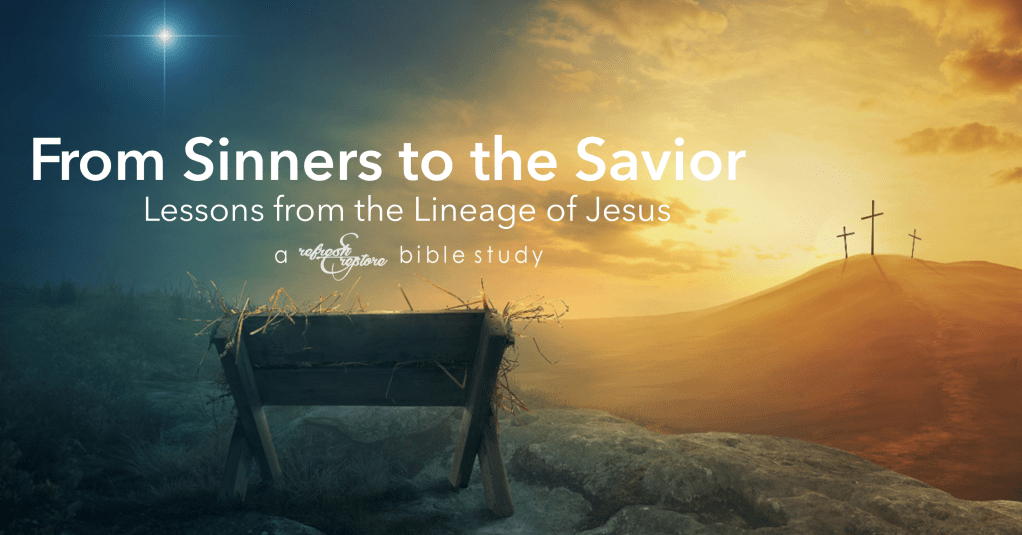
Matthew 1:1-17 —
1 The book of the genealogy of Jesus Christ, the son of David, the son of Abraham.
2 Abraham was the father of Isaac, and Isaac the father of Jacob, and Jacob the father of Judah and his brothers, 3 and Judah the father of Perez and Zerah by Tamar, and Perez the father of Hezron, and Hezron the father of Ram, 4 and Ram the father of Amminadab, and Amminadab the father of Nahshon, and Nahshon the father of Salmon, 5 and Salmon the father of Boaz by Rahab, and Boaz the father of Obed by Ruth, and Obed the father of Jesse, 6 and Jesse the father of David the king.
And David was the father of Solomon by the wife of Uriah, 7 and Solomon the father of Rehoboam, and Rehoboam the father of Abijah, and Abijah the father of Asaph, 8 and Asaph the father of Jehoshaphat, and Jehoshaphat the father of Joram, and Joram the father of Uzziah, 9 and Uzziah the father of Jotham, and Jotham the father of Ahaz, and Ahaz the father of Hezekiah, 10 and Hezekiah the father of Manasseh, and Manasseh the father of Amos, and Amos the father of Josiah, 11 and Josiah the father of Jeconiah and his brothers, at the time of the deportation to Babylon.
12 And after the deportation to Babylon: Jechoniah was the father of Shealtiel, and Shealtiel the father of Zerubbabel, 13 and Zerubbabel the father of Abiud, and Abiud the father of Eliakim, and Eliakim the father of Azor, 14 and Azor the father of Zadok, and Zadok the father of Achim, and Achim the father of Eliud, 15 and Eliud the father of Eleazar, and Eleazar the father of Matthan, and Matthan the father of Jacob, 16 and Jacob the father of Joseph the husband of Mary, of whom Jesus was born, who is called Christ.[1]

"Kept Through the Trial: Jesus's Letter to the Church at Philadelphia" (The KING is Coming) – Refresh & Restore | A JustKeithHarris.com Podcast
Merry Christmas, Sojourners!
One thing that I love about Christmas is that people are abnormally willing to be open to talk about Jesus. Much of the year, people’s attitudes toward Scripture or gospel can be very Scrooge-like, very “Bah! Humbug!” But for a few weeks in one month out of the year, people’s hearts swell like the Grinch’s after encountering Cindy-Lou-Who.
Another thing I love about Christmas is the way this season produces stories. As I type, The Polar Express is on in the background, a narrative of a young boy regaining the childlike sense of wonder and hope. I will no doubt watch It’s a Wonderful Life on Christmas day, a fairly new tradition at the Harris household, and follow good old George Bailey finding that his life has more blessings than curses and realizing the value and impact a single life can have. I’ll even watch one of my favorite Christmas stories chronicling John McClain’s daring rescue during the hijacking of Nakatomi Corporation’s Christmas party. More than those fictional stories, though, I love the stories that come from real life, from real people.
Christmas is a time of joy and celebration, but for many, it is a time of mourning, grieving, and faking-it-till-you-make-it. As I have talked with folks about this in recent years, I find that the thing that bridges the gap between those two groups – the joyful and the weary – is their stories. Even those who are mourning have stories and memories of bygone traditions. There are funny and happy memories, and yes, sad ones, too, that come out during this season. Those memories can kind of weave together into the tapestry of who we are. They become part of our story.
Jesus’s story is not different in that aspect because part of becoming flesh and dwelling among us (John 1:14) is the sin and death we need rescuing from. His Story is of the perfect and sinless Savior deigning to live among – to live for and on behalf of – those He came to save. In order for Isaiah’s prophecy that “those who dwelt in a land of deep darkness, on them has light shone” (Isaiah 9:2), Jesus needed to come and shine in the darkness, and we need to be reminded that the “darkness has not overcome” Him (John 1:4)!
So today, let’s take a moment and look at Jesus’s Story, specifically the Story of the lineage God chose to make Jesus a part of. Sometimes we look at stories in the Bible and feel inadequate. Rest assured that Jesus’s lineage as seen in Matthew 1:1-17 is full of people just like us – people who needed a Savior like Him!

Once upon a time, there was a great and powerful King. He was foretold of old to be a hero who would come from His far away country to redeem and win back His lost love. His Story is one of romance as He left His palace to rescue His Bride. His lineage hailed back to other…great…well, um….
One of the things I love about God’s Word is how it does not fall into the temptation of prettying things up or rewriting them to be more acceptable to folks’ sensibilities. Yes, Jesus is the great King – the King of kings who was prophesied for centuries to come from heaven and rescue His people. Yes, Jesus’s Story is one of romance, where He left His throne on high and traded it for a lowly manger in a tumble-down stable. But His lineage? It wasn’t filled with kings and queens, although there were a few sprinkled in toward the middle. It wasn’t filled with flawless heroes – the flaws are many. No, Jesus’s family tree was filled with regular sinners with real sin and problems – people like me and you.
This Bible study will look at the women emphasized in Jesus’s family tree who point us to Him in specific ways. We won’t go into their full stories, but I will give you the cross-references so you can check them out directly from Scripture.
Tamar (v. 3)
…and Judah the father of Perez and Zerah by Tamar….
The first woman mentioned is Tamar (v. 3), and her story is found in Genesis 38. Tamar was Judah’s – you know, Judah as in the lion of the tribe of – she was his daughter-in-law. Originally, she was married to Judah’s oldest son, Er, until “the Lord put him to death” because he was “wicked in the sight of the Lord” (Genesis 38:7). By levirate marriage customs, it became the responsibility of Judah’s second son, Onan, to father children on behalf of his deceased big brother. But Onan was selfish and wicked, refusing to fulfill his duty; the Lord put him to death as well (Genesis 38:10). Judah promised his youngest son, Shelah, to Tamar when he came of age but had no intention of ever fulfilling that promise. Tamar, left without hope of bearing children, took matters into her own hands. Disguised as a prostitute, she tricked Judah into sleeping with her. Her actions were scandalous – and so were Judah’s.
So, why is Tamar mentioned in Jesus’s genealogy? Her story shows us God’s providence and mercy in bringing about His purposes despite human sin. Tamar’s inclusion reminds us that God can use even the most broken situations to fulfill His promises. Judah’s declaration, “She is more righteous than I” (Genesis 38:26), points to her determination to preserve the family line, a role God used in the lineage of Jesus. Her child that would be Jesus’s earthly ancestor was marked by a scarlet string around his foot. It brings to mind the way that God used her story and the stories of people like her almost like a scarlet thread of salvation running through His Story.
Rahab (v. 5)
…and Salmon the father of Boaz by Rahab….
The second woman is Rahab (v. 5), whose story is found in Joshua 2:1-21, 6:17, and 6:22-25, with further mentions in Hebrews 11:31 and James 2:25. Rahab wasn’t one of God’s chosen people. She was a Canaanite from Jericho, known for her sinful profession. But she had heard of the God of Israel and believed in His power. She protected His spies, siding with the Lord and marking her house with a scarlet cord as a sign of her faith and obedience. When Jericho’s mighty walls fell by the power of God and the city was taken, Rahab and her family were spared.
Why would someone like Rahab be included in Jesus’s official lineage? Her faith in God is the answer. Rahab’s faith stood out like a scarlet cord, demonstrating that salvation is not about where you come from but about the one you put your faith in – in the God you trust. Her inclusion reminds us of God’s grace and His power to redeem and use anyone for His glory. Rahab’s life became part of the story of salvation history, pointing us to the greater salvation found in Jesus, who rescues all who place their faith in Him.
Ruth (vv. 5-6)
…and Salmon the father of Boaz by Rahab,
and Boaz the father of Obed by Ruth,
and Obed the father of Jesse,
and Jesse the father of David the king.
The third woman is Ruth (v. 5), whose story is told in the book of the Bible bearing her name. Like Rahab, Ruth wasn’t one of God’s chosen people. She was a Moabite, descended from incest between Lot and his daughter (Genesis 19:30-37). When famine struck Israel, Ruth’s husband Mahlon and his family came to Moab for refuge, but tragedy followed. Ruth’s father-in-law, brother-in-law, and husband all died, leaving Ruth and her mother-in-law in dire straits. Despite her own loss, Ruth chose to return to Israel with Naomi, declaring, “Your people shall be my people, and your God my God” (Ruth 1:16). She returned with Naomi to Bethlehem – yes, the Christmas Bethlehem – and met Boaz, a kinsman-redeemer who married her and restored their family’s inheritance.
Why is Ruth mentioned in Jesus’s genealogy? Ruth’s story is one of God’s grace extending beyond Israel to include the nations. Her faith and devotion to God stand as a testament to His redeeming love. Her role as David’s great-grandmother and an ancestor of Jesus reminds us that God’s plan of salvation always included people from every nation.
The Wife of Uriah (vv. 6-7)
… and Jesse the father of David the king.
And David was the father of Solomon by the wife of Uriah….
The fourth woman is not named directly but is referred to as “the wife of Uriah” (v. 6). Her story is found in 2 Samuel 11:1-25. Her name was Bathsheba, and she was the wife of Uriah the Hittite, one of David’s mighty men. King David, in a moment of temptation and sin, saw Bathsheba bathing on her roof and had her brought to him so that he could sleep with her. She became pregnant, and David attempted to cover his sin by arranging Uriah’s murder. His actions were heinous, and the wages of his sin brought tragedy to his family and others.
Why is Bathsheba included in Jesus’s genealogy? The mention of her as “the wife of Uriah” highlights David’s sin and the brokenness of humanity. Jesus being a descendent of David and rightful king as his heir is meant to be a good and special thing, but “by the wife of Uriah” highlights David’s sin. Yet God’s promises are unshaken. Through Bathsheba came Solomon, the king who would build the temple, pointing forward to the great King, Jesus – who everyone, all who sin, need as Savior. That includes kings. Bathsheba’s inclusion reminds us of God’s power to bring beauty from ashes and fulfill His covenant despite human failure.
Mary (v. 16)
…and Jacob the father of Joseph the husband of Mary,
of whom Jesus was born, who is called Christ.
The fifth and final woman is Mary (v. 16). Her story is found in Luke 1:26-38 and Matthew 1:18-25. Mary was a young woman of humble means, betrothed (like engaged but more intentional and binding) to Joseph. When the angel Gabriel announced to her that she would conceive by the Holy Spirit, she responded in faith and submission: “Behold, I am the servant of the Lord; let it be to me according to your word” (Luke 1:38). The fact that she was a virgin fulfilled the prophecy of Isaiah 7:14, demonstrating that Jesus’s conception was a miraculous act of God.
Why is Mary included in Jesus’s genealogy? Well, first how can one be born without a mother? God could have chosen to come and save in any way He wanted, but to come as the baby of a mother is one of the oldest promises in the Book. Genesis 3:15 promises victory of the “seed” of woman over the serpent, over Satan. Victory over our sin comes from her seed as well. Furthermore, Mary’s role here points to God’s grace. She bore the Savior of the world, yet she also needed Him as her Savior (Luke 1:47). Her inclusion highlights the miracle of the incarnation: God becoming flesh to dwell among us (John 1:14). Mary’s life, from the miraculous conception to standing at the foot of Jesus’s cross during his crucifixion (John 19:25), consistently points us to Jesus, to the Savior, and the fulfillment of God’s promises.
Wrapping Up
Why does the Bible recognize the sins and sinners in Jesus’s lineage? Simply put: because it all really happened. Sin happens. All people “have sinned and fall short of the glory of God” (Romans 3:23). None of us – not a single person in the history or future of the world – deserve to be in Jesus’s family tree, not even the great King David. But faith in God, trusting in Him, His work, and His steadfast love, is woven through that lineage like a scarlet cord. Looking at the sin and faith in Jesus’s genealogy reminds us that none are worthy of saving. That’s why He came. Jesus Himself said He came to “seek and save the lost” (Luke 19:10).
So, as you gather with family and friends and notice some rough-looking fruit in your family tree – or whether you notice the same by looking in your own mirror – realize that Jesus is more than the reason for the season. He’s more than a holiday. He’s the King. He’s the Savior. He’s the Christ. He is God. And He came to save sinners like me and you.
While Jesus is more than a holiday, He offers His salvation to us as a gift. There is no season like this one that highlights something important about gift giving: it’s no good if the gift is not received.
Won’t you receive Him?
The Bible tells us that “all who…receive Him,” who believe in His name, He gives “the right to become children of God” (John 1:12). The Bible also shows us what that belief looks like. In Romans 10:9, it says, “if you confess with your mouth that Jesus is Lord and believe in your heart that God raised Him from the dead, you will be saved.” This goes beyond mere words or understanding the concept of who He is – it’s giving Him your life, ceding control to Him as Lord and trusting that His death on the cross paid the penalty for your sin and His resurrection gives you eternal life in Him.
That’s good news.
That’s a wonderful gift, freely given but not cheap. Won’t you receive it – receive Him? Merry Christmas, dear Sojourner, and I pray that God blesses you and yours this season — not necessarily with the traditional holiday trappings but absolutely by seeing Him for who He is in your lives.
[1] The Holy Bible: English Standard Version (Wheaton, IL: Crossway Bibles, 2016), Matthew 1:1-17.

 Just Keith Harris