
The Bible teaches us that it is good to meditate on God’s Word so that, as the Lord told Joshua, we “may be careful to do everything written in it” (Joshua 1:8). To meditate on it means that we are doing more than reading or comprehending it because we are dwelling on it, allowing it to stay on our minds and hearts throughout the day. This is a practice the Bible attributes to those who “delight” or “love” God’s Word and want the words of their mouths and meditation of their hearts to be pleasing in the sight of God (Psalm 1:2, 19:14, 119:97).
Meditation Monday is an opportunity for us to take a short passage of Scripture — no more than a few verses, consider what it means, and store it in our minds so that we think on it throughout the day and it make its way into our hearts and lives.
Here is today’s passage:
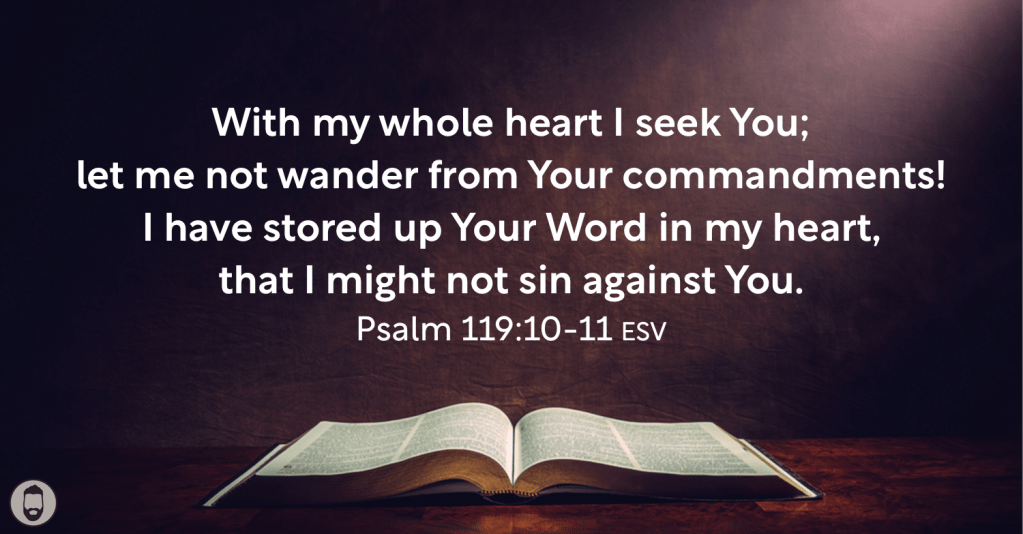
Psalm 119 is all about God’s Word. It is 176 verses long and has 22 sections (one for each letter of the Hebrew alphabet). It is a very long poem of adoration and worship to God for giving His Word and providing His people with it. There are eight words the psalmist uses to talk about the Word of God: law, testimonies, ways, precepts, statutes, commandments, rules, and, of course, word. We are going to be spending a while on Mondays looking at some highlights from Psalm 119 to help train our minds and hearts to meditate on God’s Word.
Today’s passage helps us understand the way studying God’s Word — meditating on it, storing it in our minds and hearts (memorizing it), and listening to or obeying it — helps us to follow Christ.
Psalm 119:10 gives us the picture of how we need God’s Word, specifically His commandments, to keep our “whole heart” seeking after the Lord. His ways are best. God knows what we need and how we should live. This is not a popular viewpoint today; well, it never has been a popular viewpoint. But v. 10 clearly shows us the value in trusting in God’s authority as Creator and Lord to tell us how we should live our lives, to command us with sovereign authority to live as He calls us and to recognize how His Word conveys His authority to us.
This carries over into Psalm 119:11 and the value of storing God’s Word in our hearts, namely preventing sin. The idea of storing up God’s Word is clearly speaking of memorizing Scripture, but it also extends to meditating or pondering on God’s Word. This sort of memorization or meditation is not for knowing information but for knowing the Lord. The idea of storing up God’s Word is clearly speaking of memorizing Scripture, but it also extends to meditating or pondering on God’s Word (Psalm 1:2). This sort of memorization or meditation is not for knowing information but for knowing the Lord (John 17:3). The idea is that God is able to keep us from sin — that knowing Him and desiring a deeper relationship with Him is better than any fleeting pleasure sin can offer (Hebrews 11:25).
Look at the way v. 10 and v. 11 fit together. Seeking after God with one’s whole heart means that you do not want to sin against Him. Read that again: sin against Him. Having God’s Word in our minds and hearts — stored up like bales of hay to sustain life and livelihood through the winter — keeps our focus on Him and not our desires (Psalm 37:31). To continue the analogy of storing hay ahead of winter, memorizing and meditating on God’s Word is like cultivating and tilling the ground, planting grass seeds, fertilizing, cutting, and baling, all with winter in mind. Storing up God’s Word in our hearts means cultivating our relationship with Him by having His Word teach us correct doctrine and holy living (2 Timothy 3:16), watering the implanted Word and having His Spirit grow us to bear fruit in keeping with repentance and walking with Him (Matthew 3:8, James 1:21-22, Galatians 5:22-23).
May we meditate on these verses today with eternity in mind rather than the futile fleeting pleasures of sin. May we store up His Word and seek Him with our whole hearts today.

 Just Keith Harris