
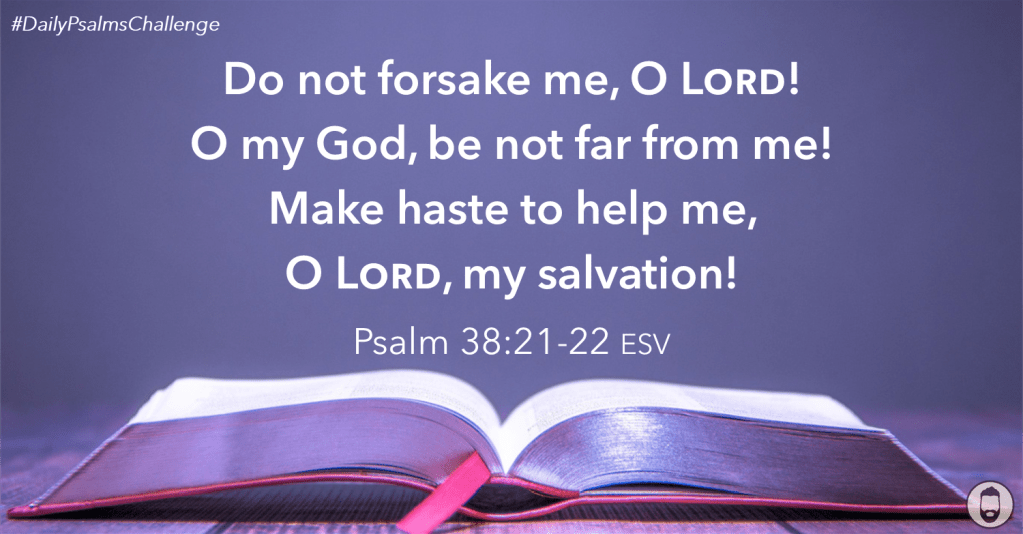
Do not forsake me, O LORD! O my God, be not far from me! Make haste to help me, O LORD, my salvation!
Psalm 38:21-22
Psalm 38 is a penitential psalm – a psalm that expresses sorrow for sin, a desire for repentance, and a plea to God for mercy and forgiveness. In it, David pours out his heart, overwhelmed by the weight of his own sin. He is experiencing physical suffering (vv. 3-8), emotional distress (vv. 9-10), and opposition from enemies (vv. 12, 19-20). But perhaps worst of all, he feels distant from God because of his own iniquity.
David is not suffering unjustly as he has in other psalms. He confesses that he is sorry for his sin (v. 18). It is clear his guilt is crushing him as he says, “My iniquities have gone over my head; like a heavy burden, they are too heavy for me” (v. 4). This is a clear picture of what being convicted of sin by God’s Spirit looks like: deep grief from knowing that your sin has dishonored God.
Yet in his distress, David doesn’t run from God – he runs to Him! He doesn’t blame others or make excuses but cries out to God asking Him not to forsake him or be far from him (v. 21). Even when feeling abandoned, he knows that he can trust God alone to save him.
Part of what David feels is the effects of God’s discipline. He disciplines His children not in wrath but love (Hebrews 12:6). He isn’t eager to destroy His people but to restore them. Like a loving Father, God corrects His children so they may share in His holiness (Hebrews 12:10).
Psalm 38 ends with a plea to God for mercy – a reminder that our only hope is being saved by the Lord. That’s good news! Saving people is His speciality.
Seeing Jesus in Psalm 38
David’s prayers and pleas in Psalm 38 are answered fully in Jesus. He bore the ultimate weight of sin on the cross, crying out, “My God, my God, why have you forsaken me?” (Matthew 27:46), so that we would never be forsaken. Though He never sinned, He took our sin upon Himself (2 Corinthians 5:21). The arrows of God’s judgment that David felt (v. 2) ultimately fell on Jesus. He endured isolation, agony, and opposition so that we could be reconciled to God. Because of Him, we can pray (and praise) with confidence: “O Lord, my salvation!” (v. 22)
Reflection
No matter how far we have fallen, the Lord is ready to restore those who seek Him in repentance. He is our salvation.
Maybe you have experienced God’s discipline as David did. Do you recognize it as a sign of His love and not rejection? When conviction comes, do you run from God or run to Him in repentance?
The good news is that He saves those who call on Him (Romans 10:13). So, take a good, healthy look at your life and your sin and see if it’s time for a penitential psalm of your own.
The #dailyPSALMSchallenge gives us the opportunity to start 2025 in God’s Word by digging into a psalm a day. Each day will identify a key passage for us to meditate on as well as seeking to help us see Jesus in the psalm and reflect on what we have read.
Won’t you take the challenge?

 Just Keith Harris