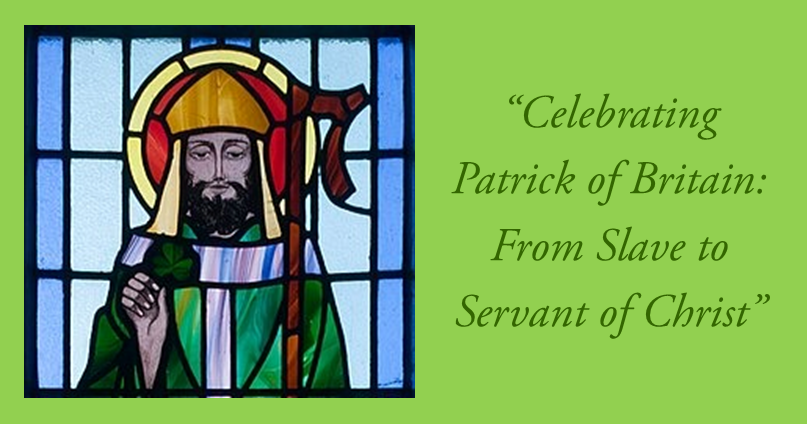
Every year in March, the name St. Patrick is invoked and associated with green clothes, three-leaf clovers, and a plethora of Irish-themed festivities. Legends often circulate about him driving all the snakes out of Ireland or using the clovers to explain the Trinity.
Most of that is more folk tale than history, though. The real Patrick is much more compelling than the myths.
His life tells the story of a young man captured into slavery, transformed by the grace of God, and sent back as a missionary to the people who enslaved him so that they might hear the gospel.
From Captive to Convert
Patrick was born in Britain in the 4th century into a Christian family. His father served as a deacon and other relatives served the church as well. Yet, as Patrick admitted himself, faith didn’t mean much in his youth. He had been raised around Christianity, but he didn’t know Him or follow Him personally.
Everything changed for him when he was about sixteen. Irish raiders attacked the region where he lived, carried him across the sea, and sold him as a slave in Ireland. He was a slave for six long years, working as a shepherd and enduring loneliness, exposure to the elements, and humiliation.
It was during those years that God began working in his heart. Reflecting on that season later in life, Patrick wrote:
“I was sixteen years old and knew not the true God, and I was carried away captive into Ireland… but in that strange land the Lord opened my unbelieving eyes, and although late I called my sins to mind and was converted with my whole heart to the Lord my God.”
The fields and hills of Ireland became the place where Patrick learned to seek the Lord. Removed from the comforts of home and forced into solitude, he turned increasingly to prayer. What began as hardship became the very means by which he came to Christ. He wrote that his faith in Christ deepened because of constant prayer:
“I used to pray many times each day. The love of God and fear of Him increased more and more in me, and my faith grew. In a single day I would pray as many as a hundred times.”
Tragedy, through God’s providence and grace, became the place where Patrick encountered, and was saved by Jesus (more ways than once).
A Call to Return
Patrick was eventually able to escape slavery and return to Britain. Freedom brought relief, but his story with Ireland was not finished. In time he began to sense that God was calling him to Ireland to take the gospel there.
According to Patrick’s own account, this calling came through dreams and visions which compelled him to take the gospel to Ireland rather than seeking revenge or keeping his distance from the land of his suffering. He felt deep concern for those people rather than bitterness. He pursued theological training and prepared for the ministry, despite the fact that he considered himself less educated than many church leaders in his time; once done, he returned to Ireland as a missionary.
Looking back on all this, Patrick wrote:
“Who am I, Lord, and what is my calling, that you have worked with me with such divine power? So that today among the barbarians I might constantly exalt and magnify your name wherever I should be.”
Mission to the “Ends of the Earth”
In the 5th century, Ireland was far beyond the boundaries of the Roman world and was widely considered to be uncivilized. Yet Patrick believed that the Jesus’s Great Commission to make disciples of all nations applied even – and especially – there. Travelling among tribes and villages, he preached the gospel, discipled new believers, and helped establish churches and Christian communities. Over time and as more churches were planted, he trained leaders and helped many turn away from pagan worship to follow Jesus.
He knew the dangers he faced first-hand. Hostilities from local rulers, threats of violence, and the possibility of being re-enslaved were constant realities, yet he continued his work because he believed following Christ and preaching His gospel was worth any cost.
His ministry endured for decades and played a significant role in establishing Christianity in Ireland. In the generations that followed, the Irish church would send missionaries to other parts of Europe, carrying the message of Christ far beyond Patrick’s lifespan and ministry.
Christ With Me
Though the famous hymn “St. Patrick’s Breastplate” was likely written centuries after Patrick lived, its words beautifully reflect the kind of Christ-centered faith that marked his life and ministry:
Christ with me, Christ before me, Christ behind me, Christ in me, Christ beneath me, Christ above me, Christ on my right, Christ on my left, Christ when I lie down, Christ when I sit down, Christ when I arise, Christ in the heart of every man who thinks of me, Christ in the mouth of everyone who speaks of me, Christ in every eye that sees me, Christ in every ear that hears me.
It’s this sort of confidence in Christ’s presence helps explain Patrick’s courage and faith. The young man who once trembled in the Irish countryside as a slave returned years later with boldness, convinced that Jesus went with him wherever he walked.
Lessons from Patrick’s Life
Patrick’s story reminds us that God often works through circumstances we would never choose. The years of slavery that once seemed like a disaster became the very means by which God drew him to faith.
His life also demonstrates the power of the gospel to transform our hearts toward others. He returned to the land of his captors with the hope that they too would know the grace he had received from Christ.
Finally, Patrick’s example reminds believers that the gospel is meant for every people. In an age when many considered the Irish beyond the reach of the church, he believed that Jesus’s command to make disciples extended even to the farthest edges of the known world.
The cultural celebrations surrounding St. Patrick’s Day today often eclipse the real man behind the holiday, yet the historic Patrick deserves to be remembered – not as a figure of myth and legend but as a servant of Christ whose life was marked by humility, courage, and a deep commitment to the gospel. The boy who was once a slave became, by the grace of God, a missionary who helped bring the light of Christ to that very land.
There are times when it seems that things are better left unsaid, but often too much goes unsaid — too many things are assumed to be known.
Scripture reminds us that what we say matters, that our words matter. Words have the power to bless and shape (James 3:9-10, Proverbs 18:21), and when they are carefully spoken and intentionally kept, they can serve as reminders of what is true in an ever-changing world.
What follows is an ode and blessing I wrote to honor my daughter, Keri, on her 16th birthday — not for attention but for remembrance, not for publicity but for posterity. I wanted this to exist in a form that can be held on to, returned to and read again, reminding her of how she is loved and cherished. I don’t want to leave anything unsaid.
So, here is this ode, this homage from me and Candice to a daughter worthy of being cherished — to a young woman worth writing beautiful words to and about, spoken in love, shaped by Scripture, and published in hopes that she never forgets her parents are thankful for her, proud of her, and in continual pursuit of getting to be a part of her life in all the days the Lord sees fit to give us.
Keri,
Today you turn sixteen, and that’s something worth celebrating — not quietly, not quickly, but joyfully.
Sixteen years of you is a milestone moment that asks us to pause and give thanks, not because the calendar says to, but because we have you. We have you here growing, living, and becoming, and we are grateful for the gift you are. That’s right: on a day when gifts are given and celebrated, we celebrate the gift you are to us.
You give us so much joy.
Joy in who you are right now.
Joy in all the ways you’ve grown.
Joy in the laughter, conversations, quiet moments, and memories made and yet-to-be made.
It’s not about looking back in sadness or forward with fear. It’s a day to rejoice and mark this moment in your life.
At the same time, you know reflection comes naturally to me. Birthdays invite reflection, especially your sweet sixteen. Sixteen sits in a season when things are changing. You are growing in ways that are visible to all and in ways only your mama and I, and all those who walk closely with you, can see. We see the growth and changes, and we delight in it. We are grateful not only for who you have been but for who you are becoming.
This reflection is meant to be more than sentimental. It’s not meant to hold you in place, even though I joke about wishing there was a pause button sometimes keeping everything just as it is. It’s not meant to rush you forward, either. It’s meant to meet you in this moment — to say clearly and joyfully that you are seen, deeply loved, and that we are thankful to get to be your parents as this season unfolds. We celebrate sixteen years of you, but we also recognize and celebrate the goodness of this moment and the faithfulness of God within it.
What I’ve written here is meant for you now, and, Lord willing, for you later — to remind you of what is true today and what will still be true as the seasons continue to change.
A Gift from the Lord
One of the ways we’ve tried to understand our role as your parents is by letting God’s Word shape how we see you — not as something we produced, but as someone we received. Scripture tells us something simple and profound about children: “Behold, children are a heritage from the LORD, the fruit of the womb a reward” (Psalm 127:3). That word “behold” matters. It’s an invitation to stop, look closely, and recognize something that might otherwise be missed. Children aren’t accidents, burdens, or accomplishments. They’re gifts, graciously given by God.
Your mama and I have always seen you that way.
You and Xander are the children whom God has graciously given to us. We didn’t earn you. We don’t own you. We received you. From the beginning, we’ve known that you have been entrusted to us by a faithful God, and that has shaped the way we’ve sought to love you and parent you — and to delight in you.
Psalm 127 goes on to compare children to arrows in the hand of a warrior (vv. 4-5). Arrows are shaped carefully. They are aimed with purpose. And, one day, they are released — not as a loss, but seen as shot where they are aimed. This imagery isn’t about something you hold onto forever but something prepared to be sent out. Even now, as we’re still very much in the season of raising you, this image helps us remember what God intends. He intends you to grow and move and live a life shaped by His goodness and plan. But before arrows are released, they are held. Before they fly, they are formed. That’s where we are now. And in this season, we give thanks — again and again — for the gift you are. We thank God not just for the joy you bring to our lives but for the privilege of getting to be your parents.
Growing into What has been Given
As we’ve watched you grow, we’ve also leaned on Scripture to help us name what we’re seeing — and to remind us what we’ve been praying toward all along. Scripture speaks honestly about what it means for children to grow. Proverbs 22:6 says, “Train up a child in the way he should go; even when he is old he will not depart from it.” This verse isn’t a formula or a guarantee. It’s a picture of something planted early in the life of a child that continues to grow and shape life long after childhood is over.
This is the season you’re in now. You’re almost grown but not quite. You’re growing — still needing some parenting and guidance, still needing some care and protection, but we can already see the day coming when you won’t need those same things in the same way. That’s not something we fear, though. It’s something we’ve hoped for and prayed toward.
The goal was never for you to rely on us forever. It was for the things that mattered most — faith, wisdom, discernment, compassion, courage — to take root so deeply within you that they remain when our voices grow quieter. Parenting doesn’t disappear when you grow up; it just takes a different shape. What has been taught, modeled, and lived — good and bad — begins to live within you.
We see this happening already. Your mama and I see you thinking carefully, loving faithfully, and walking with Jesus not because you have to but because He’s your Lord, your Savior. We’ve watched this together — praying for you, talking about you, and giving thanks for the ways He is at work in you. That tells us something important: the work God has been doing in you isn’t dependent upon us. It’s part of who you are. So even as we continue to parent you in this season, we do so with gratitude and trust. We’re grateful for the years God has given us with you, and we trust that what has been planted and begun in you will continue to grow as you do.
We’re still walking with you, still guiding, still loving. But we rejoice that the path you are walking is becoming more and more yours.
A Changing Season
When we try to make sense of how much is changing — and how much is still the same — Scripture has helped us see that this tension isn’t something to fear. Scripture reminds us that “for everything there is a season, and a time for every matter under heaven” (Ecclesiastes 3:1). Life unfolds not all at once, but in God’s wise and purposeful timing. Seasons come and go, not by accident but by design. We also see in Ecclesiastes 3 that God “has made everything beautiful in its time” (Ecclesiastes 3:11).
Sixteen places you right in the middle of a season like that. You’re not stepping out of childhood all at once, and you’re not fully stepping into adulthood yet, either. You’re in between. But this season is a good, meaningful one, one that God is actively shaping and blessing.
At the same time, as your parents, we’re in an in-between season, too. We still get to guide, protect, and walk closely with you, but our season is shifting as you’re taking on more responsibility, more ownership, and more independence. That change doesn’t take away from what was; it honors it. Every season builds on the one before it.
Ecclesiastes 3 helps us see the beauty in changes like these — the beauty of faithfully stepping into what God has next for us. He doesn’t waste seasons, nor does He abandon His people as their seasons change. The same God who has been faithful to you in this season will be faithful in the seasons that follow.
So, we’ll try not to cling too tightly or let go too quickly. We’re just grateful for where we are with you and trusting God for where you are going. Enjoy this season while it lasts. And know that the next season will be good, too, because God is present and at work in both of them.
Walking Together
Some of the clearest ways we’ve seen God’s goodness in your life haven’t come in big moments but in ordinary ones — moments repeated over time, quietly shaping us as much as they have you.
You might not remember this, but we used to walk to church together in Picayune. We’d walk over early before others got there. You’d sit on the front pew while I practiced songs or sermons, and when you went to children’s church later, there was always a little reminder of your presence left behind: glitter and sparkles, a little shiny shimmer on the pew that made it obvious you had been there, that the sparkly dresses you loved to wear had left their mark on the pew cushion. You had moved on, but a reminder of your presence remained.
Those sparkles became something of an illustration for us. You’ve always left an impression. You’ve been our constant companion through many seasons, simply by being near, or by walking with us, sharing life alongside us — with your mama and me, and with so many who love you. And now, slowly and naturally, that companionship is changing shape.
These days, walking together looks different. You still come with me early to church, but now, you come with purpose of your own. You have a role of your own, getting music together, organizing what needs to be ready, and faithfully serving behind the scenes. The front pew has been replaced by the passenger seat of the truck, the early mornings quieter than they used to be. Sometimes we talk. Sometimes we just listen to music or sit in the silence together.
When I look over and see you there, I see the young woman you are becoming — and at the same time, I swear I can still see the little girl you were. The sparkles aren’t on the pew anymore; they’re imprinted in my memory now. One day, you’ll be heading out into the world on your own. But even then, those sparkles will still be there — glimmers of love and presence that time can’t erase.
Walking with you has always been a gift. And as that walk continues, changing and growing as you do, we remain grateful — not just for where we’ve been but for the privilege of walking with you wherever this next season leads. We’ll be ready as the seasons change to shift to following your lead and from our driver’s seat to your passenger seat, just glad to be part of your life — your journey — any way we can be.
A Blessing for This Season and the Ones to Come
All of this leads us here — not away from you, but toward you — to speak a blessing shaped by what we believe God is doing in your life. As we close, we want to speak a blessing over you — not as a goodbye to this season, and not as a rush into what comes next, but as an assurance meant to hold true in every season of your life.
Scripture reminds us that “the LORD will keep your going out and your coming in from this time forth and forevermore” (Psalm 121:8). That promise isn’t tied to a place or a stage of life. It isn’t dependent on how close you are to home or how familiar the road feels. It’s a promise that wherever you go — near or far — you are never outside the care of the Lord. He keeps you. He watches over you. He does not sleep, forget, or lose sight of you.
Scripture also tells us, “Blessed is the one who trusts in the LORD… He is like a tree planted by water, that sends out its roots by the stream” (Jeremiah 17:7–8). That picture speaks of a life that is steady and rooted — nourished even as circumstances change. We pray that your trust in the Lord continues to deepen, that your roots grow strong, and that your life bears fruit in every season, even when the days feel uncertain.
But before all of that future unfolds, we want you to know this: we are here for the now, too, as well as the future.
There are still trips to chaperone and buses to ride. There’s homework and projects, report cards and regular days that all start to blend together. There’s school and performances, practices and plans. There are dances and dates and ordinary evenings at home. There are more of the days that will feel like the same — and those days matter. They are not filler. They are the places where life is lived and faith is practiced.
Sixteen doesn’t mean the ordinary disappears. It means the ordinary is starting to carry more weight. Sixteen is when you begin to notice what needs to change and what needs to be clung to. Sixteen is when “the same” starts becoming different — not all at once, but steadily.
And this is where you are right now.
So hear this clearly: we are here for this part, too. We’re here for the regular days and the big ones, for what stays the same and what slowly shifts. We’re here to walk with you through this season as it unfolds, just as we have before.
So, this is our blessing for you, Keri:
May you always know that you are kept by God and deeply loved by us.
May you walk forward with confidence, knowing that the Lord goes with you and that you never walk alone.
May your life be rooted in Jesus, strengthened by His grace, and shaped by His goodness.
And wherever life takes you—now, and in all the seasons to come—may you always remember that you have a home to return to, arms ready to receive you, and parents who are grateful beyond words for the privilege of walking with you.


 Just Keith Harris