
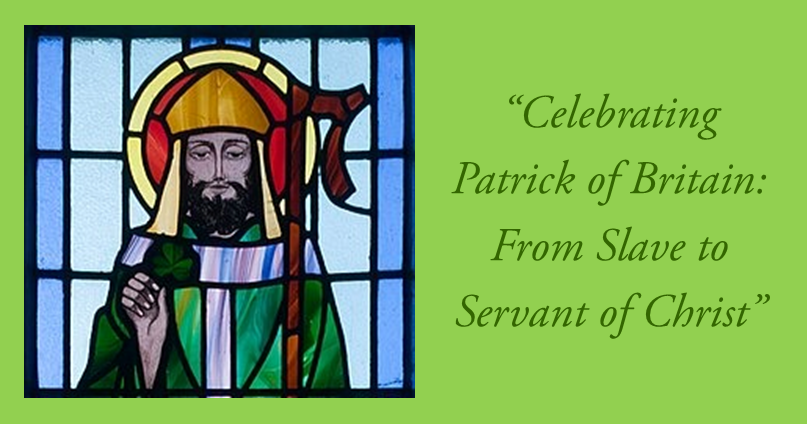
Every year in March, the name St. Patrick is invoked and associated with green clothes, three-leaf clovers, and a plethora of Irish-themed festivities. Legends often circulate about him driving all the snakes out of Ireland or using the clovers to explain the Trinity.
Most of that is more folk tale than history, though. The real Patrick is much more compelling than the myths.
His life tells the story of a young man captured into slavery, transformed by the grace of God, and sent back as a missionary to the people who enslaved him so that they might hear the gospel.
From Captive to Convert
Patrick was born in Britain in the 4th century into a Christian family. His father served as a deacon and other relatives served the church as well. Yet, as Patrick admitted himself, faith didn’t mean much in his youth. He had been raised around Christianity, but he didn’t know Him or follow Him personally.
Everything changed for him when he was about sixteen. Irish raiders attacked the region where he lived, carried him across the sea, and sold him as a slave in Ireland. He was a slave for six long years, working as a shepherd and enduring loneliness, exposure to the elements, and humiliation.
It was during those years that God began working in his heart. Reflecting on that season later in life, Patrick wrote:
“I was sixteen years old and knew not the true God, and I was carried away captive into Ireland… but in that strange land the Lord opened my unbelieving eyes, and although late I called my sins to mind and was converted with my whole heart to the Lord my God.”
The fields and hills of Ireland became the place where Patrick learned to seek the Lord. Removed from the comforts of home and forced into solitude, he turned increasingly to prayer. What began as hardship became the very means by which he came to Christ. He wrote that his faith in Christ deepened because of constant prayer:
“I used to pray many times each day. The love of God and fear of Him increased more and more in me, and my faith grew. In a single day I would pray as many as a hundred times.”
Tragedy, through God’s providence and grace, became the place where Patrick encountered, and was saved by Jesus (more ways than once).
A Call to Return
Patrick was eventually able to escape slavery and return to Britain. Freedom brought relief, but his story with Ireland was not finished. In time he began to sense that God was calling him to Ireland to take the gospel there.
According to Patrick’s own account, this calling came through dreams and visions which compelled him to take the gospel to Ireland rather than seeking revenge or keeping his distance from the land of his suffering. He felt deep concern for those people rather than bitterness. He pursued theological training and prepared for the ministry, despite the fact that he considered himself less educated than many church leaders in his time; once done, he returned to Ireland as a missionary.
Looking back on all this, Patrick wrote:
“Who am I, Lord, and what is my calling, that you have worked with me with such divine power? So that today among the barbarians I might constantly exalt and magnify your name wherever I should be.”
Mission to the “Ends of the Earth”
In the 5th century, Ireland was far beyond the boundaries of the Roman world and was widely considered to be uncivilized. Yet Patrick believed that the Jesus’s Great Commission to make disciples of all nations applied even – and especially – there. Travelling among tribes and villages, he preached the gospel, discipled new believers, and helped establish churches and Christian communities. Over time and as more churches were planted, he trained leaders and helped many turn away from pagan worship to follow Jesus.
He knew the dangers he faced first-hand. Hostilities from local rulers, threats of violence, and the possibility of being re-enslaved were constant realities, yet he continued his work because he believed following Christ and preaching His gospel was worth any cost.
His ministry endured for decades and played a significant role in establishing Christianity in Ireland. In the generations that followed, the Irish church would send missionaries to other parts of Europe, carrying the message of Christ far beyond Patrick’s lifespan and ministry.
Christ With Me
Though the famous hymn “St. Patrick’s Breastplate” was likely written centuries after Patrick lived, its words beautifully reflect the kind of Christ-centered faith that marked his life and ministry:
Christ with me,
Christ before me,
Christ behind me,
Christ in me,
Christ beneath me,
Christ above me,
Christ on my right,
Christ on my left,
Christ when I lie down,
Christ when I sit down,
Christ when I arise,
Christ in the heart of every man who thinks of me,
Christ in the mouth of everyone who speaks of me,
Christ in every eye that sees me,
Christ in every ear that hears me.
It’s this sort of confidence in Christ’s presence helps explain Patrick’s courage and faith. The young man who once trembled in the Irish countryside as a slave returned years later with boldness, convinced that Jesus went with him wherever he walked.
Lessons from Patrick’s Life
Patrick’s story reminds us that God often works through circumstances we would never choose. The years of slavery that once seemed like a disaster became the very means by which God drew him to faith.
His life also demonstrates the power of the gospel to transform our hearts toward others. He returned to the land of his captors with the hope that they too would know the grace he had received from Christ.
Finally, Patrick’s example reminds believers that the gospel is meant for every people. In an age when many considered the Irish beyond the reach of the church, he believed that Jesus’s command to make disciples extended even to the farthest edges of the known world.
The cultural celebrations surrounding St. Patrick’s Day today often eclipse the real man behind the holiday, yet the historic Patrick deserves to be remembered – not as a figure of myth and legend but as a servant of Christ whose life was marked by humility, courage, and a deep commitment to the gospel. The boy who was once a slave became, by the grace of God, a missionary who helped bring the light of Christ to that very land.
Sources:
- Mike Pettengill, “St. Patrick: Reclaiming the Great Missionary,” The Gospel Coalition
- Kevin DeYoung, “Who Was St. Patrick?” Clearly Reformed
- George Grant, “Who Was St. Patrick?” Ligonier Ministries
- Andrew Menkis, “From Slave to Missionary: Meet St. Patrick,” Core Christianity
- Patrick of Britain, The Confession of St. Patrick

 Just Keith Harris