
For the month of October, we are answering the challenge John Goldwater, pastor of Christ Community Church in Grenada, MS, laid out — the #DailyWisdomChallenge. Each day, we are going to read through a chapter of Proverbs corresponding to the day of the month.
This fits with what we have studied in Colossians, specifically Colossians 3:1-2, namely that we should seek “the things that are above, where Christ is” and set our minds like a thermostat “on things that are above, not on things that are on earth”. Imagine what a month meditating on God’s Word daily can do for us.
Won’t you join us on this #DailyWisdomChallenge and set your minds on Christ?
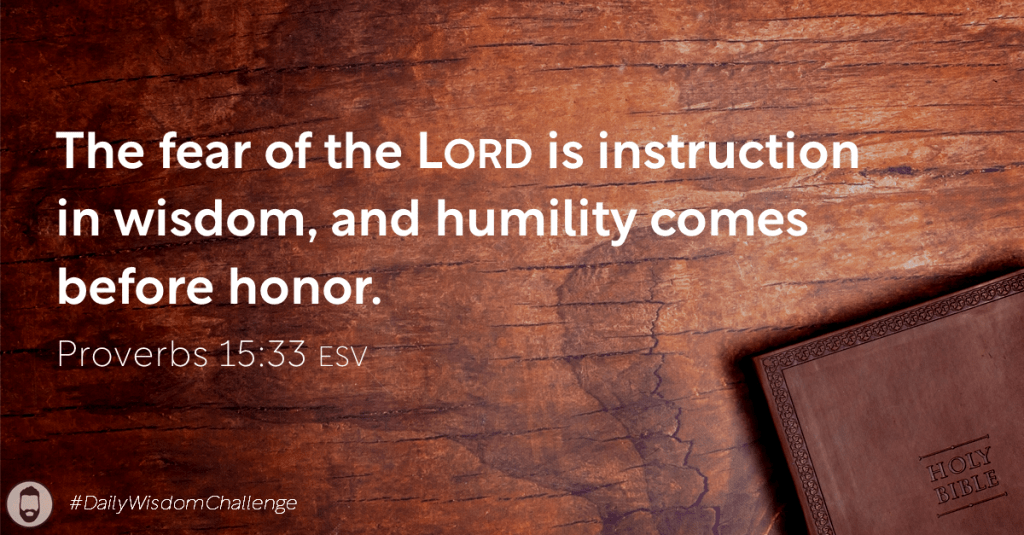
Today’s proverb reminds me of an old Mac Davis song, “It’s Hard to Be Humble”. Check out the chorus, a satire of a prayer:
“Oh, Lord, it’s hard to be humble / When you’re perfect in every way / I can’t wait to look in the mirror / Cause I get better looking each day / To know me is to love me / I must be a [heck] of a man / Oh, Lord, it’s hard to be humble / But I’m doing the best that I can”
Mac Davis was right about one thing, it is hard to be humble, but it’s not difficult because of our perfection. No, it is difficult because we do not want to face our imperfections.
As it has been with so many of the proverbs we have read and those we have covered here in the #DailyWisdomChallenge, there is a contrast here, almost like a seesaw. In Proverbs 15:33, one side of the seesaw is the fear of the LORD learned from His “instruction and wisdom”; on the other is humility — that may or may not produce honor. The seesaw illustration helps us because, as it has been on every playground since its invention, balance is unlikely because one side is invariably heavier than the other.
Talk of “instruction and wisdom” here is likely referencing what needs to be learn to correct one’s way of life. Receiving instruction can be a humbling experience, especially when you get old enough to apply what you have learned. For example, I can remember in my teens and twenties being so frustrated with people, like my parents and some in authority, who could not see how much I knew despite my youth. Growing older and having to put my knowledge to work saw times when I learned the hard way that I did not know as much as I thought, and even in times when I was right, I was too inexperienced and foolish to apply what I knew correctly. This is not to say that everyone with more age always knows more or is wiser. No, unfortunately, foolishness hangs on with a death grip until, well, death. I find it much more humbling to find that some younger have wisdom beyond their years and I learn from their instruction.
The “humility” side of the seesaw gives the opportunity for honor — to gain “fear of the LORD” and bow to His “wisdom and instruction”. Essentially, this is the opportunity to both learn that you have been a fool and have an avenue to either stop being foolish or dive head-long into being a fool. This is a conundrum people have to deal with throughout their whole lives. As bad as I hate it, being humbled — which often means humiliation, comes around time and time again. Choosing to be a fool when confronted with your foolishness is called willful ignorance; it is not actual ignorance (not knowing) but living in a way where you try to fool yourself into not seeing you are a fool. That is a dangerous way to live. Or, you can choose to submit to God and walk in His ways, which is honorable.
Up and down, back and forth, the seesaw goes up and down. Sin and conviction. Correction and being humbled. Fear of God and willful ignorance. But this is real life and not a playground.
Which side will you give weight to: the instruction that comes from the “fear of the LORD” and leads to honor, or foolishness and fighting against humility?

 Just Keith Harris